
vip@mingyuforklift.com
+86-0535-2090977

1. Introduction
Definition of Aerial Work Platforms (AWPs) / Mobile Elevating Work Platforms (MEWPs)
The shift from traditional access methods (ladders, scaffolding) to powered platforms
Thesis: Why AWPs have become the preferred solution for modern aerial operations across industries
Brief overview of scope: types, benefits, safety, selection, and trends
2. Types of Aerial Work Platforms
Scissor Lifts — vertical-only movement, high load capacity, ideal for maintenance and installation
Boom Lifts
Articulating (knuckle) booms: maneuverability around obstacles
Telescopic booms: maximum horizontal and vertical reach
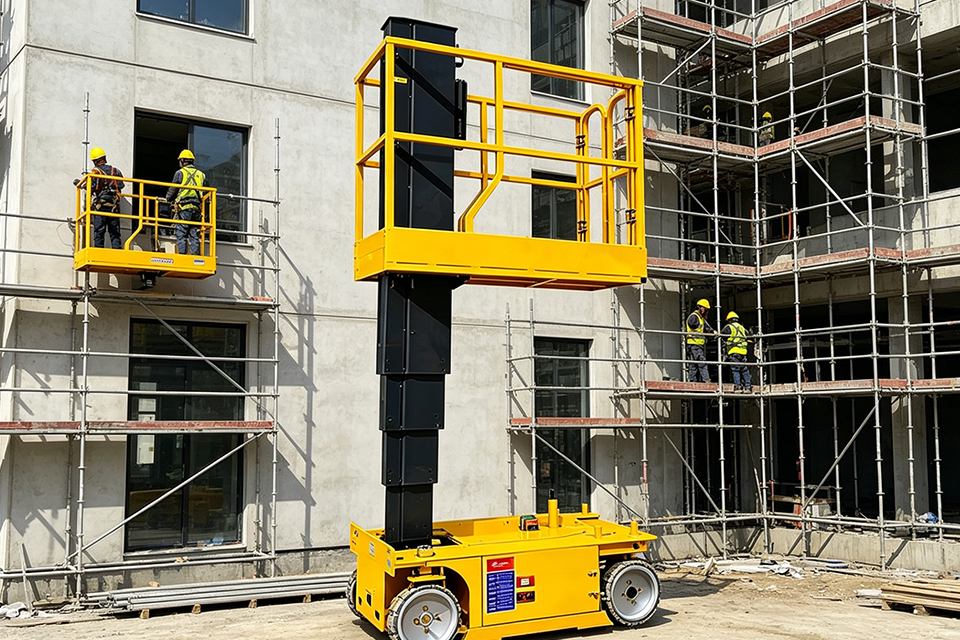
Vertical Mast Lifts — compact footprint, push-around and self-propelled variants
Spider Lifts / Crawler Lifts — lightweight, tracked chassis for sensitive or uneven terrain
Towable/Trailer-Mounted Lifts — portability for contractors and rental fleets
Comparison matrix: reach height, load capacity, terrain capability, indoor/outdoor suitability
3. Core Advantages Over Traditional Access Methods
Efficiency: Faster setup and repositioning vs. scaffolding erection
Flexibility: Single machine serves multiple work zones in a single shift
Productivity: Larger platform area, tool/material capacity, and ergonomic positioning
Cost-effectiveness: Reduced labor hours, lower total cost of ownership for recurring tasks
Access to complex geometry: Reaching over obstacles and into confined vertical spaces
4. Safety Features and Compliance Standards
Built-in safety systems: tilt sensors, overload protection, emergency lowering, pothole guards
Guardrail standards and platform gate interlocks
Key regulations: ANSI A92 / CSA B354 (North America), EN 280 (Europe), GB/T 27548 (China)
Operator training and certification requirements
Risk mitigation: fall protection planning, ground condition assessment, exclusion zones
Incident data: comparative safety record vs. ladders and scaffolding
5. Industry Applications
Construction & Infrastructure: facade work, steel erection, MEP installation
Industrial Maintenance: facility upkeep, conveyor access, tank inspection
Warehousing & Logistics: high-bay racking, inventory management, LED retrofits
Utilities & Telecom: line maintenance, cell tower service, streetlight repair
Retail & Commercial: signage, HVAC, atrium cleaning
Specialized environments: explosion-proof builds, non-marking tires for cleanrooms
6. Selecting the Right Platform (~250 words)
Work height vs. platform height distinction
Load calculation: personnel, tools, and materials
Power source trade-offs: diesel, electric, hybrid, lithium-ion
Terrain analysis: slab, rough-terrain, gradeability requirements
Transport and site access constraints
Rental vs. purchase decision framework
7. Future Trends and Innovations
Electrification and lithium-ion battery adoption
Telematics and fleet management integration
Automation features: self-leveling, obstacle avoidance, remote operation
Lightweight materials and increased reach-to-weight ratios
Sustainability pressures and emissions regulations driving design changes
8. Conclusion
Recap of why AWPs dominate modern aerial operations
Emphasis on the intersection of safety, efficiency, and versatility
Call to action: invest in proper equipment selection and operator training to maximize ROI and minimize risk
Name: selena
Mobile:+86-13176910558
Tel:+86-0535-2090977
Whatsapp:8613181602336
Email:vip@mingyuforklift.com
Add:Xiaqiu Town, Laizhou, Yantai City, Shandong Province, China