
vip@mingyuforklift.com
+86-0535-2090977

Introduction: The Outdoor Material Handling Challenge
Construction sites, lumber yards, agricultural fields, and remote infrastructure projects share a common logistical headache: moving palletized and bulk materials across ground that bears no resemblance to a warehouse floor. When rain turns unpaved surfaces into mud, the problem intensifies dramatically. Standard warehouse forklifts, with their solid rubber tires, rear-wheel steering, and low ground clearance, become liabilities the moment they leave concrete. Enter the rough terrain forklift (RTFL)—a machine purpose-built to bridge the gap between crane-assisted heavy lifts and the precision of indoor material handling. But the question remains: do these machines genuinely deliver stable load handling when the ground beneath them is slick, uneven, and yielding? The answer lies in a sophisticated interplay of drivetrain engineering, chassis geometry, tire technology, and operator discipline.
Defining the Machine: What Separates Rough Terrain Forklifts from Standard Counterbalance Trucks
Under ANSI/ITSDF B56.6-2021—the safety standard governing rough terrain forklift trucks in the United States—a rough terrain forklift is formally defined as a vehicle "intended for operation on unimproved natural terrain as well as the disturbed terrain of construction sites." This regulatory precision matters because it distinguishes genuine RTFLs from marketing-labeled "all-terrain" variants that may lack the structural and mechanical credentials for hazardous ground conditions.
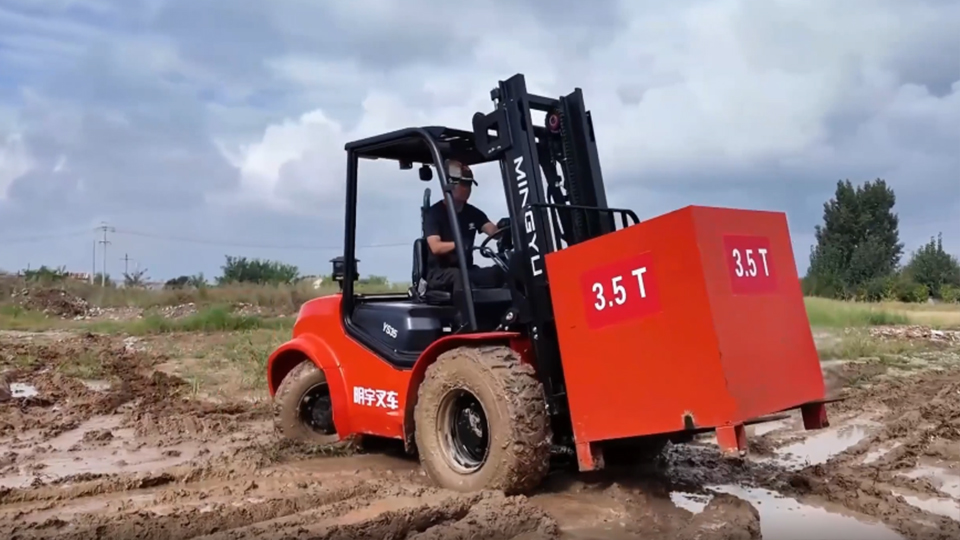
Mechanically, a classic rough terrain forklift is a counterbalanced lift truck with a vertical mast, functionally analogous to a warehouse counterbalance forklift but rebuilt from the chassis up for outdoor unprepared surfaces. The differences are not cosmetic. Where a standard forklift offers ground clearance of 100–150 mm, a professional RTFL provides 300–450 mm at its lowest point. Its frame is reinforced to resist torsional stress, and its mast is constructed from high-tensile rolled steel sections with oversized, sealed-for-life roller bearings designed to withstand lateral forces that would damage indoor machines.
The Tire-Ground Interface: Traction on Mud Starts Here
The most critical interface between machine and terrain is the tire. Standard forklifts rely on solid rubber or cushion tires optimized for smooth, hard surfaces. On mud, these tires offer minimal mechanical bite and a small contact patch that concentrates ground pressure, causing the machine to sink and lose traction. Rough terrain forklifts address this through large-diameter pneumatic tires—typically 12.00-20 to 16.00-25 depending on capacity—featuring deep, aggressive off-road lug treads.
These tires serve a dual stability function. First, the aggressive tread pattern provides mechanical interlock with loose and slippery surfaces, channeling mud away from the contact patch to maintain grip. Second, the large footprint lowers ground pressure (PSI), distributing the machine's weight across a broader area and reducing the tendency to sink into soft soil. On saturated ground, this lower ground pressure can mean the difference between traversing a site and becoming immobilized up to the axle.
Drivetrain Sophistication: Powering Through Uneven Grip
Traction on mud is not merely about tires; it is about how power reaches them. Professional-grade rough terrain forklifts employ full-time or selectable four-wheel-drive (4WD) systems that distribute torque across all four wheels. This prevents the "digging-in" phenomenon, where a two-wheel-drive machine spins its drive wheels into ruts while the undriven wheels remain passive, progressively destabilizing the chassis.
More advanced systems incorporate limited-slip differentials or manual differential locks. On uneven muddy ground, one wheel may lose contact or traction entirely; a differential lock ensures power is diverted to the wheels with the most grip, allowing the machine to power through ruts that would strand less capable equipment. Hydrostatic four-wheel-drive systems offer further refinement by modulating torque delivery to each wheel independently, preventing the destabilizing torque transfer that can occur with mechanical differentials on uneven ground.
Chassis Geometry and the Stability Triangle
The concept of the "stability triangle" is fundamental to forklift safety. In a counterbalance forklift, the vehicle remains stable so long as the combined center of gravity of the machine and its load stays within the triangular base formed by the front and rear wheels. On muddy, sloped, or uneven terrain, this triangle becomes a dynamic variable rather than a fixed geometric constraint.
Rough terrain forklifts manage this through several geometric strategies. Oscillating steer axles—often offering up to 10 degrees or more of oscillation—keep all four tires in contact with the ground on undulating surfaces. This mechanical flexibility prevents the chassis from teetering on three wheels, a condition that dramatically narrows the stability triangle and invites tip-over.
Simultaneously, manufacturers pursue what might be called the "low center of gravity paradox." High ground clearance is necessary to clear obstacles, yet a high center of gravity is inherently destabilizing. Leading designs solve this by placing engines, fuel tanks, and heavy hydraulic components as low as possible within the wheelbase. This "underslung" ballast approach lowers the machine's inherent center of gravity, compensating for the elevated chassis and providing a broader stability margin when loads are raised or when traversing side slopes.
Mast Engineering: Maintaining Load Control on Rough Ground
The mast of a rough terrain forklift is subjected to forces that warehouse masts never encounter. Every bump, rut, and slope transition transmits kinetic energy through the chassis into the hydraulic cylinders and mast channels. If the mast cannot absorb and manage these forces, load stability degrades rapidly.
Modern RTFL masts employ high-strength, low-alloy steel profiles optimized for wide-view visibility, allowing operators to monitor both fork tips and ground obstacles simultaneously. Heavy-duty, sealed-for-life roller bearings withstand lateral side-thrusts that would cause mast sway in standard machines. Advanced units incorporate hydraulic cushioning in the lift cylinders, acting as shock absorbers for the load and preventing violent fork bounce that could dislodge a pallet during transit over rough paths.
The Reality of Mud: Where RTFLs Excel and Where They Struggle
It is important to approach the capabilities of rough terrain forklifts with engineering honesty. These machines are not amphibious, and they are not immune to the laws of physics. Mud exists on a spectrum from damp, compacted soil to deep, liquid-like slurry, and RTFL performance varies accordingly.
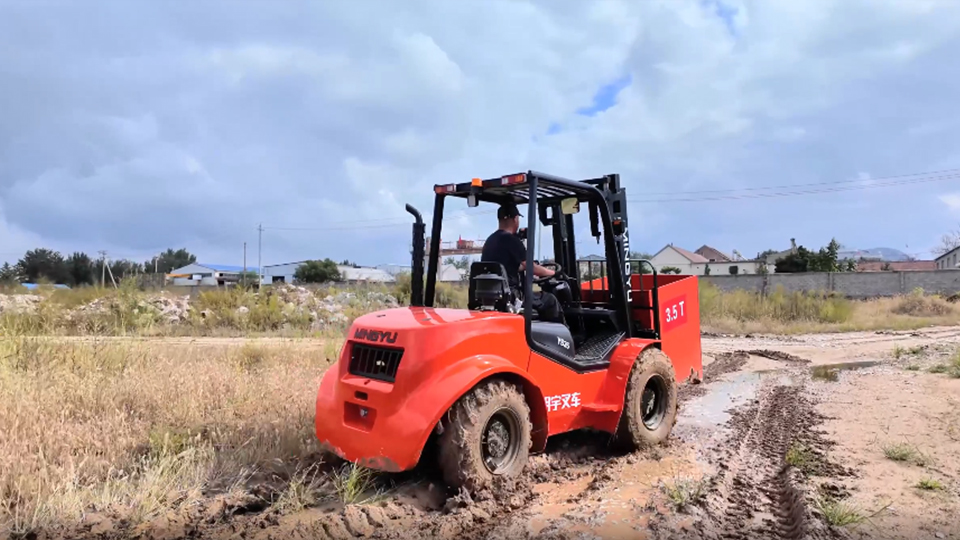
On moderately muddy construction sites—where the surface is wet, soft, and rutted but still provides some bearing capacity—RTFLs excel. The combination of 4WD, differential locks, low ground-pressure tires, and high clearance allows them to maintain traction and stability while carrying rated loads.
However, deep mud—where the machine sinks significantly and the tires cannot find a firm substrate—presents fundamental limitations. No amount of tread depth can generate traction against a fluid with negligible shear strength. In such conditions, the machine's weight becomes a liability rather than an asset, and the risk of becoming immobilized or tipping during recovery operations increases sharply. ANSI B56.6 requires operators to recognize site conditions that reduce effective capacity, and deep mud is precisely such a condition.
Load Handling Discipline: The Human Factor in Stability
Machine engineering provides the potential for stable load handling; operator discipline realizes it. On muddy sites, several operational principles become critical.
First, speed must be moderated. Mud reduces traction and extends stopping distances. A load carried at excessive speed over uneven ground generates dynamic forces that can shift the combined center of gravity outside the stability triangle. Second, grade negotiation requires specific protocols: when carrying a load, travel with the load uphill to prevent backward tipping, and never turn on a slope, as this is the highest-risk maneuver in RTFL operation.
Third, operators must assess ground bearing capacity before staging materials. A surface that supports the unloaded machine may compress or fail under the concentrated load of a 3-ton pallet. Setting down loads on unstable ground can cause the surface to collapse, destabilizing both the load and the machine during placement.
Fourth, load charts must be respected as legal documents, not suggestions. On rough terrain, effective working capacity is reduced from the rated flat-surface capacity by the stability limitations imposed by terrain conditions. A machine rated for 5,000 kg on level concrete may have significantly reduced safe capacity on a muddy slope.
Safety Systems: The Last Line of Defense
Beyond mechanical design, modern rough terrain forklifts incorporate active and passive safety systems. Roll-Over Protective Structures (ROPS) certified to ISO 3471 are mandatory under ANSI B56.6, providing a survival cell for the operator in the event of a tip-over. Falling-Object Protective Structures (FOPS) shield operators from debris. Hydraulic velocity fuses fitted to mast rams reduce the speed of collapse in the event of hose failure, while automatic deration valves reduce lift capacity above certain heights to enhance safety and stability.
Telematics systems such as JCB's LiveLink provide real-time machine monitoring, geofencing alerts, and maintenance scheduling, allowing fleet managers to track how machines are being used in challenging environments and intervene before unsafe patterns develop.
Operator Training: Competence Over Confidence
Perhaps no factor influences stability on muddy sites more than operator competence. OSHA 29 CFR 1926.602 mandates that operators be trained on the specific type of truck they will operate, the hazards of their specific work environment, and all required safety procedures. This is not bureaucratic box-checking; it is essential because construction site conditions change daily. Surface conditions shift as grading progresses, site layouts evolve, and weather transforms firm ground into hazardous mud. An operator trained only on warehouse counterbalance trucks lacks the judgment to assess slope stability, ground bearing capacity, and dynamic load shifts on rough terrain.
Effective training covers the stability triangle in dynamic conditions, slope negotiation protocols, soft ground and rut avoidance, center of gravity shifts during mast operation, and the critical importance of pre-operation inspections that include tire condition, hydraulic integrity, and attachment security.
Conclusion: Engineered Capability Within Physical Limits
So, do rough terrain forklifts deliver stable load handling on muddy outdoor sites? The technically accurate answer is: they deliver the most stable load handling achievable by mechanized means on such sites, within well-defined operational envelopes. They are not magic machines that suspend the laws of physics, but they are profoundly capable tools when specified, operated, and maintained correctly.
Their stability derives from a systems-level engineering approach: deep-tread, low-pressure pneumatic tires that grip and float; four-wheel-drive systems with differential locks that distribute power intelligently; oscillating axles and low centers of gravity that maintain the stability triangle; reinforced masts and hydraulic cushioning that manage dynamic loads; and ROPS-certified cabs that protect operators when margins are exceeded. When combined with trained operators who understand terrain assessment, load chart deration, and safe maneuvering protocols, RTFLs transform muddy, uneven construction sites from logistical dead zones into functional material handling environments.
The key is respecting the boundary between "challenging" and "unsafe." A rough terrain forklift can handle mud that would immobilize a warehouse truck, but it cannot handle mud that would bog a tracked vehicle. Procurement managers and site supervisors must classify their ground conditions honestly, match machine specifications to actual terrain demands, and invest in operator training that emphasizes caution over bravado. In that balanced approach—where engineering capability meets operational discipline—rough terrain forklifts indeed deliver on their promise of stable, productive load handling in the world's most demanding outdoor environments.
Name: selena
Mobile:+86-13176910558
Tel:+86-0535-2090977
Whatsapp:8613181602336
Email:vip@mingyuforklift.com
Add:Xiaqiu Town, Laizhou, Yantai City, Shandong Province, China
