
vip@mingyuforklift.com
+86-0535-2090977

1. Introduction
The used forklift market: cost savings vs. hidden risk exposure
Why metric-driven evaluation outperforms visual inspection alone
Scope: counterbalance forklifts (electric and IC), sit-down and stand-up configurations
The evaluation hierarchy: safety → structural integrity → powertrain → hydraulics → cosmetics
2. Operational History and Documentation Metrics
2.1 Hour Meter Verification
Reading accuracy and tamper detection
Relationship between hours, age, and application severity
2.2 Maintenance Records
Scheduled service compliance vs. reactive repair patterns
Frequency of major component replacement (motors, transmissions, pumps)
2.3 Previous Application Environment
Indoor smooth floors vs. outdoor rough terrain vs. cold storage/corrosive environments
Single-shift vs. multi-shift duty cycles
2.4 Ownership and Title Verification
Fleet lease returns vs. auction salvage vs. trade-ins
Lien checks and recall compliance status
3. Structural and Frame Integrity Metrics
3.1 Frame and Chassis Examination
Crack detection at high-stress weld points (counterweight mounts, mast anchors, axle pockets)
Evidence of prior collision repair or frame straightening
3.2 Mast Condition Assessment
Chain stretch measurement (percentage elongation vs. OEM spec)
Roller diameter wear and mast channel scoring depth
Carriage fork heel thickness and crack inspection (ANSI/ISO minimums)
3.3 Counterweight and Overhead Guard
Structural cracks, impact damage, and mounting bolt integrity
OHG compliance with current safety standards
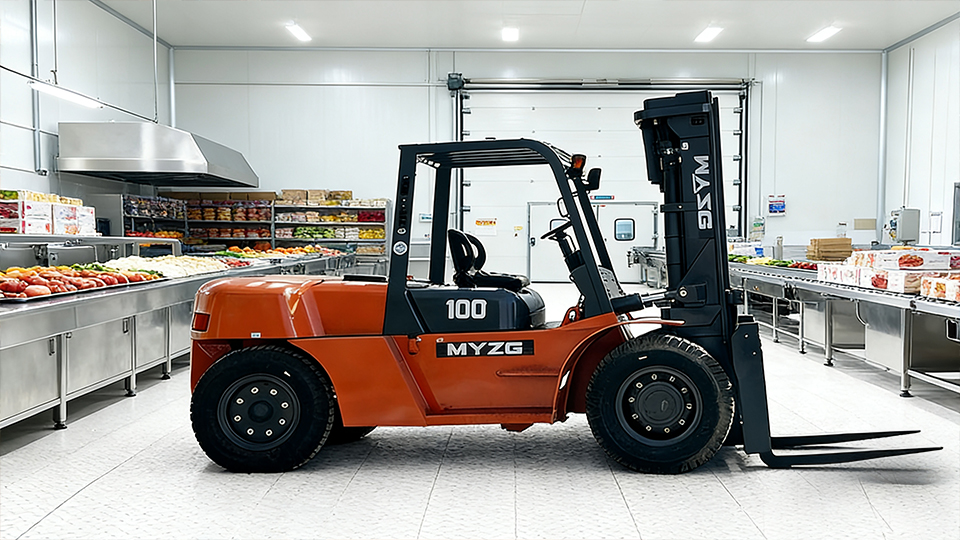
4. Powertrain and Driveline Metrics
4.1 Electric Forklift Powertrain
Battery capacity test results (ampere-hour delivery vs. rated capacity)
Cell voltage balance and specific gravity variance (lead-acid)
Drive motor brush condition and commutator scoring (DC systems)
Motor controller fault history and thermal event logs
4.2 Internal Combustion Powertrain
Compression test results across all cylinders
Engine oil analysis (soot, fuel dilution, metal particulate)
Exhaust emissions compliance and after-treatment system status
Transmission/clutch engagement quality and noise signature
4.3 Differential and Drive Axle
Gear backlash measurement and oil contamination assessment
Drive tire tread depth and compound condition
5. Hydraulic System Performance Metrics
5.1 Lift and Tilt Function Testing
Full-load lift speed and drift test (inches of descent over 10 minutes)
Tilt cylinder response and holding pressure under rated load
5.2 Hydraulic Fluid Condition
Particle count and ISO cleanliness code
Water contamination and viscosity degradation
5.3 System Pressure Verification
Relief valve setting against manufacturer specification
Hose age dating and pressure rating compliance
6. Braking and Safety System Metrics
6.1 Service Brake Performance
Brake pad/shoe remaining thickness vs. discard limits
Stopping distance test with rated load at maximum travel speed
Brake fluid contamination or air-in-system assessment
6.2 Parking and Emergency Systems
Grade-holding capacity on specified slope
Operator presence switch and dead-man pedal functionality
6.3 Warning and Visibility Systems
Light output intensity and alarm decibel levels
Backup alarm, strobe, and blue-spot pedestrian warning operation
7. Electrical and Control System Metrics
7.1 Wiring Harness Condition
Chafing at flex points and mast cable track integrity
Connector pin corrosion and moisture intrusion evidence
7.2 Control Interface Functionality
Display module pixel integrity and fault code retention
CAN-bus communication error frequency
7.3 Charger and Accessory Compatibility
Charger output calibration and connector pin recession
Attachment controller compatibility (if applicable)
8. Tire and Undercarriage Metrics
8.1 Tire Condition and Specification
Cushion tire chunking, flat-spotting, and bond separation
Pneumatic tire sidewall cuts and tread depth measurement
Load capacity rating verification against forklift data plate
8.2 Steering and Alignment
Kingpin play and tie rod end looseness
Steer axle kingpin inclination and caster stability
9. Cost-Benefit Quantification Metrics
9.1 Immediate Repair Cost Projection
Parts and labor estimates to bring unit to certified operating condition
Battery replacement cost as percentage of total asset value
9.2 Remaining Useful Life Estimation
Component-hour modeling: engine, transmission, hydraulics, mast chains
Residual value trajectory over intended ownership period
9.3 Total Cost of Ownership (TCO) Benchmarking
Used unit TCO vs. new unit TCO over equivalent operational horizon
Energy cost differentials (electric charging vs. fuel consumption)
10. Evaluation Scoring Framework
Weighted scoring matrix for objective comparison across multiple units
Red-flag thresholds that disqualify a candidate regardless of price
Documentation template for standardizing evaluations across procurement teams
11. Conclusion
Recap of non-negotiable metrics vs. negotiable cosmetic concerns
The procurement decision as a risk-management function, not merely a cost exercise
Final recommendation: always prioritize structural and safety metrics over superficial appearance or low-hour claims without verification
Name: selena
Mobile:+86-13176910558
Tel:+86-0535-2090977
Whatsapp:8613181602336
Email:vip@mingyuforklift.com
Add:Xiaqiu Town, Laizhou, Yantai City, Shandong Province, China
