
vip@mingyuforklift.com
+86-0535-2090977

A diesel forklift is a ubiquitous and essential piece of equipment in the logistics, warehousing, and construction industries.1 Known for their high torque, powerful lifting capacity, and durability in outdoor and demanding environments, they form the backbone of many material handling operations.2 However, the performance and utility of these machines are inextricably linked to their fuel consumption rate—a critical metric that directly impacts the total operating cost and environmental footprint of a business.
This article provides a comprehensive, technical analysis of typical diesel forklift fuel consumption rates, explores the multitude of factors that influence this consumption, and outlines practical, evidence-based strategies for optimizing fuel efficiency and reducing overall operational expenses.3
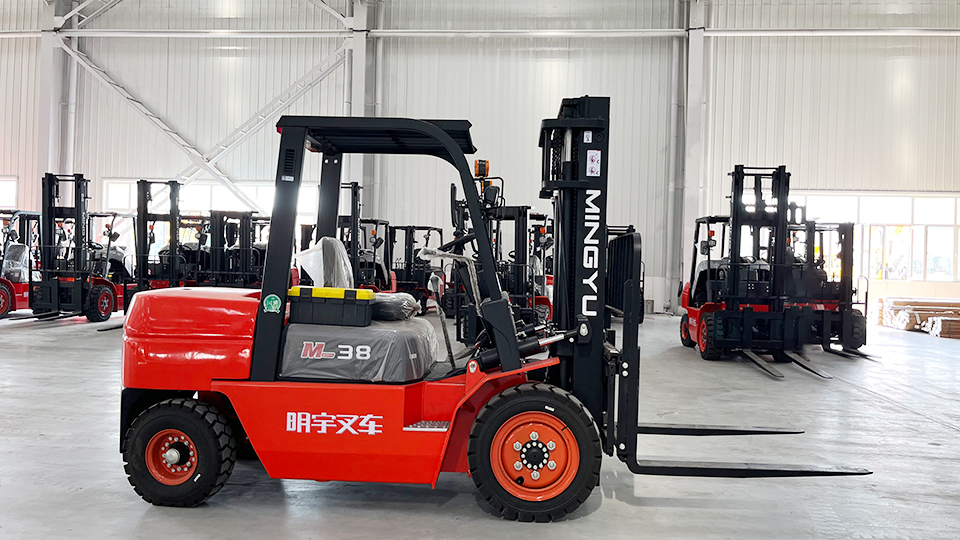
Understanding Typical Fuel Consumption Rates
The fuel consumption of a diesel forklift is not a fixed, singular number but a range highly dependent on the machine's specifications, age, and application.4 It is generally measured in liters per hour (L/hr) or gallons per hour (gal/hr).5
Categorization by Capacity
Fuel consumption correlates closely with the forklift’s rated lifting capacity, as a larger capacity necessitates a more powerful, fuel-hungry engine and heavier components.6
|
Forklift Capacity (Metric Tons) |
Typical Engine Power (kW / hp) |
Estimated Fuel Consumption (L/hr) |
Estimated Fuel Consumption (gal/hr) |
|
1.5 - 2.5 (Small) |
25 - 35 kW / 33 - 47 hp |
1.8 - 2.5 |
0.48 - 0.66 |
|
3.0 - 5.0 (Medium/Standard) |
40 - 65 kW / 54 - 87 hp |
2.5 - 4.0 |
0.66 - 1.06 |
|
6.0 - 8.0 (Heavy Duty) |
75 - 90 kW / 100 - 120 hp |
4.0 - 6.0 |
1.06 - 1.58 |
|
10.0 + (Very Heavy) |
100+ kW / 134+ hp |
6.0 - 10.0+ |
1.58 - 2.64+ |
Note: These figures represent consumption under mixed-duty cycles, which include a combination of idling, traveling, lifting, and lowering. Consumption rates can be significantly higher (up to 20-30% higher) during periods of continuous, heavy-load lifting and accelerating, and lower during prolonged idling (often < 1.0 L/hr).
The Diesel Engine Efficiency Equation
Modern diesel engines in forklifts operate on the four-stroke compression-ignition cycle
Shutterstock
. Their efficiency is fundamentally linked to the brake specific fuel consumption ($\text{BSFC}$), which is the amount of fuel an engine consumes to produce a specific amount of power over time, typically measured in $\text{g/(kW} \cdot \text{h)}$.
$$\text{Fuel Consumption Rate} (\text{L/hr}) \propto \frac{\text{Power Output} (\text{kW}) \times \text{BSFC} (\text{g/(kW} \cdot \text{h)})}{\text{Fuel Density} (\text{g/L})}$$
A well-maintained, modern Tier 4 Final or Stage V compliant engine utilizes technologies like Common Rail Direct Injection (CRDI), Turbocharging, and sophisticated Engine Control Units (ECUs) to achieve a lower BSFC and, consequently, better fuel efficiency compared to older models.
Major Factors Influencing Fuel Consumption
Fuel consumption in material handling is a complex outcome influenced by a dynamic interplay of factors categorized into four main groups: Machine Factors, Operational Factors, Environmental Factors, and Maintenance Factors.
1. Machine Factors (Technical Specifications)
Engine Type and Technology: As noted, modern engines with CRDI, variable geometry turbochargers (VGT), and precise electronic controls are inherently more efficient.7 The displacement (engine size) directly relates to the maximum power and fuel used.
Transmission Type: Hydrostatic and advanced powershift transmissions offer different efficiencies.8 Hydrostatic drives are often lauded for their smooth, precise power transfer and can be highly efficient in applications involving frequent, short movements, but may introduce power losses through the hydraulic system.9
Hydraulic System Efficiency: The main hydraulic pump (for lifting/tilting) and auxiliary pumps consume engine power. Highly efficient load-sensing hydraulic systems only draw the power necessary for the current task, minimizing wasted energy compared to fixed-displacement pumps.10
Forklift Weight and Tire Type: A heavier counterweight (for stability with heavier loads) means the engine must work harder to accelerate and travel. Pneumatic tires are generally more efficient on rough or outdoor surfaces, while cushion tires are better suited for smooth indoor use but may increase rolling resistance on less-than-perfect floors.11
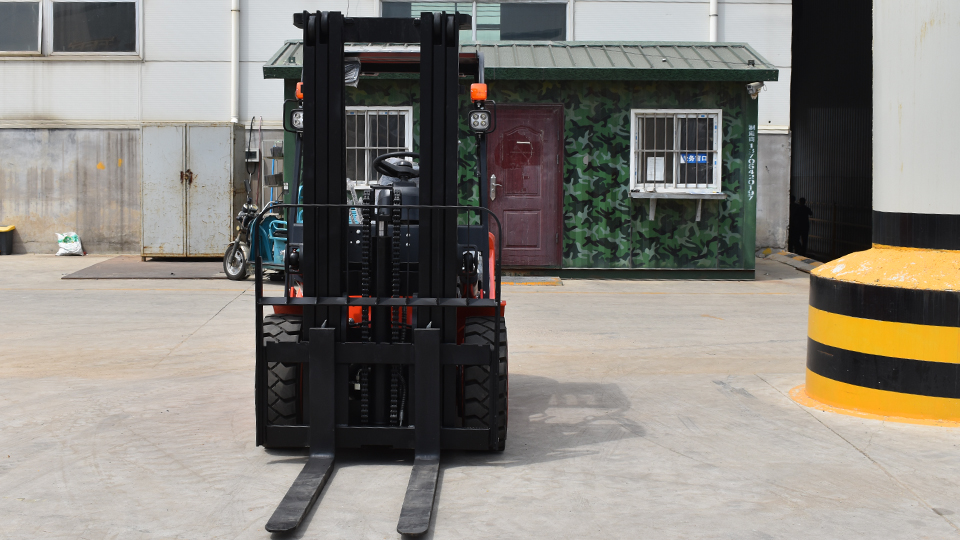
2. Operational Factors (Driver and Application)
Duty Cycle and Load Factor: This is the most significant operational factor.
High Load Factor: Continuous handling of near-maximum rated loads requires the engine to operate at or near peak power, dramatically increasing consumption.
Frequent Acceleration/Braking: The energy lost in braking must be replaced by fuel burned during the next acceleration. Inefficient, 'stop-start' operations drastically reduce fuel economy.12
Lift Height and Speed: Higher lift cycles require more power and time. Excessive lift and travel speed beyond what is necessary burns fuel rapidly.
Idling Time: Excessive engine idling is pure fuel waste.13 A typical 5.0-ton forklift can consume over 1.0 L/hr while idling. Operations with long wait times for loads or documentation see unnecessary fuel drain.
Driving Technique: Aggressive driving, characterized by harsh acceleration, late and heavy braking, and fast cornering, can increase consumption by 10-15% compared to smooth operation.
3. Environmental Factors
Ambient Temperature: Diesel engine efficiency can be marginally affected by extreme cold, requiring a longer warm-up period or higher fuel use for starting.
Ground Surface and Gradient: Operating on unpaved, soft, or rough terrain dramatically increases rolling resistance, forcing the engine to provide more tractive effort. Similarly, operating on a steep incline (gradient) requires significantly more power.
Wind Resistance: For outdoor operations, moving large, bulky loads (like empty containers) at speed increases aerodynamic drag, demanding higher engine output.
4. Maintenance Factors
Engine Tune-up: Simple issues like a clogged air filter restrict airflow, leading to an over-rich fuel mixture and incomplete combustion.14 Faulty injectors or a worn fuel pump can cause poor fuel atomization, wasting fuel.15
Tire Pressure and Condition: Under-inflated tires increase the tire-to-surface contact area, significantly increasing rolling resistance and requiring more engine power for movement.
Oil and Fluid Condition: Using the wrong grade of engine oil or hydraulic fluid can increase internal friction and parasitic power losses.16 Old, degraded oil loses its lubricating properties, causing the engine to work harder.17
Brake Drag: Improperly adjusted or worn brakes can cause them to drag on the wheels even when not in use, creating a constant, unnecessary load on the engine.
��️ Optimization Strategies: Practical and Technical Solutions
Optimizing diesel forklift fuel consumption is a multifaceted process that requires a combination of equipment management, driver training, and operational re-engineering.18
A. Equipment and Technology Optimization (Technical)
1. Implement Telematics and Fleet Management Systems
Telematics is the single most effective tool for measuring and optimizing fuel use.
Real-time Data Collection: Install GPS and Engine Control Unit (ECU) interfaces to record fuel level, consumption rate (L/hr), idle time, travel speed, and lift cycles.
Performance Benchmarking: Identify the least and most efficient machines and operators. Use the data to set a benchmark for a fuel-efficient $\text{L/hr}$ rate.
Idling Shutdown: Configure ECUs or telematics to enforce an automatic engine shutdown after a pre-set period of excessive idling (e.g., 3-5 minutes).19
2. Right-Sizing and Modernization
Match Equipment to Task: Do not use a 7.0-ton forklift for a 2.0-ton load. Over-specifying capacity leads to higher fuel consumption due to the larger, heavier machine.
Invest in Tier 4/Stage V Engines: Modern diesel engines are designed for superior efficiency and lower emissions, often featuring technologies like Selective Catalytic Reduction (SCR) and Diesel Particulate Filters (DPF) . The fuel savings can rapidly offset the higher initial capital cost.
Evaluate Electric/LPG Alternatives: For indoor or lighter-duty cycles, consider transitioning to electric (battery) or Liquefied Petroleum Gas (LPG) forklifts, which eliminate diesel consumption entirely and reduce emissions.
3. Tire and Rolling Resistance Management
Optimal Tire Pressure: Strictly adhere to the manufacturer's recommended tire pressure. A tire with a $\text{10-15\%}$ pressure reduction can increase rolling resistance significantly. Implement a regular, documented tire pressure check as part of the daily pre-shift inspection.20
Proper Tire Selection: Use Low Rolling Resistance (LRR) tires where appropriate, as they can reduce the energy required for movement.21
B. Maintenance and Engine Health (Preventive)
1. Scheduled Preventative Maintenance (PM)
Establish a rigorous PM schedule focused on the engine's core components for fuel efficiency:
Air and Fuel Filters: Replace these as per the manufacturer's recommendation. A clogged air filter can reduce fuel economy by up to $5-10\%$.
Fuel Injector Cleaning/Replacement: Dirty or worn injectors spray fuel inefficiently, resulting in poor combustion. Use high-quality fuel and periodic cleaning to maintain the correct atomization pattern.
Fluid Analysis: Conduct regular oil analysis to monitor engine health and determine optimal oil change intervals, ensuring the use of the correct-grade, low-viscosity oils to minimize friction.
2. Hydraulic System Integrity
Check for Leaks and Proper Function: Leaks in the hydraulic system or poorly functioning relief valves waste power by requiring the pump to run longer or harder.
Use the Right Fluid: Ensure the hydraulic fluid is the correct type and viscosity. An overly thick fluid, especially in cold conditions, increases the power required to drive the pump.
C. Operational Re-engineering and Driver Behavior (The Human Factor)
1. Implement Driver Training and Incentives
This is arguably the most cost-effective strategy.
Reduce Idling: Educate drivers on the cost of idling and enforce the automatic shutdown policy.
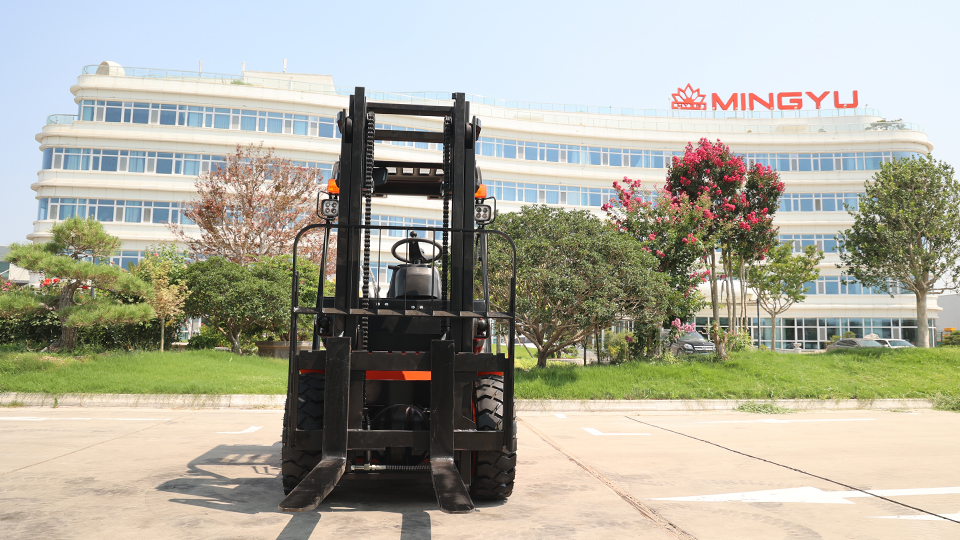
Smooth Driving Techniques: Train drivers on defensive and smooth acceleration/deceleration—avoiding harsh starts and stops.22 The goal is to maximize the time the forklift is in an efficient $\text{RPM}$ range.
Minimize Load/Lift Height: Train operators to raise and lower loads only to the height necessary for the task, minimizing the work done by the hydraulic system.
2. Workflow and Layout Optimization
Route Planning: Optimize traffic flow and warehouse layouts to minimize travel distance and reduce congestion/wait times. Eliminate unnecessary detours and long runs.
Strategic Staging: Position staging areas for incoming and outgoing goods as close as possible to their point of use or loading, reducing travel time and distance for loaded forklifts.
Avoid Empty Runs (Deadheading): Plan tasks so that the forklift is carrying a load as often as possible. An empty run is still consuming fuel without productive output.23
3. Load Management
Single-Load Policy: While high-capacity forklifts can sometimes double-stack, excessive overloading beyond the recommended load center and capacity is unsafe and forces the engine into its most inefficient, high-power operating range.
Calculating Fuel Cost Savings: A Case Study Example
Understanding the economic impact of a small change in consumption provides a powerful incentive for optimization.
Assume a fleet of ten 5.0-ton diesel forklifts operating for 2,000 hours per year each, with a fuel price of $\$1.50$ per liter.
Baseline Scenario (Inefficient): $\text{4.0 L/hr}$
Annual Fuel Consumption: $10 \text{ forklifts} \times 2,000 \text{ hrs/year} \times 4.0 \text{ L/hr} = 80,000 \text{ L/year}$
Annual Fuel Cost: $80,000 \text{ L} \times \$1.50/\text{L} = \$120,000$
Optimized Scenario (Target): $\text{3.5 L/hr}$ (A reduction of just $\text{0.5 L/hr}$, or $12.5\%$)
Annual Fuel Consumption: $10 \text{ forklifts} \times 2,000 \text{ hrs/year} \times 3.5 \text{ L/hr} = 70,000 \text{ L/year}$
Annual Fuel Cost: $70,000 \text{ L} \times \$1.50/\text{L} = \$105,000$
Annual Savings: $\$120,000 - \$105,000 = \$15,000$
A seemingly small $12.5\%$ improvement in fuel efficiency translates to a substantial $\$15,000$ annual saving for a modest fleet. This demonstrates that the investment in telematics, training, and maintenance is rapidly justified by reduced operating costs.
Conclusion
The fuel consumption rate of a typical diesel forklift is a variable parameter, but one that can be effectively managed. The rates, generally ranging from $1.8 \text{ to } 10.0+ \text{ L/hr}$, are fundamentally determined by the machine's capacity and the engine's technical efficiency.
Optimization is a journey encompassing three primary pillars: Technical Modernization (leveraging telematics and efficient Tier 4 engines), Rigorous Maintenance (focusing on filters, injectors, and proper tire inflation), and Behavioral Management (eliminating idling and promoting smooth driving).
By systematically addressing these factors, businesses can significantly lower their Total Cost of Ownership (TCO), reduce their carbon footprint, and ensure their material handling operations remain both productive and economically sustainable.
Name: selena
Mobile:+86-13176910558
Tel:+86-0535-2090977
Whatsapp:8613181602336
Email:vip@mingyuforklift.com
Add:Xiaqiu Town, Laizhou, Yantai City, Shandong Province, China
