
vip@mingyuforklift.com
+86-0535-2090977

1. Introduction
Hook: Diesel remains the dominant power source for heavy-duty material handling, yet fuel costs represent a significant portion of total operating expenditure.
Scope: Define "hourly diesel consumption" as a variable metric rather than a fixed number.
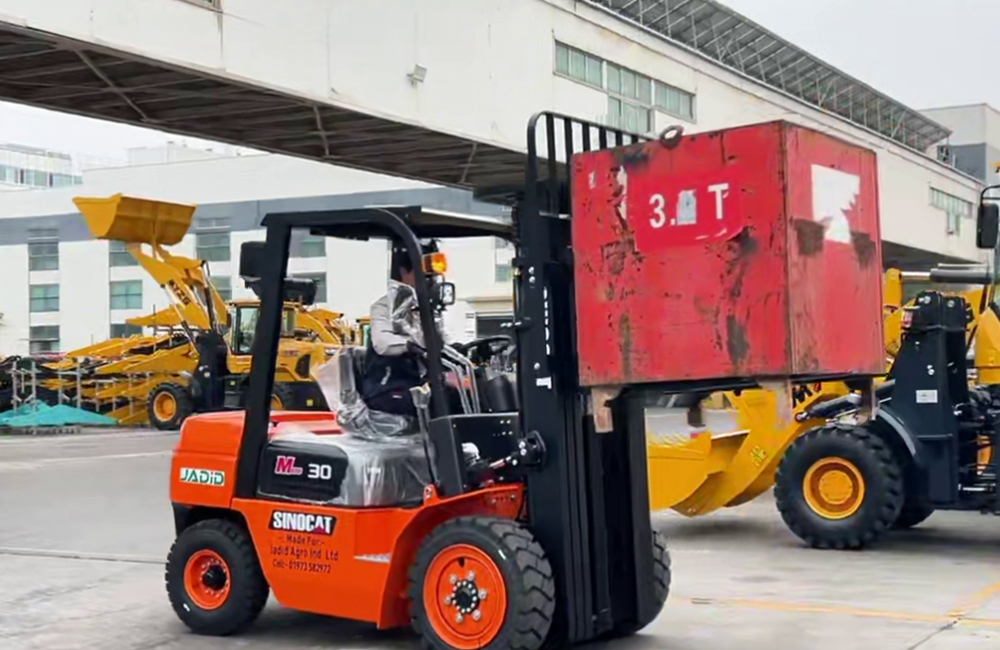
Thesis: While a standard 3-ton diesel forklift typically consumes 2–5 L/h, actual consumption depends on load, duty cycle, environment, and maintenance.
Article roadmap: Brief preview of the technical factors, data tables, measurement methods, and optimization strategies to follow.
2. Defining the Baseline: Typical Consumption Ranges by Capacity
2–3 ton class: 2.0–3.5 L/h under normal mixed duty; up to 5 L/h under continuous heavy load.
3.5 ton class: Reference benchmark of ~3.2 L/h (manufacturer test cycle data).
5 ton class: 4.5–8.0 L/h depending on hydraulic demand and travel distance.
Heavy-duty (5+ ton): 6–10+ L/h; high-mast container handlers at the upper end.
Idle consumption: ~0.5 L/h even when stationary; significance in intermittent operations.
Table: Summary of capacity vs. consumption range with source attribution (manufacturer specs, field studies).
3. Key Variables Affecting Hourly Fuel Burn
Load factor: Relationship between rated capacity and actual lift mass; hydraulic energy demand.
Duty cycle intensity: Continuous vs. intermittent operation; VDI 2198 test cycles vs. real-world usage.
Travel distance and speed: Acceleration/deceleration patterns; yard layout efficiency.
Idle time: Proportion of engine runtime spent stationary; impact on average consumption.
Environmental conditions: Grade/slope, surface condition, ambient temperature (cold-start enrichment).
Operator behavior: Aggressive throttle use, pre-shift warm-up duration, mast tilt timing.
Equipment condition: Engine tuning, air filter restriction, injector wear, tire pressure/condition, hydraulic system leaks.
4. Measurement and Calculation Methodologies
Direct measurement: Flow meters vs. timed top-off method (tank-to-tank).
Indirect estimation: Engine-specific fuel consumption maps (g/kWh) × operating power.
Standardized testing: ISO 2330 / VDI cycle procedures and their limitations for real-world prediction.
Fleet telematics: On-board diagnostics (OBD) and CAN-bus fuel monitoring systems.
Formulaic approach: Introduce a basic estimation equation combining load factor, engine power, and specific consumption.
5. Comparative Context: Diesel vs. Alternative Powertrains
LPG/propane forklifts: Comparable power, slightly lower fuel cost per hour but different infrastructure.
Electric (lead-acid / Li-ion): Zero direct fuel burn; energy equivalent comparison (kWh vs. liters).
Total cost of ownership (TCO): Fuel + maintenance + infrastructure over 5–7 years.
When diesel still wins: Outdoor use, extreme climates, continuous heavy-duty cycles, and high uptime requirements.
6. Strategies for Reducing Hourly Diesel Consumption
Operational: Anti-idling policies, optimized routing, load consolidation, operator training programs.
Technical: Engine auto-shutoff systems, variable displacement hydraulics, telematics-driven feedback.
Maintenance: Scheduled injector cleaning, air filter replacement, tire condition monitoring, hydraulic oil viscosity management.
Fleet right-sizing: Matching forklift capacity to actual task requirements to avoid over-specification.
7. Conclusion
Recap the central answer: hourly consumption is a distribution, not a single number.
Emphasize that 2–5 L/h for a 3-ton unit is a planning baseline, but measurement and management are what drive real savings.
Closing thought: As emissions regulations tighten, understanding and minimizing diesel burn is both an economic and environmental imperative.
Name: selena
Mobile:+86-13176910558
Tel:+86-0535-2090977
Whatsapp:8613181602336
Email:vip@mingyuforklift.com
Add:Xiaqiu Town, Laizhou, Yantai City, Shandong Province, China
