
vip@mingyuforklift.com
+86-0535-2090977

For most general industrial, warehouse, and yard operations, the standard capacity range for a diesel counterbalance forklift is typically 1.5 to 8 metric tons (3,000 to 18,000 pounds). The most common and widely utilized model in this class is the 5,000-pound (2.5-ton) diesel pneumatic tire forklift.
However, the maximum capacity for any diesel forklift—including specialized heavy-duty container handlers—extends to the absolute extreme of material handling, with machines rated up to 90 metric tons (200,000 pounds). The Guinness World Record-holding Kalmar DCG850, for example, is rated for nearly 85 metric tons (187,393 pounds).1
This technical article will dissect the capacity classes of diesel forklifts, examine the engineering principles governing their stability and lifting power, and detail the critical operational factors that reduce the rated capacity to the actual lift capacity.
�� Defining the Capacity Classes of Diesel Forklifts
To provide a clear technical answer, diesel forklifts (Class IV and V, Internal Combustion) must be categorized by their intended application and resulting capacity.
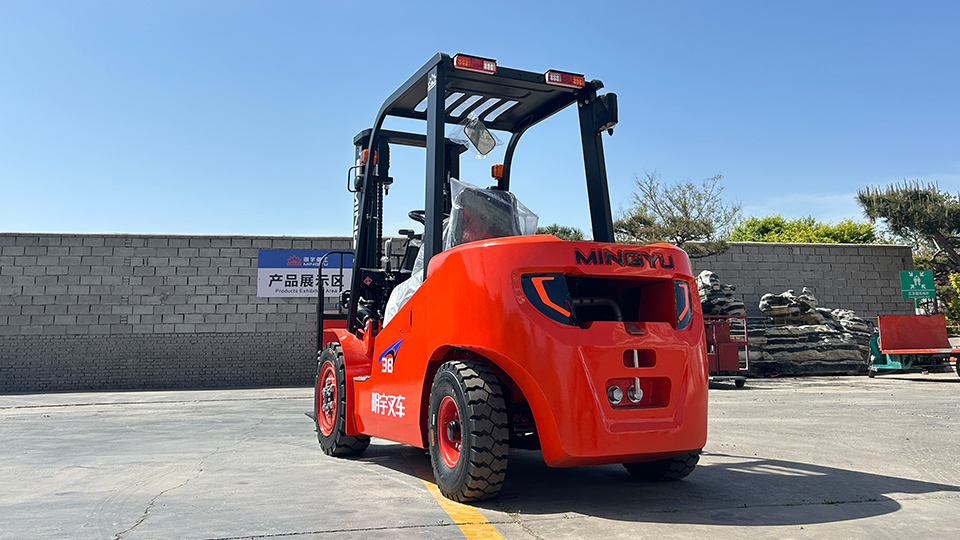
1. Standard/General-Purpose Class
This is the "standard" workhorse most people encounter, used for loading/unloading trucks, moving palletized goods in an outdoor yard, and general manufacturing floor transport.
Capacity Range: 1.5 to 8 metric tons (3,000 to 18,000 lbs.)
Most Common Model: The 2.5 to 3.5-ton (5,000 to 7,000 lbs.) forklift. This capacity is optimized for moving the vast majority of standard palletized goods in the logistics chain (e.g., a standard 40" x 48" pallet loaded up to 2,000 lbs.).
Engineering Focus: Balancing maneuverability, travel speed, and sufficient engine power for grades and sustained outdoor use.
2. Industrial/Medium-Heavy Class
These machines are used in sectors that routinely handle heavier individual loads, such as pipe, lumber, large engine components, and mid-sized steel coils.
Capacity Range: 8 to 25 metric tons (18,000 to 55,000 lbs.)
Engineering Focus: Increased counterbalance weight, significantly larger chassis and mast structures, and high-displacement, high-torque diesel engines to power robust hydraulic systems.
3. High-Capacity/Container Handling Class
These specialized giants are engineered for extreme, continuous heavy lifting, primarily found in intermodal ports, steel mills, shipyards, and heavy machinery manufacturing. This class defines the maximum capacity of diesel forklifts.
Capacity Range: 25 to over 90 metric tons (55,000 to 200,000+ lbs.)
Maximum Models: Brands like Kalmar and Hyster manufacture extreme-capacity models.2 The Kalmar DCG850-12LB is an example, capable of lifting nearly 85 metric tons (187,393 lbs.)—the technical maximum for a mobile lift truck.3
Engineering Focus: Massive hydrostatic drives, multi-cylinder industrial diesel engines (often 9L+), and advanced load-sensing systems to manage dynamic stability under colossal loads.
�� The Technical Principles of Lift Capacity
A forklift's capacity is not an arbitrary number; it is a precisely calculated engineering limit based on the principle of stability and the physics of the Load Moment. The entire design is based on the concept of a seesaw with the fulcrum being the front axle's center line.
1. Rated Capacity and the Load Center
The most critical factor in determining capacity is the Rated Load Capacity, which is specified on the forklift's Data Plate.4
Rated Capacity (RLC): The maximum weight a forklift can safely lift under specific, standardized conditions.5
Load Center (6$L_C$): The horizontal distance from the vertical face of the forks to the center of gravity (CG) of the load.7 This is the lever arm that dictates the tipping force.
For almost all standard diesel forklifts, the RLC is measured at a 24-inch (600 mm) load center.8 This is based on the standard dimensions and common weight distribution of a typical pallet load.
2. The Load Moment Equation (Tipping Force)
The capacity is dictated by ensuring the Load Moment (the tipping force generated by the load) never exceeds the Stability Moment (the stabilizing force generated by the forklift's own weight and counterweight).
$$\text{Load Moment} (M_L) = \text{Load Weight} (W_L) \times \text{Load Center} (L_C)$$
$$\text{Stability Moment} (M_S) = \text{Forklift Weight} (W_F) \times \text{Distance to Counterweight CG} (D_{CG})$$
For safe operation, the Stability Moment must always be significantly greater than the Load Moment. The RLC is the maximum weight ($W_L$) at the specified $L_C$ that keeps this safety margin intact.
3. Counterweight Engineering
The key to a diesel forklift's high capacity is the Counterweight, a massive cast iron block at the rear of the truck.
Function: The counterweight's purpose is to shift the combined Center of Gravity of the unloaded forklift (the Stability Triangle) as far back as possible to maximize the $\text{Stability Moment} (M_S)$.
Capacity to Weight Ratio: Due to the leverage principle, a forklift must be significantly heavier than its maximum rated load. A rule of thumb is that the forklift's operating weight is typically 1.5 to 2.5 times its Rated Lift Capacity. For instance, a common 5,000 lb. (2.5-ton) forklift may weigh over 8,000 to 10,000 lbs. (4 to 5 tons) itself.
�� Factors That De-Rate the Maximum Capacity
The Rated Capacity on the data plate is the theoretical maximum under perfect conditions.9 In reality, several operational variables create an Actual Capacity that is always lower than the RLC.
1. Load Center Change (The De-Rating Curve)
The most significant factor affecting actual capacity is a change in the Load Center. If the load is longer, or the weight is distributed unevenly, the $L_C$ increases, dramatically increasing the $M_L$ (Load Moment).
$$\text{Actual Capacity} = \text{RLC} \times \left( \frac{\text{Rated Load Center}}{\text{Actual Load Center}} \right)$$
Example:
A standard 5,000 lb. forklift rated at a 24-inch $L_C$ attempts to lift a heavy 48-inch long load with its center of gravity now at a 36-inch $L_C$.
$$\text{Actual Capacity} = 5,000 \text{ lbs} \times \left( \frac{24 \text{ in}}{36 \text{ in}} \right) = 5,000 \text{ lbs} \times 0.667 \approx 3,335 \text{ lbs}$$
The machine's safe lifting capacity has been de-rated by 33% due to the load length alone. This technical calculation is mandatory for operators and is detailed on the Capacity Plate.
2. Lift Height ($H_{Lift}$)
As a load is raised, the forklift's overall Center of Gravity (CG) shifts upwards and forward. This reduces the size of the Stability Triangle (the operational base of support between the front axle and the rear axle pivot point).
De-Rating at Height: Most capacity charts show a stepped reduction in RLC as the lift height increases. A forklift capable of lifting 5,000 lbs. to 10 feet may only be rated to lift 4,000 lbs. or less to its maximum mast height (e.g., 20 feet) to maintain the required stability margin.
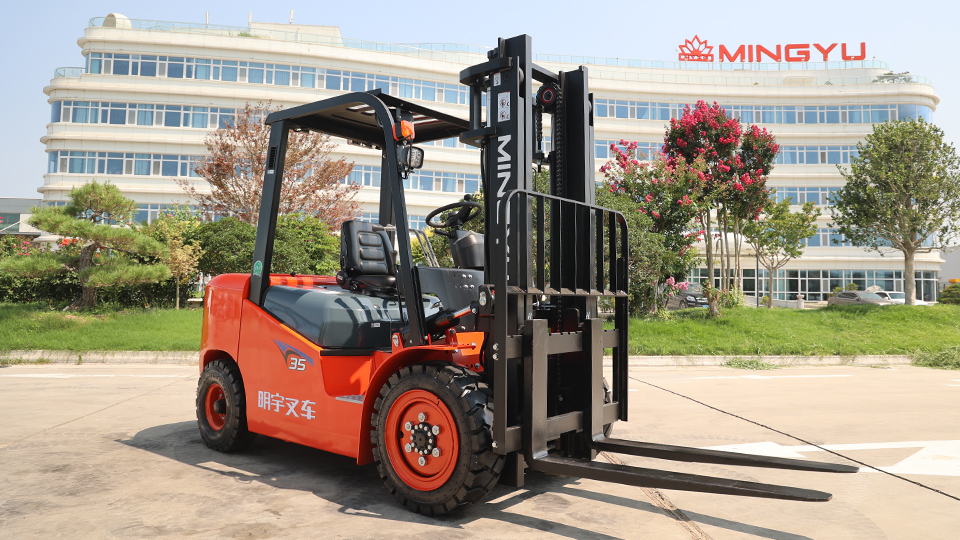
3. Forklift Attachments
The addition of hydraulic attachments is common in diesel applications (e.g., side shifters, fork positioners, bale clamps, rotators). Any attachment:
Adds Weight: The weight of the attachment itself permanently reduces the weight available for the load.10
Increases Forward Load Center: By placing the load further out from the mast face, the attachment effectively increases the $L_C$ before the load is even factored in, causing a permanent de-rating of the RLC.
A standard side-shifter can easily de-rate a forklift's RLC by 5% to 10%.
4. Tire Type and Condition
Diesel forklifts often utilize pneumatic (air-filled) tires for outdoor and rough-terrain stability.
Deflation: Under-inflated tires affect the stability triangle, causing the forklift to lean and reducing the effective width of the stability base, thus decreasing the safe RLC.
Wear: Excessively worn tires reduce traction and overall stability, particularly when traveling on slopes or uneven surfaces.
⚙️ The Engineering Systems Supporting Maximum Capacity
Achieving maximum lift capacity is a convergence of massive engine power and meticulously designed hydraulic and structural systems.
1. Engine and Hydraulic Power
A diesel engine's primary role in lifting is to drive the hydraulic pump. The horsepower of the engine is less important than the torque it can generate at low RPMs, which is necessary for slow, controlled lifting of extremely heavy loads.
Hydraulic System: The pressure and flow rate of the hydraulic pump determine the speed and force of the lift. High-capacity diesel trucks use specialized, high-pressure, load-sensing hydraulic pumps that only draw the necessary power from the engine, maximizing efficiency and minimizing heat generation during heavy lifts.
$$P_{Hydraulic} = \frac{Q \times \Delta p}{600}$$
Where $P_{Hydraulic}$ is the hydraulic power required ($kW$), $Q$ is the flow rate ($L/min$), and $\Delta p$ is the pressure differential ($bar$). High-capacity machines operate with higher $\Delta p$ and larger cylinder bores.
2. The Mast Structure
The mast must not only withstand the compressive forces of the load but also the significant bending moment (leverage) and torsional forces created during travel and high-speed lifting.
Construction: High-capacity masts are built with high-yield-strength steel and often employ a Duplex or Triplex design with heavy-duty rollers and channels to manage immense forces without deflection or binding.
3. Stability and Overload Protection
Modern high-capacity diesel forklifts incorporate advanced safety systems to prevent exceeding the actual capacity limit.
Load Sensing: Sensors monitor hydraulic pressure in the lift cylinders to calculate the instantaneous load weight and compare it against the programmed capacity chart (which factors in $L_C$ and $H_{Lift}$).
Lockout Feature: If the system detects an overload condition, it will often automatically lock out the hydraulic lift function, preventing the operator from raising the load further or tilting the mast forward until the load is reduced or the $L_C$ is corrected.
�� Global Standardization and Capacity Terminology
Capacity ratings are typically standardized under international codes, which ensures consistency across manufacturers:
ISO 3691 (Industrial Trucks - Safety Requirements and Verification): Defines the stability testing requirements that determine the RLC.
ASME B56.1 (Safety Standard for Low Lift and High Lift Trucks): Provides safety rules relating to the design, construction, operation, and maintenance of powered industrial trucks in North America.
It is crucial for procurement and safety officers to understand that capacity ratings are always in mass units (kilograms or pounds) and refer to the load, not the weight of the forklift itself. Confusing the two is a common error in logistics planning.
|
Common Capacity Terminology |
Capacity Range (Approx.) |
Typical Application |
|
Light-Duty |
1.5 - 2.5 metric tons (3,000 - 5,000 lbs.) |
Small warehouse, light manufacturing. |
|
Standard/Medium |
3.0 - 8.0 metric tons (6,000 - 18,000 lbs.) |
General yard work, truck loading, mid-size manufacturing. |
|
Heavy-Duty |
10.0 - 25.0 metric tons (22,000 - 55,000 lbs.) |
Heavy coils, container staging, lumber/pipe yards. |
|
Container Handler/Ultra-Heavy |
30.0 - 90.0 metric tons (66,000 - 200,000 lbs.) |
Port operations, shipping containers, steel mill transport. |
Conclusion: The Spectrum of Diesel Power
The maximum lift capacity of a standard diesel forklift is a multi-tiered answer:
The statistical standard or industry average for general use is 3.5 metric tons (7,000 lbs.).
The maximum practical limit for the industrial-grade, non-specialized fleet is around 8 to 10 metric tons.
The absolute technical maximum for specialized, heavy-duty diesel lift trucks (e.g., container handlers) reaches up to 90 metric tons (200,000 lbs.).11
Fundamentally, maximum capacity is an engineering trade-off between power, stability, and size. As the required capacity increases, the forklift must become geometrically larger and heavier to maintain the strict stability criteria dictated by the load moment principle. For any operation, the safest and most efficient choice is a machine whose Rated Capacity slightly exceeds the heaviest expected load, ensuring that the Actual Capacity, even with attachments and increased load centers, remains within the machine's safe operating envelope.
Name: selena
Mobile:+86-13176910558
Tel:+86-0535-2090977
Whatsapp:8613181602336
Email:vip@mingyuforklift.com
Add:Xiaqiu Town, Laizhou, Yantai City, Shandong Province, China
