
vip@mingyuforklift.com
+86-0535-2090977

Introduction
The center of gravity represents the single most critical factor in forklift safety and operational stability. Unlike passenger vehicles where suspension systems and wide wheelbases provide inherent stability margins, forklifts operate as precision-balanced lever systems where the center of gravity must remain within strictly defined geometric boundaries to prevent catastrophic tip-over incidents. Understanding where this center of gravity should stay—and the factors that influence its position—is fundamental to safe forklift operation, regulatory compliance, and operational efficiency.
This technical guide examines the physics of forklift stability, the geometric constraints governing center of gravity placement, and the operational protocols necessary to maintain safe balance under dynamic working conditions.
The Physics of Forklift Stability: Understanding the Fulcrum and Load Moment
A counterbalanced forklift operates on principles similar to a playground seesaw, with the front axle serving as the fulcrum—the central pivot point where balance is achieved . On one side of this fulcrum sits the counterweight, strategically positioned at the rear of the forklift to provide stabilizing mass. On the opposite side, the forks lift and support the operational load. The counterweight must always exert greater force than the load to prevent forward tipping, creating a constant state of engineered imbalance that enables lifting functionality .
The load moment quantifies the overturning force applied to a loaded forklift, calculated as the product of load weight multiplied by the load's distance from the fulcrum (front axle): Maximum Load Moment = Weight × Distance . This mathematical relationship explains why forklift capacity decreases as load center increases—even with identical weights, loads positioned further from the mast generate greater overturning moments that threaten stability .
For a standard 48-inch by 48-inch pallet with evenly distributed weight, the load center measures 24 inches from the vertical face of the forks—the industry standard reference point for most forklift capacity ratings . However, irregular loads or non-standard pallet sizes shift the center of gravity unpredictably, requiring operators to identify the actual balance point and position it as close to the carriage as possible .
The Stability Triangle: Geometric Boundaries for Center of Gravity Placement
Defining the Stability Triangle
The stability triangle constitutes the fundamental geometric framework governing forklift stability. This invisible triangle is formed by connecting three physical points on the forklift: the pivot point at the center of the rear steer axle and the two front wheels (load wheels) . The rear axle attaches to the forklift frame via a single pivot pin, creating a three-point suspension system that allows wheels to maintain contact on uneven surfaces while establishing the triangular stability zone .
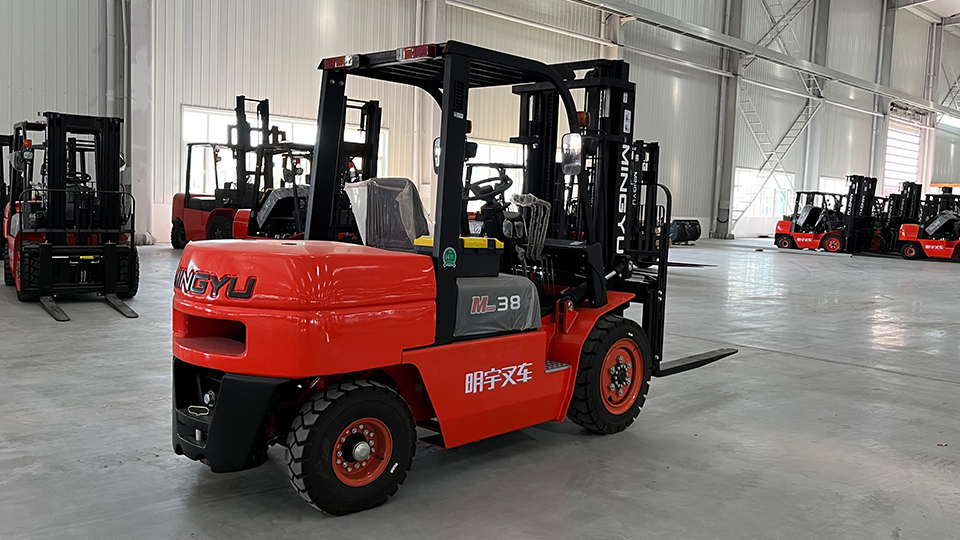
When the forklift is unloaded, its center of gravity sits firmly within this triangle, typically positioned just below the operator's seat . As weight is added to the forks, the combined center of gravity (integrating both forklift and load masses) shifts forward toward the front axle . The forklift remains stable only while this combined center of gravity stays within the boundaries of the stability triangle .
The Stability Pyramid: Three-Dimensional Considerations
While the stability triangle provides a useful two-dimensional model, actual forklift stability operates in three dimensions. As the mast elevates a load, the center of gravity shifts not only forward but also upward, effectively transforming the stability triangle into a stability pyramid . The pyramid's apex represents maximum lift height, with progressively smaller cross-sectional areas available for center of gravity placement as height increases.
This geometric reality explains critical operational constraints: a load that remains stable at ground level may cause tip-over when elevated, as the center of gravity moves outside the pyramid's narrowing upper boundaries . The stability pyramid concept mandates that operators always travel with loads positioned as close to the ground as possible—typically 4 to 6 inches above the surface—to maintain the lowest possible center of gravity and maximize stability margins .
Longitudinal Stability: Front-to-Rear Center of Gravity Management
Load Center Distance and Capacity Calculations
Longitudinal stability refers to the forklift's resistance to tipping forward or backward, governed primarily by the horizontal position of the center of gravity relative to the front axle . The standard load center distance—24 inches for typical palletized loads—serves as the baseline for manufacturer capacity ratings displayed on the data plate .
When actual load centers exceed rated distances, capacity decreases proportionally. The calculation follows this formula: Actual Capacity = (Rated Load Center / Actual Load Center) × Rated Capacity . For example, a forklift rated for 4,000 pounds at a 24-inch load center can safely handle only 3,200 pounds if the load center extends to 30 inches (96,000 inch-pounds maximum moment divided by 30 inches) .
Critical Threshold: The Front Axle Line
The front axle represents the absolute forward boundary for center of gravity placement. When the combined center of gravity reaches this line, the forklift operates at its absolute stability limit . Any forward shift beyond this point—whether from mast tilt, acceleration, or load movement—results in forward tip-over.
Operators must maintain adequate safety margins by positioning the heaviest portion of any load as close as possible to the fork carriage face, thereby minimizing the actual load center and keeping the combined center of gravity well behind the front axle . Mast tilt adjustments can temporarily shift the center of gravity forward or backward, requiring careful management during load placement and retrieval .
Lateral Stability: Side-to-Side Center of Gravity Management
While longitudinal stability concerns forward/rearward tipping, lateral stability addresses side-to-side balance. The line connecting the two front wheels forms the lateral stability boundary, preventing sideways tip-over during turns . Unlike longitudinal stability where load weight significantly influences center of gravity position, lateral stability depends primarily on operator behavior, terrain conditions, and load positioning .
Off-center loads shift the center of gravity laterally toward one front wheel, reducing the stability margin on the opposite side. When combined with centrifugal force during turning, this lateral shift can move the center of gravity outside the stability triangle's side boundaries, causing sideways tip-over . Operators must ensure loads are centered on both forks, with no overhang or uneven weight distribution, before initiating any movement .
Dynamic forces during operation—sudden braking, rapid acceleration, or sharp turns—create temporary center of gravity shifts that can exceed static stability boundaries even with properly positioned loads . Smooth, controlled operation maintains the center of gravity within stable zones throughout the work cycle.
Dynamic Stability: Managing Center of Gravity Under Motion
Dynamic stability encompasses the shifting of center of gravity caused by operational movements including braking, acceleration, turning, and mast tilting . These dynamic factors can momentarily relocate the center of gravity outside the stability triangle even when static conditions suggest adequate safety margins.
Speed and Centrifugal Force
Centrifugal force generated during turns acts horizontally on the combined center of gravity, effectively pulling it toward the outside of the turn radius. The faster the turn, the greater the centrifugal force and the more the center of gravity shifts laterally . At sufficient speed, this shift can move the center of gravity outside the stability triangle's side boundary, causing lateral tip-over.
Operational protocols mandate slow, wide turns with loads kept low to minimize dynamic center of gravity displacement . Turning on ramps or inclines compounds these effects by introducing gravitational components that further shift the center of gravity, making such maneuvers extremely hazardous .
Mast Movement and Height Effects
Raising the mast elevates the center of gravity both vertically and horizontally (due to mast geometry), simultaneously reducing stability margins in all directions . The stability pyramid concept demonstrates that elevated loads have minimal tolerance for center of gravity displacement before tip-over occurs.
Tilting the mast forward shifts the load center and combined center of gravity forward toward the front axle, potentially exceeding longitudinal stability limits . Tilting backward moves the center of gravity rearward, enhancing stability but potentially compromising load retention. Operators must balance these considerations, typically traveling with the mast tilted slightly backward to keep the center of gravity rearward while maintaining load security .
Operational Protocols for Center of Gravity Management
Pre-Operational Assessment
Before lifting any load, operators must verify that the combined center of gravity will remain within stability boundaries throughout the intended operation. This assessment includes:
Confirming load weight against the capacity chart for the actual load center distance
Identifying the load's center of gravity for irregular or non-uniform items
Planning travel routes that avoid slopes, uneven surfaces, and tight turns
Verifying that attachment installations have not altered capacity ratings
Load Positioning Standards
Optimal center of gravity management requires positioning the load so that its center of gravity aligns with the forklift's longitudinal centerline and remains as close to the carriage as possible . The load should rest fully against the backrest, with forks inserted to at least 75% of the load depth to ensure adequate support and minimize forward load center distance .
For irregular loads, operators must determine the actual center of gravity through balancing methods or engineering calculations, then position this point closest to the carriage rather than assuming geometric center alignment .
Travel Protocols
During travel, the center of gravity must be maintained as low and as rearward as possible. This requires:
Keeping loads 4-6 inches above the ground surface
Avoiding sudden acceleration or braking that would shift the center of gravity longitudinally
Making wide, slow turns to minimize lateral center of gravity displacement
Never turning on ramps or inclines where gravitational forces compound stability risks
Slope and Ramp Operations
Slope navigation presents unique center of gravity challenges. When traveling loaded on an incline, the center of gravity shifts downhill relative to the forklift chassis. To maintain stability, operators must drive with the load upgrade (forks pointing uphill), ensuring that if tip-over occurs, the forklift falls backward onto the counterweight rather than forward onto the load .
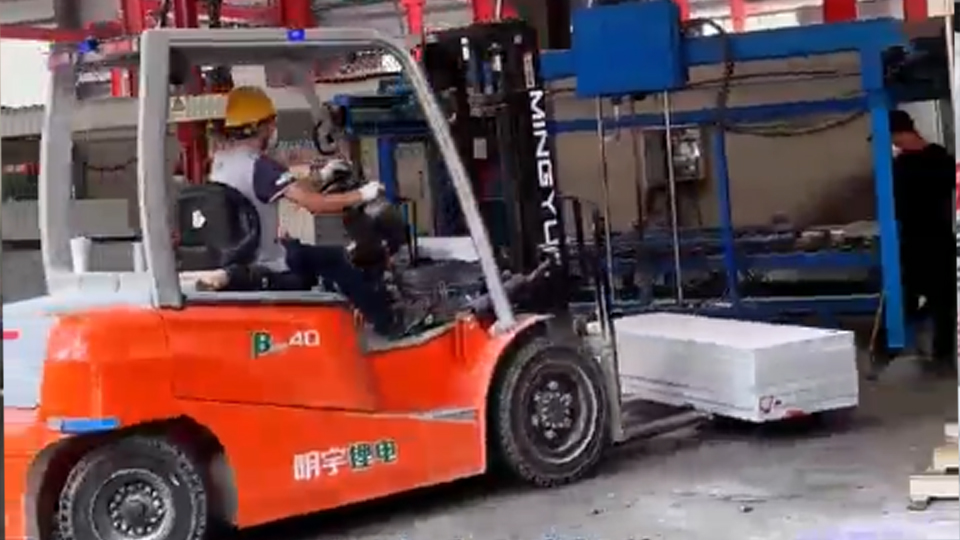
When traveling empty, the reverse applies—the center of gravity shifts toward the rear, making backward tip-over the primary risk. Therefore, empty forklifts should travel with forks downgrade .
Regulatory Compliance and Training Requirements
OSHA regulations under 29 CFR 1910.178 mandate that forklift operators receive formal training covering stability principles, including center of gravity management and stability triangle concepts . This training must include both theoretical instruction and practical evaluation, with documentation maintained by the employer for specific truck types and worksites .
Training curricula emphasize that operators must understand the stability triangle not as an abstract concept but as a dynamic boundary that changes with load characteristics, lift height, and operational maneuvers . Operators learn to visualize the combined center of gravity and predict how operational decisions will affect its position relative to stability boundaries.
Conclusion
The center of gravity in forklift operations must remain strictly within the stability triangle (or pyramid, when considering height) formed by the front wheels and rear axle pivot point. This geometric constraint governs every aspect of safe forklift operation, from load acceptance decisions to travel protocols and maneuvering techniques.
Maintaining center of gravity within safe boundaries requires understanding the physics of load moments, the effects of mast height on stability margins, and the dynamic forces generated during acceleration, braking, and turning. By adhering to capacity ratings, positioning loads optimally, traveling with loads near ground level, and operating smoothly to minimize dynamic forces, forklift operators ensure that the center of gravity stays where it belongs—firmly within the stability triangle, ensuring safe and productive material handling operations.
Name: selena
Mobile:+86-13176910558
Tel:+86-0535-2090977
Whatsapp:8613181602336
Email:vip@mingyuforklift.com
Add:Xiaqiu Town, Laizhou, Yantai City, Shandong Province, China