
vip@mingyuforklift.com
+86-0535-2090977

The choice of battery technology for an electric forklift is one of the most critical decisions a warehouse, distribution center, or manufacturing plant can make. This choice dictates not only the upfront capital expenditure but also the operational efficiency, maintenance workload, charging infrastructure, and total cost of ownership (TCO) over the lifespan of the equipment.1
For decades, the standard choice has been the proven, reliable Lead-Acid battery.2 However, the advent and rapid maturity of Lithium-Ion (Li-ion) technology has introduced a compelling, highly efficient alternative.3 To determine which battery is truly more suitable for a given operation, a deep technical and economical comparison across various operational scenarios is required.
�� Which Battery is More Suitable for Your Forklift? A Technical and Economic Evaluation
I. Technical Fundamentals: The Core Technologies
The two dominant battery types in the motive power sector—specifically for electric forklifts—are traditional flooded Lead-Acid and advanced Lithium-Ion (LiFePO4 chemistry being the most common).4 They differ fundamentally in their chemistry, construction, and operational characteristics.
A. Lead-Acid Batteries (Flooded Wet-Cell)5
Invented in 1859, the Lead-Acid battery is a mature, low-cost, and robust technology.6
1. Chemistry and Construction:
These batteries consist of lead plates (positive: lead dioxide; negative: porous lead) submerged in an electrolyte solution of water and sulfuric acid.7 The electrochemical reaction produces an electrical current, and the charging process reverses this reaction.
2. Dual Purpose in Forklifts:
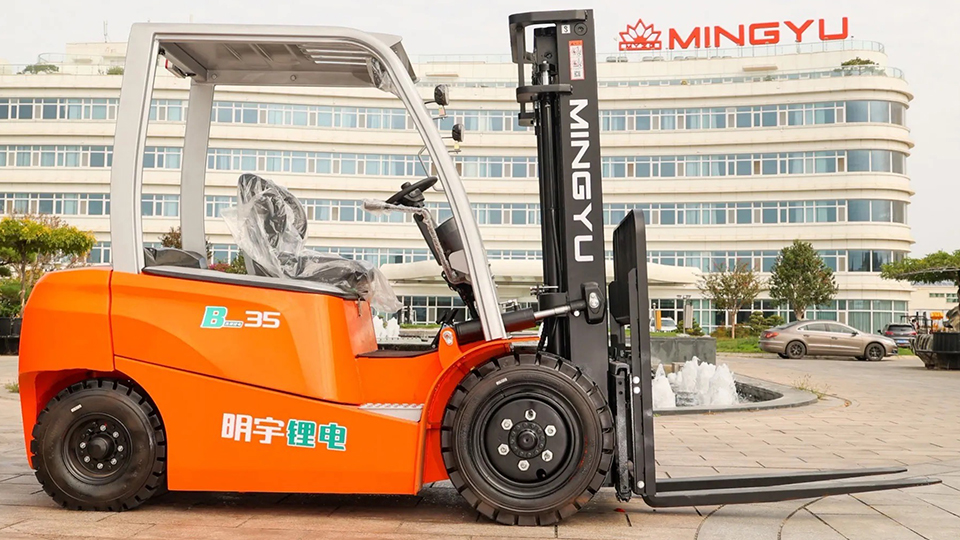
A critical technical advantage of the Lead-Acid battery in a counterbalanced forklift is its mass. These batteries are extremely heavy, often weighing between 800 kg and 1,800 kg (1,700–4,000 lbs). This weight is integral to the forklift's design, acting as the counterbalance necessary to prevent the machine from tipping when lifting heavy loads.8
3. Cycle Life and Depth of Discharge (DoD):
Lead-Acid batteries are sensitive to deep discharge. To maintain their lifespan, they should ideally not be discharged below 80% Depth of Discharge (20% State of Charge, or SoC). Routinely exceeding this limit dramatically reduces their cycle life, which typically ranges from 1,000 to 1,500 cycles under proper maintenance and use.9
B. Lithium-Ion Batteries (LiFePO4)
Lithium-ion batteries, particularly those employing Lithium Iron Phosphate (10$\text{LiFePO}_4$) chemistry, represent a modern, high-energy-density solution.11
1. Chemistry and Construction:
Li-ion batteries transfer lithium ions between the anode (usually carbon) and the cathode (12$\text{LiFePO}_4$) through a solid or gel-polymer electrolyte.13 They are sealed units, eliminating the need for watering or exposure to corrosive acid.14 Crucially, they contain a sophisticated Battery Management System (BMS).15
2. The Role of the BMS:
The BMS is the brain of the battery. It continuously monitors the voltage, temperature, and current of every cell, performing cell balancing and protecting the battery from over-charging, over-discharging, and overheating.16 This electronic management is the primary reason Li-ion batteries can tolerate 100% Depth of Discharge and maintain a significantly longer cycle life, typically 2,000 to 3,000 cycles, often lasting two to three times longer than Lead-Acid.17
3. Counterbalance Consideration:
Because Li-ion batteries have a much higher energy density and are lighter than their Lead-Acid counterparts, the forklift may require supplemental ballast or counterweights integrated into the chassis design to maintain the necessary stability and lifting capacity.18
II. Operational and Performance Metrics
The differences in battery chemistry translate directly into vastly different operational profiles.
A. Charging Characteristics and Downtime
|
Feature |
Lead-Acid Battery |
Lithium-Ion Battery |
|
Full Charge Time |
8 to 10 hours |
1 to 3 hours |
|
Cooling Time |
8 hours required after charging |
0 hours required |
|
Opportunity Charging |
Generally detrimental; reduces lifespan |
Highly beneficial; standard operating procedure |
|
Total Turnaround |
Approx. 16 hours (Charge + Cool) |
1 to 3 hours |
|
Efficiency (AC to DC) |
$\approx 70\% \text{ to } 80\%$ |
$\approx 90\% \text{ to } 98\%$ |
The 8/8/8 Rule: Traditional Lead-Acid batteries necessitate the "8 hours run, 8 hours charge, 8 hours cool" cycle.19 This mandates a battery swapping program for multi-shift operations, requiring one battery in the truck, one on charge, and one cooling, thus requiring three batteries per truck.
Opportunity Charging: Li-ion's ability to be plugged in during short breaks (coffee, lunch, loading downtime) without harming its lifespan is revolutionary.20 This eliminates battery swaps, the need for multiple batteries per truck, and virtually removes downtime, allowing for true 24/7 continuous operation with a single battery.21
B. Consistent Power Output (Voltage Drop)
Lead-Acid: The voltage output drops linearly as the battery discharges. This means that a forklift performs slower lift and travel speeds toward the end of a shift (at lower State of Charge), impacting productivity.22
Lithium-Ion: The BMS ensures the voltage remains extremely stable until the battery is nearly depleted. This provides consistent, peak performance (full lift speed, full traction speed) from the start of the shift until the end, leading to higher average productivity.23
C. Maintenance Requirements and Safety
|
Feature |
Lead-Acid Battery |
Lithium-Ion Battery |
|
Watering |
Weekly or bi-weekly topping up with distilled water |
None (Sealed unit) |
|
Equalization |
Weekly or monthly long overcharge to balance cells |
Automatic via BMS |
|
Gassing |
Releases explosive Hydrogen gas during charging |
None (Sealed unit) |
|
Charging Area |
Dedicated, well-ventilated, certified room with acid-wash stations |
No special requirements; can charge anywhere |
|
Spill Risk |
High risk of corrosive sulfuric acid spills |
None |
The elimination of watering, equalization, and dedicated, ventilated charging rooms for Li-ion translates to significant savings in labor costs, infrastructure investment (real estate), and greatly improved safety protocols.24
III. Economic Comparison: Total Cost of Ownership (TCO)
While the initial purchase price is a critical factor, the most meaningful metric for long-term fleet management is the Total Cost of Ownership (TCO).25
A. Initial Capital Expenditure (CapEx)
Lead-Acid batteries are significantly cheaper upfront.26
Lead-Acid: Typically 27$30\%$ to 28$40\%$ of the cost of a Li-ion equivalent.29
Lithium-Ion: High initial cost, often two to three times the price of Lead-Acid.30
B. Long-Term Operating Expenditure (OpEx)
The higher upfront cost of Li-ion is offset by substantial savings across multiple OpEx categories:31
1. Labor and Maintenance:
Lead-Acid: Requires dedicated labor for watering, cleaning terminals, acid spill cleanup, and battery swap management.32
Lithium-Ion: Near-zero maintenance labor.33 The only requirement is checking cables and connectors.
2. Energy Efficiency:
Lead-Acid: Low charging efficiency (energy lost as heat) and the necessity of overcharging during equalization means a higher electric bill per kWh stored.
Lithium-Ion: Superior charging efficiency (34$\approx 95\%$) means less electricity is pulled from the grid to achieve a full charge, resulting in up to 35$30\%$ lower energy consumption.36
3. Fleet Size and Real Estate:
Multi-Shift with Lead-Acid: Requires $3\times$ batteries per truck and a large, dedicated, and costly battery room.
Multi-Shift with Lithium-Ion: Requires 37$1\times$ battery per truck, zero battery room (charging can occur by the usage location), freeing up valuable warehouse space for product storage.38
4. Replacement Frequency and Lifespan:
A Li-ion battery, with its superior cycle life, can often outlast two or even three Lead-Acid batteries, particularly in aggressive multi-shift environments where Lead-Acid batteries are often discharged too deeply or improperly maintained.39 This reduces replacement costs over the forklift’s operational life.40
C. Return on Investment (ROI)
For most multi-shift, high-throughput operations, the ROI on a Li-ion conversion is typically achieved within 2 to 4 years. The gains come from:
Elimination of costly battery swaps and maintenance labor.41
Increased productivity due to consistent power and minimal downtime.42
Lower electricity costs due to high charging efficiency.43
IV. Niche Technologies: VRLA Variants (AGM and Gel)
While Lead-Acid and Lithium-Ion dominate, a subset of Valve-Regulated Lead-Acid (VRLA) batteries exists, primarily for smaller, lighter-duty electric equipment (like electric pallet jacks) or specific environmental applications.
A. Absorbed Glass Mat (AGM)
In AGM batteries, the electrolyte is absorbed into a fine fiberglass mat.44 They are sealed (non-spillable) and require no watering.45
Pros: Lower internal resistance than Gel, allowing for higher currents (good for high-power, short bursts); better performance in cold temperatures.
Cons: Less resilient to deep discharge than traditional flooded cells; shorter cycle life than Gel or Li-ion.
B. Gel Cell
Gel batteries use a silica-based gel to suspend the electrolyte.46 They are also sealed and maintenance-free.
Pros: Highly resilient to deep discharge and high temperatures; superior cycle life to AGM at lower discharge rates.
Cons: High internal resistance; cannot accept fast charging or high current draws, as this creates "pockets" in the gel, leading to premature failure (thermal runaway risk is high with fast charging).47
Suitability: VRLA batteries are generally not suitable for the heavy, deep-cycle demands of large, high-capacity industrial forklifts but serve well in niche, single-shift, light-duty applications where maintenance-free operation is prioritized over cycle life or high-speed charging.
V. The Decision Matrix: Choosing the Right Battery
The optimal battery choice is not a simple comparison of features but a calculation based on the specific operational profile of the facility. The key differentiators are the number of shifts and the required daily uptime.
A. Single-Shift Operation (8 hours/day)
|
Battery Choice |
Rationale |
|
Lead-Acid (Flooded) |
Most Suitable (Economical). Ample time (16 hours) for the 8-hour charge and 8-hour cool cycle. Low upfront CapEx. Maintenance is manageable and the lower cycle life is acceptable given the low usage rate. |
|
Lithium-Ion |
Acceptable, but the high CapEx is difficult to justify as the speed/efficiency benefits (opportunity charging) are largely unused. |
B. Two-Shift Operation (16 hours/day)
|
Battery Choice |
Rationale |
|
Lithium-Ion |
Most Suitable (Optimal TCO). Opportunity charging during shift changes and breaks eliminates the need for a battery swap program. Consistent power maintains productivity across both shifts. The TCO is significantly lower due to the elimination of a second battery and maintenance labor. |
|
Lead-Acid (Flooded) |
Feasible, but sub-optimal. Requires three batteries per truck and a robust, safety-compliant battery swapping station. Operational risks (improper swaps, missed watering) increase dramatically, leading to higher OpEx. |
C. Multi-Shift / 24/7 High-Throughput Operation
|
Battery Choice |
Rationale |
|
Lithium-Ion |
The Only Viable Solution. Lead-Acid cannot sustain continuous operation without a large fleet of swapped batteries and massive charging infrastructure. Li-ion's fast-charging capability and minimal maintenance are essential for maximizing uptime and achieving the lowest TCO. |
|
Lead-Acid (Flooded) |
Unsuitable. The high cost of the required $3\times$ battery fleet, dedicated labor, enormous battery room real estate, and guaranteed long-term damage from improper use make the TCO prohibitive. |
VI. Final Verdict and Forward-Looking Considerations
The choice between Lead-Acid and Lithium-Ion batteries for forklifts boils down to a fundamental business decision: Low CapEx vs. Low TCO.
For small, single-shift operations with limited budgets and existing infrastructure, the Lead-Acid battery remains a reliable, cost-effective choice, provided a commitment is made to strict maintenance protocols.48
For any medium to large operation running two or more shifts, or any operation prioritizing productivity, consistency, safety, and a cleaner operating environment, the Lithium-Ion battery is the unequivocally superior technology.49 Its higher initial investment is rapidly recouped through drastically reduced maintenance, labor, energy costs, and the massive productivity boost derived from zero downtime and consistent power output.50
As Li-ion prices continue to fall and energy density improves, the economic case for traditional Lead-Acid motive power will weaken further. The future of electric material handling is undoubtedly sealed, maintenance-free, and opportunity-charged.
Name: selena
Mobile:+86-13176910558
Tel:+86-0535-2090977
Whatsapp:8613181602336
Email:vip@mingyuforklift.com
Add:Xiaqiu Town, Laizhou, Yantai City, Shandong Province, China
