
vip@mingyuforklift.com
+86-0535-2090977

Understanding Diesel Consumption in 5-Ton Forklifts: A Technical Analysis
A 5-ton (or 10,000-pound) capacity diesel forklift is a workhorse in heavy industry, essential for moving large loads like shipping containers, concrete blocks, and heavy machinery components. Operators, fleet managers, and financial controllers are keenly interested in the question: "How much diesel does a 5-ton forklift use?"
The answer is complex, as it is influenced by physics, engine technology, hydraulic system efficiency, and most critically, the duty cycle—how the machine is actually used. While an average can be estimated, any single number is misleading without a detailed understanding of the contributing factors.
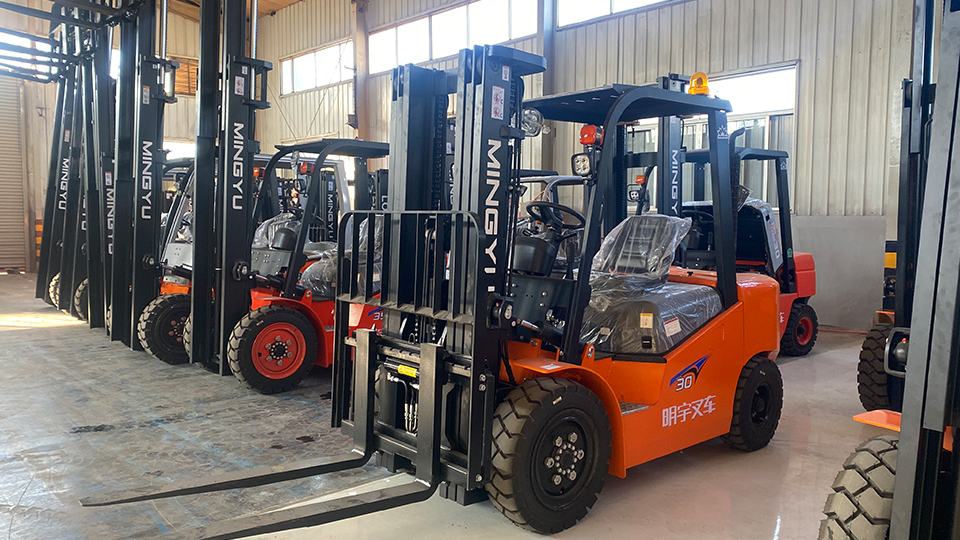
This analysis breaks down the technical and operational variables that govern fuel consumption, providing a framework for accurate estimation and efficiency management.
��️ I. The Physics of Consumption: Forces at Play
A forklift consumes diesel primarily to overcome two major forces: gravity (lifting) and rolling resistance (driving). The engine converts the chemical energy in the diesel fuel into mechanical work to combat these forces.2
A. Work Done During Lifting (Hydraulic System)
The heaviest component of fuel consumption is typically the hydraulic system, which performs the work of lifting the load.
1. Potential Energy and Work:
Lifting a 5-ton load ($m \approx 5,000 \text{ kg}$) to a height of 4 meters ($h$) requires a specific amount of work ($W$), which translates directly to fuel usage. The work done is equal to the change in potential energy ($\Delta E_p$).
$$W = \Delta E_p = m \cdot g \cdot h$$
Where 3$g$ is the acceleration due to gravity (4$9.81 \text{ m/s}^2$).5
Calculation Example (Ideal): Lifting a 5,000 kg load to 4 m requires $5,000 \text{ kg} \cdot 9.81 \text{ m/s}^2 \cdot 4 \text{ m} \approx 196,200 \text{ Joules (or } 196.2 \text{ kJ} \text{)}.$
2. Hydraulic Inefficiency:
In the real world, the hydraulic system is not 100% efficient.6 Energy is lost as heat due to fluid friction, component leakage, and pump inefficiency. Modern forklift hydraulic systems, which often use load-sensing (LS) technology, aim for efficiency values in the range of $75\% \text{ to } 85\%$. Older or poorly maintained systems can be much lower. The actual required work from the engine is $W_{engine} = W_{ideal} / \eta_{hyd}$.
3. Auxiliaries:
Tilting the mast, side-shifting, and using attachments also draw power from the hydraulic pump, adding to the consumption, even if the load is not being actively lifted.
B. Work Done During Driving (Traction System)
The energy needed for movement is less load-dependent than lifting but is significantly affected by distance, speed, and surface.
1. Rolling Resistance:
This is the force opposing motion, caused by the deformation of the tires and the surface. Rolling resistance is a function of the Total Vehicle Weight (TVW) (forklift base weight + load) and the Coefficient of Rolling Resistance ($C_{rr}$).
$$F_{rr} = C_{rr} \cdot TVW$$
A soft surface (gravel, dirt) has a high $C_{rr}$, demanding more fuel.
A smooth, flat concrete floor has a low $C_{rr}$, minimizing fuel use.
2. Aerodynamic Drag:
While less significant at typical low forklift speeds, air resistance becomes a factor when moving quickly over long distances, such as in large distribution centers.
3. Acceleration:
Changing the velocity of the machine (acceleration) requires a pulse of energy. A duty cycle involving frequent starting and stopping (shuttling) will consume significantly more fuel than one involving continuous, steady travel.
⚙️ II. Engine Technology and Efficiency
The design and maintenance of the diesel engine itself are paramount to fuel economy. Modern industrial engines must balance power, fuel efficiency, and emissions compliance (e.g., EU Stage V or EPA Tier 4 standards).
A. Engine Sizing and Turbocharging
A 5-ton forklift typically uses a rugged, high-torque industrial diesel engine, often in the 3.0 to 4.5-liter displacement range, producing anywhere from 50 to 80 kW (approx. 67 to 107 hp).
Optimal Engine Speed (RPM): Diesel engines achieve their best Brake Specific Fuel Consumption (BSFC), a measure of efficiency, near their peak torque output, not necessarily their peak horsepower. Modern engine control units (ECUs) are programmed to keep the engine in this efficient "sweet spot" as much as possible, especially during high-demand operations like heavy lifting.
Turbocharging: Almost all modern heavy-duty forklifts use turbochargers to compress intake air, allowing for more complete combustion and a higher power-to-displacement ratio, which is critical for fuel efficiency under load.
B. Fuel Injection Technology
The transition from older mechanical fuel pumps to modern Common Rail (CR) direct injection is the single largest factor in recent fuel economy gains.
Common Rail Systems: These systems use extremely high pressure (up to 7$2,500 \text{ bar}$) and electronic injectors to atomize the fuel with precision.8 The ECU can control the timing and number of injection events (pre-injection, main injection, post-injection) per power stroke, optimizing combustion for both power and efficiency across the entire operating range.9 This precision dramatically reduces wasted fuel.
C. Transmission Type
Most 5-ton forklifts use a robust powershift (hydrodynamic) transmission. While reliable and smooth, it inherently introduces some power loss (slip) compared to a purely mechanical transmission. Some high-end models may incorporate more efficient hydrostatic drives, which use a variable displacement pump and motor to transfer power, often leading to better fuel economy in dynamic, low-speed applications.
�� III. Estimating Actual Fuel Consumption (Duty Cycle)
The single most important variable determining fuel use is the duty cycle—the specific combination of lifting, driving, and idling over a given period.
A. Typical Consumption Range
Based on industry testing and operational data, a well-maintained 5-ton diesel forklift generally falls into the following consumption ranges:
|
Duty Cycle |
Description |
Estimated Consumption (Liters/Hour) |
Estimated Consumption (Gallons/Hour) |
|
Light |
Minimal lifting, long steady travel, frequent idling. E.g., loading/unloading flatbed trucks. |
$3.0 - 4.5 \text{ L/hr}$ |
$0.8 - 1.2 \text{ gal/hr}$ |
|
Medium |
Standard warehouse work, moderate travel, significant lifting and maneuvering. |
$4.5 - 6.5 \text{ L/hr}$ |
$1.2 - 1.7 \text{ gal/hr}$ |
|
Heavy |
Constant operation, maximum load capacity used repeatedly, long lifts, steep ramps, fast travel. E.g., port or lumber yard work. |
$6.5 - 9.0+ \text{ L/hr}$ |
$1.7 - 2.4+ \text{ gal/hr}$ |
Note: These are average consumption rates over an operating hour. Peak consumption during a full-throttle, maximum-weight lift will be significantly higher momentarily.
B. The Impact of Idling
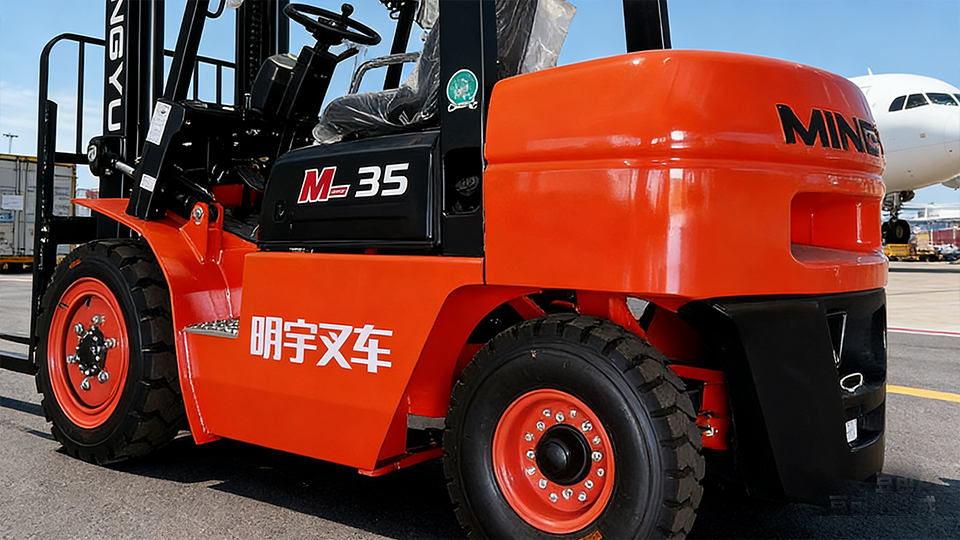
Idling—when the engine is running but no work is being performed—is pure waste.10 For a 5-ton unit, idling can consume between 1.0 and 2.0 L/hr. In many operational settings, idling accounts for 20% to 40% of the total engine runtime. Modern fleet management systems (telematics) allow managers to monitor and minimize excessive idling, which is one of the quickest ways to reduce fuel bills.11
C. Fuel Consumption per Ton-Move
A more meaningful metric for logistics managers is fuel consumed per unit of work, often measured in Liters per Ton Moved (L/Ton) or Liters per Load Cycle.
Hypothetical Scenario: A forklift completes 15 cycles (lift, transport, drop) per hour, handling 5-ton loads each time (75 tons total per hour), and consumes $6 \text{ L/hr}$.
Fuel Efficiency: $6 \text{ Liters} / 75 \text{ Tons} = 0.08 \text{ L/Ton}$ moved.
This metric allows for direct comparison between different equipment models or operator efficiency across shifts, normalizing the consumption data against the work performed.
���� IV. Operational and Maintenance Factors
Even with identical forklifts, two different operations can see a 20-30% variance in fuel use based on external and human factors.
A. Operator Technique
The operator is the most significant human variable. Aggressive driving and lifting techniques waste fuel by:
Over-revving: Unnecessarily pushing the accelerator (throttle) during non-lifting operations.
Rough Braking/Acceleration: Frequent, harsh changes in speed demand high power peaks.
"Riding" the Hydraulics: Holding hydraulic controls (like tilt or lift) against their stops, which causes the pump to continuously circulate pressurized fluid, generating heat and wasting engine power.
Eco-mode settings, available on many new forklifts, electronically limit the maximum engine RPM and hydraulic flow to encourage smoother, more efficient operation without significantly sacrificing work output.12
B. Environmental Conditions
Temperature: Diesel engines perform better in cooler air (denser air means more oxygen for combustion).13 Extreme cold requires more power for starting and can lead to increased idling to maintain engine and hydraulic oil temperature.
Surface Condition: As noted earlier, a rough, potholed, or soft (unpaved) surface significantly increases rolling resistance and, thus, fuel consumption.
Ramps and Grades: Driving up a ramp is a high-power, high-consumption event. A 5-ton forklift climbing a $10\%$ grade will see consumption spike dramatically compared to driving on a level surface.
C. Maintenance and Wear
Poor maintenance directly translates to reduced efficiency and higher fuel bills.
|
Component |
Maintenance Impact on Fuel Efficiency |
|
Air Filters |
Clogged filters restrict air intake, leading to a fuel-rich mixture and incomplete combustion. |
|
Fuel Injectors |
Dirty or worn injectors result in poor spray patterns, leading to sub-optimal combustion and misfiring/smoking. |
|
Tire Pressure |
Under-inflated tires increase the Coefficient of Rolling Resistance ($C_{rr}$), dramatically increasing the power needed for driving. |
|
Hydraulic System |
Internal leakage in the pump or control valves means the engine must work harder and longer to achieve the desired lift/tilt, wasting energy as heat. |
�� V. Conclusion: Achieving Optimal Fuel Efficiency
While the average 5-ton diesel forklift is likely consuming 5 to 7 Liters per operating hour in a typical medium-duty application, relying on this single figure is insufficient for proper cost management. The technical conclusion is that fuel consumption is a dynamic variable governed by the work performed.
For fleet managers seeking to optimize efficiency, a successful strategy involves a combination of engineering and operational discipline:
Invest in Modern Technology: Prioritize forklifts with Common Rail diesel engines, Load-Sensing Hydraulics, and Eco-Mode settings.
Implement Telematics: Use data logging to monitor Idling Percentage, Fuel Efficiency (L/Ton), and Hard Braking/Acceleration Events.
Strict Maintenance Schedule: Ensure all filters, tires, and hydraulic systems are maintained to manufacturer specifications to minimize energy losses due to mechanical inefficiency.14
Operator Training: Train operators on fuel-saving techniques, emphasizing smooth movements, minimizing over-revving, and immediately shutting down the engine during prolonged idle periods.15
By understanding the forces of gravity and rolling resistance, the efficiency of the engine and hydraulic components, and the variability of the duty cycle, businesses can move beyond a simple estimation and take proactive steps to reduce the operating costs of their heavy-duty forklift fleet.
Name: selena
Mobile:+86-13176910558
Tel:+86-0535-2090977
Whatsapp:8613181602336
Email:vip@mingyuforklift.com
Add:Xiaqiu Town, Laizhou, Yantai City, Shandong Province, China
