
vip@mingyuforklift.com
+86-0535-2090977

Published: November 5, 2026
HTML Meta Description: Plan remote-control forklift use in wind-farm service yards with a verified radio boundary, load chart, exclusion zone and recovery procedure.
Keywords: remote-control rough-terrain forklift, wind farm service yard, warehouse AI decision support, remote forklift radio test, turbine maintenance logistics, outdoor component staging, line-of-sight forklift control, forklift exclusion zone, ZGFORKLIFT, MYZG
Warehousing discussions increasingly connect AI-supported decisions with practical work execution. In a wind-farm service yard, digital work orders may help teams prepare turbine spares, tooling and maintenance kits, while a remote-control rough-terrain forklift may be considered for a defined outdoor transfer where the operator can maintain visibility and the site has approved the control method. These are separate controls: software does not make a machine autonomous, and remote operation does not authorize access into a turbine, electrical enclosure or restricted work zone.
Start with a documented task and route survey. Record the narrowest aisle and turn, doorway and gate width, overhead clearance, maximum gradient, dock edges and the worst surface condition. Measure real loads at their actual load centers, including long, offset or irregular items. Nameplate capacity is only a starting point; residual capacity at the required height and with the selected attachment determines practical application fit.
Gartner's September 2026 discussion of AI trends in warehousing highlights decision support and more adaptive operating processes. The useful lesson for field logistics is to make information actionable without confusing an AI recommendation with a safety approval. A work order can identify the required part and destination; the operator and site lead still verify the load, route, weather, permit and exclusion zone before movement. Keep a human decision-maker responsible for an interrupted or uncertain task. The Gartner analysis is available at AI trends transforming warehousing.
Review the DY26-3T rough-terrain forklift as the first product reference, then confirm current specifications with the manufacturer.
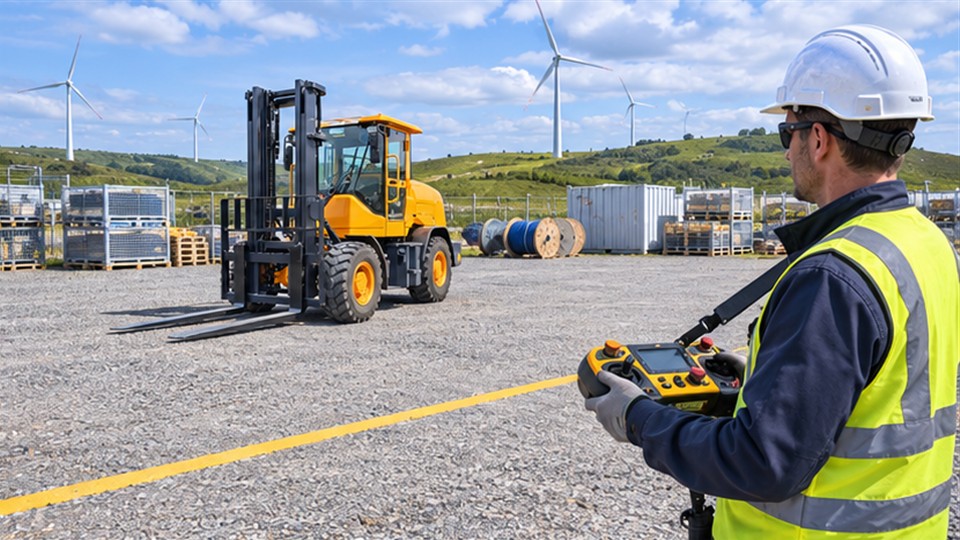
Develop a yard map showing the service gate, unloading point, turbine-spare racks, kit assembly area, pedestrian walkways and emergency access. For each lift, note the mass, dimensions, lifting points, fork spacing, centre of gravity, attachment and required height. Review capacity at the actual load centre. Test the radio link in the proposed work area for line-of-sight, shadowing, reflections and interference. Define permitted control positions, control handover, emergency stop, loss-of-signal response and a recovery method if the truck becomes immobilized. Confirm that the machine configuration and remote kit are approved by the manufacturer for the stated duty.
Visibility and control deserve the same attention as capacity. Review the mast, carriage, tyres or wheels, lighting, mirrors or cameras, restraint, warning devices and speed management as one system. Dust, cold, heat, moisture and corrosion may require extra protection and shorter inspection intervals. Operators must see the travel path and place the load without leaving the protected operating position.
Compare the 7T off-road forklift for a second view of capacity, manoeuvrability, energy and service access.
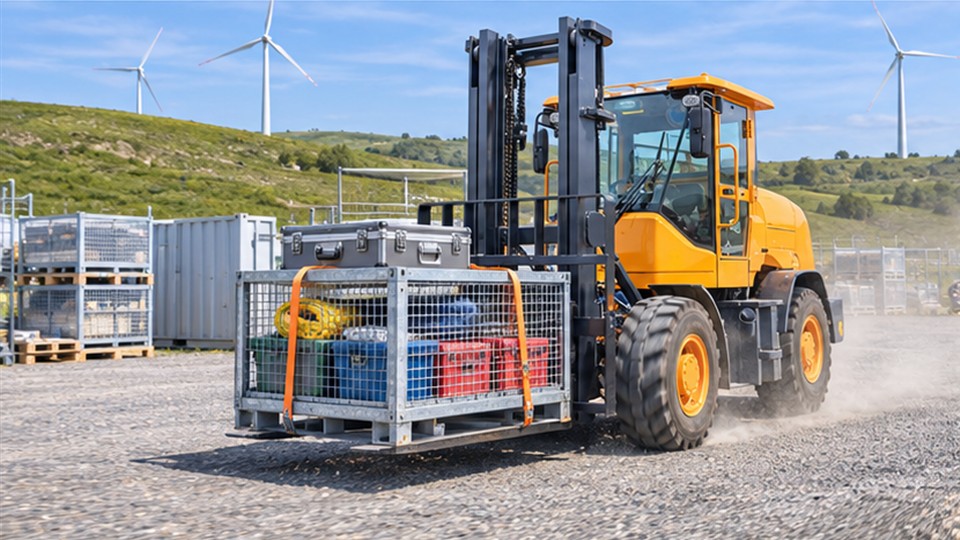
Create a physical exclusion zone and appoint a spotter wherever people, service vehicles or contractors may cross the operating path. The remote operator must keep the load and travel route in view; remote control is not a reason to operate behind a building or beyond an approved line of sight. Lower forks before travel, keep clear of suspended or unstable components, and stop when wind, rain, darkness or dust affects control. Demonstrate emergency stop and safe-state behavior in an empty area before each shift. Wind-turbine work permits, electrical isolation, lifting plans and rescue arrangements remain mandatory and take precedence over a delivery schedule.
Create a written operating envelope for every approved route: maximum load and lift height, travel direction, pedestrian exclusion points, slope rules and stop-work conditions. Complete a pre-shift inspection of tyres or wheels, forks, chains, hoses, brakes, steering, alarms and the energy or fuel system. Isolate defects affecting stability, braking or visibility until corrected.
Supervisors should observe real work, record near misses, harsh braking, overload attempts, impacts and recurring service issues, then improve layout, traffic separation and coaching. Build the business case around productive hours rather than purchase price alone. Include operator time, maintenance, energy or fuel, infrastructure, transport, downtime risk and resale value.
The CPC30SY rough-terrain forklift is the third internal product reference for application comparison.
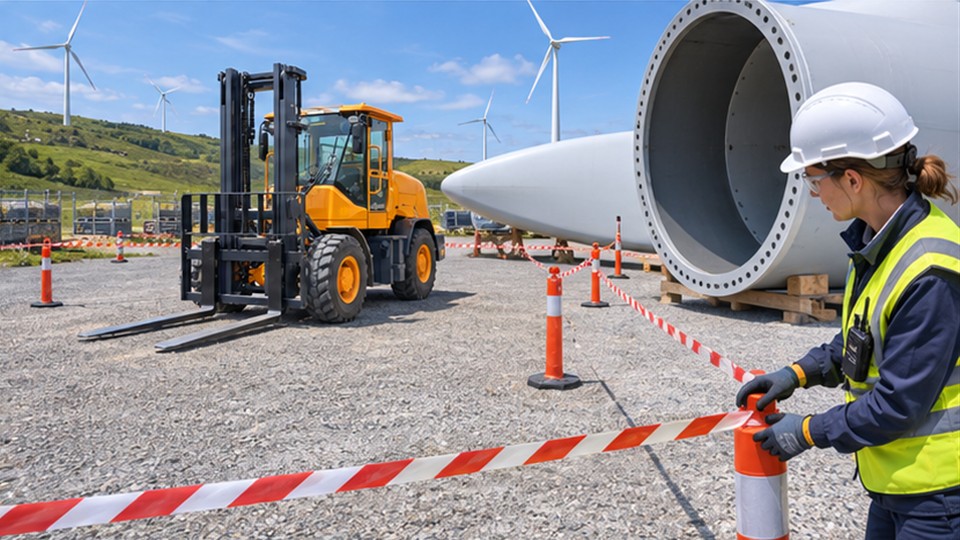
Measure safe completed transfers, setup time, radio checks, waiting for permits, component damage, near misses, battery or fuel use and recovery events. Include operator training, spare control devices, inspection, communication coordination and service access. Compare remote operation only against the same defined task performed with another approved method. A limited trial should have a named supervisor, a stop-work rule and a written acceptance record. If the main delay comes from missing parts, crane availability or weather windows, the forklift control system cannot remove that dependency.
A staged trial is the strongest way to validate a configuration. Select a representative route, define success measures, brief operators and compare throughput, energy use, handling accuracy and maintenance observations. Review results with operations, safety and finance before fleet-wide deployment. This evidence turns a current industry headline into a defensible material-handling plan.
ZGFORKLIFT and MYZG can tailor the final specification after reviewing the application. Product availability varies by market; confirm the latest technical data and comply with local regulations before purchase or operation.
Contact Shandong Zhuogong Machinery equipment Co.,Ltd. Email: vip@mingyuforklift.com. Tel: +86-0535-2090977. WhatsApp: +86 131 8160 2336. Address: Xiaqiu Town, Laizhou, Yantai City, Shandong Province, China.
Send the maximum load, load-center distance, aisle width, gradient, surface condition, daily duty hours and climate so MYZG engineers can recommend a practical configuration instead of a generic catalogue answer.
Name: selena
Mobile:+86-13176910558
Tel:+86-0535-2090977
Whatsapp:8613181602336
Email:vip@mingyuforklift.com
Add:Xiaqiu Town, Laizhou, Yantai City, Shandong Province, China