
vip@mingyuforklift.com
+86-0535-2090977

Introduction
In the material handling and aerial access industries, terminology often creates dangerous operational confusion. The phrase "cherry picker forklift" is frequently used colloquially to describe equipment that bears little resemblance to the counterbalance forklifts most operators are trained to operate. This semantic imprecision is not merely a linguistic inconvenience—it carries significant safety, regulatory, and operational implications. Under OSHA's powered industrial truck classifications, a standard counterbalance forklift (Class I, IV, or V) and a cherry picker—whether interpreted as an order picker (Class II) or an aerial work platform—represent fundamentally different equipment categories with distinct training requirements, stability characteristics, and hazard profiles.
This technical analysis examines the complete dimensional, operational, regulatory, and functional differences between cherry pickers and standard forklifts. By dissecting design architecture, OSHA classification systems, operational envelopes, and certification requirements, this guide enables safety managers, procurement specialists, and operators to make equipment selections that align with actual task requirements rather than colloquial mischaracterizations.
Defining the Equipment: Classification and Taxonomy
Standard Forklifts: The Counterbalance Architecture
When industry professionals refer to a "standard forklift," they typically mean a counterbalance lift truck—the most ubiquitous powered industrial truck in warehouses, manufacturing facilities, and loading docks. These machines operate on a fundamental mechanical principle: a rear-mounted counterweight balances the forward moment created by the load on the forks, enabling lifting without forward tipping.
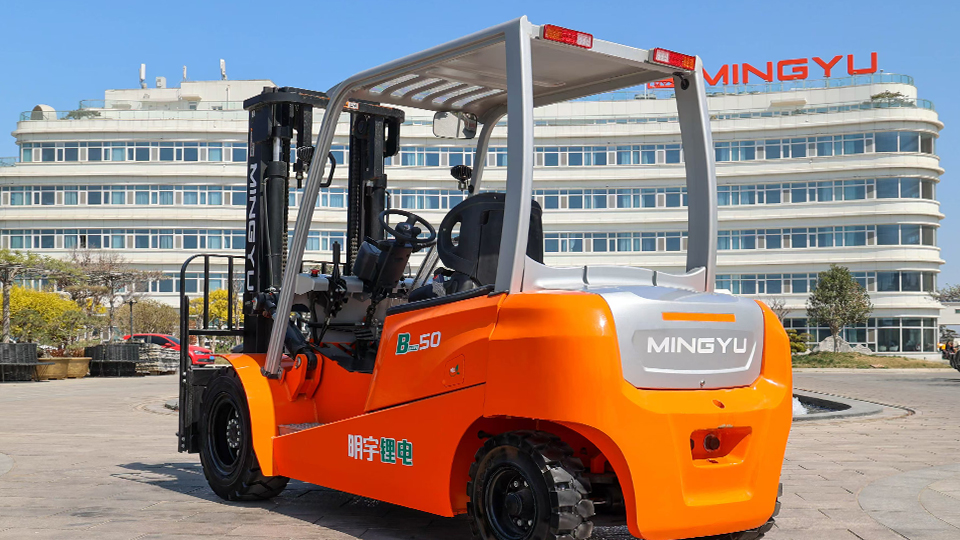
Standard forklifts fall primarily into OSHA Classes I, IV, and V. Class I encompasses electric motor rider trucks, including sit-down and stand-up counterbalance configurations, representing approximately two-thirds of all new forklift purchases globally. Class IV covers internal combustion engine trucks with cushion (solid) tires, optimized for indoor smooth surfaces and low-clearance environments. Class V comprises internal combustion trucks with pneumatic tires, designed for outdoor applications on uneven or unpaved terrain.
The defining characteristic of standard forklifts is load manipulation at ground or low-elevation levels. While mast configurations vary—two-stage, three-stage, or quad-stage masts enable lift heights from 10 to 25 feet—the primary function remains horizontal transport and vertical stacking of palletized or unitized loads. The operator remains seated or standing at ground level throughout operation, with the load elevated but the operator position fixed.
Cherry Pickers: Dual Interpretations and Technical Ambiguity
The term "cherry picker" creates technical confusion because it references two distinct equipment categories that share only the characteristic of elevating personnel.
Order Pickers (Class II Narrow Aisle Trucks). In warehouse and logistics contexts, "cherry picker" often refers to order picker forklifts classified under OSHA Class II as electric motor narrow aisle trucks. These machines feature an operator platform that elevates alongside the forks, enabling personnel to access individual items at height rather than moving entire pallet loads. The operator rides the platform upward, manually selecting cases or pieces from rack locations while the machine remains stationary or moves slowly under power.
Order pickers operate in very narrow aisles (VNA) often measuring 5 to 6 feet wide, maximizing warehouse storage density. They typically reach heights of 20 to 35 feet, with specialized wire guidance or rail guidance systems enabling precise aisle navigation without manual steering. The Raymond 5500 and 5600 series exemplify this category, featuring wraparound operator compartments, variable lift speeds, and optional IntelliSpeed systems that coordinate travel speed with platform height.
Aerial Work Platforms (AWPs). In construction, utilities, and outdoor maintenance contexts, "cherry picker" refers to vehicle-mounted aerial lifts—technically boom lifts or bucket trucks mounted on truck chassis. These units elevate personnel in a work platform or bucket attached to a telescopic or articulating boom, providing access to overhead infrastructure, building facades, or vegetation. Working heights range from 20 feet for compact van-mounted units to over 60 feet for large truck-mounted configurations.
This equipment category falls outside OSHA's standard forklift classifications and is instead governed by separate aerial lift standards. The critical distinction is that these machines are designed exclusively for personnel elevation and work positioning, not for material handling or load transport. While some configurations incorporate limited lifting capacity, their primary function is providing safe access to elevated work areas.
Design Architecture: Structural and Mechanical Divergence
Chassis and Stability Systems
Standard forklifts employ a rear-counterweight design that creates a fixed center of gravity relationship between the machine and its load. The stability triangle—an imaginary triangle connecting the front drive tires and the rear steer axle pivot point—defines the safe operating envelope. Load moment (load weight multiplied by horizontal distance from front axle) must remain within the counterweight moment to prevent forward tipping. This architecture is optimized for load transport and stacking, with stability calculations based on rated capacity at specified load centers and lift heights.
Cherry picker order pickers utilize a fundamentally different stability approach. Because the operator platform elevates alongside the load, the combined center of gravity shifts dynamically as the operator moves on the platform and as the platform rises. These machines incorporate active stability monitoring systems, outrigger or mast-based stabilization, and weight sensors that restrict operation if load distribution exceeds safe parameters. The Raymond 5500 series, for example, employs patented suspension systems and smooth mast staging to isolate vibrations and maintain platform stability during elevation changes.
Vehicle-mounted cherry pickers (aerial work platforms) rely on outrigger deployment and hydraulic leveling systems for stability. The truck chassis provides the base, but the working platform's stability depends entirely on outrigger footprint extension and ground bearing pressure calculations. Unlike forklifts, which operate while moving with loads, aerial lifts require stationary setup with outriggers fully deployed before boom elevation—creating a critical operational protocol divergence.
Mast and Elevation Mechanisms
Standard forklift masts are vertical lifting structures comprising nested rail sections that extend telescopically. The carriage and forks travel along these rails, with lift chains or hydraulic cylinders providing vertical force. Mast design focuses on load elevation speed, free lift (height achievable before mast extension begins), and overall collapsed height for facility clearance. Tilt functions (forward and backward) enable load leveling and deposit but do not provide horizontal outreach.
Order picker masts similarly employ vertical rail systems, but with the critical addition of an integrated operator platform that travels with the forks. The platform includes controls, guardrails, and safety harness attachment points, transforming the machine from a load handler into a personnel elevator. Mast staging—the sequential extension of nested sections—must be precisely controlled to prevent platform jerking that could destabilize the operator.
Aerial work platform cherry pickers utilize boom mechanisms rather than masts. Telescopic booms extend linearly through nested sections, while articulating booms incorporate jointed segments enabling up-and-over reach capabilities. This boom architecture provides horizontal outreach—positioning the platform at distance from the machine base—which no forklift mast can achieve. Outreach capability is the defining performance metric for aerial lifts, often more operationally significant than maximum vertical height.
Propulsion and Mobility
Standard forklifts are designed for facility-internal mobility. Electric models (Class I) operate on smooth, prepared surfaces with turning radii optimized for aisle navigation. Internal combustion models (Classes IV and V) achieve higher travel speeds and outdoor capability but remain fundamentally material transport vehicles. Steering is rear-wheel, enabling tight turns in confined spaces but creating tail swing hazards that operators must manage.
Order pickers prioritize precise low-speed maneuverability over travel speed. Wire guidance systems—electromagnetic or mechanical—enable hands-free aisle navigation, while variable speed controls allow precise positioning at pick locations. Travel speed is typically restricted when the platform is elevated, with automatic limiting systems preventing high-speed operation at height.
Vehicle-mounted cherry pickers are road-legal vehicles designed for rapid deployment across multiple job sites. They travel at highway speeds between locations, then deploy outriggers and elevate the boom upon arrival. This road mobility is their defining operational advantage over self-propelled boom lifts, which require trailer transport between sites. However, once deployed, their on-site repositioning is constrained by outrigger setup requirements, unlike forklifts which operate continuously mobile.
Operational Envelopes: Function, Task, and Environment
Load Handling vs. Personnel Access
The fundamental functional divergence between standard forklifts and cherry pickers is the distinction between load manipulation and personnel elevation. Standard forklifts are engineered to lift, transport, and stack materials. The operator controls the machine from a fixed position; the load moves vertically and horizontally. Safety systems protect the operator from load-related hazards (falling objects, tip-over) but do not address fall protection for the operator because the operator remains at ground level.
Cherry picker order pickers invert this relationship: the operator becomes the elevated element, accessing inventory at height while the machine provides controlled elevation and limited horizontal positioning. Fall protection—guardrails, harness attachment points, and platform gates—becomes a primary design consideration. The "load" is the operator and selected items, with weight capacity significantly lower than standard forklifts (typically 200 to 500 pounds for operator plus picked items, versus 3,000 to 5,000+ pounds for standard forklifts).
Vehicle-mounted aerial lifts eliminate load handling entirely, focusing exclusively on personnel positioning. Platform capacities range from 200 to 1,000 pounds depending on configuration, sufficient for one or two workers plus tools. The operational task is work execution—maintenance, inspection, installation—rather than material transport.
Vertical Reach and Horizontal Outreach
Standard forklifts achieve vertical lift through mast extension, with maximum heights typically ranging from 15 to 25 feet for standard configurations and up to 40+ feet for high-lift models. However, all lift is vertical; horizontal positioning is achieved by driving the machine, not by extending the load beyond the chassis footprint. The load remains directly above or slightly forward of the front axle throughout operation.
Order pickers achieve similar vertical ranges but with the critical difference that the operator accesses the elevated zone directly. Maximum platform heights of 25 to 35 feet enable piece-picking from upper rack levels that standard forklifts can reach only with pallet loads. The horizontal envelope is constrained by the machine's position within the aisle; the operator cannot outreach beyond the aisle width.
Aerial work platform cherry pickers combine substantial vertical reach with significant horizontal outreach. Telescopic booms can position platforms 40+ feet vertically and 30+ feet horizontally from the machine base, enabling access over obstacles, across voids, or into recessed areas. This outreach capability is entirely absent from forklift design and represents the aerial lift's core operational value.
Operating Environment and Surface Requirements
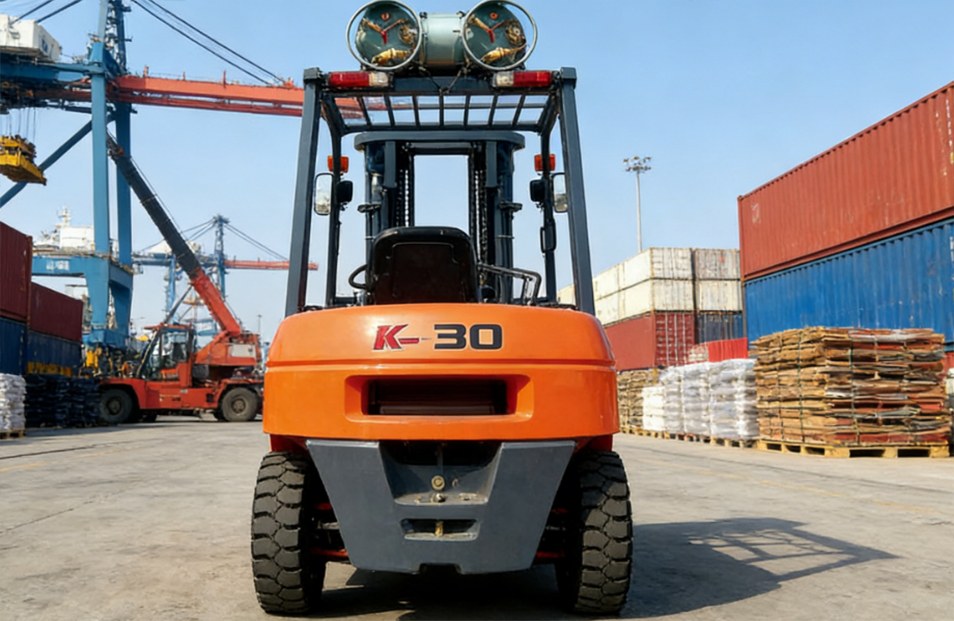
Standard forklifts require prepared, level surfaces appropriate to their tire configuration. Cushion tire models (Class IV) are restricted to smooth concrete or asphalt; pneumatic tire models (Class V) accommodate gravel, dirt, and moderate unevenness but cannot operate on steep grades or soft ground. Facility design—including aisle width, overhead clearance, dock height, and turning radius—must accommodate the specific forklift class deployed.
Order pickers operate in engineered very narrow aisle environments with precisely dimensioned racking systems, guidance rails or wires, and floor surfaces designed for consistent traction. Their operational environment is among the most controlled in material handling, with minimal tolerance for surface irregularities that could disrupt guidance systems or platform stability.
Vehicle-mounted cherry pickers require road access to job sites and firm, level surfaces for outrigger deployment. While the truck chassis navigates standard roads, the working platform demands stable ground capable of supporting outrigger loads without settlement or tipping. Unlike rough terrain forklifts (Class VII) that operate on unprepared surfaces, aerial lifts cannot compensate for significant ground instability through traction or maneuverability.
OSHA Classification and Regulatory Divergence
Powered Industrial Truck vs. Aerial Lift Standards
Standard forklifts and order picker cherry pickers fall under OSHA 29 CFR 1910.178, the Powered Industrial Trucks standard. This regulation mandates formal instruction, practical training, and performance evaluation for all seven equipment classes. Operators must be trained on the specific class they will operate; Class I certification does not authorize Class II operation. The standard addresses stability, load capacity, pre-operation inspection, and safe operating practices specific to load-handling equipment.
Vehicle-mounted aerial lifts are governed by separate regulatory frameworks. OSHA 29 CFR 1910.67 addresses vehicle-mounted elevating and rotating work platforms, while 1926.453 covers aerial lifts in construction. ANSI A92.2 and A92.3 standards provide equipment-specific safety requirements. These regulations address boom integrity, platform guardrail requirements, fall protection, electrical clearance (minimum approach distances to energized lines), and wind speed limitations—hazards largely absent from forklift operations.
Training and Certification Requirements
OSHA requires that forklift operators, including order picker operators, receive training specific to the truck type and workplace conditions. Training must cover truck-related topics (operating instructions, warnings, controls, instrumentation, engine operation, steering, maneuvering, visibility, fork adaptation, capacity, stability, inspection, maintenance, refueling/charging) and workplace-related topics (surface conditions, load composition, load handling, pedestrian traffic, narrow aisles, hazardous locations, ramps, closed environments).
Aerial lift operators require distinct training addressing boom dynamics, platform positioning, outrigger deployment, wind effects, electrical hazards, and fall protection systems. While some competencies overlap (pre-operation inspection, basic hydraulic principles), the hazard profiles diverge sufficiently that cross-training is not automatically valid. An operator certified on standard forklifts cannot legally operate aerial lifts without supplemental, equipment-specific training.
The 2026 regulatory environment intensifies these distinctions. OSHA's National Emphasis Programs targeting warehousing and construction elevate inspection scrutiny of training documentation. Employers must maintain records demonstrating that each operator's certification aligns precisely with the equipment operated. A "forklift license" that does not specify Class II order picker authorization will not satisfy compliance requirements for cherry picker operation in warehouse contexts, nor will it cover aerial lift operation under construction standards.
Safety Systems and Hazard Profiles
Tip-Over Dynamics
Standard forklifts tip forward when load moment exceeds counterweight moment, or sideways when cornering speed creates centrifugal force exceeding lateral stability limits. Safety systems include load moment indicators, speed restrictors, and stability triangles marked on the machine. Operator training emphasizes load center awareness, grade operation protocols, and speed management during turns.
Order pickers introduce elevated center-of-gravity dynamics that standard forklifts do not experience. As the operator platform rises, the combined machine-plus-operator center of gravity shifts upward, reducing resistance to tipping from platform movement, sudden stops, or uneven floor surfaces. Active stability systems monitor platform load and position, restricting operation if parameters exceed safe thresholds. Operator training must address platform movement protocols, harness use, and weight distribution on the platform.
Aerial lifts face tip-over hazards from outrigger failure, ground subsidence under outriggers, boom over-extension beyond stability limits, or operation on excessive grades. Wind loading on the elevated platform creates additional overturning moments that forklifts do not encounter. Boom lift standards mandate wind speed monitoring and operation cessation thresholds typically between 25 and 35 mph depending on platform size and boom configuration.
Fall Protection
Fall protection is not a primary design consideration for standard forklifts because the operator remains at ground level. Overhead guards protect against falling objects, but the operator is not exposed to fall from height. Order pickers and aerial lifts, by contrast, incorporate comprehensive fall protection as a core safety system. Guardrails, mid-rails, toe boards, and designated harness attachment points are mandatory. Operator training must cover proper harness donning, attachment protocols, and emergency descent procedures.
Electrocution Hazards
Standard forklifts operate primarily indoors or in controlled yards with minimal electrical exposure. Aerial lifts, however, frequently position workers near overhead power lines, creating electrocution hazards from boom contact or electrical arcing. Minimum approach distances—10 feet for lines up to 50kV, greater for higher voltages—are legally mandated and must be incorporated into site-specific training. Insulated booms provide additional protection for electrical utility work, representing a specialized configuration absent from forklift design.
Application Suitability: Selection Criteria
When Standard Forklifts Are Appropriate
Standard forklifts excel at unitized load transport, pallet stacking, loading dock operations, and bulk material movement. When the task requires moving entire pallet loads between locations, depositing loads at height in rack or staging areas, or handling heavy, bulky items, counterbalance forklifts are the technically correct selection. Their capacity, speed, and load stability are optimized for these tasks.
When Order Picker Cherry Pickers Are Appropriate
Order pickers are the correct choice for piece-picking, case-picking, and e-commerce fulfillment operations where individual items must be selected from rack locations rather than moving full pallets. Very narrow aisle configurations maximize storage density, while the elevated operator platform enables direct access to inventory without requiring separate ladders or scaffolding. Operations with high SKU diversity, low pick quantities per SKU, and rapid order turnaround benefit from order picker deployment.
When Aerial Work Platform Cherry Pickers Are Appropriate
Vehicle-mounted aerial lifts are indicated when work requires personnel access to elevated areas that cannot be reached from ground-based equipment, and when the work locations are distributed across multiple road-accessible sites. Utility maintenance, building facade work, tree trimming, signage installation, and bridge inspection exemplify appropriate applications. The road mobility enables rapid deployment between dispersed locations without trailer transport logistics.
Conclusion
The colloquial conflation of "cherry picker" with "forklift" obscures fundamental technical distinctions that have direct operational, safety, and regulatory consequences. Standard counterbalance forklifts, order picker narrow aisle trucks, and vehicle-mounted aerial work platforms represent three distinct equipment categories with divergent design architectures, operational envelopes, hazard profiles, and certification requirements.
Standard forklifts manipulate loads from a ground-level operator position, utilizing counterweight stability and vertical mast elevation. Order picker cherry pickers elevate the operator alongside limited loads in controlled warehouse environments, requiring narrow aisle navigation and fall protection systems. Vehicle-mounted aerial lifts position personnel at height with substantial horizontal outreach, demanding outrigger stabilization, electrical hazard management, and wind monitoring.
Under OSHA's 2026 enforcement framework, these distinctions are not academic—they are compliance mandates. Operators must hold class-specific certification aligned with the exact equipment operated. Employers must provide training addressing the specific hazards of each machine type. Procurement decisions must select equipment matched to actual task requirements rather than colloquial terminology.
The technically precise approach demands abandonment of the generic "cherry picker forklift" designation in favor of equipment-specific classification: counterbalance forklift, order picker, or aerial work platform. This precision ensures that training, certification, safety protocols, and operational planning align with the actual capabilities and hazards of the equipment deployed, reducing incident risk and regulatory exposure in an increasingly scrutinized enforcement environment.
Name: selena
Mobile:+86-13176910558
Tel:+86-0535-2090977
Whatsapp:8613181602336
Email:vip@mingyuforklift.com
Add:Xiaqiu Town, Laizhou, Yantai City, Shandong Province, China