
vip@mingyuforklift.com
+86-0535-2090977

Introduction
Forklift maintenance is not a discretionary activity—it is a regulatory obligation, a safety imperative, and a financial discipline. Under OSHA 29 CFR 1910.178(q)(7), every powered industrial truck must be inspected before each shift, and any unit found unsafe must be removed from service immediately. Violations carry penalties of up to $16,131 per serious violation and $161,323 for willful violations, with each uninspected forklift and each missed shift constituting a separate citation.
Beyond compliance, systematic maintenance is the primary determinant of equipment lifespan, operating cost, and workplace safety. A forklift that receives disciplined daily care and scheduled maintenance can operate 15,000–20,000 hours before major overhaul. A neglected unit may require catastrophic repairs within 5,000 hours. This article provides a comprehensive technical framework for daily maintenance protocols, scheduled service intervals, and systematic troubleshooting across internal combustion and electric forklift platforms.
The Regulatory Foundation: OSHA Pre-Shift Inspection Requirements
OSHA splits the inspection process into two phases: visual inspection (engine off) and operational inspection (engine running). The pre-shift inspection must be completed by the operator before the first lift of each shift, documented in writing or digitally, and reviewed for open defects from previous shifts.
Visual Inspection Protocol (Engine Off)
The visual inspection covers six critical areas with 30 discrete checkpoints:
Documentation and Capacity Verification: Verify that the data plate is present, legible, and permanently attached, showing rated capacity, weight, and any attachment derating. Confirm operator certification is current. Review previous shift defects and verify they have been resolved before operation.
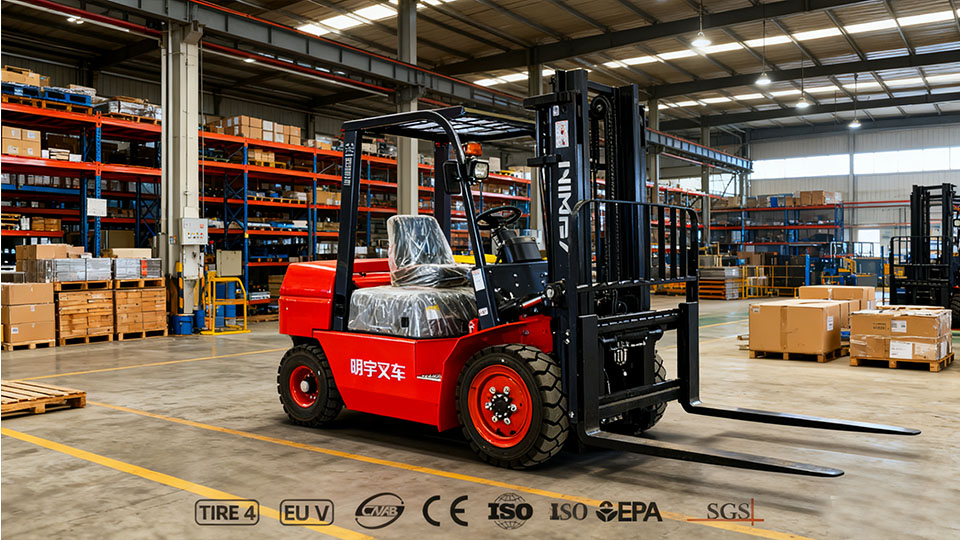
Power System Inspection: For internal combustion forklifts, check engine oil, coolant, and fuel levels, verifying no leaks under the truck. For electric forklifts, confirm battery charge level is sufficient for the shift—electrolyte levels checked for lead-acid batteries, BMS fault codes verified for lithium-ion systems. Inspect hydraulic fluid level and confirm no leaks at cylinders, hoses, or fittings.
Mast, Forks, and Attachments: Examine fork blades for cracks, bends, or notches. Blade thickness at the heel must not be reduced by more than 10% of original specification. Verify fork angle deviation does not exceed 3 degrees from the original 90-degree configuration. Check fork positioning locks and retaining clips. Inspect mast chains for equal tension, lubrication, and absence of stretched, twisted, or cracked links. Examine mast channels for cracks or deformation.
Tires and Wheels: Evaluate drive and steer tires for chunking, cuts, cord exposure, or separation. Verify pneumatic tire pressure and cushion tire integrity. Check wheel fasteners for presence and torque, observing for corrosion that indicates loosening.
Safety Mechanisms: Confirm overhead guard and load backrest are structurally sound with no cracks or modifications. Verify seatbelt retracts, buckles, and secures properly. Check that operator manual is present on board. Inspect finger guards, latches, and all safety labels.
Frame and Structure: Walk around the unit inspecting the frame for cracks, particularly at mast mounting points, axle attachments, and counterweight brackets. Check for corrosion that has penetrated wall thickness. Verify that no unauthorized modifications have been made to the chassis or safety systems.
Operational Inspection Protocol (Engine Running)
After completing the visual inspection, start the engine and perform operational verification:
Brake Systems: Test service brake pedal for firm, consistent feel without sponginess or excessive travel. The truck must decelerate evenly without pulling to either side. Engage the parking brake and verify it holds the unit stationary on both flat surfaces and rated operating grades.
Steering and Controls: Verify steering is responsive without excessive free play, pulling, or stiffness. Listen for hydraulic noise from the steering cylinder that indicates low fluid or aeration. Test all operator controls—drive, inch, tilt, hoist, lowering, and attachment controls—for smooth, proportional response.
Hydraulic Function: Operate the mast through full lift and lower range, observing for smooth, consistent motion without jerking or hesitation. Test tilt forward and backward through full range. Verify the mast holds position when controls are released (drift test). Listen for unusual hydraulic pump noise—whining, grinding, or knocking indicates pump wear, cavitation, or aeration.
Safety Devices: Test horn, backup alarm, lights, and any proximity sensors. Verify gauges display correctly—hour meter, oil pressure, battery state of charge, and instrument monitor. Test wipers, defroster, and heater if equipped.
Defect Reporting and Out-of-Service Protocol
Any defect affecting safe operation requires immediate out-of-service tagging. The operator must stop operation, attach an out-of-service tag, document the defect with date, truck ID, defect description, and operator name, and notify the supervisor before the end of the shift. No other operator may use the truck until authorized maintenance repairs the defect, signs off on the repair, and a supervisor or safety manager countersigns the return-to-service authorization.
Scheduled Maintenance by Operating Hours
While daily inspections catch immediate safety concerns, scheduled maintenance addresses component wear before it becomes critical. Maintenance intervals are defined by operating hours, not calendar time, because wear is a function of use intensity.
250-Hour Minor Service
The 250-hour service interval is the first scheduled maintenance milestone, encompassing fluid top-offs, component inspections, and battery system checks. Tasks include checking and topping off hydraulic fluid; inspecting and cleaning battery terminals and connections; checking brake pad thickness and brake fluid level; inspecting tires for wear and correct inflation; lubricating mast channels, carriage rollers, and lift chains; checking steering responsiveness and hydraulic lift function; and inspecting overhead guard and operator restraint systems.
500-Hour Full Service
The 500-hour service is the primary scheduled maintenance milestone for electric forklifts and includes all 250-hour checks plus: replacing the hydraulic oil filter; inspecting and servicing the complete hydraulic system including cylinders, hoses, and control valves; performing a full electrical system inspection covering wiring integrity, fuse condition, and motor brush wear; conducting a mast assembly inspection of roller clearances, chain tension, and tilt cylinder function; inspecting drive motor and brake systems; performing a battery performance load test comparing capacity against rated output; torquing all critical fasteners; and conducting a full safety systems check including stability assist systems, speed limiters, and proximity sensors if fitted.
1,000-Hour Deep Inspection
At 1,000 hours, a comprehensive deep inspection addresses hydraulic system integrity, mast assembly condition, and worn component replacement. This includes a full hydraulic system teardown inspection of pump condition, valve wear, and cylinder seals; complete mast and carriage inspection with replacement of worn rollers, chain links, or bent components; electrical system deep inspection including motor insulation resistance test and controller diagnostics; transmission fluid replacement if applicable; inspection and testing of all safety interlocks and load management systems; and review of recurring fault codes from onboard diagnostics.
2,000-Hour / Annual Full Overhaul
The 2,000-hour or annual overhaul—whichever comes first—is the most comprehensive scheduled maintenance event. It includes replacing all fluids and filters (hydraulic, brake, gear); performing a full battery capacity and cell balance test with battery replacement if capacity has fallen below 80% of rated output; conducting a complete diagnostic scan and fault code clearance; performing comprehensive safety system certification covering lights, alarms, seatbelts, and guards; inspecting the operator compartment including pedals, controls, and display function; and issuing service certification documentation for compliance records.
Service records for every milestone, particularly 1,000-hour and 2,000-hour services, must be retained as compliance documentation and may be required in the event of a workplace incident investigation.
Battery Maintenance: Lead-Acid vs. Lithium-Ion
The battery is the most expensive maintenance component of an electric forklift, and its care regimen dominates the maintenance schedule. The choice between lead-acid and lithium-ion chemistry fundamentally changes the daily maintenance burden.
Lead-Acid Battery Maintenance
Lead-acid batteries require active, labor-intensive maintenance that directly impacts daily operations. The electrolyte evaporates during charging, acid stratification occurs over time, and sulfate crystals build on plates if charging is inconsistent. These physical processes require direct human intervention.
Watering: Every 5–10 operating days—weekly is the common standard—top off every cell with distilled water to maintain electrolyte levels above the plates. Each watering takes 15–30 minutes per battery manually, or under a minute with a single-point watering system. Skipping watering is the single most common cause of premature lead-acid failure and warranty voiding.
Equalization: A controlled overcharge applied weekly de-sulfates the plates and balances voltage across all cells. It requires 4–8 hours of forklift downtime. Without equalization, cells drift out of balance, sulfation builds up, and battery capacity drops permanently.
Cleaning: Remove acid residue from terminals and battery tops to prevent corrosion and self-discharge. Acid accumulation creates conductive paths between cells, causing parasitic discharge and accelerated degradation.
Charging Discipline: Lead-acid batteries follow a fixed charge cycle and should not be opportunity charged. Each connection to a charger consumes one full charge cycle regardless of discharge depth. Overcharging generates excessive heat and accelerates water consumption; undercharging leaves sulfation partially unreversed, permanently reducing capacity. Using an incorrect charger voltage degrades cells and risks thermal events.
Safety Protocols: Personnel must wear chemical splash goggles, acid-resistant gloves, rubber aprons, and face shields when servicing lead-acid batteries. The charging area requires mechanical ventilation with hydrogen gas detectors (lead-acid batteries emit hydrogen during charging; accumulation above 4% concentration creates explosion risk), an eyewash station accessible within 10 seconds, a Class C fire extinguisher, an acid spill kit with neutralizing agent, and clear no-smoking signage.
Lithium-Ion Battery Maintenance
Lithium-ion batteries are marketed as maintenance-free, and for routine purposes they are. No watering, no equalization, no acid cleaning. But "maintenance-free" is not "ignore-free." Four care practices protect the investment and warranty.
BMS Monitoring: The Battery Management System is the brain of the lithium-ion pack. Check its state-of-charge and state-of-health data and fault logs periodically. A failing BMS—not the cells—is the most common lithium failure point. Opt for UL-certified packs with quality BMS hardware.
Physical Inspection: Daily checks include inspecting battery casing for physical damage, cracks, or deformation; checking connector pins for debris, corrosion, or bent contacts; and confirming the BMS indicator shows no fault or warning codes. Weekly checks cover inspecting charging cable for wear or damaged insulation and cleaning connector contacts with a dry cloth or approved contact cleaner.
Charging Discipline: Lithium-ion thrives on opportunity charging—topping up during breaks and shift changes without penalty to cycle life. However, avoid discharging below 20% state of charge, as deep discharge stresses cells and reduces long-term capacity. Avoid prolonged storage at 100% charge; maintain stored batteries at 50–80% state of charge. Use only the manufacturer-specified charger, as incorrect voltage or amperage damages the BMS and voids warranty.
Temperature Management: Lithium-ion operates efficiently from -4°F to 113°F, but charging below 0°C (32°F) requires a heated cabinet to protect the cells. Discharge in cold is fine; charging in cold is not. For cold storage operations, this temperature boundary is a critical design consideration.
Counterbalance Verification: Lithium packs are lighter than lead-acid. Forklifts rely on battery weight for counterbalance, and a lithium retrofit often requires added ballast to maintain safe lift capacity. Verify with the OEM before converting existing equipment.
Common Troubleshooting Scenarios
Engine Starting Problems (Internal Combustion)
Symptom: Engine cranks but fails to start
Check fuel supply first—verify tank has fuel, fuel valve is open, and fuel lines are not kinked or blocked. For LPG forklifts, check that the tank valve is fully open and that the vaporizer is delivering fuel. For diesel units, verify glow plug operation in cold conditions; glow plugs that fail to heat will prevent cold starts even with adequate compression and fuel.
Check ignition system for gasoline/LPG units—verify spark plug condition, ignition coil output, and distributor cap integrity if equipped. For diesel units, verify injection timing and injector spray pattern; worn injectors may deliver fuel but fail to atomize properly for combustion.
Check air intake system for blockage—clogged air filters restrict airflow and prevent proper fuel-air mixture. Verify that the intake manifold is not obstructed by debris or collapsed hoses.
Symptom: Engine starts but stalls immediately
This typically indicates a fuel delivery problem or air leak in the intake system. Check for vacuum leaks at intake manifold gaskets, throttle body seals, or PCV valve connections. For fuel-injected engines, verify that the fuel pressure regulator maintains proper pressure; a failed regulator may deliver fuel at startup but fail to maintain pressure under load.
Hydraulic System Problems
Symptom: Slow or weak lifting
First verify hydraulic fluid level and condition. Low fluid reduces pump capacity and introduces air into the system. Check hydraulic filter condition—a clogged filter restricts flow and reduces system pressure. Inspect the hydraulic pump for wear; a worn pump may deliver adequate flow at low pressure but fail to maintain pressure under load.
Check for internal leakage in control valves and cylinders. A drift test—raising forks to mid-height and observing position holding—reveals internal bypass. If forks drift down with controls released, cylinder seals or valve spools are leaking internally. This requires disassembly and seal replacement.
Symptom: Jerky or erratic mast motion
Jerky operation indicates air in the hydraulic system. Bleed the system according to manufacturer procedure, typically by cycling the mast through full range with the reservoir at proper level. If jerking persists after bleeding, check the hydraulic pump for cavitation caused by restricted suction lines or low fluid level. Worn control valves may also cause erratic flow, particularly if spools are sticking due to contamination or seal degradation.
Symptom: Hydraulic fluid overheating
Overheating indicates excessive system load, restricted flow, or inadequate cooling. Check that the hydraulic reservoir is at proper level and that the cooling system—if equipped with an oil cooler—is clean and unobstructed. Verify that relief valve settings are correct; a relief valve set too low causes continuous bypass and heat generation. Check for internal leakage that causes the pump to work continuously against a leaking circuit.
Electrical System Problems (Electric Forklifts)
Symptom: Forklift fails to move or lift
First verify battery state of charge. A battery that appears charged on the gauge may be unable to deliver current under load due to sulfation (lead-acid) or cell degradation (lithium-ion). Perform a load test to verify actual capacity.
Check main contactor and fuse condition. A blown main fuse or welded contactor prevents power delivery to the drive and hydraulic systems. Verify that all emergency stop circuits are reset and that the operator presence switch is functioning.
For lithium-ion systems, check BMS fault codes. The BMS may disable the battery due to over-temperature, under-voltage, or cell imbalance conditions. These require diagnostic tools to interpret and may indicate battery replacement is needed.
Symptom: Reduced travel speed or lifting power
This indicates battery degradation or motor/controller problems. For lead-acid batteries, check specific gravity across all cells; significant variation indicates cell imbalance that reduces overall pack capacity. For lithium-ion, BMS diagnostics reveal cell imbalance or capacity fade.
Check motor brush wear on DC drive motors. Worn brushes reduce motor efficiency and output power. Inspect motor commutator for scoring or discoloration that indicates arcing or brush seating problems.
For AC drive systems, check motor controller fault codes. Controllers may derate output power due to over-temperature, over-current, or encoder feedback problems. Verify encoder alignment and cable integrity.
Brake System Problems
Symptom: Spongy or low brake pedal
Spongy pedal indicates air in the hydraulic brake lines or master cylinder seal failure. Bleed the brake system according to manufacturer procedure. If pedal remains spongy after bleeding, inspect the master cylinder for internal bypass—fluid leaks past the primary seal without generating pressure.
Check brake fluid level and condition. Contaminated fluid (milky appearance indicates water intrusion; dark, gritty fluid indicates degradation) reduces hydraulic efficiency and accelerates seal wear.
Symptom: Brake pull during stopping
Brake pull indicates uneven braking force between wheels. Check brake adjustment—mechanical brakes must be adjusted evenly on both sides. For hydraulic brakes, inspect for contaminated brake surfaces, stuck caliper pistons, or hydraulic imbalance caused by restricted lines or failed proportioning valves.
Check tire condition—uneven tire wear or mismatched tires between sides can cause apparent brake pull during deceleration.
Symptom: Parking brake fails to hold
Inspect parking brake cable or linkage for stretch, corrosion, or binding. Mechanical parking brakes rely on cable tension; stretched cables reduce clamping force. For hydraulic parking brakes, check fluid level and verify that the parking brake valve maintains pressure when engaged.
Steering System Problems
Symptom: Hard or stiff steering
Check power steering fluid level and condition. Low fluid causes the pump to cavitate, reducing assist pressure. For electric power steering systems, check motor and controller function—fault codes may indicate motor overheating or encoder problems.
Inspect steering linkage for binding, corrosion, or worn joints. Worn tie rod ends or kingpins cause increased steering effort and imprecise response. Check tire pressure—underinflated tires increase rolling resistance and steering effort.
Symptom: Excessive steering play
Excessive play indicates worn steering linkage components. Check tie rod ends, drag link connections, and steering gearbox backlash. Worn steering column couplings may also contribute to play between the steering wheel and gearbox input.
For hydraulic steering systems, check cylinder rod seals for leakage. Internal seal leakage allows fluid to bypass between cylinder chambers, reducing steering response and creating free play.
Maintenance Documentation and Compliance
Every maintenance activity—daily inspections, scheduled services, repairs, and troubleshooting interventions—must be documented. This documentation serves three purposes: regulatory compliance (OSHA and ASME B56.1 require retained inspection records), warranty protection (manufacturers require documented maintenance to honor warranty claims), and operational intelligence (maintenance records reveal failure patterns that inform fleet replacement decisions).
Digital maintenance management systems offer significant advantages over paper records: they enforce inspection completion by blocking equipment operation until checks are completed, automatically timestamp and geotag records, flag overdue maintenance before failures occur, and generate audit-ready reports instantly. For operations managing multiple forklifts across shifts, digital systems transform maintenance from a compliance burden into a proactive asset management tool.
Conclusion
Forklift maintenance is a disciplined practice that integrates regulatory compliance, mechanical care, and operational vigilance. The daily pre-shift inspection is the foundation—catching defects before they become incidents. Scheduled maintenance at 250, 500, 1,000, and 2,000-hour intervals addresses progressive wear before it becomes catastrophic failure. Battery maintenance—whether the labor-intensive regimen of lead-acid or the monitoring discipline of lithium-ion—protects the single most expensive component of electric forklifts.
Troubleshooting is not guesswork; it is a systematic process of symptom isolation, hypothesis testing, and root cause verification. The maintenance technician who understands the interaction between hydraulic, electrical, mechanical, and control systems can diagnose problems efficiently and repair them correctly the first time.
The organizations that achieve the lowest total cost of forklift ownership are not those that spend the least on maintenance—they are those that maintain most consistently. Preventive maintenance is always less expensive than reactive repair, and disciplined daily care is always less expensive than regulatory penalties, accident liability, or premature equipment replacement.
Name: selena
Mobile:+86-13176910558
Tel:+86-0535-2090977
Whatsapp:8613181602336
Email:vip@mingyuforklift.com
Add:Xiaqiu Town, Laizhou, Yantai City, Shandong Province, China
