
vip@mingyuforklift.com
+86-0535-2090977

��️ The Vertical Core: A Technical Deconstruction of the Forklift Mast
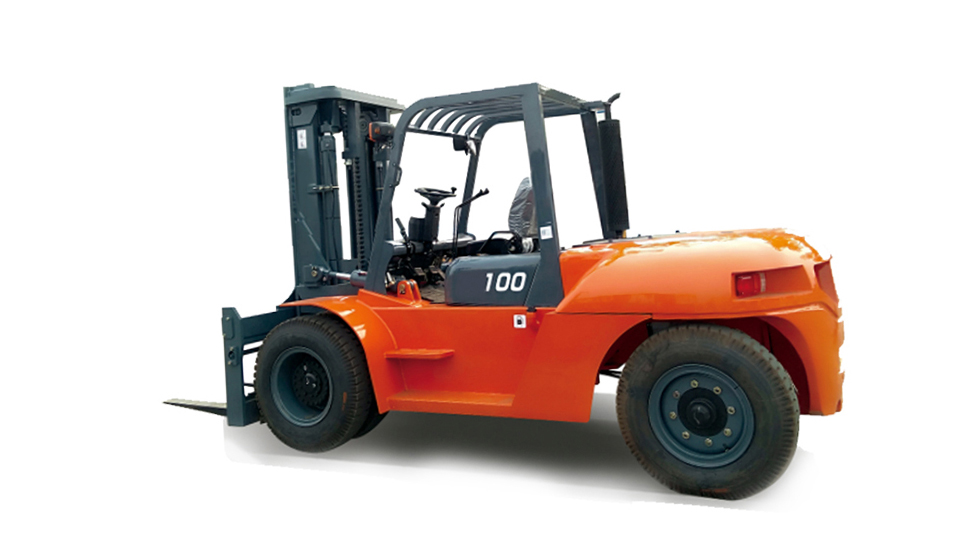
The forklift, or powered industrial truck, is the essential workhorse of global logistics, material handling, and warehousing. While the combustion engine, electric battery, and chassis provide the counterbalanced power and mobility, the true functional capability of the machine rests almost entirely on a single, intricate assembly: the forklift mast. Often referred to simply as the "upright" or "lift," the mast is the vertical, telescoping structure that executes the machine’s primary function: the precise vertical manipulation of heavy loads.1
Technically, the forklift mast is a highly engineered system of interlocking rails, hydraulic cylinders, lift chains, and rollers, working in concert to convert hydraulic fluid pressure into controlled mechanical lifting force.2 Understanding its construction, function, and various types is paramount for selecting the correct equipment, ensuring operational safety, and maximizing vertical storage efficiency.3
I. Anatomical Breakdown: Core Components of the Mast Assembly
The forklift mast is a marvel of applied physics and structural engineering.4 It must be rigid enough to handle asymmetrical loads without twisting or buckling, yet dynamic enough to telescope multiple sections with smooth precision. The entire assembly is typically mounted to the forklift chassis via pivot points, allowing for the crucial forward and backward tilting action controlled by the tilt cylinders.5
The primary components of a typical mast assembly include:
A. The Mast Channels (or Rails)
These are the vertical, interlocking steel beams that form the main structure of the mast.6 They are the "stages" that telescope upward.7
Outer Rails: The stationary section attached to the forklift frame.8
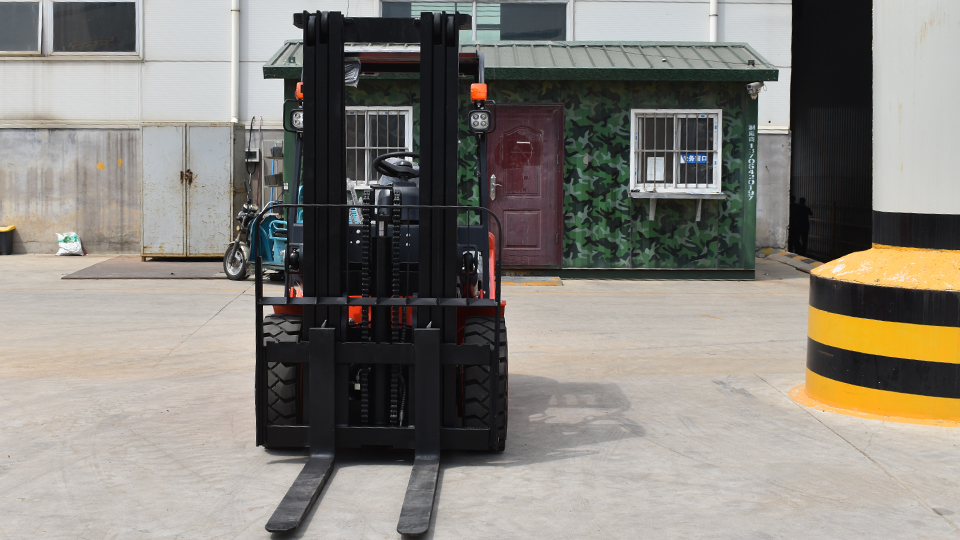
Inner Rails (or Intermediate Rails): Sections that slide vertically within the outer rails.9 The number of these nested rails determines the mast's classification (Duplex, Triplex, Quad, etc.).10
Function: The rails act as a controlled guide for the carriage, ensuring the load moves straight up and down and handles the immense bending moment stress created when a heavy load is extended at height.
B. The Carriage Assembly
The carriage is the horizontal platform that travels vertically along the mast channels.11 It serves as the mounting point for all load-engaging tools.
Forks (Tynes): The load-bearing prongs that engage pallets.12 They are easily adjustable and replaceable.
Load Backrest: A vertical extension attached to the carriage that prevents the load from shifting backward toward the operator or striking the mast components during acceleration, deceleration, and lifting.13 This is a critical safety component mandated by OSHA.
Attachments: The carriage is the universal interface for various attachments, such as side-shifters, fork positioners, drum clamps, and carton clamps, transforming the forklift's function.14
C. The Hydraulic System and Power Transmission
The hydraulic system is the "muscle" of the mast, using the non-compressibility of fluid to generate colossal lifting force.15
Lift Cylinders (Rams): These are single-acting hydraulic cylinders—they push in one direction to raise the load.16
In two-stage (Duplex) and three-stage (Triplex) masts, there may be a large, central Free Lift Cylinder and two smaller side-mounted cylinders.17
Lift Chains and Sheaves (Pulleys): The chains are the final connection between the hydraulic system and the carriage.18 They are routed over sheaves (pulleys) at the top of the mast. In multi-stage masts, these chains use a 2:1 mechanical advantage—for every one inch the hydraulic cylinder rod extends, the carriage assembly is lifted two inches.19 This is a key design feature that allows the forks to reach higher than the physical extension of the cylinder itself.
Tilt Cylinders: These are double-acting cylinders (meaning they can push and pull) connected between the forklift frame and the mast assembly.20 They control the forward tilt (to engage and deposit loads) and the backward tilt (to cradle and stabilize the load during transport).21
D. Bearings and Rollers
Smooth, safe operation depends on the precision movement of the components.
Mast Guide Rollers: Mounted at various points, these rollers or bearings minimize friction and prevent lateral movement or "slop" between the telescoping rails as they extend and retract.22 They are critical for preventing component wear and maintaining load stability.
II. The Operational Dynamic: Lift Types and Terminology
The functionality of a mast is described by several critical technical terms that dictate its suitability for a specific working environment.23
A. Free Lift (FL) and Full Free Lift (FFL)24
This is arguably the most crucial feature for indoor logistics, particularly in containers, boxcars, or facilities with low door clearances.
Free Lift (FL): The vertical distance the forks can be raised before the height of the mast assembly begins to increase.25
Full Free Lift (FFL): A specialized design where the forks can lift to the very top of the inner mast channel without the overall height of the mast increasing at all.26 This is achieved by the primary, center-mounted cylinder lifting the carriage directly (often at a 2:1 chain ratio) before the side cylinders begin to extend the mast rails.
Application: FFL masts are essential for stacking inside enclosed spaces (like semi-trailers) where the operator needs to lift one pallet on top of another without the mast hitting the trailer roof.27
B. Key Height Specifications
Three metrics are used to define a mast’s operational envelope:
|
Technical Term |
Definition |
Application Necessity |
|
Overall Lowered Height (OALH) |
The height from the floor to the top of the mast when fully collapsed. |
Determines if the forklift can clear doorways, overhead ducts, or trailer openings. |
|
Maximum Fork Height (MFH) |
The maximum height from the floor to the load-bearing surface of the forks when fully extended. |
Dictates the maximum height a load can be stacked or retrieved in a racking system. |
|
Overall Raised Height (OARH) |
The height from the floor to the highest point of the mast (usually the top of the inner rail) when fully extended. |
Defines the total overhead clearance required when operating at maximum lift height. |
III. The Classification System: Types of Forklift Masts
Forklift masts are classified by the number of telescoping sections (stages) they possess, each optimized for different lift height and spatial needs.28
|
Mast Type |
Stages (Rails) |
Primary Features |
Ideal Application |
|
Simplex (V-Mast) |
One (Two-stage assembly) |
Limited lift height, Zero Free Lift. The outer mast rail is stationary, but the inner rail begins to extend immediately when the forks move up. |
Low-level stacking, outdoor use where overhead clearance is not a concern. |
|
Duplex (FV/Hi-Lo Mast) |
Two (Two-stage assembly) |
Features Full Free Lift (FFL). Forks rise first, then the inner mast rail extends. Offers a greater lift height than Simplex. |
Medium-level stacking, loading/unloading inside boxcars and trailers (due to FFL). |
|
Triplex (FSV/Triple Mast) |
Three (Three-stage assembly) |
Most common and versatile. Features Full Free Lift and two movable inner rails, providing a balance of high lift and low collapsed height. |
High-rack warehousing, general material handling, distribution centers. |
|
Quad (QFV/Quad Mast) |
Four (Four-stage assembly) |
Maximum lift height capability (up to 20+ feet). Also features Full Free Lift. The most structurally complex mast type. |
High-bay storage, specialized facilities requiring maximum vertical space utilization. |
The Triplex Dominance
The Triplex mast is the industry standard for general-purpose warehouse forklifts.29 Its design elegantly solves the common conflict between achieving extreme lift heights and maintaining a low overall collapsed height.30 A Triplex mast on a 16-foot high-rack system can easily pass through a 7-foot doorway, a duality of function that makes it an indispensable tool for most modern logistics operations.
IV. Maintenance and Technical Safety Considerations
Given that the mast assembly supports the entire weight of the load and the dynamic forces of lifting, maintenance is critical for safety and longevity.31 Failure in a mast component can lead to catastrophic accidents, including tip-overs, load drops, and severe injury.
A. Mast Chain Inspection
The lift chains are the most wear-prone components of the lifting mechanism. They are constantly subjected to immense tensile stress.32
Daily Inspection: Operators must visually inspect chains for obvious damage, such as broken links, corrosion, or turned pins (caused by insufficient lubrication).33
Elongation: Due to the constant stress, chains will naturally elongate over time.34 A professional technician must use a special chain gauge to measure elongation. If a chain has stretched or elongated more than 3%, it must be replaced as per industry standards, as its load-bearing integrity is compromised.35
Lubrication: Proper lubrication is vital to minimize pin and plate wear.36
B. Hydraulic System Integrity
The lift function depends on maintaining hydraulic pressure.37
Cylinder Leaks: Lift and tilt cylinders must be inspected for leaks or fluid weeping.38 Any visible fluid accumulation on the piston rods is a sign of seal failure, leading to a dangerous condition known as mast drift (the gradual lowering of a load when the hydraulics are meant to be holding it stationary).
Hoses and Fittings: High-pressure hydraulic hoses that supply the cylinders are subject to rubbing, abrasion, and degradation. A ruptured hydraulic line under load is extremely dangerous.
C. Structural and Alignment Checks
Rail and Roller Wear: Worn mast guide rollers can cause excessive play (wobble) in the carriage, leading to poor load stability and accelerated wear on the rails themselves.39
Carriage Wear: The carriage itself, and the mounting points for the forks, must be checked for cracks, bending, or excessive wear that could compromise the connection to the load.
Conclusion
The forklift mast is far more than a simple set of telescoping poles; it is the highly refined actuator of the powered industrial truck's core function. Its technical complexity, governed by the hydraulic power system and the mechanical advantage of the chain and roller assembly, dictates the machine's ultimate capability in terms of lift height, maneuverability, and safety profile.
From the compact Simplex mast of a pallet stacker to the towering Quad mast of a high-bay facility, the proper selection, diligent operation, and meticulous maintenance of the mast assembly remain the single greatest determinant of operational safety and efficiency in any material handling environment. Ignoring the technical integrity of this vertical core is not just poor business practice—it is a direct threat to workplace safety.
Name: selena
Mobile:+86-13176910558
Tel:+86-0535-2090977
Whatsapp:8613181602336
Email:vip@mingyuforklift.com
Add:Xiaqiu Town, Laizhou, Yantai City, Shandong Province, China
