
vip@mingyuforklift.com
+86-0535-2090977

The Engineering Logic of Horizontal Propane Integration
In the world of internal combustion (IC) forklifts, Liquid Petroleum Gas (LPG) remains a dominant fuel source due to its low emissions and rapid refueling capabilities. However, to the casual observer, the mounting of the fuel cylinder seems counterintuitive compared to the vertical tanks used for backyard grills. The "sideways" orientation is not an aesthetic choice; it is a critical requirement of the engine’s fuel delivery system and the physics of LPG.
1. Vapor vs. Liquid Extraction
The fundamental reason for the horizontal orientation lies in how the engine "consumes" the fuel.
The Backyard Grill Comparison
A standard BBQ tank sits upright because the grill’s regulator is designed to draw vapor from the top of the tank. As the liquid propane boils off inside the cylinder, the gas rises to the top and is fed into the burner.
The Forklift Requirement
Forklift engines, conversely, are high-demand systems that require a consistent, high-volume flow of fuel. To achieve this, they are designed to draw liquid propane rather than vapor.
The Dip Tube: Inside an LPG tank designed for horizontal use, there is a curved "dip tube." When the tank is mounted sideways with the locating pin in the correct position, this tube curves downward into the liquid at the bottom of the tank.
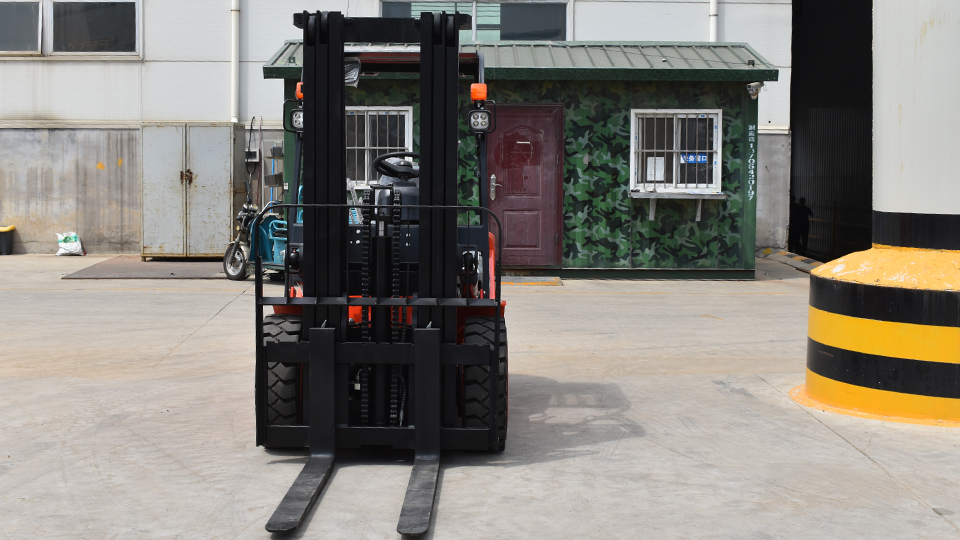
Volume Consistency: Drawing liquid ensures that the engine receives a dense fuel source that is then converted to gas by the vaporizer/regulator, which is heated by the engine's coolant.
2. The Role of the Locating Pin
If a tank is mounted sideways but rotated incorrectly, the dip tube will point toward the vapor space instead of the liquid. This results in "fuel starvation" or inconsistent engine performance.
To prevent this, forklift brackets feature a locating pin. This pin fits into a specific hole on the collar of the tank, ensuring:
The dip tube is at the 6 o'clock position (submerged in liquid).
The Pressure Relief Valve (PRV) is at the 12 o'clock position (positioned in the vapor space).
Technical Note: If the PRV is submerged in liquid (due to improper rotation), and the tank overpressurizes, it will vent liquid propane. Liquid propane expands 270 times its volume when it hits the air, creating a massive, freezing, and highly flammable cloud.
3. Center of Gravity and Stability
Forklifts are essentially see-saws. They rely on a heavy counterweight at the rear to offset the load on the forks at the front.
Vertical vs. Horizontal CG
Vertical Mounting: If a 33-lb or 43-lb propane tank were mounted vertically, it would significantly raise the vehicle's Center of Gravity (CG). In a machine where lateral stability is already a concern (the "Stability Pyramid"), a high CG increases the risk of a tip-over during tight turns.
Horizontal Mounting: Laying the tank sideways keeps the mass lower and closer to the counterweight, maintaining the integrity of the forklift’s stability design.
4. Ergonomics and Rearward Visibility
Technical design must account for the human element. Forklift operators spend a significant portion of their shift driving in reverse to maintain visibility of their surroundings.
Sightlines: A vertical tank would create a massive "blind spot" directly behind the operator. By mounting the tank horizontally across the counterweight, the profile remains low, allowing the operator to look over the tank when backing up.
Refueling Ergonomics: Lifting a 60-lb to 70-lb full propane tank to shoulder height (to place it in a vertical rack) is an ergonomic nightmare. A horizontal bracket allows for a "slide-in" motion at waist or chest height, reducing the risk of musculoskeletal injuries.
5. The Vaporizer/Regulator Interface
Because the tank delivers liquid propane, the forklift must have a specialized component called a Vaporizer (or Heat Exchanger).
$$C_3H_8 (liquid) + Heat \rightarrow C_3H_8 (gas)$$
The vaporizer uses the heat from the engine's cooling system to boil the liquid propane into gas before it enters the carburetor or fuel injectors. If the tank were vertical and delivering vapor, the system would often "freeze up" during high-demand cycles because the natural evaporation rate inside the tank couldn't keep up with the engine's appetite. By drawing liquid, the system maintains a steady "energy density" regardless of the ambient temperature.
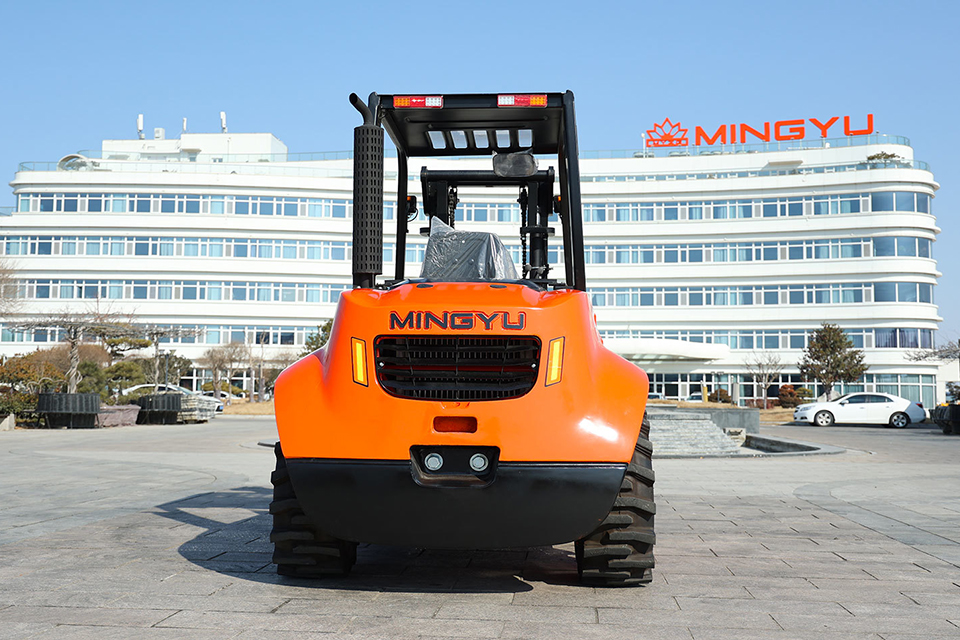
6. Safety Standards: NFPA 58
The "sideways" mounting is also a matter of international safety standards. NFPA 58 (Liquefied Petroleum Gas Code) mandates specific orientations for containers used on vehicles. These codes ensure that the relief valves are always in communication with the vapor space of the container, which is only guaranteed in a horizontal mount with a fixed locating pin.
Summary
The "sideways" propane tank is a masterpiece of pragmatic engineering. It solves the problem of high-volume fuel delivery through liquid extraction, maintains the vehicle's stability, protects the operator's visibility, and ensures that safety valves function exactly as intended.
Name: selena
Mobile:+86-13176910558
Tel:+86-0535-2090977
Whatsapp:8613181602336
Email:vip@mingyuforklift.com
Add:Xiaqiu Town, Laizhou, Yantai City, Shandong Province, China