
vip@mingyuforklift.com
+86-0535-2090977

Rough terrain forklifts are the workhorses of the outdoor industrial world.1 Unlike their smooth-surfaced warehouse cousins, these machines (classified by OSHA as Class VII lift trucks) are engineered to maintain stability and traction on unstable, natural, or disturbed surfaces like mud, gravel, and sand.2
When evaluating these machines, there are two basic styles of rough terrain forklifts: the Vertical Mast Forklift and the Variable Reach (Telehandler) Forklift.3
1. Vertical Mast Rough Terrain Forklifts4
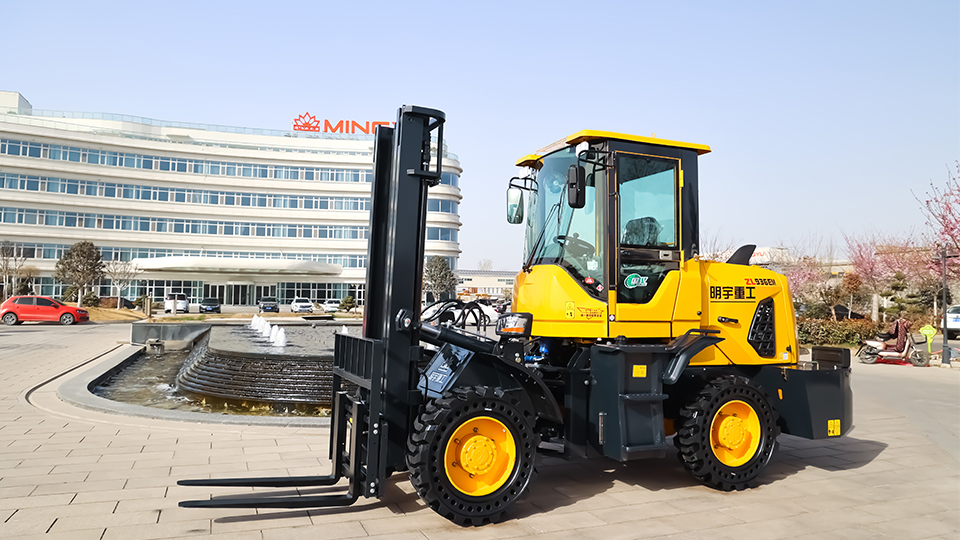
The vertical mast style is what most people visualize when they think of a traditional forklift, but on a much more rugged scale. These machines are defined by a vertical upright assembly at the front of the vehicle that raises and lowers loads in a strictly linear, vertical path.
Design and Engineering
The vertical mast forklift is built on a heavy-duty, reinforced chassis.5 Because these machines do not have the "reach" of a boom, they rely on a lower center of gravity and a shorter wheelbase to provide maximum stability while lifting heavy loads straight up.
Tires and Traction: Most vertical mast models feature oversized, tractor-style pneumatic tires with deep treads.6 They are commonly available in 4-wheel drive (4WD) configurations to prevent the machine from sinking into soft soil.7
The Mast Assembly: The mast itself is built from high-strength steel channels. Depending on the model, these can be two-stage (duplex), three-stage (triplex), or four-stage (quad) masts.
Power Source: Most vertical mast rough terrain forklifts are powered by high-torque diesel engines, providing the necessary "grunt" to move heavy materials like timber or stone across inclines.8
Applications
Vertical mast forklifts are the ideal choice when the primary requirement is high-capacity vertical lifting in outdoor settings where space might be somewhat limited.
Lumber Yards: Moving large stacks of wood over unpaved ground.9
Brick and Stone Yards: Transporting heavy pallets of masonry across gravel lots.10
Recycling Centers: Handling heavy scrap metal or baled materials in outdoor storage areas.
2. Variable Reach (Telehandler) Forklifts
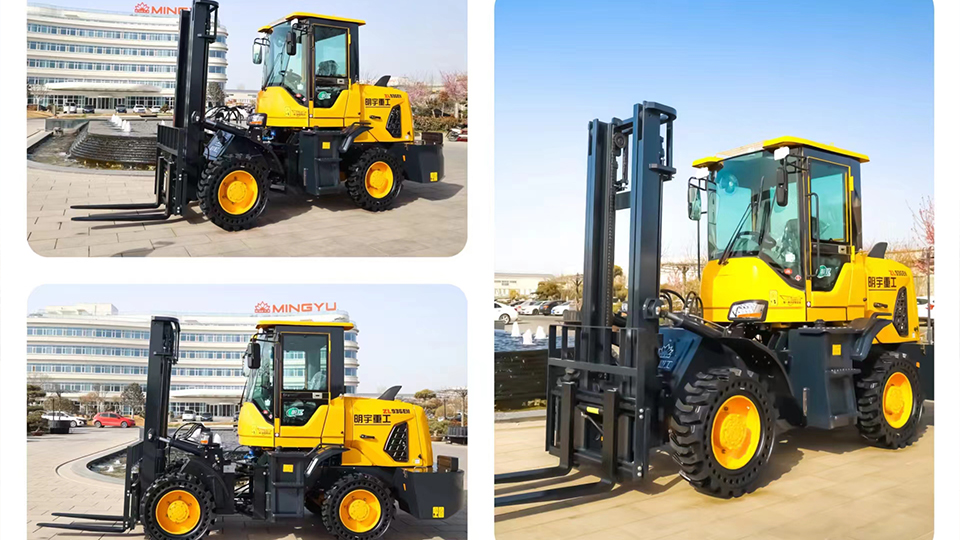
The variable reach forklift, more commonly known as a telehandler (telescopic handler), is a hybrid machine.11 It combines the lifting capability of a forklift with the reach and range of motion of a small crane.
The Telescopic Boom
The defining characteristic of this style is its telescoping boom.12 Instead of a vertical mast, the forks are attached to the end of a boom that can extend both upward and outward.13
Reach and Depth: This style allows operators to place loads not just "high up," but "deep into" a structure. For example, a telehandler can pick up a pallet of shingles from the ground and place it directly onto a second-story roof.14
Stability Systems: Because extending a heavy load outward shifts the center of gravity forward, these machines are often equipped with outriggers or stabilizers that must be deployed before the boom is extended to its maximum reach.
Versatility: Telehandlers are often compatible with a wide array of attachments beyond forks, such as buckets, work platforms, and lifting hooks.15
Applications
Telehandlers are the "Swiss Army Knives" of the construction world. They are used whenever a load needs to be moved over an obstacle or placed at a significant height.
Residential Construction: Lifting materials to rooftops or scaffolding.
Agriculture: Stacking large hay bales or reaching into high grain bins.16
Infrastructure Projects: Moving equipment across large, uneven job sites where the machine cannot get directly next to the drop-off point.
Technical Comparison: Vertical Mast vs. Variable Reach
|
Feature |
Vertical Mast |
Variable Reach (Telehandler) |
|
Lift Path |
Straight Vertical |
Arc / Diagonal / Telescopic |
|
Horizontal Reach |
Minimal (Tilt only) |
Extensive (up to 40+ feet) |
|
Stability |
Internal Counterweight |
Outriggers & Frame Leveling |
|
Maneuverability |
Higher (shorter wheelbase) |
Lower (larger footprint) |
|
Best For17 |
High-capacity vertical stacking18 |
Placing loads over obstacles19 |
Name: selena
Mobile:+86-13176910558
Tel:+86-0535-2090977
Whatsapp:8613181602336
Email:vip@mingyuforklift.com
Add:Xiaqiu Town, Laizhou, Yantai City, Shandong Province, China