
vip@mingyuforklift.com
+86-0535-2090977

In the dynamic world of warehouse material handling, the terms “reach truck” and “forklift” are often used interchangeably—leading to confusion among facility managers, operators, and even procurement professionals. While it is true that both are powered industrial vehicles designed to lift and move palletized goods, they are distinct pieces of equipment, engineered for different operational needs, environments, and tasks. The key to understanding their differences lies in recognizing that a “reach truck” is a specialized type of material handling equipment, while “forklift” is a broader category that includes multiple variants—with the standard counterbalance forklift being the most common and widely recognized.
The confusion often arises because the counterbalance forklift (referred to simply as a “forklift” in most day-to-day operations) is so ubiquitous that it becomes the default reference point for all material handling vehicles. However, reach trucks are purpose-built for narrow-aisle, high-density storage environments—filling a critical niche that standard forklifts cannot. For warehouse managers tasked with optimizing space, improving efficiency, and ensuring safety, understanding the technical differences between reach trucks and standard forklifts is essential to selecting the right equipment for their specific needs.
This technical article provides a comprehensive comparison between reach trucks and standard counterbalance forklifts (the most representative type of forklift), delving into structural design, operational mechanics, application scenarios, performance parameters, safety features, maintenance requirements, and cost considerations. Drawing on 2026 industry standards (ISO 3691-1, ISO 3691-2), manufacturer guidelines (Toyota, Linde, Raymond), and on-site operational data, this guide demystifies the differences between these two essential warehouse vehicles, helping readers make informed decisions about equipment selection, operation, and optimization.
1. Structural Design: The Fundamental Differences
The most significant differences between reach trucks and standard counterbalance forklifts lie in their structural design—differences that are engineered to address distinct operational challenges. These design variations directly impact maneuverability, lifting capacity, reach, and stability, and they are the foundation for all other differences between the two vehicles.
1.1 Standard Counterbalance Forklift: The “Workhorse” Design
The standard counterbalance forklift is designed for versatility and general-purpose material handling. Its structural design is characterized by a simple, robust layout that prioritizes stability when lifting heavy loads at moderate heights. Key structural features include:
• Counterweight System: The defining feature of a counterbalance forklift is the heavy counterweight mounted at the rear of the vehicle. This counterweight offsets the weight of the load carried on the front forks, preventing the forklift from tipping forward. The counterweight is typically made of cast iron or steel and is integrated into the rear frame, adding significant weight to the vehicle (often 30–50% of the total vehicle weight).
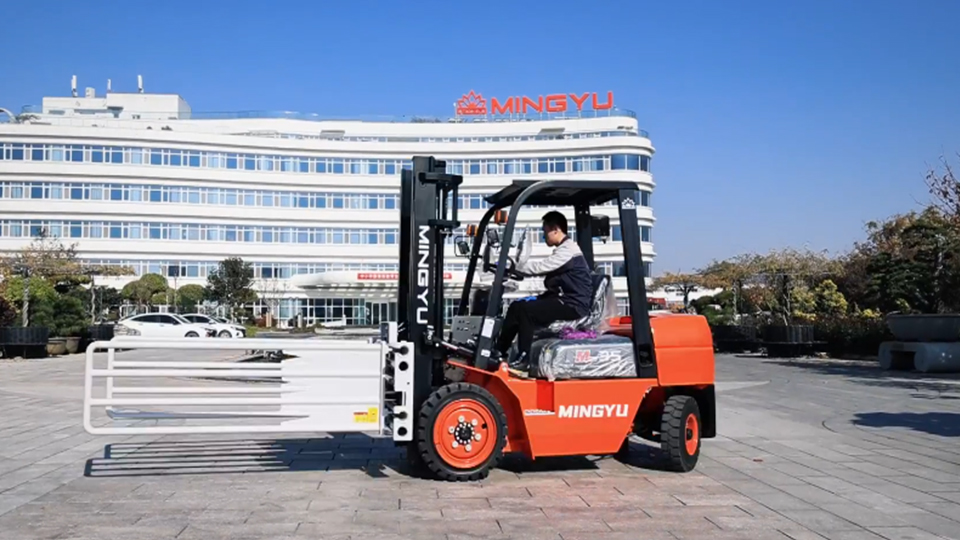
• Fixed Mast and Forks: The mast (the vertical lifting structure) is mounted directly on the front axle of the forklift, with the forks attached to the mast carriage. The mast is fixed in position—meaning it does not extend forward or backward relative to the vehicle’s frame. This fixed design simplifies operation and enhances stability when lifting heavy loads.
• Wheel Configuration: Most counterbalance forklifts have a 4-wheel configuration (two front drive wheels, two rear steer wheels) or a 3-wheel configuration (one front drive wheel, two rear steer wheels for improved maneuverability). The front wheels are larger and heavier to support the weight of the load, while the rear wheels are smaller and designed for steering.
• Operator Cab: The operator cab is positioned at the center or rear of the vehicle, providing the operator with a clear view of the forks and the load. The cab is typically enclosed (for outdoor or harsh environments) or open (for indoor warehouses) and features ergonomic controls for lifting, lowering, and steering.
1.2 Reach Truck: The Narrow-Aisle, High-Reach Specialist
Reach trucks are designed specifically for narrow-aisle, high-density storage environments—where space is at a premium and the ability to reach high storage locations is critical. Their structural design is optimized for maneuverability in tight spaces and vertical reach, with several key features that distinguish them from counterbalance forklifts:
• Reach Mechanism: The most defining feature of a reach truck is its extendable reach carriage. Unlike the fixed mast of a counterbalance forklift, the reach truck’s mast is mounted on a carriage that can extend forward (up to 30–40 inches) beyond the front wheels. This reach mechanism allows the forks to reach into pallet racks that are positioned outside the vehicle’s wheelbase, eliminating the need for the entire vehicle to enter the aisle.
• No Rear Counterweight: Unlike counterbalance forklifts, reach trucks do not have a heavy rear counterweight. Instead, they use a combination of a low center of gravity (achieved by mounting the battery and other heavy components low in the frame) and outriggers (stabilizing arms) at the front of the vehicle to maintain stability. This design significantly reduces the overall weight and width of the reach truck, making it ideal for narrow aisles.
• Wheel Configuration: Reach trucks typically have a 3-wheel configuration (one front drive wheel, two rear steer wheels) or a 4-wheel configuration with narrow tires. The front wheels are small and positioned close together, while the rear wheels are larger and can turn at sharp angles (up to 90 degrees) to enhance maneuverability in narrow aisles. Some reach trucks also feature “crab steering” (all wheels turning in the same direction) for lateral movement in extremely tight spaces.
• Operator Cab Position: The operator cab of a reach truck is positioned at the rear of the vehicle, with a side-facing or forward-facing seat. This position provides the operator with a clear view of the reach mechanism, the forks, and the high storage locations. Many modern reach trucks feature a panoramic cab design to eliminate blind spots, a critical safety feature in narrow aisles.
2. Operational Characteristics: How They Perform in Practice
The structural differences between reach trucks and counterbalance forklifts translate directly into distinct operational characteristics—affecting maneuverability, lifting capacity, reach height, and load handling precision. These operational differences are what make each vehicle suitable for specific tasks and environments.
2.1 Maneuverability: Narrow Aisles vs. Open Spaces
Maneuverability is one of the most striking differences between reach trucks and counterbalance forklifts:
• Counterbalance Forklift: Counterbalance forklifts are designed for maneuverability in open spaces and standard-width aisles. A typical 4-wheel counterbalance forklift has a turning radius of 10–15 feet, requiring aisles of at least 12–15 feet wide to operate comfortably. While 3-wheel counterbalance forklifts have a smaller turning radius (8–10 feet), they still require aisles of 10–12 feet wide. This makes them ideal for warehouses with open floor plans, loading docks, and standard-width pallet racks.
• Reach Truck: Reach trucks are engineered for maximum maneuverability in narrow aisles. Thanks to their narrow width (typically 3–5 feet) and sharp turning radius (5–8 feet), reach trucks can operate in aisles as narrow as 6–8 feet wide—significantly narrower than the aisles required for counterbalance forklifts. The reach mechanism also eliminates the need for the vehicle to turn within the aisle; instead, the operator can extend the reach carriage to access pallets on either side of the aisle without moving the entire vehicle. This makes reach trucks the ideal choice for narrow-aisle warehouses and high-density storage systems.
2.2 Lifting Capacity and Reach Height: Heavy Loads vs. High Reach
Lifting capacity and reach height are critical performance parameters that differ significantly between the two vehicles, reflecting their distinct design priorities:
• Counterbalance Forklift: Counterbalance forklifts prioritize lifting capacity over reach height. A standard counterbalance forklift has a lifting capacity ranging from 1,000 lbs. (small electric models) to 50,000 lbs. (heavy-duty diesel models). The maximum lifting height for most counterbalance forklifts is 15–20 feet, with some specialized models capable of lifting up to 30 feet. This makes them ideal for lifting heavy loads at moderate heights—such as loading and unloading trucks, moving pallets between storage locations, and stacking pallets at ground level or low to medium shelf heights.
• Reach Truck: Reach trucks prioritize reach height over lifting capacity. A standard reach truck has a lifting capacity ranging from 2,000 lbs. to 5,000 lbs.—significantly less than most counterbalance forklifts. However, their maximum reach height is much higher, ranging from 20–40 feet, with some specialized high-reach models capable of reaching up to 50 feet. This makes reach trucks ideal for accessing high storage locations in narrow-aisle warehouses, where the ability to stack pallets vertically is critical for maximizing storage capacity.
It is important to note that the lifting capacity of a reach truck decreases as the reach height increases—due to the shift in the center of gravity. For example, a reach truck with a 4,000 lbs. capacity at 10 feet may only have a 2,000 lbs. capacity at 30 feet. This is in contrast to counterbalance forklifts, whose lifting capacity remains relatively consistent across different heights (within their design limits).
2.3 Load Handling Precision: Stability vs. Precision
The way each vehicle handles loads also differs, reflecting their design priorities:
• Counterbalance Forklift: Counterbalance forklifts are designed for stable load handling. The counterweight system and fixed mast provide excellent stability when lifting and moving heavy loads, even at moderate heights. The forks are positioned directly over the front wheels, which helps to distribute the load weight evenly and reduce the risk of tip-overs. However, the fixed mast limits the precision of load placement—especially at high heights—because the operator must position the entire vehicle to align the forks with the pallet rack.
• Reach Truck: Reach trucks are designed for precise load placement. The extendable reach carriage allows the operator to adjust the position of the forks horizontally (forward and backward) without moving the entire vehicle, making it easy to align the forks with pallet racks even at high heights. Many reach trucks also feature side shifters (attachments that adjust the forks horizontally) and fork positioners (attachments that adjust the distance between the forks), further enhancing load handling precision. However, the lack of a rear counterweight means that reach trucks are less stable than counterbalance forklifts when lifting heavy loads—requiring operators to follow strict load capacity guidelines to prevent tip-overs.
3. Application Scenarios: Where Each Vehicle Excels
The structural and operational differences between reach trucks and counterbalance forklifts make each vehicle suitable for specific application scenarios. Understanding these scenarios is critical for warehouse managers to select the right equipment for their needs.
3.1 Standard Counterbalance Forklift: Versatile General-Purpose Use
Counterbalance forklifts are the most versatile material handling vehicles, suitable for a wide range of applications—making them the backbone of most warehouse operations. Key application scenarios include:
• General Warehouse Operations: Counterbalance forklifts are ideal for warehouses with open floor plans and standard-width aisles (12–15 feet). They are used for moving pallets between storage locations, loading and unloading trucks, and stacking pallets at ground level or low to medium heights (up to 20 feet).
• Loading and Unloading Docks: Counterbalance forklifts are commonly used at loading docks to unload pallets from incoming trucks and load pallets onto outgoing trucks. Their stability and lifting capacity make them suitable for handling heavy loads (up to 50,000 lbs.) that are often encountered at docks.
• Outdoor Operations: Diesel or gas-powered counterbalance forklifts are designed for outdoor use, with rugged tires and enclosed cabs to withstand harsh weather conditions. They are used in construction sites, lumberyards, and outdoor storage facilities to move heavy materials.
• Mixed Load Handling: Counterbalance forklifts can handle a wide range of load types—including pallets, crates, and bulky items—thanks to their versatile fork design and ability to accommodate attachments (e.g., clamps, booms). This makes them suitable for warehouses that handle diverse product types.
3.2 Reach Truck: Specialized Narrow-Aisle, High-Density Storage
Reach trucks are purpose-built for narrow-aisle, high-density storage environments—where space is at a premium and maximizing vertical storage is critical. Key application scenarios include:
• Narrow-Aisle Warehouses: Reach trucks are the primary equipment used in narrow-aisle warehouses (aisles 6–8 feet wide), where counterbalance forklifts cannot operate. They are used to access pallets stored in high-rise pallet racks (20–40 feet high), maximizing storage capacity in the warehouse.
• High-Density Storage Systems: Reach trucks are ideal for high-density storage systems, such as selective pallet racking, drive-in racking, and push-back racking. Their reach mechanism allows them to access pallets stored deep within the racking system, without the need for the vehicle to enter the racking.
• E-Commerce Fulfillment Centers: E-commerce fulfillment centers often require high-density storage to accommodate large volumes of small products. Reach trucks are used to store and retrieve pallets of products in high-rise racks, ensuring that the fulfillment center can handle high order volumes efficiently.
• Cold Storage Warehouses: Electric reach trucks are ideal for cold storage warehouses (e.g., refrigerated or frozen storage), as they are emission-free and quiet—eliminating the need for ventilation systems to remove exhaust fumes. Their narrow design also makes them suitable for the limited space in cold storage facilities.
4. Safety Mechanisms: Addressing Different Risks
Safety is a top priority in warehouse operations, and both reach trucks and counterbalance forklifts are equipped with safety mechanisms designed to address the specific risks associated with their design and operation.
4.1 Counterbalance Forklift Safety Features
The primary safety risks for counterbalance forklifts are tip-overs (forward or backward) and collisions with obstacles or pedestrians. To address these risks, counterbalance forklifts are equipped with the following safety features:
• Counterweight System: As mentioned earlier, the rear counterweight is the primary safety feature that prevents forward tip-overs by offsetting the weight of the load.
• Overhead Guard: A metal guard mounted over the operator cab to protect the operator from falling objects.
• Load Capacity Indicator: A device that alerts the operator when the load exceeds the forklift’s rated capacity, reducing the risk of tip-overs.
• Stability Control System: Modern counterbalance forklifts are equipped with stability control systems (e.g., Toyota’s System of Active Stability) that use sensors to detect unstable conditions (e.g., excessive speed during turns, overloading) and automatically adjust the forklift’s operation to prevent tip-overs.
• Backup Alarms and Lights: Alarms and lights that alert nearby workers to the presence of the forklift, reducing the risk of collisions.
4.2 Reach Truck Safety Features
The primary safety risks for reach trucks are tip-overs (due to the lack of a rear counterweight) and collisions in narrow aisles. To address these risks, reach trucks are equipped with the following safety features:
• Outriggers/Stabilizers: Front stabilizers that extend to the ground when the reach carriage is extended, providing additional stability and preventing tip-overs.
• Reach Carriage Lock: A mechanism that locks the reach carriage in place when not in use, preventing accidental extension and reducing the risk of instability.
• Height Limiter: A device that prevents the mast from lifting beyond the reach truck’s rated height, reducing the risk of tip-overs due to excessive height.
• Panoramic Cab and Blind Spot Sensors: A cab design that provides 360-degree visibility, combined with blind spot sensors, to alert the operator to obstacles or pedestrians in narrow aisles.
• Anti-Tip Override: A safety feature that automatically limits the reach of the carriage or the tilt of the mast if the load exceeds the rated capacity at a given height, preventing tip-overs.
5. Maintenance and Cost Considerations
Maintenance requirements and costs are additional factors that distinguish reach trucks from counterbalance forklifts—factors that warehouse managers must consider when selecting equipment and budgeting for operations.
5.1 Maintenance Requirements
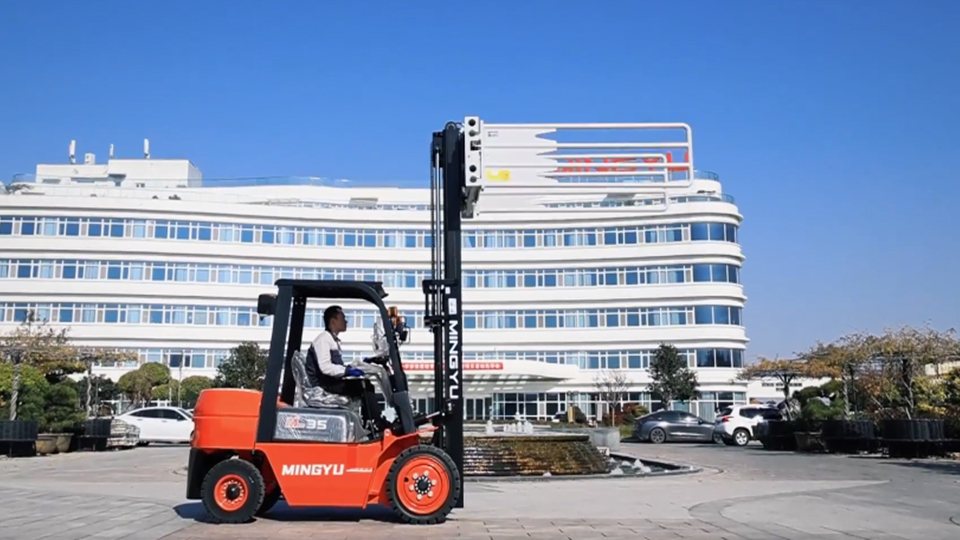
• Counterbalance Forklift: Counterbalance forklifts have relatively simple maintenance requirements, thanks to their robust, straightforward design. Key maintenance tasks include checking and changing engine oil (for diesel/gas models), inspecting the hydraulic system for leaks, checking the counterweight for damage, and maintaining the tires. Diesel and gas models require more frequent maintenance (e.g., oil changes every 250–500 hours) than electric models (e.g., battery maintenance every 100–200 hours). The average maintenance interval for a counterbalance forklift is 250–500 hours of operation.
• Reach Truck: Reach trucks have more complex maintenance requirements, due to their specialized reach mechanism and electric powertrain (most reach trucks are electric). Key maintenance tasks include inspecting and lubricating the reach carriage and its components (e.g., chains, rollers), maintaining the battery (for electric models), checking the stabilizers for wear, and calibrating the safety sensors. The reach mechanism is a high-wear component, requiring regular inspection and replacement of parts (e.g., chains, bearings) to ensure proper operation. The average maintenance interval for a reach truck is 100–250 hours of operation—more frequent than counterbalance forklifts.
5.2 Cost Considerations
Cost is a critical factor in equipment selection, and there are significant differences in upfront purchase costs, operational costs, and total cost of ownership (TCO) between reach trucks and counterbalance forklifts:
• Upfront Purchase Cost: Reach trucks are more expensive than counterbalance forklifts, due to their specialized design and complex components. A standard electric counterbalance forklift (3,000–5,000 lbs. capacity) costs between $25,000–$40,000, while a standard electric reach truck (2,000–4,000 lbs. capacity) costs between $35,000–$60,000. Specialized high-reach models can cost upwards of $80,000.
• Operational Costs: Electric reach trucks have lower operational costs than diesel/gas counterbalance forklifts, as they require less fuel (electricity is cheaper than diesel or gas) and have fewer moving parts that require maintenance. However, electric reach trucks require battery replacement every 3–5 years (costing $5,000–$10,000), which adds to operational costs. Diesel/gas counterbalance forklifts have higher fuel costs but do not require battery replacement—making their operational costs more consistent over time.
• Total Cost of Ownership (TCO): The TCO of a reach truck is typically higher than that of a counterbalance forklift, due to higher upfront costs and more frequent maintenance. However, the TCO can be offset by the space savings achieved in narrow-aisle warehouses—reducing the need for additional warehouse space (which is often costly). For warehouses with limited space, the space savings from using reach trucks can make them a more cost-effective option in the long run.
6. Common Misconceptions About Reach Trucks and Forklifts
Despite the clear differences between reach trucks and counterbalance forklifts, there are several common misconceptions that can lead to poor equipment selection and operational inefficiencies. Addressing these misconceptions is essential to understanding the role of each vehicle in warehouse operations.
6.1 Misconception 1: Reach Trucks Are Just “Narrow-Aisle Forklifts”
Many people assume that reach trucks are simply counterbalance forklifts designed for narrow aisles—but this is not the case. While both vehicles are used to lift and move pallets, their structural designs are fundamentally different. Reach trucks have an extendable reach carriage and no rear counterweight, while counterbalance forklifts have a fixed mast and a rear counterweight. These design differences mean that reach trucks are specialized for high-reach, narrow-aisle applications, while counterbalance forklifts are versatile for general-purpose use.
6.2 Misconception 2: Reach Trucks Can Replace Counterbalance Forklifts
Another common misconception is that reach trucks can replace counterbalance forklifts in all warehouse operations. While reach trucks are ideal for narrow-aisle, high-density storage, they are not suitable for lifting heavy loads (over 5,000 lbs.) or for outdoor operations. Counterbalance forklifts are still necessary for general-purpose tasks, loading and unloading docks, and outdoor operations. Most warehouses require both types of equipment to meet their diverse material handling needs.
6.3 Misconception 3: Counterbalance Forklifts Can Operate in Narrow Aisles
Some warehouse managers assume that counterbalance forklifts can operate in narrow aisles by simply reducing their speed—but this is unsafe and inefficient. Counterbalance forklifts require a minimum aisle width of 12–15 feet (for 4-wheel models) to operate safely, and attempting to operate them in narrower aisles increases the risk of collisions, tip-overs, and damage to goods or infrastructure. Reach trucks are the only safe and efficient option for narrow-aisle operations.
7. Conclusion: Choosing the Right Equipment for Your Warehouse
The difference between a reach truck and a standard counterbalance forklift is not just a matter of size or design—it is a matter of purpose. Reach trucks are specialized, narrow-aisle, high-reach vehicles designed to maximize storage capacity in space-constrained warehouses. Counterbalance forklifts are versatile, general-purpose vehicles designed to handle a wide range of material handling tasks in open spaces and standard-width aisles.
The key to selecting the right equipment lies in understanding your warehouse’s specific needs: If you have a narrow-aisle warehouse with high-rise pallet racks and need to maximize vertical storage capacity, a reach truck is the right choice. If you have an open warehouse with standard-width aisles and need to handle heavy loads, load/unload trucks, or operate outdoors, a counterbalance forklift is the better option. Many warehouses will benefit from both types of equipment—using reach trucks for high-density storage and counterbalance forklifts for general-purpose tasks.
For warehouse managers, investing in the right equipment is critical to optimizing efficiency, ensuring safety, and reducing costs. By understanding the technical differences between reach trucks and counterbalance forklifts—from structural design and operational characteristics to application scenarios and cost—you can make informed decisions that will enhance your warehouse’s performance and profitability.
In summary, reach trucks and counterbalance forklifts are both essential warehouse vehicles, but they serve distinct purposes. By recognizing their differences and leveraging their unique strengths, you can create a material handling system that is efficient, safe, and tailored to your warehouse’s specific needs. As the warehousing industry continues to evolve—with increasing pressure to maximize space and efficiency—the role of both reach trucks and counterbalance forklifts will remain critical, ensuring that warehouses can meet the demands of modern supply chains.
Name: selena
Mobile:+86-13176910558
Tel:+86-0535-2090977
Whatsapp:8613181602336
Email:vip@mingyuforklift.com
Add:Xiaqiu Town, Laizhou, Yantai City, Shandong Province, China
