
vip@mingyuforklift.com
+86-0535-2090977

The Liquefied Petroleum Gas (LPG) forklift is a staple of global logistics, prized for its ability to handle demanding outdoor environments and high-intensity multi-shift operations. However, from a technical perspective, an LPG forklift is essentially a high-pressure chemical storage system integrated with a spark-ignited combustion engine.
Operating such a machine requires more than just driving skills—it necessitates a rigorous understanding of gas physics, thermal dynamics, and chemical safety. In 2026, with safety regulations like OSHA 1910.178 and ANSI/ITSDF B56.1 becoming increasingly stringent, facility managers must implement comprehensive safety protocols to mitigate the risks of fires, explosions, and toxic exposures.
1. The Physics of LPG Hazards
To implement effective safety procedures, operators must understand what they are handling. LPG (typically propane) is stored as a liquid but expands into a gas at a ratio of approximately 270:1.
Vapor Density: LPG is heavier than air. In the event of a leak, the gas does not dissipate upward like hydrogen; it "pools" in low-lying areas, such as pits, drains, or corners of a warehouse, creating invisible "explosive pockets."
Thermal Contraction: When LPG transitions from liquid to gas, it absorbs massive amounts of heat. Skin contact with escaping liquid can cause cryogenic burns (frostbite) instantly.
2. Pre-Operational Inspection Protocols
Safety begins before the engine is even started. A technical inspection must be performed at the start of every shift.
The Fuel System Audit
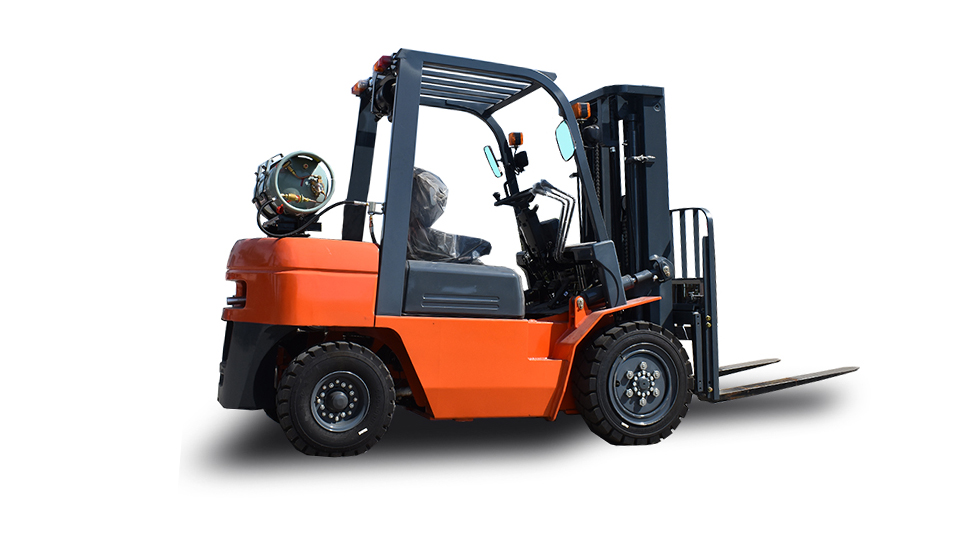
Cylinder Integrity: Inspect for "gouges," deep rust, or dents. A dented pressurized cylinder is a structural failure waiting to happen.
The 12 O’Clock Rule: Ensure the pressure relief valve is positioned at the top of the cylinder (the 12 o’clock position). If the cylinder is rotated, the valve may be submerged in liquid LPG rather than vapor, which would cause a liquid discharge instead of a controlled vapor release in an over-pressure event.
O-Ring and Seal Check: Inspect the female and male quick-connect fittings. Brittle or missing O-rings are the leading cause of slow-leak fires.
The "Senses" Test
Smell: Ethyl mercaptan is added to LPG to give it a "rotten egg" smell. If you smell it, do not start the engine.
Sound: Listen for the "hiss" of high-pressure gas.
Sight: Look for frost or ice buildup on the vaporizer or fittings, which indicates a significant leak and rapid depressurization.
3. Safe Refueling and Cylinder Exchange
Exchanging an LPG tank is a five-minute process, but it is the most dangerous window of time in a forklift’s daily cycle.
The "Empty-Run" Technique
The safest way to change a tank is to ensure the fuel lines are empty before disconnection:
Close the service valve while the engine is still running.
Allow the engine to stall. This consumes the remaining gas in the lines and vaporizer, reducing the "poof" of gas released during disconnection.
Turn off the ignition.
PPE Requirements
Because of the risk of cryogenic burns and eye injury, the following Personal Protective Equipment (PPE) is mandatory:
Gloves: Heavy-duty leather or neoprene (to insulate against the cold).
Eye Protection: Safety goggles or a face shield.
Technical Note: Never use tools to tighten fuel connections. LPG fittings are designed to be hand-tightened. Over-torquing with a wrench can damage the brass threads and lead to permanent leaks.
4. Indoor Air Quality and Ventilation
Unlike electric forklifts, LPG units produce Carbon Monoxide ($CO$). In poorly ventilated warehouses, $CO$ levels can rise to toxic levels before operators even realize it.
Ventilation Standards: Facilities must ensure a minimum air change rate (often measured in Cubic Feet per Minute per horsepower).
Catalytic Maintenance: The three-way catalytic converter must be inspected every 500–1000 hours. A "clogged" or depleted catalyst can increase $CO$ output by 1000%.
CO Monitoring: In 2026, it is best practice to install wall-mounted $CO$ detectors throughout the facility, calibrated to trigger alarms at 25–35 ppm.
5. Storage and Infrastructure Safety
Where you store your fuel is as important as how you use it.
The 20-Foot Rule: Store cylinders at least 20 feet away from combustible materials or sources of ignition (welding stations, electrical panels).
Ventilated Cages: Cylinders must be stored in lockable, ventilated outdoor cages. Indoor storage is strictly limited by local fire codes (often no more than 300 lbs of gas total).
Vertical vs. Horizontal: While LPG forklifts use cylinders horizontally, they are often stored vertically in cages to save space. Ensure they are secured with chains to prevent them from tipping and shearing off their valves.
6. Emergency Response: The "No-Start" Scenario
One of the most common causes of forklift fires is a "flooded" or "rich" engine. If an LPG forklift fails to start after three attempts, stop immediately.
Isolate the Gas: Close the cylinder valve.
Ventilate: Open the hood and allow the accumulated gas to dissipate.
Do Not Crank: Repeatedly cranking a flooded LPG engine can result in an exhaust backfire that ignites unburned gas in the air intake.
Summary Checklist for Fleet Managers
|
Task |
Frequency |
Responsibility |
|
Visual Tank Inspection |
Each Shift |
Operator |
|
Leak Testing (Soap/Water) |
Weekly |
Maintenance |
|
$CO$ Emission Testing |
Bi-Annually |
Certified Tech |
|
Hydrostatic Tank Testing |
Every 5-10 Years |
Supplier |
Safety with LPG forklifts is not about fear; it is about respecting the energy density of the fuel. By following these technical procedures, a facility can enjoy the performance of LPG while maintaining a zero-incident safety culture.
Name: selena
Mobile:+86-13176910558
Tel:+86-0535-2090977
Whatsapp:8613181602336
Email:vip@mingyuforklift.com
Add:Xiaqiu Town, Laizhou, Yantai City, Shandong Province, China
