
vip@mingyuforklift.com
+86-0535-2090977

1. Defining LPG: The Chemical Advantage
To understand the forklift, one must first understand the fuel. LPG is a flammable mixture of hydrocarbon gases, primarily propane ($C_3H_8$) and butane ($C_4H_{10}$).
Unlike gasoline or diesel, LPG is stored as a liquid under moderate pressure but consumed as a dry gas. This characteristic is central to its "clean-burning" reputation. Because the fuel enters the combustion chamber as a gas rather than a liquid mist, it mixes more homogeneously with air, leading to more complete combustion and fewer carbon deposits.
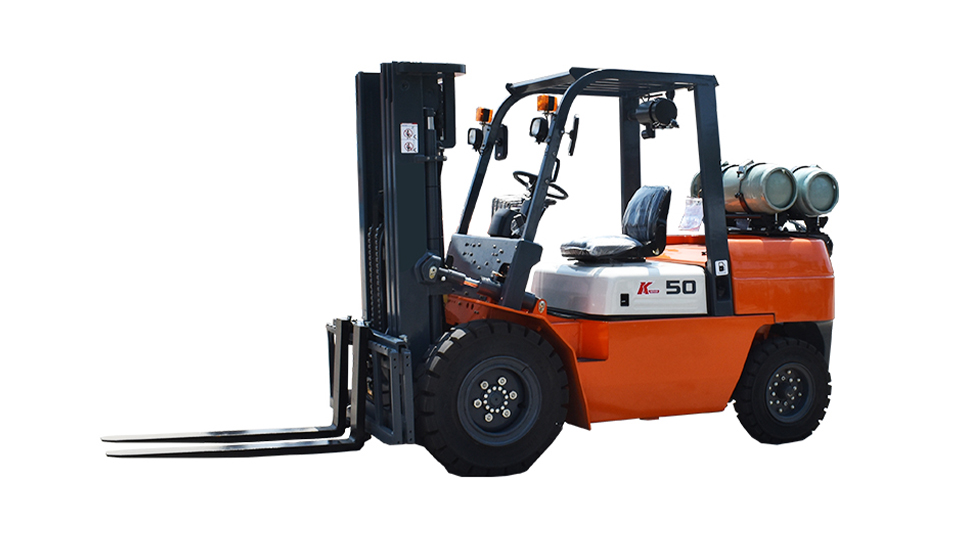
2. The Internal Combustion Engine (ICE) Assembly
The "heart" of an LPG forklift is a spark-ignited internal combustion engine. While similar in architecture to an automotive engine, it is "industrialized"—meaning it is tuned for low-end torque rather than high-end horsepower.
The Fuel Delivery Chain
The process of turning pressurized liquid into mechanical motion involves several critical components:
The Cylinder: A removable steel or aluminum tank mounted on the rear of the chassis. It includes a "dip tube" designed to draw liquid (not gas) from the bottom of the tank.
The Hydrostatic Relief Valve: A safety mechanism that prevents over-pressurization.
The Vaporizer (Regulator): This is the most technically distinct part of an LPG system. It uses hot engine coolant to heat the liquid LPG, causing it to flash into a gas. It also reduces the pressure from the tank (~100-200 psi) to a level usable by the engine.
The Mixer: Often called the "LPG carburetor," this component venturis the gaseous fuel into the incoming airstream at a precise ratio, typically around $15.5:1$ for stoichiometric combustion.
3. Power Transmission: Hydrostatic vs. Torque Converter
An LPG engine’s power is useless without an efficient way to move the wheels and the mast. There are two primary transmission technologies found in these machines:
Torque Converter (Powershift)
The most common system, utilizing a fluid coupling to transmit power. It behaves much like an automatic car but is built for "inching"—the ability to creep forward slowly while keeping engine RPMs high to provide maximum hydraulic lift speed.
Hydrostatic Drive
Found in premium European and high-spec models, this system replaces the transmission with a hydraulic pump and motors. It offers:
Dynamic Braking: The forklift slows down automatically when the accelerator is released.
Precision: Exceptional control for fragile loads.
Reduced Wear: No mechanical clutches or brake pads to wear out during frequent direction changes.
4. Emissions and Environmental Controls
While LPG is cleaner than diesel, it is not "emission-free." The combustion process produces Carbon Monoxide ($CO$), Nitrogen Oxides ($NO_x$), and Hydrocarbons ($HC$).
To operate safely indoors, modern LPG forklifts are equipped with Closed-Loop Three-Way Catalytic Converters.
The Oxygen Sensor: Monitors the exhaust gas and sends data to the Engine Control Unit (ECU).
The ECU: Constantly adjusts the fuel-to-air ratio to ensure the catalyst can neutralize up to 98% of harmful pollutants.
Technical Insight: For food-grade or pharmaceutical environments, "low-emission" LPG engines are often fitted with secondary oxidizers to further reduce $CO$ output to below 50 parts per million (ppm).
5. Thermal Management and Cooling
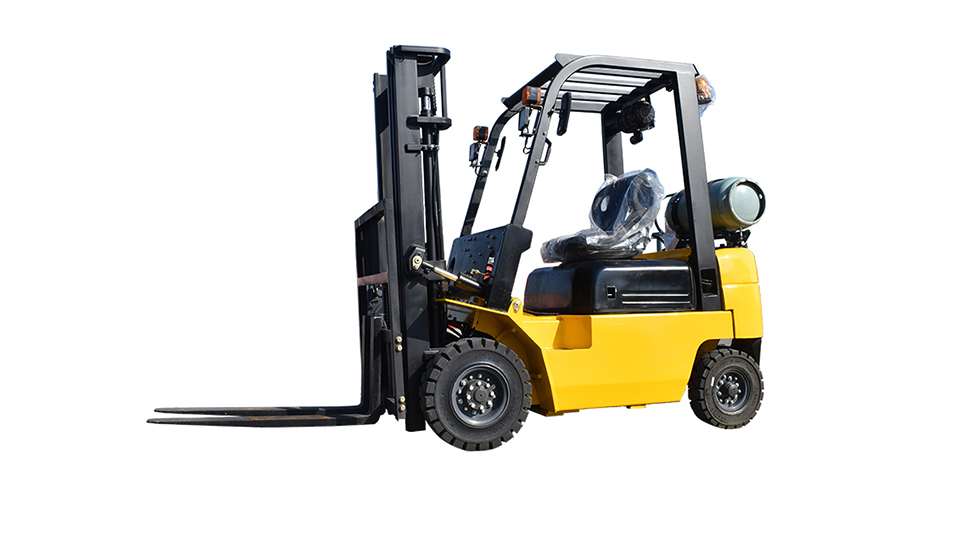
Because LPG engines often operate at high RPMs with low ground speed (limiting natural airflow), the cooling system is over-engineered compared to a road vehicle.
Heavy-Duty Radiators: Feature wide fin spacing to prevent clogging from warehouse dust and debris.
Pusher Fans: Many forklifts use fans that push air out through the radiator to prevent the operator from being blasted with engine heat.
6. LPG vs. Electric: The Technical Trade-offs
The primary competitor to LPG in 2026 is the Lithium-ion electric forklift. From a technical perspective, the choice depends on the "Duty Cycle."
|
Feature |
LPG (Internal Combustion) |
Electric (Li-ion) |
|
Refueling |
2–5 min tank swap |
1–2 hour charge |
|
Torque Curve |
Build-up (Mechanical) |
Instant (Digital) |
|
Weight |
Constant |
Heavy (Battery acts as counterweight) |
|
Life Expectancy |
12,000–15,000 hours |
20,000+ hours |
LPG excels in non-stop operations. If a facility runs three 8-hour shifts, an LPG unit only needs 15 minutes of downtime per day for fuel swaps. An electric unit requires a charging infrastructure that can handle "opportunity charging" or expensive spare batteries.
7. Safety Protocols and Handling
LPG is a high-pressure fuel, requiring specific safety engineering:
Tank Positioning: Most forklifts have a locating pin to ensure the tank is mounted with the relief valve pointing up. This prevents liquid LPG from spraying out if the valve opens.
Automatic Shut-off: If the engine stalls, a vacuum or electronic switch immediately cuts fuel flow to prevent gas leaks.
8. Maintenance Requirements
Maintaining an LPG forklift is a matter of mechanical discipline. A typical preventative maintenance (PM) schedule includes:
Oil Changes: Every 500 hours (LPG keeps oil cleaner than diesel, extending engine life).
Air Filtration: Crucial, as LPG engines are highly sensitive to air-fuel ratios.
Vaporizer Inspection: Checking for "heavy ends"—waxy residues that settle in the regulator over time.
Spark Plug Gapping: LPG requires a slightly stronger spark for ignition than gasoline.
9. The Verdict: Is the LPG Forklift Obsolete?
As we move further into 2026, the LPG forklift remains far from obsolete. Its ability to work in the rain, climb steep ramps with heavy loads, and provide 24/7 uptime without a massive electrical grid makes it indispensable for:
Brick and Stone Yards
Recycling Centers
High-Volume Distribution Hubs
Remote Construction Sites
While the world is moving toward electrification, the density of energy stored in an LPG cylinder and the reliability of the industrial ICE ensure that LPG-powered forklifts will remain a cornerstone of global logistics for the foreseeable future.
Name: selena
Mobile:+86-13176910558
Tel:+86-0535-2090977
Whatsapp:8613181602336
Email:vip@mingyuforklift.com
Add:Xiaqiu Town, Laizhou, Yantai City, Shandong Province, China