
vip@mingyuforklift.com
+86-0535-2090977

In the complex ecosystem of modern warehousing and logistics, the forklift stands as an indispensable workhorse—one whose presence is so ubiquitous that it is often taken for granted. From small local warehouses to large-scale distribution centers handling millions of units annually, forklifts play a pivotal role in keeping operations running smoothly, efficiently, and safely. But why is this industrial vehicle so essential to warehouse operations? The answer lies in the unique challenges of warehousing—moving heavy loads, maximizing space, maintaining productivity, ensuring worker safety, and adapting to the demands of global supply chains—and how forklifts are specifically engineered to address these challenges.
Warehouses exist to store, manage, and move goods, and the efficiency of these processes directly impacts a business’s bottom line. Before the advent of forklifts, warehouses relied on manual labor (e.g., hand trucks, pallets jacks, and human lifters) and cranes to move heavy loads—a method that was slow, labor-intensive, prone to injury, and limited in its ability to utilize vertical space. The introduction of the modern forklift in the early 20th century revolutionized warehousing, transforming it from a labor-heavy industry to a streamlined, efficient operation capable of handling the demands of mass production and global trade.
This technical article explores the core reasons why forklifts are essential in warehouses, delving into their role in improving operational efficiency, handling heavy and bulky loads, maximizing space utilization, enhancing workplace safety, optimizing costs, and integrating with modern warehouse systems. Drawing on 2026 industry standards (ISO 3691-1, OSHA 1910.178), warehouse operational data, and best practices from leading logistics companies (Amazon, Walmart, DHL), this guide explains how forklifts have become the backbone of modern warehousing—and why they will remain critical as the industry evolves.
1. Unmatched Efficiency in Load Handling: Speeding Up Warehouse Operations
The primary reason warehouses use forklifts is their ability to handle loads quickly and efficiently—far outpacing manual labor and other material handling equipment. In a warehouse, time is money, and even small delays in moving goods can lead to bottlenecks, missed deadlines, and increased costs. Forklifts address this by streamlining the three core load-handling processes: loading, unloading, and internal transport.
1.1 Speeding Up Loading and Unloading
Warehouses receive and ship thousands of pallets daily, and the speed at which these pallets are loaded and unloaded directly impacts the flow of goods. Manual labor can only move one or two pallets per hour (depending on weight), while a standard counterbalance forklift can move 15–20 pallets per hour— a 7–10x increase in efficiency. For large warehouses handling hundreds of pallets daily, this difference is transformative.
Forklifts are equipped with powerful hydraulic systems that allow them to lift and move heavy pallets in seconds. For example, a typical counterbalance forklift with a 5,000 lbs. capacity can lift a full pallet of goods (2,000–4,000 lbs.) to a height of 10 feet in under 10 seconds, then transport it to its destination and lower it—all in less time than it would take a team of workers to move the same pallet manually.
This efficiency is particularly critical for time-sensitive operations, such as cross-docking (where goods are unloaded from incoming trucks and immediately loaded onto outgoing trucks with minimal storage) or just-in-time (JIT) inventory systems (where goods are delivered exactly when needed). In these scenarios, forklifts ensure that goods move quickly through the warehouse, reducing storage time and preventing delays in the supply chain.
1.2 Streamlining Internal Transport
Once goods are unloaded, they must be transported to their storage locations (e.g., pallet racks, shelving units) and later retrieved for shipping. Warehouses can be large—some distribution centers span over 1 million square feet—and moving pallets manually across long distances is impractical and time-consuming.
Forklifts are designed for efficient internal transport, with speeds of up to 10 mph indoors (and faster outdoors) and the ability to navigate narrow aisles and tight corners. This allows operators to move pallets from the loading dock to storage locations (and vice versa) in a fraction of the time it would take with manual labor. For example, moving a pallet 500 feet across a warehouse takes a forklift less than a minute, while a worker using a hand truck would take 5–10 minutes—wasting valuable time that could be spent on other tasks.
Modern forklifts also feature ergonomic designs and power steering, reducing operator fatigue and allowing them to work longer shifts without a drop in efficiency. This further enhances productivity, as operators can maintain a consistent pace throughout the day.
2. Handling Heavy and Bulky Loads: Beyond Human Capability
Another critical reason warehouses use forklifts is their ability to handle heavy, bulky, and awkwardly shaped loads that are beyond the physical capability of manual labor. Warehouses often store goods weighing thousands of pounds—pallets of building materials, machinery parts, large boxes, and industrial equipment—and attempting to move these loads manually is not only inefficient but also dangerous.
2.1 Lifting Capacity Beyond Manual Labor
The average human can safely lift and carry a maximum of 50–75 lbs. (OSHA guidelines), and even with the help of hand trucks or pallet jacks, the maximum load capacity is limited to 2,000 lbs. In contrast, industrial forklifts have load capacities ranging from 1,000 lbs. (small electric forklifts) to over 100,000 lbs. (heavy-duty forklifts for industrial applications). This means that forklifts can handle loads that would require a team of 10–20 workers to move manually—if it were even possible.
For example, a pallet of concrete blocks weighs approximately 3,000 lbs.—far beyond the capacity of manual labor. A standard counterbalance forklift can lift and move this pallet with ease, reducing the number of workers needed and eliminating the risk of injury from overexertion. Similarly, large machinery parts weighing 10,000 lbs. or more can be safely moved using a heavy-duty forklift, ensuring that these critical goods are transported without damage or delay.
2.2 Handling Bulky and Awkward Loads
Warehouses also handle bulky and awkwardly shaped loads—such as large furniture, industrial pipes, and oversized boxes—that are difficult to move manually, even if they are not extremely heavy. These loads often require precise positioning, which is nearly impossible with manual labor but easily achievable with forklifts.
Forklifts can be equipped with specialized attachments (e.g., side shifters, fork positioners, clamps, and booms) that allow them to handle these awkward loads. For example, a paper roll clamp attachment enables a forklift to grip and move large paper rolls (often 5–10 feet long and weighing 2,000–5,000 lbs.) without damaging them. A boom attachment allows a forklift to lift and move awkwardly shaped machinery parts, while a side shifter allows the operator to adjust the position of the forks horizontally, ensuring precise placement of the load.
This ability to handle bulky and awkward loads is essential for warehouses that store non-palletized goods or specialized industrial equipment, as it ensures that these goods are moved safely and efficiently without damage.
3. Maximizing Vertical Space Utilization: The Key to Warehouse Efficiency
Warehouse space is a valuable commodity, and the cost of renting or owning warehouse space continues to rise. To remain competitive, warehouses must maximize their storage capacity—both horizontally and vertically. Forklifts are critical to this goal, as they enable warehouses to utilize vertical space that would otherwise be inaccessible with manual labor or other material handling equipment.
3.1 Reaching High Storage Locations
Manual labor and hand trucks are limited to lifting loads to a maximum height of 6–8 feet, which means that warehouses relying on these methods can only use the lower levels of shelving and pallet racks. In contrast, forklifts can lift loads to heights of 15–30 feet (and even higher with specialized reach trucks or order pickers), allowing warehouses to utilize the full height of their facilities.
For example, a standard counterbalance forklift can lift a pallet to a height of 15 feet, while a reach truck can lift to 30 feet or more. This means that a warehouse with a 20-foot ceiling can use pallet racks up to 18 feet high—doubling or tripling its storage capacity compared to a warehouse relying on manual labor. This vertical space utilization is particularly critical for urban warehouses, where space is limited and expensive.
3.2 Enabling High-Density Storage
Forklifts also enable high-density storage systems, such as narrow-aisle storage and pallet racking systems, which further maximize storage capacity. Narrow-aisle forklifts (e.g., reach trucks, order pickers) are designed to navigate aisles as narrow as 6–8 feet—significantly narrower than the 12–15 feet required for standard forklifts or manual labor. This allows warehouses to install more pallet racks in the same amount of space, increasing storage density by 30–50%.
High-density storage systems are essential for warehouses handling large volumes of goods, such as e-commerce distribution centers. For example, Amazon’s fulfillment centers use narrow-aisle forklifts and high-rise pallet racks to store millions of products in a relatively small footprint, ensuring that they can fulfill customer orders quickly and efficiently.
4. Enhancing Workplace Safety: Reducing Injuries and Accidents
Workplace safety is a top priority in warehouses, and forklifts play a critical role in reducing the risk of injuries and accidents associated with manual load handling. According to OSHA statistics, manual material handling is one of the leading causes of workplace injuries—accounting for over 30% of all non-fatal workplace injuries. These injuries include strains, sprains, hernias, and fractures—all of which can be prevented by using forklifts to handle heavy loads.
4.1 Eliminating Manual Lifting Injuries
The most significant safety benefit of using forklifts is the elimination of manual lifting, which is the primary cause of musculoskeletal disorders (MSDs) in warehouses. MSDs—such as back pain, shoulder strains, and wrist injuries—are painful, costly, and often result in long-term disability. By using forklifts to lift and move heavy loads, warehouses can reduce the risk of MSDs by up to 90%, according to industry studies.
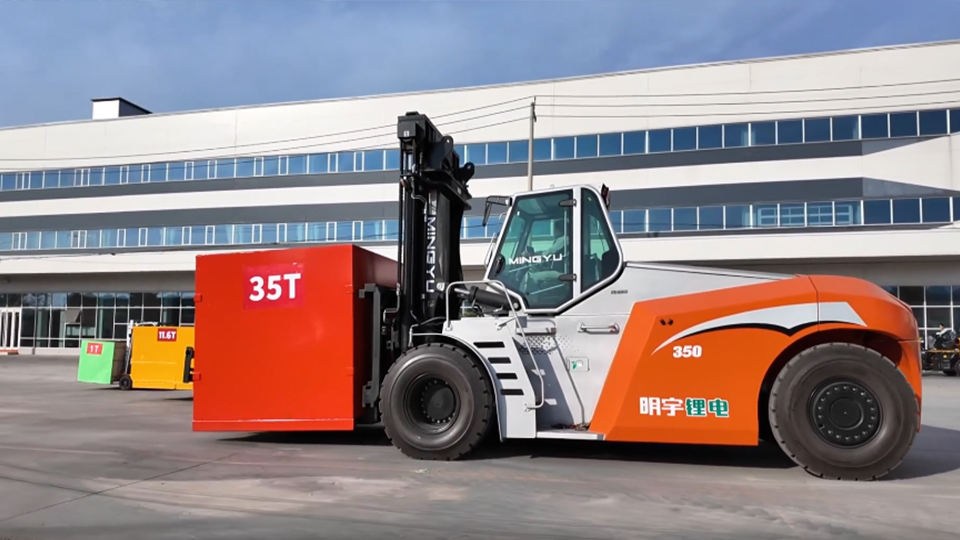
Forklifts are designed to handle heavy loads safely, with features such as stable counterweights, hydraulic lifting systems, and ergonomic operator seats that reduce the physical strain on workers. Operators are trained to use forklifts safely, and modern forklifts are equipped with safety features (e.g., seat belts, overhead guards, backup alarms, and load capacity indicators) that further reduce the risk of injury.
4.2 Reducing Load-Related Accidents
Manual load handling is also prone to accidents such as dropped loads, which can cause serious injury to workers or damage to goods. Forklifts reduce this risk by providing a stable, controlled way to lift and move loads. The hydraulic lifting system ensures that loads are lifted smoothly and evenly, while the forks provide a secure platform for the load. Operators can also adjust the mast tilt to cradle the load, preventing it from sliding or falling during transport.
Modern forklifts also feature safety interlocks (e.g., seat belt interlocks, park brake interlocks) that prevent the forklift from operating unless the operator is properly secured and the machine is in a safe position. Backup alarms and lights alert nearby workers to the presence of the forklift, reducing the risk of collisions.
5. Optimizing Costs: Reducing Labor and Operational Expenses
While forklifts require an initial investment (purchase or rental) and ongoing maintenance, they ultimately reduce warehouse costs by optimizing labor, reducing damage to goods, and maximizing space utilization. For most warehouses, the cost savings from using forklifts far outweigh the initial and ongoing expenses.
5.1 Reducing Labor Costs
Manual load handling requires a large number of workers, which is one of the biggest expenses for warehouses. Forklifts reduce labor costs by replacing multiple workers with a single operator. For example, a team of 5–10 workers is needed to move 10 pallets per hour manually, while a single forklift operator can move 15–20 pallets per hour. This reduces the number of workers needed, lowering labor costs by 50–70%.
Forklifts also reduce overtime costs, as they can handle high volumes of work quickly, eliminating the need for workers to work overtime to meet deadlines. Additionally, forklifts reduce the cost of worker compensation claims by reducing the number of injuries, which can be costly for warehouses (both in terms of medical expenses and lost productivity).
5.2 Minimizing Damage to Goods
Manual load handling is prone to damage to goods, as workers may drop, bump, or mishandle loads. Damaged goods are costly for warehouses, as they must be replaced or discounted, leading to lost revenue. Forklifts reduce damage to goods by providing a controlled, stable way to lift and move loads. The precise control offered by forklifts ensures that loads are positioned accurately, reducing the risk of bumps and drops.
Specialized attachments (e.g., soft clamps, padded forks) further reduce damage to fragile goods, such as glass, electronics, and delicate machinery. This minimizes the number of damaged goods, saving warehouses money and improving customer satisfaction.
5.3 Maximizing Space Utilization to Reduce Rent Costs
As mentioned earlier, forklifts enable warehouses to maximize vertical space utilization, which reduces the need for additional warehouse space. Renting or owning additional warehouse space is costly, and by using forklifts to increase storage capacity in the existing space, warehouses can avoid these costs. For example, a warehouse that uses forklifts to double its storage capacity can avoid renting a second warehouse, saving thousands of dollars in rent each month.
6. Integrating with Modern Warehouse Systems: Enabling Automation and Digitization
Modern warehouses are becoming increasingly automated and digitized, with systems such as warehouse management systems (WMS), barcode scanners, and automated guided vehicles (AGVs) being used to streamline operations. Forklifts play a critical role in integrating with these systems, ensuring that warehouses can leverage the benefits of automation and digitization.
6.1 Compatibility with Warehouse Management Systems (WMS)
Warehouse management systems (WMS) are software applications that track inventory, manage orders, and optimize warehouse operations. Forklifts can be integrated with WMS systems, allowing operators to receive real-time instructions (e.g., where to pick up a load, where to store it) directly on a display in the forklift cab. This eliminates the need for paper-based instructions, reducing errors and improving efficiency.
For example, when a customer places an order, the WMS system sends a signal to the forklift operator, instructing them to retrieve the required pallet from a specific storage location. The operator uses the forklift to retrieve the pallet and transport it to the shipping dock, where it is scanned and logged into the WMS system. This integration ensures that inventory is tracked accurately, and orders are fulfilled quickly and efficiently.
6.2 Supporting Automation with AGVs and Autonomous Forklifts
Automated guided vehicles (AGVs) and autonomous forklifts are becoming increasingly common in modern warehouses, as they eliminate the need for human operators and further improve efficiency. These automated vehicles use sensors, cameras, and software to navigate the warehouse, lift and move loads, and interact with other warehouse systems—all without human intervention.
Autonomous forklifts are designed to perform the same tasks as manual forklifts (e.g., loading, unloading, internal transport) but with greater efficiency and accuracy. They can operate 24/7 without fatigue, reducing downtime and increasing productivity. Additionally, autonomous forklifts integrate seamlessly with WMS systems and other automated equipment, creating a fully integrated, automated warehouse ecosystem.
7. Adapting to Diverse Warehouse Environments and Applications
Warehouses come in all shapes and sizes, and they handle a wide range of goods—from small packages to heavy industrial equipment. Forklifts are highly versatile, with different types of forklifts designed to diverse warehouse environments and applications. This versatility makes forklifts essential for any warehouse, regardless of its size or the type of goods it handles.
7.1 Different Types of Forklifts for Different Applications
There are several types of forklifts, each designed for specific warehouse environments and applications:
•Counterbalance Forklifts: The most common type, used for general-purpose load handling in warehouses with standard aisles. They are available in electric, gas, and diesel models, with load capacities ranging from 1,000–50,000 lbs.
• Reach Trucks: Designed for narrow-aisle warehouses, reach trucks can navigate aisles as narrow as 6 feet and lift loads to heights of 30 feet or more. They are ideal for high-density storage systems.
• Order Pickers: Used for picking individual items from high shelves, order pickers allow operators to lift themselves along with the load, making it easy to access items stored at height.
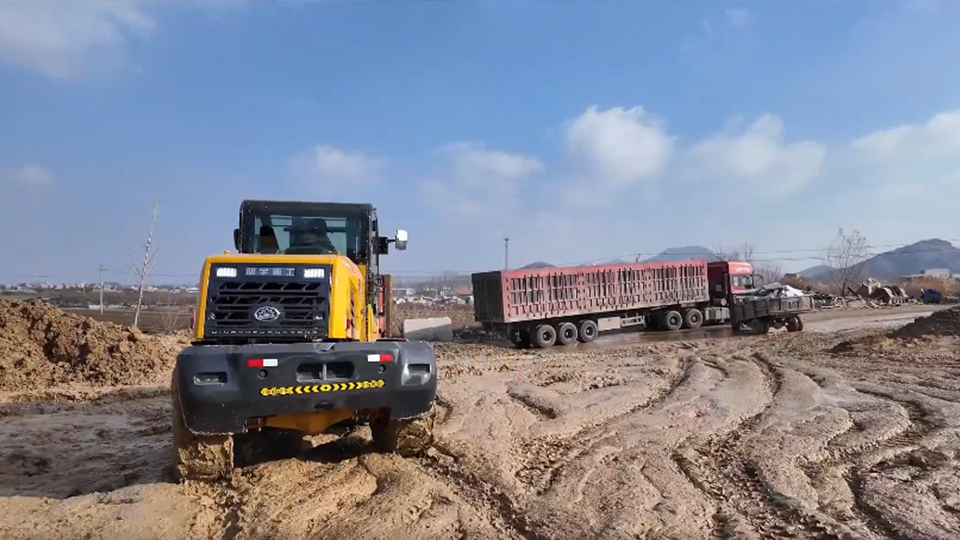
• Rough-Terrain Forklifts: Designed for outdoor warehouses or uneven surfaces, rough-terrain forklifts have large, heavy-duty tires and are powered by gas or diesel engines. They are ideal for construction sites, lumberyards, and outdoor storage facilities.
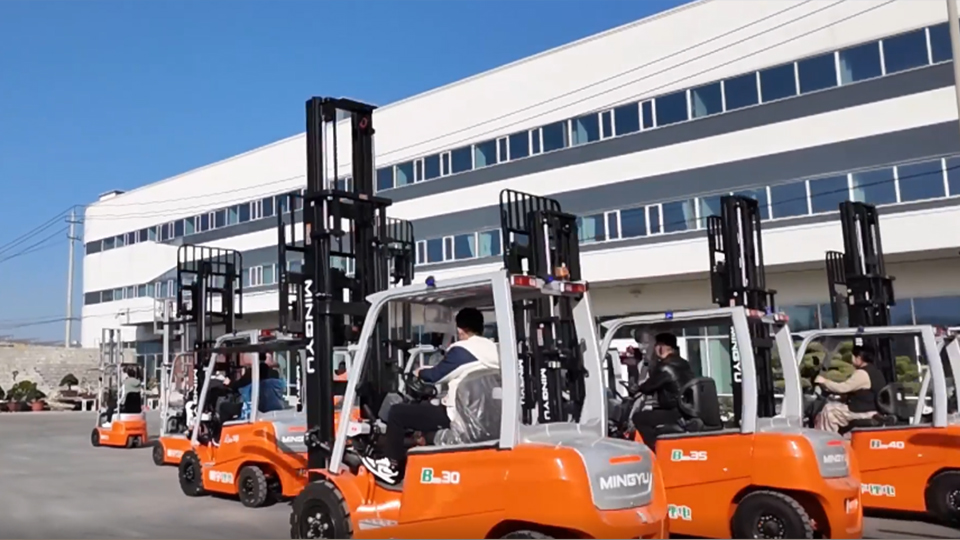
• Electric Forklifts: Used for indoor warehouses, electric forklifts are quiet, emission-free, and low-maintenance. They are ideal for warehouses that handle food, pharmaceuticals, or other goods that require a clean environment.
7.2 Versatility in Handling Different Load Types
Forklifts are also versatile in their ability to handle different load types, thanks to specialized attachments. As mentioned earlier, attachments such as clamps, booms, and side shifters allow forklifts to handle bulky, awkward, and fragile loads. This versatility means that a single forklift can be used for multiple tasks, reducing the need for specialized equipment and lowering costs.
8. Conclusion: Forklifts Are the Backbone of Modern Warehousing
Forklifts are not just a piece of equipment in warehouses—they are the backbone of modern warehousing and logistics operations. From improving efficiency and handling heavy loads to maximizing space utilization and enhancing safety, forklifts address the core challenges of warehousing and enable businesses to compete in today’s fast-paced global supply chain.
The core reasons why we use forklifts in warehouses are clear: they provide unmatched efficiency in load handling, enabling warehouses to move goods quickly and streamline operations; they can handle heavy, bulky, and awkward loads that are beyond human capability; they maximize vertical space utilization, reducing the need for additional warehouse space; they enhance workplace safety, reducing the risk of injuries and accidents; they optimize costs by reducing labor expenses, minimizing damage to goods, and lowering rent costs; they integrate with modern warehouse systems, enabling automation and digitization; and they are versatile, adapting to diverse warehouse environments and applications.
As the warehousing industry continues to evolve—with the rise of e-commerce, automation, and global trade—the role of forklifts will only become more critical. Autonomous forklifts, advanced safety features, and integration with smart warehouse systems will further enhance the efficiency, safety, and versatility of forklifts, ensuring that they remain an indispensable tool in warehouses for years to come.
For warehouse managers and operators, investing in forklifts and proper operator training is not just a cost—it is an investment in the efficiency, safety, and success of their operations. By understanding the critical role of forklifts in warehouses and leveraging their capabilities, businesses can optimize their warehousing processes, reduce costs, and stay competitive in the global marketplace.
In summary, forklifts are essential in warehouses because they do what manual labor and other equipment cannot: they move heavy loads quickly, safely, and efficiently; they maximize the use of valuable warehouse space; and they enable warehouses to adapt to the ever-changing demands of modern logistics. Without forklifts, modern warehousing as we know it would not be possible.
Name: selena
Mobile:+86-13176910558
Tel:+86-0535-2090977
Whatsapp:8613181602336
Email:vip@mingyuforklift.com
Add:Xiaqiu Town, Laizhou, Yantai City, Shandong Province, China
