
vip@mingyuforklift.com
+86-0535-2090977

Beyond Diesel: Effective Forklift Alternatives for Cold Storage Environments
Cold storage facilities—including refrigerated warehouses, freezers, and deep-freeze operations (often operating between 1$0^{\circ}\text{C}$ and 2$-30^{\circ}\text{C}$ or lower)—present a uniquely challenging environment for material handling equipment.3 While the robust nature and high torque of diesel forklifts make them reliable in standard outdoor conditions, their use in controlled cold storage is highly problematic and often prohibited due to technical limitations and operational hazards.
This technical article explores why traditional diesel forklifts are unsuitable for prolonged cold storage use, and provides a comprehensive, technical evaluation of the viable, superior alternatives: Electric Counterbalance Forklifts, Fuel Cell (Hydrogen) Forklifts, and specialized Liquefied Petroleum Gas (LPG) models.
I. Why Diesel Fails in the Freeze
The operation of a conventional diesel forklift in a freezer environment introduces severe technical, safety, and logistical challenges that make it an impractical and inefficient choice.
1. Technical Performance Degradation
Fuel Gelling (Wax Crystallization): Standard diesel fuel (No. 2-D) contains paraffins that begin to crystallize (gel) at temperatures around $0^{\circ}\text{C}$. This clogs fuel filters and lines, leading to engine starvation and failure.4 While winterized diesel (No. 1-D) can tolerate lower temperatures, it may still fail in deep freeze environments ($<-20^{\circ}\text{C}$) and has a lower energy density, slightly reducing power.
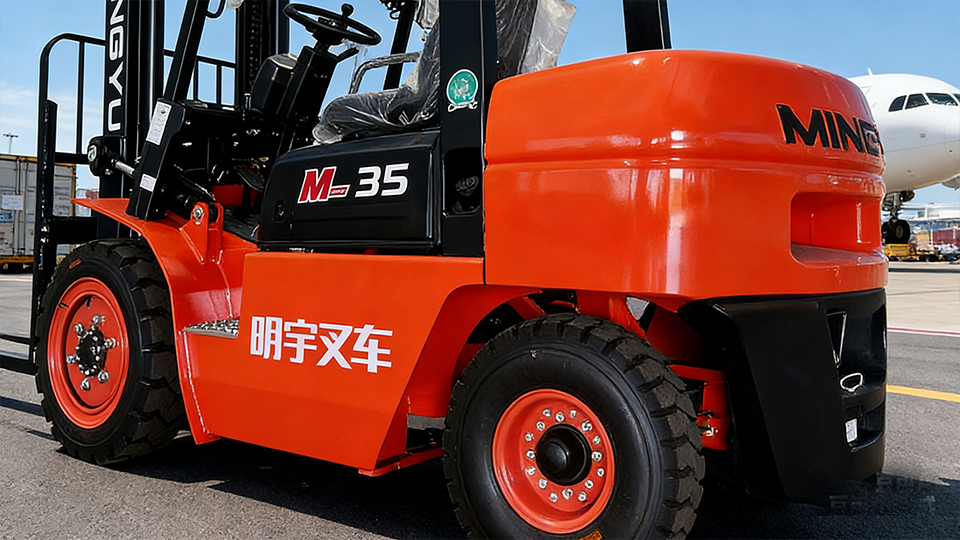
Oil Viscosity and Cold Cranking: Engine oil viscosity increases dramatically in the cold, leading to excessive cranking resistance and strain on the starter motor and battery.5 The engine must overcome significantly higher internal friction ($\tau$) during start-up, demanding block heaters or prolonged warm-up cycles.
Condensation and Icing: Moving the machine in and out of the cold storage area causes moisture to condense on cold surfaces, leading to rapid icing of critical components like brakes, linkages, electronic sensors, and seals.
2. Safety and Environmental Concerns
Exhaust Emissions: Diesel engines produce combustion byproducts, including Carbon Monoxide (6$\text{CO}$), Nitrogen Oxides (7$\text{NO}_x$), and Diesel Particulate Matter (8$\text{DPM}$) (soot).9 In enclosed spaces, these emissions pose a severe health hazard to workers and require complex, expensive ventilation systems (air exchange rates) that fight against the need to maintain cold temperatures.
Ventilation Costs: Maintaining safe air quality requires continuous air exchange, which translates directly into massive refrigeration load penalties. Every cubic meter of warm, incoming air must be cooled, directly escalating utility costs.
3. Logistical Problems
Downtime and Defrosting: Diesel forklifts require frequent removal from the freezer to thaw and dry out crucial systems (electronics, brakes) to prevent failure, leading to significant unproductive downtime.
II. The Primary Alternative: Electric Forklifts
Electric (Battery-Powered) Counterbalance Forklifts are the industry standard for cold storage operations, offering zero emissions and superior technical adaptability, provided they are correctly specified and managed.
A. Technical Advantages of Electric Power in Cold
Zero Emissions: Eliminates the need for expensive high-volume ventilation systems, dramatically reducing the refrigeration load.
Reduced Component Failure: Electric motors and drive systems have fewer moving parts than internal combustion engines, simplifying maintenance and reducing the opportunity for cold-related failures like fluid thickening or gelling.
Instant Torque: Electric motors deliver peak torque from zero 10$\text{RPM}$, offering responsive performance ideal for stop-start, close-quarters operations common in racking aisles.11
B. The Cold-Weather Battery Challenge
The primary technical hurdle for electric forklifts in cold environments is the lead-acid battery, as chemical reactions slow down significantly with decreasing temperature.
Capacity Degradation: Below $0^{\circ}\text{C}$, the usable capacity of a standard lead-acid battery degrades approximately 1% to 1.5% per degree Celsius. At $-20^{\circ}\text{C}$, the available capacity can drop to $60\% - 70\%$ of the rated capacity.
$$\text{Available Capacity} \propto T \text{ (Temperature)}$$
Voltage Drop and Internal Resistance: The battery's internal resistance (12$R_{\text{int}}$) increases in the cold.13 When high current is drawn (e.g., during lifting or acceleration), the voltage drop ($\Delta V = I \cdot R_{\text{int}}$) is higher, which can prematurely trigger the battery discharge limit cut-off, shortening runtime.
C. Electric System Cold-Weather Solutions (Specifications)
To counteract these effects, cold storage electric forklifts require specific hardware and operational protocols:
Freezer Conditioning (The "F" Option):
Heated Compartments: Critical electronic controllers, hydraulic pumps, and displays must be protected by dedicated internal heaters and robust insulation.
Specialized Oils: Hydraulic systems must use low-viscosity, synthetic hydraulic fluid specifically rated for low-temperature operation (e.g., ISO $\text{VG} 15$ or $22$), preventing sluggish hydraulic response.
Teflon/Stainless Components: Exposed components (like lift cylinder rods) are often coated (Teflon) or made of stainless steel to resist icing.
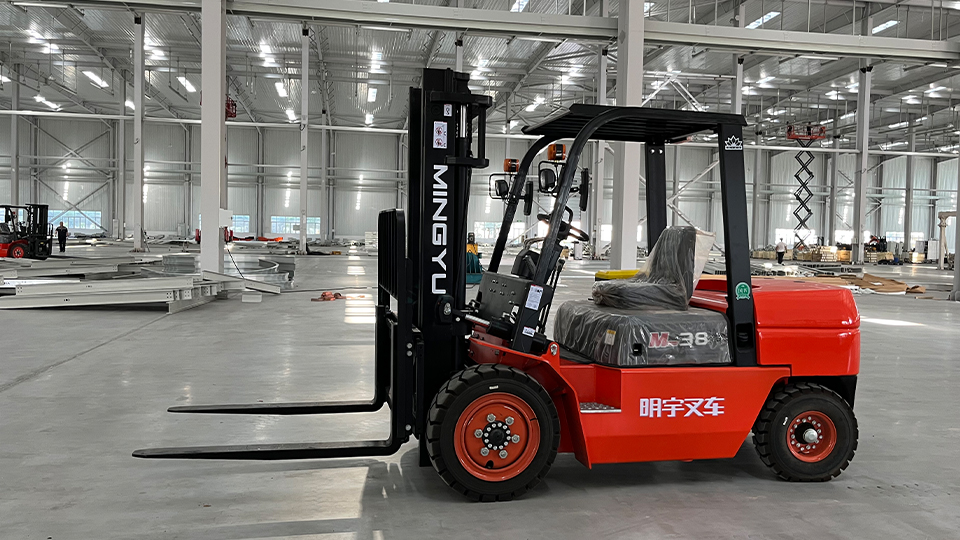
Battery Technology and Management:
Heated Batteries: High-capacity batteries are often equipped with an integrated heating blanket or circulation system to maintain the core temperature above the critical $10^{\circ}\text{C}$ threshold.
Opportunity Charging: Instead of relying on a single, long charge, opportunity charging (brief charges during breaks outside the freezer) helps recover capacity lost to the cold.14
Lithium-Ion (Li-ion) Batteries: Li-ion technology is increasingly preferred in cold storage despite a higher initial cost.15 Li-ion batteries offer:
Lower Cold Degradation: Their performance degradation in the cold is less severe than lead-acid.
Integrated Thermal Management: Most Li-ion packs include sophisticated Battery Management Systems (BMS) that heat or cool the cells to maintain peak efficiency and safety.16
Zero Maintenance: Eliminates the need for watering and equalization.
III. Emerging Alternative: Fuel Cell (Hydrogen) Forklifts
Fuel Cell Electric Vehicles (17$\text{FCEV}$) represent a rapidly maturing solution, offering the benefits of electric power with the rapid refueling convenience of internal combustion.18
A. How Fuel Cells Work in the Cold
A hydrogen fuel cell is an electrochemical device that converts the chemical energy of hydrogen (19$\text{H}_2$) and oxygen (20$\text{O}_2$) into electricity, producing water and heat as the only byproducts.21
$$\text{Anode}: \text{H}_2 \rightarrow 2\text{H}^+ + 2\text{e}^-$$
$$\text{Cathode}: \frac{1}{2}\text{O}_2 + 2\text{H}^+ + 2\text{e}^- \rightarrow \text{H}_2\text{O}$$
Fuel Cell Stack: The $\text{PEM}$ (Proton Exchange Membrane) fuel cell stack generates power, which then charges a buffer battery pack and drives the electric motor.
Thermal Byproduct: The heat generated as a byproduct of the reaction is a significant advantage in cold storage. This heat is used to maintain the optimal operating temperature of the fuel cell stack itself and can be used for supplemental cabin or hydraulic component heating.
B. Technical Advantages in Cold Storage
Sustained Performance: Fuel cell performance is less affected by sustained cold temperatures compared to lead-acid batteries, as the chemical reaction (electrochemistry) is continuously supplied with fresh fuel and is internally heated.
Rapid Refueling: Refueling takes only $2 \text{ to } 3$ minutes (similar to gasoline/diesel), compared to $8 \text{ to } 12$ hours for lead-acid battery charging. This drastically reduces downtime and eliminates the need for large battery change rooms.
Consistent Power: Unlike batteries, which experience a voltage sag as they discharge, fuel cells maintain a consistent power output throughout the entire hydrogen tank depletion cycle.22
C. Infrastructure and Implementation Challenges
High Initial Cost: The capital investment for fuel cell forklifts and the necessary on-site hydrogen storage and dispensing station is substantial.
Hydrogen Supply Chain: Requires a secure, reliable source of high-purity hydrogen, typically delivered via tube trailers or generated on-site via electrolysis or natural gas reforming.
Safety Protocols: Handling and storage of high-pressure hydrogen (typically 23$\mathbf{350 \text{ bar}}$ or 24$\mathbf{5,000 \text{ psi}}$) requires strict adherence to safety codes and certified training.25
IV. Specialized LPG Forklifts (The Viable Combustion Option)
While diesel is largely out, a specialized Liquefied Petroleum Gas (LPG) forklift can be a viable combustion-engine alternative, particularly for high-throughput, short-duration applications in chillers (above $-10^{\circ}\text{C}$).
A. LPG System Advantages over Diesel
Cleaner Combustion: LPG produces significantly lower $\text{NO}_x$ and virtually no $\text{DPM}$ (particulate matter) compared to diesel. This makes their use permissible in some well-ventilated chiller zones, though still restricted in deep freezers.
No Gelling: LPG (primarily propane and butane) remains a gas at standard storage temperatures, eliminating the fuel gelling problems inherent to diesel.
Consistent Starting: LPG ignition systems generally perform more reliably in the cold compared to diesel compression ignition systems fighting thick oil and poor atomization.
B. Technical Constraints of LPG in Cold Storage
Vaporization: LPG is stored as a liquid and must vaporize before injection. Low ambient temperatures hinder this vaporization process, potentially leading to performance issues if the tank is not properly pressurized or heated.
Solution: Specialized LPG systems for cold storage incorporate tank heaters and pressure regulators designed to ensure the fuel remains in the gaseous state required for optimal combustion.
$\text{CO}$ Risk: Despite being cleaner than diesel, LPG still produces Carbon Monoxide ($\text{CO}$). Operators must strictly monitor ambient $\text{CO}$ levels, and ventilation requirements remain higher than for electric fleets.
Operational Limitations: LPG forklifts are still subject to icing and component freezing if exposed to extreme cold or frequent transitions, requiring more frequent defrosting cycles than electric units.
V. Technical Comparison and Selection Matrix
The choice of the optimal forklift alternative for cold storage is dictated by temperature, duty cycle, and capital budget.
|
Feature |
Electric (Lead-Acid/Li-ion) |
Fuel Cell (Hydrogen) |
Specialized LPG |
Unmodified Diesel |
|
Suitable Temperature Range |
$\mathbf{-35^{\circ}\text{C} \text{ to } 0^{\circ}\text{C}}$ |
$\mathbf{-30^{\circ}\text{C} \text{ to } 0^{\circ}\text{C}}$ |
$-10^{\circ}\text{C} \text{ to } 0^{\circ}\text{C}$ (Chiller only) |
Not Recommended/Prohibited |
|
Emissions (Enclosed Space) |
Zero (Ideal) |
Zero (Water Vapor) |
Low $\text{CO}/\text{NO}_x$ (Requires Ventilation) |
High $\text{CO}/\text{NO}_x/\text{DPM}$ (Unsafe) |
|
Refueling/Recharge Time |
8-12 hrs (Lead-Acid) / 1-2 hrs (Li-ion) |
2-3 Minutes (Ideal) |
2-3 Minutes |
2-3 Minutes |
|
Cold Performance Factor |
Capacity loss (managed by heating/Li-ion $\text{BMS}$) |
High, sustained power (internal heating) |
Reliable start, but limited by vaporization |
Severe performance loss/starting failure (gelling) |
|
Initial Investment Cost |
Medium (Higher for Li-ion/Freezer Specs) |
Highest (Includes infrastructure) |
Lowest |
Low (But unsuitable) |
|
Best Application |
Sustained deep freeze operation, low ventilation costs. |
High-throughput, $24/7$ operations where battery swaps are impractical. |
Medium-throughput, short-duration chiller zone work. |
Outdoor yard/dock (Non-freezer). |
Conclusion for Selection
Deep Freeze ($\mathbf{<-20^{\circ}\text{C}}$): Electric (Lithium-Ion) is the superior technical choice. The $\text{BMS}$ and thermal management ensure reliability, and zero emissions eliminate catastrophic ventilation costs.
High-Throughput Freezer: Fuel Cell technology provides the necessary uptime and performance consistency for $24/7$ operations where extended battery charge times are unacceptable.
Chiller/Cooler ($\mathbf{0^{\circ}\text{C}}$ to $\mathbf{-10^{\circ}\text{C}}$): Specialized LPG or Electric (less specialized) models are both viable, depending on local ventilation codes and infrastructure.
Conclusion: The Mandate for Specialized Solutions
Operating material handling equipment in cold storage is a specialized engineering challenge. The technical and safety failures inherent in standard diesel operation—fuel gelling, oil thickening, high emissions, and extreme ventilation costs—render it largely obsolete in this domain.
The modern cold storage facility must transition to specialized alternatives. Electric forklifts, particularly those utilizing advanced Lithium-Ion batteries with integrated thermal management, offer the cleanest, most technically robust solution for sustained deep-freeze work. For facilities prioritizing throughput above all else, Hydrogen Fuel Cells represent the future of rapid, high-performance cold storage material handling. The selection hinges not just on initial cost, but on the total energy consumption penalty and the ability of the chosen technology to maintain operational integrity in a hostile, freezing environment.
Name: selena
Mobile:+86-13176910558
Tel:+86-0535-2090977
Whatsapp:8613181602336
Email:vip@mingyuforklift.com
Add:Xiaqiu Town, Laizhou, Yantai City, Shandong Province, China