
vip@mingyuforklift.com
+86-0535-2090977

Selecting the correct tire for a diesel forklift is a critical decision that directly impacts the safety, efficiency, longevity, and maintenance costs of your material handling operations. Unlike electric forklifts, which are almost exclusively designed for indoor use, diesel forklifts are often deployed in a wider variety of environments, including indoor warehouses with specific flooring types, outdoor yards, and combined indoor/outdoor operations.
The warehouse floor itself—its composition, condition, and environment—is the primary determinant in this selection process. Using the wrong tire can lead to premature tire wear, increased fuel consumption, floor damage, instability, and operator discomfort.
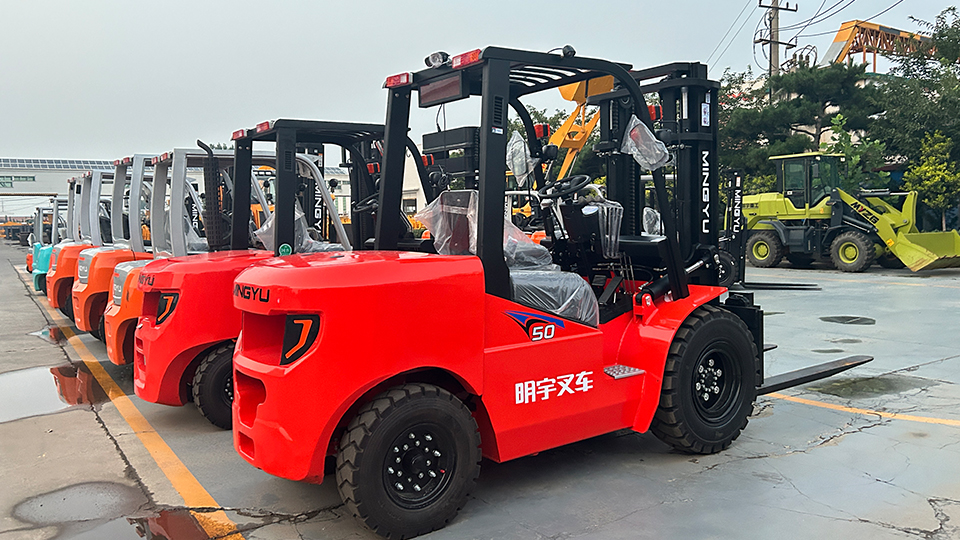
This technical article provides a comprehensive guide to understanding the main diesel forklift tire types, assessing common warehouse floor conditions, and detailing the methodology for making the optimal choice.
1. Understanding Diesel Forklift Tire Types
Diesel forklifts, due to their typically higher load capacities and often outdoor use, primarily utilize two major categories of tires: Pneumatic and Solid (Cushion).
1.1. Pneumatic Tires (Air-Filled)1
Pneumatic tires are similar in construction to standard vehicle tires, comprising a rubber tread, reinforced sidewalls, and an inner tube (for tube-type) or a sealed structure (for tubeless).
1.1.1. Standard Pneumatic Tires
Construction: Air-filled, offering a cushioned ride due to the compressed air absorbing shocks and vibrations.2
Best Suited For: Rough, uneven, or loose surfaces, such as asphalt, gravel, dirt, and expansion joints.3 Their flexibility allows them to conform to minor irregularities.
Pros: Superior traction and shock absorption, significantly reducing the impact on the forklift chassis and the operator. Better for high-speed, long-distance travel.
Cons: Vulnerable to punctures from sharp debris (nails, metal shavings), leading to downtime.4 Higher maintenance (monitoring air pressure). Their width can increase rolling resistance on smooth floors.
1.1.2. Solid Pneumatic (or "Resilient") Tires
Construction: These tires have the shape and tread pattern of a pneumatic tire but are made entirely of solid rubber compound (typically a three-stage compound: base, cushion, and tread). They are not air-filled.
Best Suited For: The transition zone between harsh outdoor use and puncture-prone indoor environments. They are ideal for operations that have outdoor travel but need the puncture-proof nature of a solid tire.
Pros: Puncture-proof (zero flats), longer wear life than standard pneumatics, and still offer better cushioning than pure cushion tires. Excellent stability.
Cons: Ride is stiffer than air-filled tires, generating more heat at high speeds. Heavier, which can slightly increase fuel consumption.
1.2. Solid Tires (Cushion Tires)
Cushion tires are made of solid rubber molded directly onto a steel band.5 They are designed to operate on the pressure of the entire solid mass of rubber.
Construction: Solid rubber, typically narrower and smaller in diameter than pneumatic tires. They are pressed onto the wheel hub.
Best Suited For: Smooth, flat, indoor surfaces such as polished concrete, epoxy floors, and high-density flooring. They are primarily used in applications where turning radius and high-stacking are important.
Pros: Extremely long lifespan (due to the sheer volume of rubber), puncture-proof, virtually maintenance-free, and allow for a smaller turning radius on the forklift (as the tire is physically smaller). They are the most stable option for indoor, high-stacking applications.
Cons: Poor shock absorption, transmitting most of the floor’s imperfections and vibration directly to the chassis and operator. Unsuitable for uneven ground (will cause rapid component wear and operator fatigue). Less traction than pneumatics.
2. Assessing the Warehouse Floor and Environment ��️
The selection process must begin with a rigorous assessment of the operational environment.
2.1. Floor Material and Condition
|
Floor Type |
Characteristics |
Impact on Tire Selection |
Recommended Tire Type |
|
Polished Concrete / Epoxy |
Very smooth, hard, flat, often seamless. |
Requires minimal cushioning; tires must resist leaving marks (non-marking option). |
Cushion (Solid) |
|
Rough/Sealed Concrete |
Flat, but may have minor pitting, cracks, or expansion joints. |
Requires some shock absorption to protect the load/operator from minor vibrations. |
Solid Pneumatic or Cushion (with caution) |
|
Tile / High-Density Flooring |
Smooth, but joints or broken tiles can create small hazards. |
Prioritize low-impact and non-marking tires to protect the floor surface. |
Cushion (Solid), Non-Marking Compound |
|
Asphalt / Blacktop |
Softer than concrete, can be rough, uneven, and temperature-sensitive. |
Requires good heat dissipation and load stability. |
Solid Pneumatic or Standard Pneumatic |
|
Gravel / Dirt (Outdoor) |
Extremely rough, loose debris, deep ruts. |
Requires maximum shock absorption and traction to prevent slipping and punctures. |
Standard Pneumatic (Deep Tread) |
2.2. Environmental Factors and Debris
Puncture Hazards: If the floor has a consistent presence of metal fragments, glass, sharp aggregate, or construction debris, Solid Pneumatic or Cushion tires are mandatory. Standard Pneumatics will lead to excessive downtime.
Temperature: High-speed or continuous operation generates heat, particularly in solid tires.6 For very long, continuous runs on smooth floors, ensure the rubber compound is rated for heat dissipation (often a three-stage construction).
Contaminants: Spills of oils, chemicals, or solvents can degrade natural rubber compounds.7 In these environments, consider synthetic or specialized rubber compounds that offer chemical resistance.
2.3. Operational Profile
Indoor Only: Primarily on smooth, flat concrete or high-density floors. Cushion tires are the default choice for their long life, stability, and small turning radius.
Outdoor Only: Primarily on rough, paved, or unpaved yards (gravel, dirt, asphalt).8 Standard Pneumatic or Solid Pneumatic are essential for traction and shock absorption.9
Indoor/Outdoor Mix (50/50): The most challenging scenario. Solid Pneumatic tires offer the best compromise, providing stability and puncture resistance indoors while still providing adequate cushioning and traction outdoors.
3. Tire Compound Considerations: Beyond the Structure
Once the basic structure (Pneumatic vs. Cushion) is determined, the composition of the rubber compound is the next critical layer of selection, particularly for indoor environments.
3.1. Standard Rubber (Black)
Composition: Typically carbon black is used as a reinforcing filler, which provides high strength, abrasion resistance, and excellent heat dissipation.10
Use: The default choice for almost all diesel forklift applications, especially outdoors or in high-intensity operations where marking is not a concern.
The Mark: The primary drawback is that they leave black marks (skid marks) on indoor floors, which can be unacceptable in certain facilities (e.g., food processing, retail, or clean manufacturing).
3.2. Non-Marking (White or Grey)
Composition: Carbon black is replaced by materials like silica or specialized resins. This sacrifice of carbon black results in a slight reduction in abrasion resistance and heat dissipation.
Use: Mandatory for sensitive indoor floors (polished concrete, epoxy, tile) where black marks are prohibited. They are common on cushion and solid pneumatic tires.
Caveat: Non-marking tires typically have a shorter lifespan (up to 20-25% less) and can sometimes run hotter than black tires, making high-speed, continuous use a concern.11 They also show dirt and grease more readily, requiring more frequent cleaning.
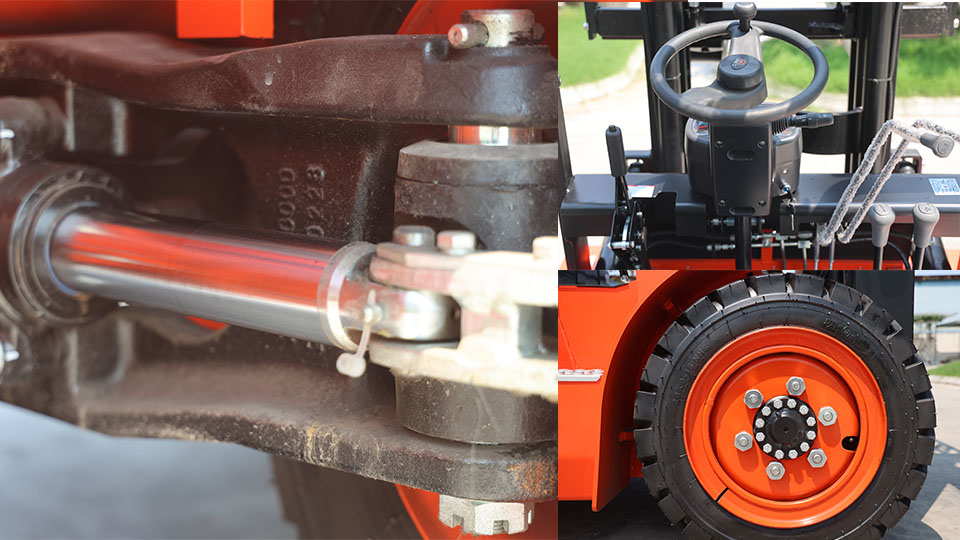
3.3. Specialized Compounds
Static-Dissipative: Used in environments with sensitive electronics, such as data centers or clean rooms, to prevent the buildup and discharge of static electricity.12
Oil/Chemical Resistant: Rubber compounds formulated to resist the softening and degradation caused by specific industrial oils, hydraulic fluids, and corrosive chemicals, common in certain manufacturing or refinery settings.
4. The Selection Methodology: A Step-by-Step Guide ��
Choosing the right tire involves a systematic evaluation of all the factors discussed.
Step 1: Identify the Operational Environment
Question: Is the operation 100% Indoor, 100% Outdoor, or Mixed?
100% Indoor/Smooth: Proceed to Step 2.
100% Outdoor/Rough: Default to Standard Pneumatic (if punctures aren't an issue) or Solid Pneumatic.
Mixed or Indoor/Puncture Risk: Default to Solid Pneumatic.
Step 2: Assess Floor Condition (For Indoor/Mixed)
Question: Is the floor smooth/flat (polished concrete, epoxy) or rough/uneven (cracked concrete, expansion joints)?
Smooth/Flat: Cushion Tire is the optimal choice for maximum longevity and lowest fuel consumption. Proceed to Step 3.
Rough/Uneven: Solid Pneumatic is the best choice to bridge the gap between stability and necessary shock absorption. Proceed to Step 3.
Step 3: Determine Marking Requirement
Question: Do floor marks need to be avoided?
Yes (Marking is a Concern): Select a Non-Marking Compound (White/Grey). Be mindful of the potentially shorter life and heat generation.
No (Marking is Acceptable): Select a Standard (Black) Compound for superior strength, heat resistance, and wear life.
Step 4: Evaluate Load and Speed
Load: Always ensure the Load Rating stamped on the tire matches or exceeds the forklift's rated capacity at maximum lift height and load center. This is non-negotiable.
Speed/Duration: For extremely long runs (over 500 feet one way) or continuous use over many hours (e.g., three shifts), the tire must be able to dissipate heat. Standard Black Compounds and Solid Pneumatics are generally better for heat than Non-Marking Cushions. Consult the tire manufacturer's TMPH (Tons Miles Per Hour) rating for high-duty cycles.
Step 5: Consider Maintenance and Replacement Costs
Cushion Tires: Lowest maintenance (no flats, no air pressure checks). Require a press to replace, which can increase the replacement cost if you don't own the equipment.
Standard Pneumatic Tires: Highest maintenance (flat risk, regular air checks). Easiest to replace with standard tools.
Solid Pneumatic Tires: Low maintenance (no flats). Replacement is similar to standard pneumatics but often requires specialized fitting due to the rigidity.
5. Potential Pitfalls and Advanced Considerations
5.1. The Dangers of Using Cushion Tires Outdoors
While physically possible to run a cushion-tired diesel forklift outdoors, it is highly discouraged. Cushion tires offer zero meaningful shock absorption for the rough, uneven surfaces found in yards.
Impact: The vibration is transmitted directly into the operator (leading to fatigue and potential injury) and the forklift's components (leading to rapid wear of the transmission, differential, steering axle, and mast rollers).
Solution: For occasional outdoor use, keep the distance and speed to a minimum. For regular use, invest in the appropriate Solid Pneumatic or Standard Pneumatic tire set.
5.2. Understanding Tire Wear Patterns
Tire wear provides vital clues about the floor and operational errors:
Toe/Heel Wear: Often indicates improper inflation (for pneumatics) or a need for alignment adjustments.
Cupping/Scooping: Indicates problems with the steering system, suspension, or wheel bearings.
Fast Center Wear: Indicates over-inflation (for pneumatics).
Fast Shoulder Wear: Indicates under-inflation (for pneumatics) or overloading.
Tearing/Chunking: Typically indicates the tires are running on surfaces too rough for their type (e.g., cushion tires on concrete spalls) or hard braking/skidding.
5.3. Tire Tread Depth and Patterns
Smooth (Slick): Used primarily on cushion tires for the flattest, smoothest indoor floors. Maximum contact patch for smooth movement.
Standard Ribbed/Traction: The most common tread pattern for pneumatic and solid pneumatic tires. Provides forward/backward traction and channels water away in wet conditions. Essential for outdoor use.
Deep-Tread/Lug: Highly aggressive pattern used for extremely rough, loose, or muddy outdoor environments (e.g., construction sites or lumberyards). Offers superior traction but is unsuitable for indoor use as it can damage the floor and create unnecessary rolling resistance.
Conclusion
The selection of a diesel forklift tire is a calculated balance between durability, cushioning, traction, and floor preservation.
For the vast majority of dedicated indoor warehouse applications with smooth, well-maintained concrete, the Cushion (Solid) Tire is the economical and high-performance champion. It maximizes run time and minimizes fuel consumption and maintenance.
However, where floors are rough, where operations are mixed indoor/outdoor, or where debris is a threat, the Solid Pneumatic Tire provides the necessary resilience, shock absorption, and puncture resistance to protect the equipment and the operator.13
Neglecting this decision results in costly floor repairs, premature forklift component failure, and operational inefficiencies. A careful, systematic assessment based on the four core factors—Environment, Floor Condition, Marking Requirement, and Operational Load—is the key to ensuring your diesel fleet operates safely and at peak efficiency.
Name: selena
Mobile:+86-13176910558
Tel:+86-0535-2090977
Whatsapp:8613181602336
Email:vip@mingyuforklift.com
Add:Xiaqiu Town, Laizhou, Yantai City, Shandong Province, China
