
vip@mingyuforklift.com
+86-0535-2090977

Off-road forklifts, often referred to as Rough Terrain Forklifts (RTFLs) or Telehandlers (Telescopic Handlers), are indispensable machines on construction sites, lumberyards, agricultural fields, and remote industrial locations. Unlike their warehouse counterparts, which operate on smooth, controlled surfaces, RTFLs must contend with dynamic, unpredictable, and hazardous environments—including steep grades, soft ground, debris, and low visibility.
The inherent instability of operating a high-capacity lifting machine on uneven surfaces elevates the risk profile significantly. Consequently, the safety features required for off-road operation extend far beyond the basic requirements for indoor forklifts. These features fall into three critical categories: Stability and Tip-Over Prevention, Operator Protection and Restraint, and Enhanced Visibility and Warning Systems.
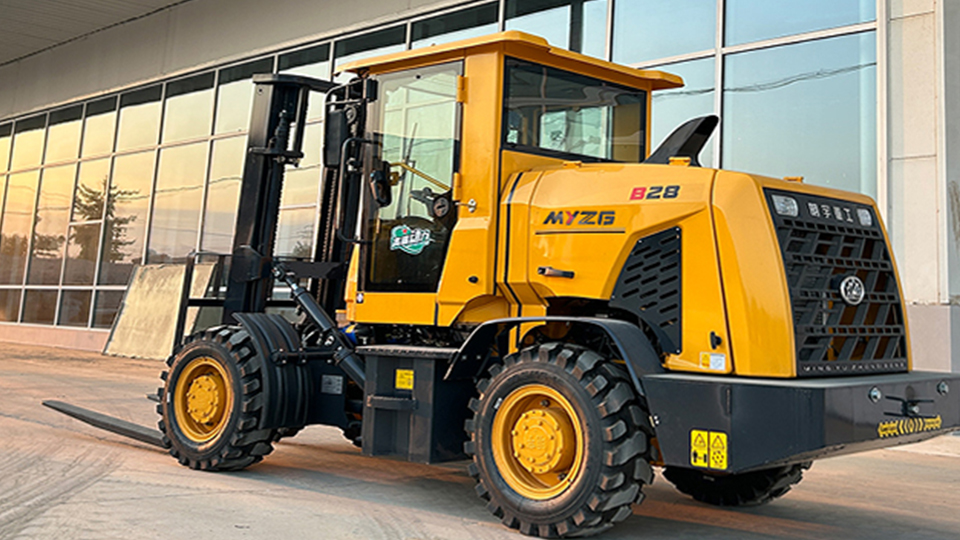
This technical article details the essential safety features, both engineered into the machine and mandated by best practices, necessary for safe and compliant off-road forklift operation.
1. Stability and Tip-Over Prevention Systems
The single greatest hazard in off-road forklift operation is the risk of a lateral or longitudinal tip-over. Stability is dramatically reduced on sloped, uneven, or soft ground. The following features are non-negotiable for mitigating this risk.
1.1. Rollover Protection System (ROPS) and Falling Object Protective Structure (FOPS)
This is the foundational safety architecture of any rough-terrain machine.
ROPS (Rollover Protection System): A high-strength, reinforced frame (often a roll cage or four-post structure) integrated into the chassis of the forklift. Its primary function is to create an Occupant Protective Zone around the operator in the event of a lateral or longitudinal tip-over. Crucially, the ROPS is only effective if the operator remains secured inside the zone, necessitating the mandatory use of a seatbelt.
FOPS (Falling Object Protective Structure): A robust cage or canopy (often the Overhead Guard) integrated above the operator compartment. In off-road environments, this structure must be substantially stronger than those on indoor forklifts to protect the operator from falling debris, materials shifted by high winds, or objects displaced from high stacks. FOPS compliance is often detailed in standards like ANSI/ITSDF B56.6.
1.2. Dynamic Stability Systems (DSS) and Load Moment Indicators (LMI)
While operators are trained on the "stability triangle," modern safety demands active, real-time monitoring.
Load Moment Indicator (LMI) / Load Moment Limiter (LML): Found most commonly on telehandlers, this system actively monitors the relationship between the load weight, load distance (reach), and the machine’s structural capacity. The LMI provides the operator with an audible and visual warning when the load is approaching or exceeding the safe operating limit. The LML acts as a hard safety stop, automatically locking out hydraulic functions (e.g., boom extension or load lowering) to prevent movement into an unsafe zone.
Dynamic Stability System (DSS): This advanced system uses sensors to continuously monitor the forklift’s parameters, including mast tilt angle, steering angle, load weight, and travel speed. It can actively limit functions, such as slowing the travel speed when turning with a load elevated, or restricting mast tilt if the load height exceeds a safe threshold for the current ground conditions.
1.3. Frame Leveling and Stabilizer/Outrigger Deployment
Rough terrain dictates that the initial lift point is rarely perfectly level.
Hydraulic Frame Leveling: Many RTFLs feature a hydraulic tilt function that allows the operator to level the main chassis/frame side-to-side (lateral axis) before the load is lifted. This ensures the mast is vertical and the load's center of gravity is positioned correctly within the machine's stability base, even when the ground is sloped up to 10 degrees. Crucially, the frame should only be leveled before the load is significantly elevated.
Stabilizers (Outriggers): Used on high-lift or high-reach telehandlers. These hydraulically extendable supports increase the machine's stability base, particularly when extending the boom/mast horizontally or lifting to maximum height. Interlocks are essential: the machine must be prevented from engaging certain lifting or travel functions unless the stabilizers are fully and correctly deployed on a firm surface.
2. Operator Protection and Ergonomics
The severe vibration, jarring, and potential for violent movement on rough terrain necessitate specialized features to protect the operator from injury and fatigue.
2.1. Operator Restraint System (Seatbelt)
The seatbelt is arguably the most critical component paired with the ROPS.
Mandatory Three-Point Harnesses: Standard lap belts are often insufficient. A three-point or full harness system is essential to prevent the operator from being ejected or from making contact with the ground, the overhead guard, or the ROPS structure itself during a severe tip-over or impact.
Interlock System: The seatbelt must be integrated with an operator presence system (OPS) that includes a safety interlock. The machine should not allow hydraulic functions (lift/tilt) or travel unless the operator is properly seated and the seatbelt is fastened. This enforces the rule that the operator must remain within the protective envelope of the ROPS at all times.
2.2. Suspension Seat and Isolation
Prolonged exposure to whole-body vibration (WBV) from rough ground leads to operator fatigue and long-term health issues.
Full Air-Ride or Mechanical Suspension Seats: High-quality RTFLs feature advanced suspension seats designed to absorb the severe vertical and horizontal jolts. These seats often have multiple adjustments for height, weight, and lumbar support to reduce spinal compression and vibration transmission.
Vibration-Damping Cab Mounts: The entire cab structure should be mounted on specialized vibration and noise-damping systems to isolate the operator from engine and ground noise and vibration, improving comfort, reducing fatigue, and enhancing cognitive focus.
2.3. Safe Access and Egress
The increased height of off-road equipment, combined with muddy or greasy conditions, makes mounting and dismounting hazardous.
Three Points of Contact: All rough terrain equipment requires securely attached, non-slip access steps and handholds designed to maintain three points of contact (two hands and one foot, or one hand and two feet) when entering or exiting the cab.
High-Visibility Handles and Steps: Steps and access points should be clearly demarcated with high-contrast colors and feature self-cleaning, anti-slip grating or serrated surfaces.
3. Enhanced Visibility and Warning Systems
Off-road worksites are characterized by constantly changing terrain, unpredictable pedestrian traffic, and frequent blind spots due to large components and elevated loads. Visibility and alerting systems are paramount for preventing struck-by accidents.
3.1. All-Terrain Tires and Wheel/Axle Configuration
While not a 'safety feature' in the same sense as a sensor, the proper wheels are essential for stability and control.
Aggressive Pneumatic Tires: Rough terrain forklifts require large-diameter, deep-tread, pneumatic tires to provide maximum floatation on soft ground and superior traction on loose surfaces (mud, gravel, loose dirt). These tires act as the initial, most crucial shock absorber.
Four-Wheel Drive (4x4 or AWD): Essential for maintaining traction, especially when climbing grades or navigating soft ground with a load, which is critical for directional control and preventing uncontrolled slippage.
3.2. Advanced Lighting and Proximity Warning
Standard headlights and brake lights are insufficient for the scale and chaos of an off-road site.
High-Intensity LED Work Lights: Powerful, multiple LED lights are required for 360-degree illumination, not just for the direction of travel, but for the load area and the operator’s immediate surroundings, especially during pre-dawn, night, or fog operations.
Blue Spot Lights and Red Zone Lighting: These project highly visible, focused blue or red beams onto the ground ahead of and around the machine.
Blue Spot: Alerts pedestrians and other operators to the forklift's imminent approach.
Red Zone: Creates a visual perimeter barrier (the "no-go zone") that pedestrians must stay clear of while the machine is maneuvering. This is particularly effective in high-noise environments where horns are drowned out.
Audible Alarm System: A loud, multi-tone backup alarm is mandatory. Some advanced systems feature an auto-adjusting volume that dynamically increases the alarm intensity relative to the ambient noise level, ensuring it is heard without causing nuisance in quiet areas.
3.3. Operator Visibility Augmentation
The large mast, engine housing, and high loads inherently create severe blind spots.
Multi-Angle Camera Systems: High-definition cameras covering the rear, sides, and fork tips are essential for rough terrain. The rear camera is particularly critical when backing up, as the rear swing radius is large and the terrain may be too uneven for the operator to safely twist in the seat.
Large, Convex Mirrors: Strategically positioned convex mirrors must be used to provide the operator with an expansive view of all four corners of the machine and the area immediately behind the counterweight.
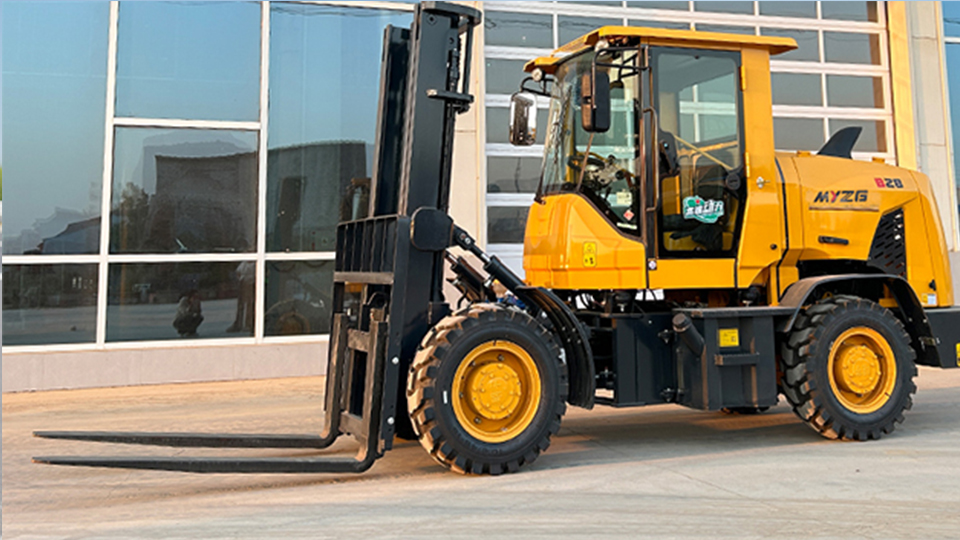
Clear Visibility Design: The mast, carriage, and fork designs must incorporate maximized visibility pathways, and the cab must utilize large, low-sill windows.
4. Operational and Maintenance Safety Features
These features relate to the machine's state of readiness and the control of the immediate work environment.
4.1. Braking and Parking Systems
Heavy-Duty, Multi-Disc Wet Brakes: Unlike dry brake systems, wet brakes are sealed in oil and are resistant to contamination from mud, water, dust, and debris common in rough terrain. They offer superior, consistent, and reliable braking force necessary for steep inclines.
Locking Parking Brake: The parking brake must be robust and interlocked to prevent accidental release. Wheel chocks are also a mandatory safety practice when parking on any incline, regardless of the machine's brake capacity.
4.2. Fuel and Fire Safety
Engine Shut-Off: Easily accessible, clearly marked emergency fuel and electrical shut-off switches are required to rapidly isolate power in the event of a mechanical failure or fire.
Fire Extinguisher Mount: A high-capacity, approved fire extinguisher (e.g., ABC dry chemical) must be mounted in an easily accessible, secure location outside the cab.
4.3. Load Charts and Operator Manuals
While not a physical feature of the machine, the documentation is a critical safety component.
Visible Load Chart: A clear, weather-resistant, and current Load Chart (Capacity Plate) must be conspicuously displayed within the operator's view. This chart dictates the maximum safe working load at various lift heights and horizontal extensions (reach) for the specific machine and attachment. Operators must be rigorously trained on how to interpret this chart.
Onboard Manuals: A copy of the manufacturer's Operator Manual and Safety Guide should be securely stored in the cab, providing immediate reference for emergency procedures, maintenance checks, and operational limits.
Conclusion
The operation of an off-road forklift is a complex interplay of machine capability and environmental hazard. The selection of essential safety features must address the unique challenges of dynamic terrain—namely, severe instability, operator fatigue, and limited visibility.
The robust pairing of the Rollover Protection System (ROPS) and the mandatory seatbelt interlock forms the core of operator injury prevention. This is reinforced by active systems like the Load Moment Indicator (LMI) and Frame Leveling that maintain the machine's stability base. Finally, enhanced visibility systems (Red Zone Lights, Blue Spots, and camera aids) are necessary to control the chaotic interface between the machine and the surrounding personnel.
For any employer deploying a rough terrain fleet, a commitment to these features—combined with comprehensive, site-specific operator training—is the defining factor in maximizing safety and minimizing catastrophic risk.
Name: selena
Mobile:+86-13176910558
Tel:+86-0535-2090977
Whatsapp:8613181602336
Email:vip@mingyuforklift.com
Add:Xiaqiu Town, Laizhou, Yantai City, Shandong Province, China
