
vip@mingyuforklift.com
+86-0535-2090977

1. The Foundation: Energy Density and Thermal Efficiency
The core difference in fuel efficiency stems from the chemical properties of the fuel and the thermodynamic cycles of their respective engines.
1.1. Energy Density (BTU Content)
Energy density defines the total chemical energy stored in a unit of fuel. This is the primary determinant of how far a machine can run or how much work it can perform before refueling.
Diesel (No. 2 Fuel Oil): Diesel has a significantly higher energy density.2
Approximate Energy Content: 3$\approx 138,700$ British Thermal Units (BTU) per gallon.4
Propane (LPG): Propane has a much lower energy density when measured by volume.5
Approximate Energy Content: $\approx 91,500$ BTU per gallon.
This difference means that a gallon of diesel contains roughly 52% more usable energy than a gallon of propane. Therefore, a diesel forklift tank of the same volume as a propane forklift tank will provide a considerably longer run time, assuming identical engine efficiency.
1.2. Engine Thermal Efficiency
Thermal efficiency is the measure of how effectively the engine converts the fuel's chemical energy into mechanical work (power and torque), rather than wasting it as heat or noise.
Diesel Engine (Compression Ignition): Diesel engines operate on the Compression Ignition cycle. They achieve very high compression ratios (typically $14:1$ to $25:1$). The fuel ignites purely from the heat generated by compressing the air. This high-compression, lean-burn process allows diesel engines to operate at a higher thermal efficiency (often $35\%$ to $45\%$ for industrial IC engines) compared to spark-ignition engines.
Propane Engine (Spark Ignition): Propane engines operate on the Spark Ignition cycle, similar to gasoline engines. They have lower compression ratios (typically $8:1$ to $12:1$) to avoid uncontrolled detonation (knocking). The lower compression ratio and the throttling mechanism inherent in spark-ignition engines mean they operate at a lower thermal efficiency (often $25\%$ to $35\%$ for industrial IC engines).
Conclusion on Efficiency: The diesel engine's higher energy density and superior thermal efficiency combine to give the diesel forklift a distinct advantage in terms of run time per volume of fuel.
2. Operational Environment: Rough Terrain Demands
The off-road, rough terrain environment amplifies the differences between these two fuel types, particularly regarding sustained power and torque requirements.6
2.1. Power and Torque Output
Off-road forklifts (Rough Terrain Forklifts, RTFLs, or Telehandlers) require high torque at low engine speeds for tasks like:
Climbing steep grades or ramps.7
Traversing soft, muddy, or sandy ground (which requires continuous high power).
Lifting maximum loads rapidly.8
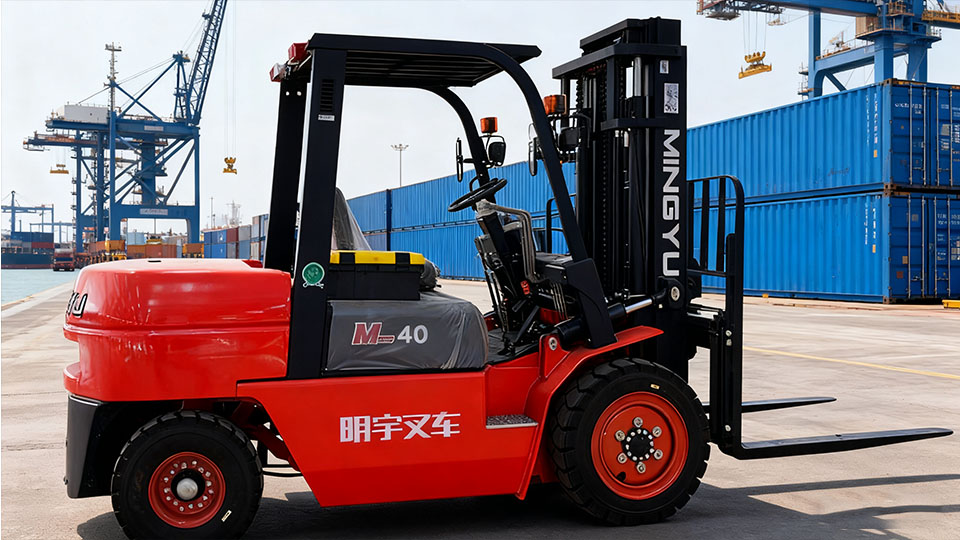
Diesel's Advantage in Torque: Diesel engines inherently produce greater torque (twisting force) than propane engines of comparable size.9 This is due to the diesel engine's design, which is optimized for maximum mechanical work and lugging capability, making them the industry standard for the heaviest, most demanding off-road applications. This higher power density means the diesel engine doesn't have to work as hard (i.e., rev as high) as a propane engine to perform the same heavy-duty task, which contributes to its efficiency in high-demand environments.
2.2. Duty Cycle and Throttle Use
Propane: Propane's lower torque often means the operator must run the engine at higher RPMs to maintain speed and lift capacity on rough or sloped terrain. Operating at higher RPMs increases the instantaneous fuel consumption rate. Propane consumption tends to be less sensitive to light-duty, frequent stop-and-go work but suffers significantly under continuous, heavy loads.
Diesel: Diesel engines are designed to maintain their torque output at lower RPMs. The engine is more likely to operate in its most efficient power band for heavy lifting or sustained travel, even on demanding surfaces. This ability to operate efficiently under load translates directly into better overall fuel economy in tough, off-road conditions.
3. Comparing Fuel Consumption Metrics
To compare the fuel efficiency between the two types, it is necessary to move beyond simple run time and look at the calculated operational cost.
3.1. Fuel Consumption Rate (Gallons/Hour)
While diesel offers more BTU/gallon, the actual consumption rate depends on the engine size and workload.
|
Metric |
Diesel RTFL (Example) |
Propane RTFL (Example) |
Notes |
|
BTU/Gallon |
$\approx 138,700$ |
$\approx 91,500$ |
Diesel provides 52% more energy per gallon. |
|
Typical Consumption (GPH) |
$1.2 - 2.0 \text{ GPH}$ |
$1.7 - 2.8 \text{ GPH}$ |
Higher consumption for propane to match the power output. |
|
Run Time per Tank/Cylinder |
$8 - 12$ hours (large tank) |
$6 - 8$ hours (33 lb cylinder) |
Diesel offers longer uninterrupted operation. |
3.2. Fuel Cost per Hour
This is the most critical metric for TCO.
$$\text{Cost per Hour} = \text{Fuel Price per Gallon} \times \text{Consumption Rate (GPH)}$$
In a simple scenario, where a diesel engine consumes $1.5 \text{ GPH}$ and a propane engine consumes $2.2 \text{ GPH}$ to do the same work:
If Diesel costs $$3.50/$gallon:
Diesel Cost/Hour: $\$3.50 \times 1.5 = \$5.25$
If Propane costs $$2.50/$gallon (due to lower energy density, propane is often priced lower per volume):
Propane Cost/Hour: $\$2.50 \times 2.2 = \$5.50$
In this scenario, despite the diesel price being significantly higher per gallon, the diesel engine still offers a slightly lower cost per hour due to its much lower consumption rate (GPH). This is a common finding, demonstrating the overwhelming efficiency advantage of the diesel engine.
However, the margin is highly sensitive to the price differential between the two fuels, which fluctuates regionally and seasonally. For example, if propane drops to $$2.00/$gallon, the propane cost per hour becomes $\$4.40$, making it cheaper. Therefore, operators must continuously monitor the local fuel price spread.
4. Total Cost of Ownership (TCO) Factors
Fuel efficiency is only one component of the TCO. Several other factors influence the overall economic viability of each fuel type.10
4.1. Maintenance and Engine Lifespan
|
Factor |
Diesel Engine |
Propane Engine |
Impact on TCO |
|
Complexity |
More complex (turbochargers, high-pressure injectors, emissions control) |
Simpler (spark plugs, carburetor/throttle body) |
Propane has lower short-term maintenance cost. |
|
Engine Longevity |
Higher (robust build, lubricating properties of diesel) |
Lower (often runs hotter, less robust due to lower compression) |
Diesel offers a longer engine lifespan, lowering capital expense depreciation. |
|
Emissions Controls |
Requires Diesel Particulate Filter (DPF) and Diesel Exhaust Fluid (DEF) on modern engines |
Requires catalyst/muffler; no DPF/DEF required |
Diesel adds significant cost and complexity for emissions maintenance. |
The higher initial and ongoing emissions-related maintenance (DEF consumption, DPF regeneration, sensor replacement) on modern Tier 4 Final diesel engines can significantly erode their fuel efficiency advantage over propane.
4.2. Refueling Downtime and Infrastructure
|
Factor |
Diesel |
Propane |
Impact on TCO |
|
Refueling Time |
Fast (pumping into integrated tank) |
Very Fast (swapping cylinders) |
Propane tank exchange is often slightly faster and requires zero spill cleanup. |
|
Infrastructure |
Requires bulk tank, spill containment, and pump station |
Requires secure cylinder storage cage and delivery service/on-site dispenser |
Propane is generally easier and cheaper to set up than an industrial diesel bulk tank. |
While propane engines are less fuel-efficient, the ability to quickly swap a depleted cylinder minimizes downtime, which is a major factor in high-utilization, multi-shift off-road operations.11 A diesel engine, though running longer, must be driven to the pump, refueled, and driven back, accumulating more non-productive time.
4.3. Emissions and Indoor/Outdoor Flexibility
Diesel: Produces higher levels of Nitrogen Oxides (12$\text{NO}_{\text{x}}$), Sulfur Dioxide (13$\text{SO}_{2}$), and Particulate Matter (Soot).14 Modern emissions controls mitigate this, but diesel RTFLs are generally restricted to outdoor use or highly ventilated indoor areas.

Propane: Burns cleaner than diesel, emitting primarily Carbon Monoxide (15$\text{CO}$) and Carbon Dioxide (16$\text{CO}_{2}$).17 Propane RTFLs offer indoor/outdoor flexibility as their emissions are manageable with proper ventilation, making them the preferred choice for operations that span between a lumberyard (outdoor) and an adjacent covered warehouse (indoor).18 This flexibility adds operational efficiency that is difficult to quantify in a simple fuel economy calculation.
5. Conclusion and Selection Criteria
The fuel efficiency differences between diesel and propane off-road forklifts are starkly defined by the fuels' respective energy content and the engines' thermodynamic efficiency.
Diesel is the technically superior choice for fuel efficiency due to:
52% Higher Energy Density (BTU/gallon).
Higher Thermal Efficiency from compression ignition.
Superior Low-End Torque, allowing the engine to operate efficiently under the heavy loads characteristic of rough terrain.19
Name: selena
Mobile:+86-13176910558
Tel:+86-0535-2090977
Whatsapp:8613181602336
Email:vip@mingyuforklift.com
Add:Xiaqiu Town, Laizhou, Yantai City, Shandong Province, China
