
vip@mingyuforklift.com
+86-0535-2090977

1. Defining Free Lift
At its simplest, Free Lift is the distance the forks can be raised before the inner mast sections begin to extend upward.
In a standard forklift mast, as you raise the forks, the inner rails of the mast slide upward simultaneously to provide support. However, if you are inside a confined space—like a semi-truck trailer—the top of the mast would hit the ceiling long before the forks reached the desired height. Free lift solves this problem by allowing the carriage to move independently of the mast rails for a set distance.
The Two Categories of Free Lift:
Limited Free Lift: The forks can only rise a few inches (typically 2 to 6 inches) before the mast begins to extend. This is common in basic, single-stage masts.
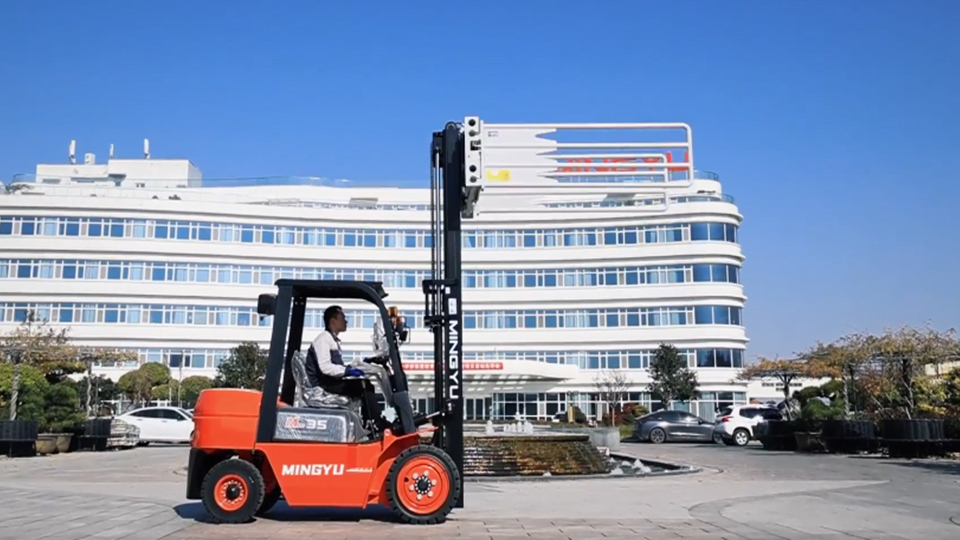
Full Free Lift: The carriage and forks can travel all the way to the top of the outermost mast section without any part of the inner mast sections rising above the lowered height of the machine.
2. The Mechanics: How It Works
To understand free lift, we must look at the hydraulic cylinder arrangement.
The Primary (Center) Cylinder
Masts equipped with full free lift feature a dedicated primary cylinder (often called the "free lift cylinder") located directly behind the carriage. When the operator pulls the lift lever, hydraulic fluid is first directed to this center cylinder. Because this cylinder is attached only to the carriage and the first mast stage, it pushes the forks up without engaging the telescopic rails.
The Secondary (Side) Cylinders
Once the primary cylinder reaches its full extension, the hydraulic pressure shifts to the secondary cylinders (usually located on the sides of the mast). These cylinders then begin to push the inner mast sections upward to reach maximum lift heights.
3. Mast Configurations and Free Lift Capacity
The amount of free lift available is dictated by the type of mast installed on the forklift.
|
Mast Type |
Number of Sections |
Free Lift Capability |
Best Use Case |
|
Simplex (Single Stage) |
1 |
Limited |
Outdoor yards, no overhead height restrictions. |
|
Duplex (Two Stage) |
2 |
Often Full Free Lift |
General warehousing, loading docks. |
|
Triplex (Three Stage) |
3 |
Full Free Lift |
High-reach racking and trailer loading. |
|
Quad (Four Stage) |
4 |
Full Free Lift |
Extremely high shelving; requires low collapsed height. |
4. Why Free Lift is Critical for Operations
Loading and Unloading Containers
A standard shipping container has a fixed ceiling height. Without "Full Free Lift," an operator would be unable to "double-stack" pallets inside the container because the mast would pierce the roof of the container as they tried to lift the second pallet.
Low Clearance Navigation
In older facilities with low doorways or overhead HVAC ducting, a forklift with full free lift can carry a load high enough to clear floor debris or thresholds while keeping its overall "collapsed height" at a minimum.
Stability and Vision
Technically, free lift cylinders are designed to minimize "mast drift." Additionally, many modern designs utilize "Wide View" masts where the free lift cylinder is offset or slimmed down to improve the operator's line of sight through the carriage.
5. Technical Math: Calculating Your Clearance
When specifying a forklift for a facility, engineers use the following formula to ensure the machine will fit:
$$Required\ Overhead\ Clearance > Collapsed\ Height + (Total\ Lift - Free\ Lift)$$
Collapsed Height: The height from the floor to the top of the mast when the forks are fully lowered.
Total Lift: The maximum height the forks can reach.
Free Lift: The vertical travel available before the collapsed height increases.
If an operator exceeds the free lift limit while in a trailer, the Extended Height becomes the new vertical constraint, often leading to structural damage to the building or the forklift mast itself.
6. Maintenance of Free Lift Systems
Because free lift relies on a specific sequence of hydraulic pressure, maintenance is specialized:
Chain Tension: The lift chains must be perfectly synchronized. If one side is tighter, the carriage will tilt during the free lift phase, causing premature wear on the mast rollers.
Seal Integrity: The center cylinder often operates at different pressure thresholds than the side cylinders. A leak in the primary cylinder will result in a "dead zone" where the forks drop slightly before the secondary cylinders take over.
Lubrication: The inner channels where the carriage rollers travel during free lift must be kept clear of debris, especially in timber or dusty environments.
Summary
Free lift is the "secret" to forklift versatility. It allows a machine to be a high-reaching titan in the warehouse aisles while remaining a compact, low-profile worker inside trailers and containers. Understanding the difference between limited and full free lift is the key to selecting the right equipment for any specialized material handling environment.
Name: selena
Mobile:+86-13176910558
Tel:+86-0535-2090977
Whatsapp:8613181602336
Email:vip@mingyuforklift.com
Add:Xiaqiu Town, Laizhou, Yantai City, Shandong Province, China
