
vip@mingyuforklift.com
+86-0535-2090977

1. Introduction
Context: the shift toward electrification in material handling
Clarification of terms: "electric stacker" (walkie/rider pallet stackers) vs. "electric forklift" (counterbalance or reach trucks with seated/stand-up cabs)
The procurement dilemma: both are electric, but serve fundamentally different operational roles
Purpose: a structured guide to matching equipment type to operational reality
2. Definitions and Equipment Categories
2.1 Electric Stackers
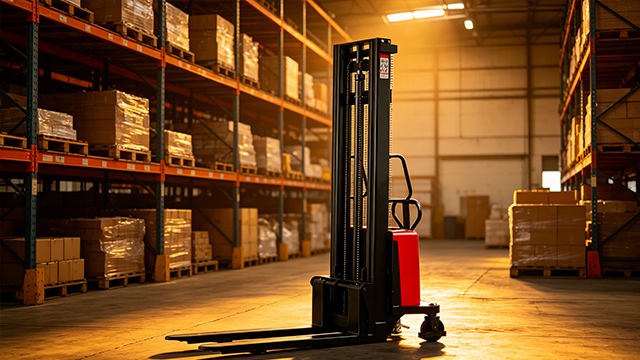
Pedestrian walkie stackers, rider stackers, and straddle stackers
Core design: front-mounted mast, rear-mounted drive/tiller, minimal or no counterweight
Typical configurations: single-stage to triple-stage masts
Load capacity range: 1,000–2,000 kg
2.2 Electric Forklifts
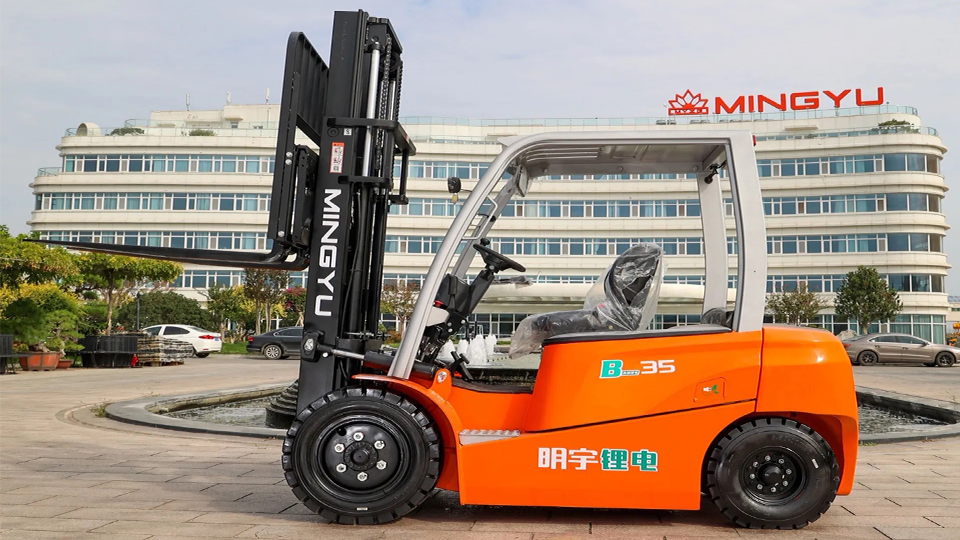
Counterbalance electric forklifts (3-wheel and 4-wheel)
Reach trucks, order pickers, and articulated narrow-aisle trucks
Core design: integrated counterweight or outrigger system, seated or stand-up operator compartment
Load capacity range: 1,500–8,000+ kg
2.3 The Gray Zone
Overlapping applications where either machine could theoretically perform the task
Why specification sheets alone do not determine the right choice
3. Fundamental Design and Mechanical Differences
3.1 Stability Philosophy
Counterbalance forklifts: weight distribution and stability triangle
Stackers: straddle legs or counterweight-assisted stability, narrower stability footprint
Impact on load center and rated capacity at height
3.2 Mast and Lift Mechanisms
Forklift masts: duplex, triplex, with or without free lift, tilt and side-shift functions
Stacker masts: simpler rail systems, often without tilt, limited side-shift options
Maximum lift heights compared (stackers: ~6 m; reach trucks: ~12 m)
3.3 Drive and Steering Architecture
Forklifts: rear-wheel steering, tighter turning circle relative to wheelbase
Stackers: front-drive, tiller-steered or electronic steering, walk-behind maneuvering
Travel speed and acceleration profiles
3.4 Operator Interface
Forklift: seated ergonomics, overhead guard, full suspension seat
Stacker: walking or standing, open design, exposure to environment
4. Performance and Productivity Analysis
4.1 Throughput Metrics
Loads per hour over short distances (<50 m): stacker efficiency
Loads per hour over long distances (>100 m): forklift dominance
Acceleration, top speed, and braking energy recovery
4.2 Maneuverability and Space Utilization
Minimum aisle widths: stackers in 2,000–2,500 mm aisles
Counterbalance forklifts requiring 3,500–4,000 mm aisles
Reach trucks narrowing the gap but at higher cost
4.3 Vertical Reach and Stacking Density
Rack height compatibility and beam-level access
Free-lift requirements in low-ceiling environments
Load visibility at height: operator sight-line differences
5. Application Scenarios and Working Conditions
5.1 When Electric Stackers Are Optimal
Small to medium warehouses with limited capital budgets
Light-duty pallet movement and low-to-medium height stacking (up to 4–5 m)
Retail backrooms, workshops, and light manufacturing
Operations with frequent pedestrian interaction requiring low speeds
Short-run dock-to-storage workflows
5.2 When Electric Forklifts Are Essential
Heavy palletized loads (>2,000 kg) or non-standard load centers
High-rack warehousing (>6 m) requiring reach or counterbalance capability
Outdoor/indoor transitions, uneven floors, or ramp operations
Multi-shift, high-throughput distribution centers
Applications requiring attachments: clamps, rotators, push-pull systems
5.3 Hybrid Operations
Using stackers for last-meter put-away and forklifts for bulk transport
Fleet composition strategies for peak season flexibility
6. Economic Comparison and Total Cost of Ownership
6.1 Capital Expenditure
Acquisition cost differential: stackers typically 40–60% less than equivalent-capacity forklifts
Battery and charger infrastructure: shared vs. dedicated systems
Licensing and certification costs for operators
6.2 Operating Expenditure
Energy consumption per pallet moved
Tire wear: cushion tires (forklifts) vs. polyurethane wheels (stackers)
Operator labor costs: walk-behind fatigue vs. seated productivity over long shifts
6.3 Maintenance and Lifecycle
Simpler hydraulic and drive systems on stackers
Forklift complexity: brakes, transmissions, masts, and overhead guards
Expected service life and residual value at disposal
7. Safety, Training, and Regulatory Considerations
7.1 Operator Certification Requirements
Forklift licensing: formal training, practical assessment, periodic recertification
Stacker training: often less regulated but increasingly standardized
Regional variance: OSHA, HSE, ISO 3691 series, and local industrial safety codes
7.2 Workplace Safety Profiles
Forklift hazards: tipping, pedestrian strikes, falling loads, overhead collisions
Stacker hazards: operator foot injuries, tiller whip, limited braking on ramps
Environmental controls: noise, emissions (zero for both electric types), and battery acid risks
7.3 Facility Safety Infrastructure
Floor flatness and load-bearing requirements
Guardrails, mirrors, and designated traffic lanes
Battery charging room ventilation and fire suppression
8. Selection Decision Framework
8.1 Load Profile Assessment
Average and maximum unit load weights
Load dimensions, fragility, and handling frequency
Attachment and special handling needs
8.2 Facility and Layout Audit
Aisle widths, ceiling heights, door clearances, and floor conditions
Travel distances and route congestion points
Expansion plans and layout flexibility
8.3 Operational and Financial Modeling
Pallets moved per day, peak season multipliers, and shift patterns
5-year TCO calculation including depreciation, energy, maintenance, and labor
Lease vs. buy considerations for each equipment type
9. Maintenance and Fleet Management Implications
Preventive maintenance intervals and component accessibility
Battery management: watering, opportunity charging, and lithium-ion migration
Fleet telematics: impact monitoring, utilization tracking, and operator accountability
Service network availability and parts lead times
10. Future Trends and Conclusion
Lithium-ion battery adoption across both categories
Automation convergence: AGV/AMR stackers vs. autonomous forklifts
Sustainability metrics: carbon footprint per pallet moved
Final synthesis: stackers for agility and economy, forklifts for power and reach—choose based on operational truth, not specification optimism
Name: selena
Mobile:+86-13176910558
Tel:+86-0535-2090977
Whatsapp:8613181602336
Email:vip@mingyuforklift.com
Add:Xiaqiu Town, Laizhou, Yantai City, Shandong Province, China
