
vip@mingyuforklift.com
+86-0535-2090977

1. Introduction
Overview of material handling equipment evolution and the role of stackers
Definition of "stacker" as a powered pallet truck with lifting capability
The central question: when to choose a rider stacker versus a pedestrian stacker
Scope of the article: design, operational, safety, and economic dimensions
2. Definitions and Core Classifications
2.1 Pedestrian Stacker
Operator walks behind or alongside the unit
Tiller arm or dual-handle control configuration
Typical power sources: electric battery, manual/hydraulic variants
Common mast configurations: single-stage, two-stage, or triple-stage
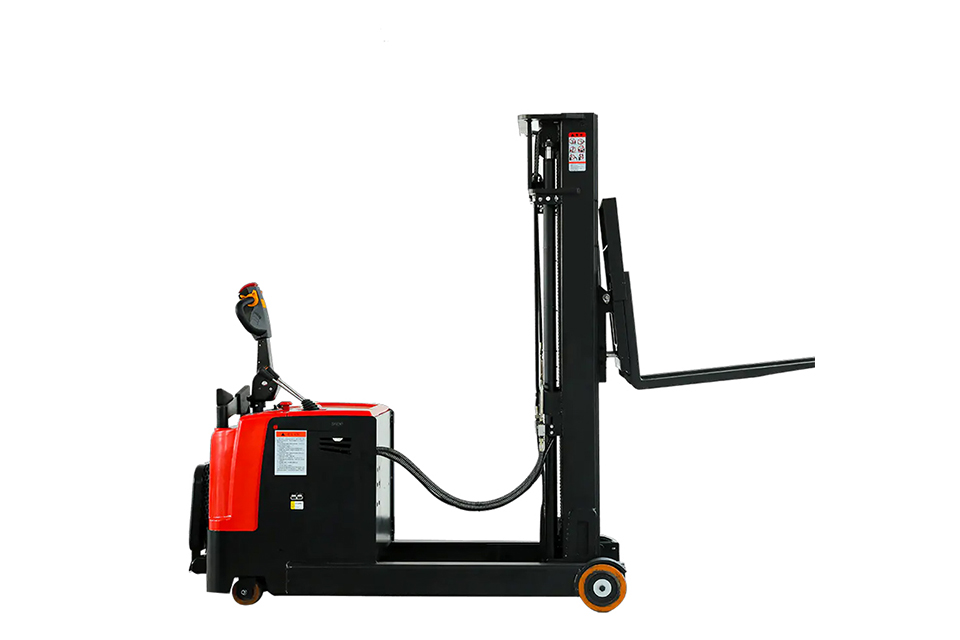
2.2 Rider Stacker
Operator stands on a fixed or foldable platform
Side-facing or forward-facing operating position
Powered travel and lift with higher travel speeds
Platform types: fixed platform vs. fold-out platform (hybrid designs)
2.3 The Hybrid Spectrum
Pedestrian stackers with foldable ride-on platforms
Sit-down vs. stand-on rider variants
How industry terminology sometimes blurs the line
3. Key Design and Mechanical Differences
3.1 Chassis and Footprint
Rider stacker: longer wheelbase, heavier counterweight or straddle legs
Pedestrian stacker: compact footprint, tighter turning radius
Overall length, width, and aisle width requirements
3.2 Powertrain and Performance
Travel speed differentials (pedestrian: 4–5 km/h; rider: 8–10 km/h)
Battery capacity and duty cycle implications
Gradeability and ramp performance
3.3 Mast and Load Handling
Maximum lift heights compared (typically similar ranges: 3,000–6,000 mm)
Load capacity overlap and divergence at height
Visibility differences: pedestrian view vs. rider sight lines
3.4 Operator Presence Systems
Dead-man switches on pedestrian units
Platform pressure sensors and harness points on rider units
Emergency reverse and belly buttons
4. Operational Characteristics Compared
4.1 Maneuverability
Pedestrian advantage: tight aisles, congested floors, dock areas
Rider advantage: long travel distances, large warehouses
Turning radius and aisle width minimums
4.2 Productivity Metrics
Loads moved per hour under different travel distances
Fatigue factors: walking vs. standing for extended shifts
Operator changeover and multi-tasking capability
4.3 Ergonomics and Operator Fatigue
Impact of walking 10–15 km per shift on pedestrian operators
Standing posture fatigue on rider platforms
Vibration and shock absorption differences
5. Safety Considerations and Regulatory Framework
5.1 Pedestrian Safety
Separation of pedestrians and equipment in shared zones
Lower speed limits and their safety benefits
Risk of operator foot injury or crushing at the tiller end
5.2 Rider Safety
Risk of ejection during cornering or braking
Overhead guard requirements (or lack thereof) on stand-on designs
Stability triangles and tipping dynamics at speed
5.3 Standards and Compliance
ISO 3691-5 (safety standards for pedestrian-propelled trucks)
Regional regulations: OSHA, EU machinery directives, GB standards
Training and certification requirements for each type
6. Application Scenarios and Working Conditions
6.1 Ideal Conditions for Pedestrian Stackers
Small to medium warehouses with narrow aisles (<2,500 mm)
Short travel distances (<100 m per trip)
Intermittent use or multi-shift shared equipment
Retail backrooms, pharmaceutical cleanrooms, and food processing
Loading/unloading at docks with frequent pedestrian traffic
6.2 Ideal Conditions for Rider Stackers
Large distribution centers with long travel runs (>100 m)
High-throughput operations requiring continuous movement
Outdoor/indoor transitions and ramp navigation
Manufacturing feed lines and large-scale storage facilities
Operations with dedicated operators per machine
6.3 Gray Areas: When Either Could Work
Mid-size facilities with mixed aisle widths
Operations considering future growth or layout changes
Seasonal demand fluctuations affecting fleet composition
7. Economic Analysis and Total Cost of Ownership
7.1 Acquisition Costs
Base price comparison: pedestrian units typically 30–50% less expensive
Battery and charger infrastructure costs
7.2 Operating Costs
Energy consumption per load moved
Tire and component wear rates
Operator wage efficiency: one rider vs. multiple pedestrian units
7.3 Maintenance and Lifecycle
Simpler mechanical systems on pedestrian stackers
Higher wear on rider drive units due to speed and duty cycles
Expected service life and resale value
8. Selection Decision Framework
8.1 Facility Assessment Checklist
Aisle widths, ceiling heights, and floor conditions
Average and peak throughput requirements
Distance from receiving to storage to shipping
8.2 Operational Requirements
Shift patterns and operator availability
Load characteristics: weight, dimensions, and center of gravity
Environmental factors: temperature, humidity, and surface contaminants
8.3 Future-Proofing Considerations
Scalability and fleet flexibility
Integration with warehouse management systems
Potential for automation upgrades (AGV/AMR compatibility)
9. Maintenance and Fleet Management Implications
Preventive maintenance schedules compared
Common failure modes: drive motors, hydraulic pumps, casters
Fleet telematics and operator monitoring systems
Spare parts availability and technician training requirements
10. Conclusion
Summary: pedestrian stackers excel in agility and cost; rider stackers dominate in throughput and distance
The trend toward hybrid designs and lithium-ion power
Final recommendation to conduct an operational audit before procurement
Name: selena
Mobile:+86-13176910558
Tel:+86-0535-2090977
Whatsapp:8613181602336
Email:vip@mingyuforklift.com
Add:Xiaqiu Town, Laizhou, Yantai City, Shandong Province, China
