
vip@mingyuforklift.com
+86-0535-2090977

Introduction
Port operations represent one of the most demanding environments for material handling equipment. Heavy-duty forklifts operating in maritime terminals, container yards, and bulk cargo facilities face unique challenges: corrosive salt air, extreme weight capacities often exceeding 25 tons, continuous multi-shift operations, and exposure to abrasive dust and debris. Unlike warehouse forklifts that might handle standardized pallets in climate-controlled environments, port forklifts routinely lift shipping containers, steel coils, lumber bundles, and bulk commodities under relentless schedules where downtime translates directly to vessel demurrage and supply chain disruption.
The maintenance philosophy for port heavy-duty forklifts cannot mirror that of standard industrial trucks. These machines require engineered service strategies that account for accelerated wear patterns, specialized component stresses, and operational continuity demands. This article examines the technical dimensions of port forklift maintenance, presenting service strategies optimized for high-load, high-cycle maritime operations.
Understanding the Operational Environment
Corrosive Atmosphere Challenges
Maritime ports present a chemically aggressive environment that fundamentally alters maintenance intervals. Salt-laden humidity creates electrochemical corrosion on exposed metal surfaces, electrical connections, and hydraulic systems. Studies in marine engineering indicate that corrosion rates in coastal industrial environments can exceed inland rates by factors of 3 to 5. For forklift maintenance managers, this translates to shortened lifespans for brake systems, accelerated pitting in hydraulic cylinders, and premature failure of electrical harnesses and sensor connections.
The corrosive impact extends beyond visible rust. Micro-corrosion on hydraulic valve spools can cause sticking and erratic operation, while salt crystallization in electrical connectors increases resistance and generates localized heating. Maintenance strategies must incorporate corrosion mitigation as a primary pillar rather than an afterthought.
Load Severity and Structural Fatigue
Port forklifts frequently operate at or near rated capacity. Container handling often involves dynamic loads where the center of gravity shifts during lifting and transport, creating torsional stresses on the mast assembly and carriage. Unlike warehouse operations where loads are typically uniform and stable, port cargo includes eccentrically distributed weights, partially secured containers, and shifting bulk materials.
These loading patterns generate fatigue stresses in critical structural components: the mast channels, carriage backrest, lift chains, and frame assemblies. Fatigue failure in heavy equipment follows a non-linear progression—micro-cracks initiate at stress concentrations, propagate through cyclic loading, and culminate in sudden catastrophic failure. Maintenance strategies must incorporate non-destructive testing (NDT) protocols to detect fatigue crack initiation before propagation reaches critical dimensions.
Duty Cycle Intensity
Port operations typically run 20–24 hours daily during vessel berthing windows, with forklifts accumulating operating hours at rates far exceeding standard industrial applications. A port heavy-duty forklift may accumulate 4,000–6,000 hours annually, compared to 1,500–2,500 hours for typical warehouse equipment. This intensity compresses maintenance intervals proportionally and demands strategies that maximize availability while ensuring safety-critical systems never degrade below operational thresholds.
Predictive Maintenance Architecture
Condition Monitoring Systems
Modern port forklifts increasingly incorporate telematics and onboard diagnostic systems, but comprehensive predictive maintenance requires extending beyond factory-installed sensors. Vibration analysis on drive motors, gearboxes, and pump assemblies can detect bearing degradation, gear tooth wear, and shaft misalignment weeks before functional failure. Oil analysis programs sampling hydraulic fluid and engine lubricant provide spectroscopic data on wear metal concentrations, indicating which component systems are degrading and at what rates.
Thermal imaging inspections of electrical panels, motor housings, and hydraulic systems identify abnormal heat signatures that precede failure. In port environments, electrical connections are particularly susceptible to resistance increases from corrosion; infrared thermography can detect these anomalies during routine rounds without requiring equipment shutdown.
Data Integration and Analytics
Effective predictive maintenance requires aggregating disparate data streams into unified analytics platforms. Operating hours, load histograms (recording frequency and magnitude of lifts), environmental exposure metrics, and component condition indicators must be correlated to develop equipment-specific degradation models. Machine learning algorithms applied to this data can identify patterns invisible to human analysts—subtle correlations between high-humidity periods and brake system degradation, or between frequent maximum-capacity lifts and mast structural fatigue rates.
Port operators should establish baseline performance metrics for each forklift unit, then track deviation trends. A unit showing 15% higher hydraulic fluid temperature than baseline, combined with increasing iron particle counts in oil analysis, indicates pump or cylinder wear requiring investigation. These integrated analytics transform maintenance from calendar-based or hour-based intervals to condition-directed interventions.
Structural Integrity Management
Mast and Carriage Inspection Protocols
The mast assembly represents the most structurally critical and heavily loaded component of any forklift. In port heavy-duty applications, mast maintenance requires rigorous inspection protocols exceeding manufacturer recommendations. Visual inspection should examine mast channels for deformation, weld crack initiation, and abnormal wear patterns on the inner and outer channel surfaces. Channel straightness should be verified using precision straightedges or laser alignment tools; even minor channel distortion causes uneven roller loading, accelerating wear and creating stress concentrations.
Lift chains demand particular attention in high-load port operations. Chain wear elongation must be measured regularly using calibrated gauges, with replacement criteria established conservatively. In salt-air environments, chain lubrication requires specialized corrosion-resistant formulations applied at frequent intervals. Chain anchor points and sheave bearings require inspection for wear and proper alignment—misaligned sheaves cause lateral chain wear and unpredictable loading.
Frame and Chassis Structural Assessment
The forklift frame integrates all functional systems and distributes operational loads to the axles and tires. Frame inspection must examine weld integrity at critical joints, particularly where counterweight mounting interfaces with the main frame and where the mast tilting cylinder brackets attach. Non-destructive testing using magnetic particle inspection or ultrasonic testing should be conducted annually on high-utilization units, with increased frequency for units regularly handling maximum-rated loads.
Counterweight security is paramount in port operations where dynamic loads and uneven surfaces create high inertial forces. Counterweight retention bolts must be torque-verified and examined for loosening indicators. Any counterweight movement relative to the frame constitutes an immediate safety concern requiring operational cessation.
Powertrain and Driveline Strategies
Engine and Emission Systems
Heavy-duty port forklifts predominantly utilize diesel powerplants, though electrification is advancing in certain applications. Diesel engines in port environments face accelerated air filter loading from dust and particulate matter, requiring filter service intervals potentially 50% shorter than manufacturer specifications. Turbocharger and aftercooler systems demand inspection for salt-air corrosion and intake tract contamination.
Emission control systems, including diesel particulate filters (DPF) and selective catalytic reduction (SCR) systems, require specialized maintenance protocols. DPF regeneration cycles must be monitored to ensure completion; interrupted regenerations in stop-start port operations can lead to filter plugging and engine derating. DEF (diesel exhaust fluid) quality and storage conditions require attention in humid environments where fluid degradation accelerates.
For electric port forklifts, battery maintenance strategies must account for high-duty cycling. Battery watering systems, thermal management, and state-of-charge management become critical availability factors. Opportunity charging strategies during operational breaks require careful management to prevent battery degradation from partial-state-of-charge operation.
Transmission and Axle Systems
Port forklift transmissions, whether automatic powershift or hydrostatic, encounter severe duty from frequent direction changes and load-induced torque spikes. Transmission fluid analysis should monitor for clutch material debris in powershift units, indicating clutch pack wear. Hydrostatic systems require monitoring for pump and motor efficiency degradation, evidenced by increased operating temperatures and reduced response rates.
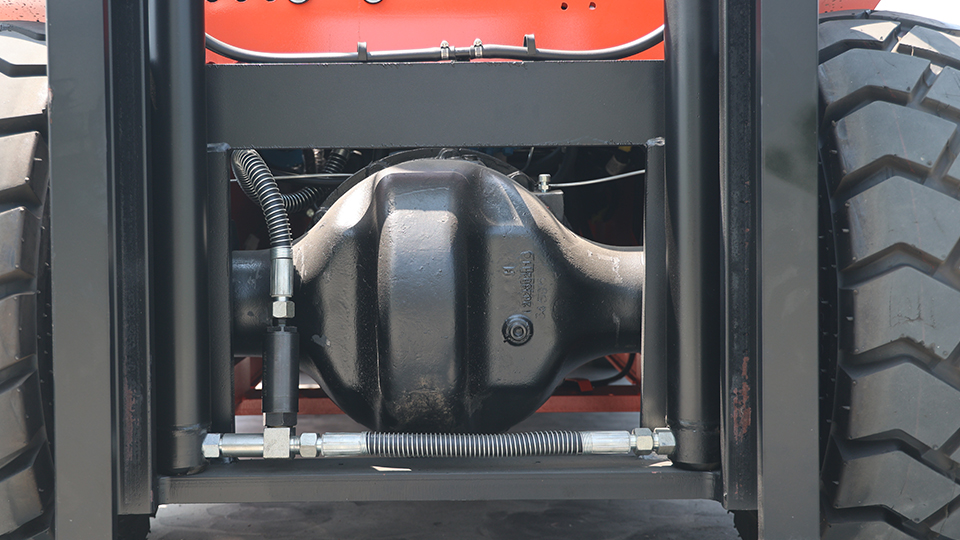
Drive axle maintenance must examine planetary hub reductions for seal integrity and lubricant condition. Salt-air exposure attacks axle seals and breather systems, allowing moisture ingress that contaminates lubricant and accelerates gear wear. Wheel bearing maintenance intervals should be shortened in port environments, with particular attention to seal condition and bearing adjustment.
Hydraulic System Excellence
Fluid Cleanliness and Contamination Control
Hydraulic systems in port forklifts operate under pressures often exceeding 3,000 PSI, with system cleanliness directly correlating to component lifespan. Port environments present severe contamination challenges: dust ingress during cylinder rod extension, salt-air particle introduction, and wear debris generation from high-load operation. Maintenance strategies must establish rigorous fluid cleanliness targets, typically ISO cleanliness codes of 18/16/13 or better for high-pressure systems.
Filtration management requires more than periodic filter replacement. Filter condition indicators must be monitored continuously, and filter bypass conditions must trigger immediate maintenance response. Reservoir breathers require desiccant filtration to prevent moisture ingress in humid port environments. Fluid sampling ports should be installed at strategic locations—return lines, pump discharge, and case drain lines—to enable representative contamination monitoring.
Cylinder and Valve Maintenance
Hydraulic cylinders in port forklifts experience severe side-loading during container handling, particularly when lifting unevenly loaded or partially secured cargo. Cylinder rod scoring from external contamination accelerates seal wear and fluid leakage. Rod wiper seal effectiveness must be verified regularly, and damaged wipers require immediate replacement to prevent particulate ingress during rod retraction.
Hydraulic valve systems, particularly multi-function control valves, are susceptible to spool sticking from contamination and corrosion. Valve response testing should be incorporated into routine maintenance, measuring spool actuation times and pressure response characteristics. Any degradation in valve responsiveness indicates internal wear or contamination requiring system investigation.
Tire and Running Gear Optimization
Tire Selection and Management
Port forklift tires represent a significant operating cost and availability factor. Pneumatic tires offer cushioning and traction advantages but are susceptible to damage from debris and require pressure maintenance. Solid pneumatic or cushion tires eliminate pressure maintenance but transmit more shock to the vehicle structure. Tire selection must match operational profiles: container handling on improved surfaces may favor cushion tires, while bulk cargo operations on uneven surfaces require pneumatic tires with heavy-duty construction.
Tire wear patterns provide diagnostic information. Rapid shoulder wear indicates improper inflation or excessive cornering speeds. Center wear suggests over-inflation. Cupping or irregular wear patterns indicate suspension or axle issues requiring mechanical investigation. Tire rotation strategies, where applicable, should be implemented to equalize wear across positions.
Brake System Vigilance
Brake systems in port forklifts face extreme thermal and mechanical demands. Wet brake systems, common in heavy-duty applications, require fluid condition monitoring for water contamination and thermal degradation. Brake performance testing should measure stopping distances under loaded conditions, with degradation trends indicating lining wear, fluid condition issues, or mechanical adjustment requirements.
Parking brake systems require particular attention in port operations conducted on sloped surfaces. Spring-applied, hydraulically released parking brakes must be tested for holding capacity on grade, and brake release pressures must be verified within specification. Any parking brake system that allows rollaway on grade constitutes an immediate safety hazard.
Electrical System Resilience
Harness and Connection Integrity
Electrical system failures represent a leading cause of unscheduled downtime in port equipment. Salt-air corrosion attacks connector terminals, fuse blocks, and grounding points. Maintenance strategies must incorporate systematic harness inspection, connector cleaning and protective treatment, and grounding integrity verification. Dielectric grease application on connectors provides corrosion protection without compromising electrical conductivity.
Battery and charging systems require attention to terminal corrosion, cable integrity, and charging system output. Battery specific gravity and voltage measurements should be recorded to track battery health trends, enabling replacement before failure-induced downtime.
Electronic Control Systems
Modern port forklifts incorporate sophisticated electronic control systems for engine management, transmission control, and hydraulic function modulation. Diagnostic trouble codes must be monitored and addressed promptly; seemingly minor sensor faults can cascade into major operational limitations when control systems enter limp-home modes. Software updates and calibration data must be maintained current, with version control ensuring all units operate on validated software configurations.
Maintenance Organization and Execution
Workshop Capabilities
Port forklift maintenance requires workshop facilities equipped for heavy-duty equipment. Overhead lifting capacity must accommodate complete powertrain removal. Hydraulic system service requires clean environments and specialized tooling for component disassembly and assembly. Welding and fabrication capabilities support structural repairs and modifications.
Tooling and equipment inventories must include specialized items: hydraulic system pressure test kits, electronic diagnostic platforms for all equipment models, precision measurement tools for structural assessment, and NDT equipment for crack detection.
Technician Competency Development
Port forklift maintenance demands technicians with diverse competencies: diesel engine and emission systems, hydrostatic and powershift transmissions, high-pressure hydraulics, structural welding, and electronic diagnostics. Competency development programs should combine manufacturer training with internal mentorship and periodic external certification. Technicians should be encouraged to develop specialization depth in specific systems while maintaining broad foundational knowledge.
Spare Parts Strategy
High-load port operations cannot tolerate extended waits for critical spare parts. Spare parts inventories must balance capital investment against availability risk. Critical spares—engine components, hydraulic pumps, control valves, brake components—should be stocked based on failure rate data and lead time analysis. Vendor relationships should ensure expedited procurement for non-stocked items, with emergency logistics protocols for vessel-schedule-critical repairs.
Safety-Critical Maintenance Protocols
Load Handling Attachment Integrity
Port forklifts frequently operate with specialized attachments: container spreaders, coil rams, lumber grapples, and multi-purpose clamps. Attachment maintenance must be integrated with base unit maintenance programs. Attachment structural integrity, hydraulic circuit integrity, and locking mechanism function must be verified on schedules matching or exceeding base unit inspection frequencies.
Operator Reporting Integration
Operators represent the frontline of condition monitoring. Formalized pre-operation inspection requirements, with documented checklists, ensure systematic identification of fluid leaks, abnormal noises, performance degradation, and structural damage. Operator reports must trigger maintenance response workflows with defined urgency classifications. A report of mast channel crack indication requires immediate inspection; a report of minor hydraulic seepage may schedule for next planned maintenance window.
Conclusion
Port heavy-duty forklift maintenance in high-load operations demands a technically rigorous, systematically organized approach that transcends standard industrial maintenance practices. The maritime environment's corrosive atmosphere, the mechanical severity of heavy container and bulk cargo handling, and the operational imperative of vessel schedule compliance create a maintenance context where failure prevention must be engineered into every process.
Successful port forklift maintenance programs integrate predictive analytics with hands-on technical inspection, maintain structural integrity through advanced NDT protocols, manage hydraulic cleanliness with pharmaceutical-level discipline, and organize maintenance execution with the precision of industrial production. The investment in comprehensive maintenance capability returns multiplied through extended equipment life, reduced catastrophic failure incidence, and—most critically—sustained operational availability when vessels are berthed and cargo must flow.
As port operations continue intensifying with global trade growth and vessel size increases, maintenance strategies must evolve correspondingly. The integration of IoT sensors, machine learning analytics, and advanced materials will shape the next generation of port equipment maintenance. Yet the fundamental principles remain: understand the operating environment, respect the physics of material degradation, and maintain with systematic diligence. Equipment that lifts 40-ton containers over human workers and valuable cargo demands nothing less than maintenance excellence.
Name: selena
Mobile:+86-13176910558
Tel:+86-0535-2090977
Whatsapp:8613181602336
Email:vip@mingyuforklift.com
Add:Xiaqiu Town, Laizhou, Yantai City, Shandong Province, China