
vip@mingyuforklift.com
+86-0535-2090977

Introduction
Ports and container yards represent some of the most demanding material handling environments on earth. These facilities operate under relentless time pressure, where vessel berthing windows are measured in hours and demurrage costs accrue by the minute. Within this ecosystem, short-distance transfer operations—moving containers, breakbulk cargo, and project freight between quayside cranes, yard stacks, inspection zones, rail sidings, and truck gates—require specialised forklift configurations that differ fundamentally from standard warehouse or manufacturing equipment.
The short-distance transfer task, typically covering 50 to 500 metres per move, places unique demands on forklift design. Equipment must handle loads measured in tonnes rather than kilograms, traverse surfaces of compacted aggregate, asphalt, or steel decking that punish suspension and tyres, and operate in weather conditions ranging from tropical downpours to freezing sleet. Unlike long-haul yard tractors that prioritise travel speed, short-distance transfer forklifts must combine heavy lift capacity with manoeuvrability, precise load placement, and rapid cycle times.
This article examines the technical characteristics, operational requirements, and specific equipment recommendations for forklifts deployed in port and container yard short-distance transfer applications. The analysis covers both laden container handling and breakbulk operations, providing a framework for fleet managers and terminal operators to optimise equipment selection.
The Operational Environment: Defining the Challenge
Before evaluating specific forklift categories, it is essential to characterise the operational environment that shapes equipment requirements. Container yards and port backlands present a convergence of stressors rarely encountered in combination elsewhere.
Load Characteristics: Standard ISO shipping containers weigh between 2,000 and 4,000 kilograms empty, while laden twenty-foot equivalent units (TEUs) frequently exceed 24,000 kilograms. Forty-foot containers (FEUs) with dense cargo such as steel, machinery, or bottled beverages can approach 30,500 kilograms gross mass—the maximum legal road weight in most jurisdictions. Forklifts engaged in short-distance transfer must handle these loads safely while accounting for dynamic forces generated by acceleration, braking, and uneven surfaces.
Surface Conditions: Port yard surfaces range from reinforced concrete in container stacking areas to crushed stone in temporary storage zones, steel decking on ro-ro (roll-on/roll-off) vessels, and asphalt in truck marshalling areas. These surfaces degrade under concentrated wheel loads, creating ruts, potholes, and uneven transitions that challenge forklift stability. Steel surfaces become slippery with moisture or hydraulic fluid, while aggregate surfaces shift under braking forces.
Spatial Constraints: Despite the vast scale of modern container terminals, the operational spaces where forklifts work are surprisingly constrained. Containers are stacked in rows with minimal aisle width, truck lanes must accommodate simultaneous queuing, and vessel-side operations compete for space with lashing teams, gantry cranes, and straddle carriers. Forklifts must manoeuvre in tight clearances while handling loads that extend well beyond the chassis envelope.
Environmental Exposure: Salt-laden coastal atmospheres accelerate corrosion of unprotected steel components. Tropical ports subject equipment to intense UV radiation and humidity that degrades seals and electrical insulation. Temperate ports present freeze-thaw cycles that crack hydraulic hoses and create icy yard surfaces. Equipment must operate reliably across these extremes with minimal downtime.
Heavy-Duty Counterbalance Forklifts: The Workhorse Category
For general cargo, breakbulk, and lighter container operations, heavy-duty counterbalance forklifts form the backbone of port short-distance transfer fleets. These machines, typically rated from 10 to 25 tonnes, offer the versatility to handle pallets, skids, machinery, and empty containers with quick attachment changes.
Engine and Powertrain Configuration: Diesel engines dominate port forklift applications due to their torque characteristics, refuelling speed, and independence from electrical infrastructure. Modern Tier 4 Final or Stage V compliant engines incorporate diesel particulate filters (DPF), selective catalytic reduction (SCR), and diesel exhaust fluid (DEF) systems to meet emissions standards. For terminals operating near urban centres with strict air quality regulations, liquefied natural gas (LNG) or hybrid configurations are increasingly available, though they require dedicated fuelling infrastructure.
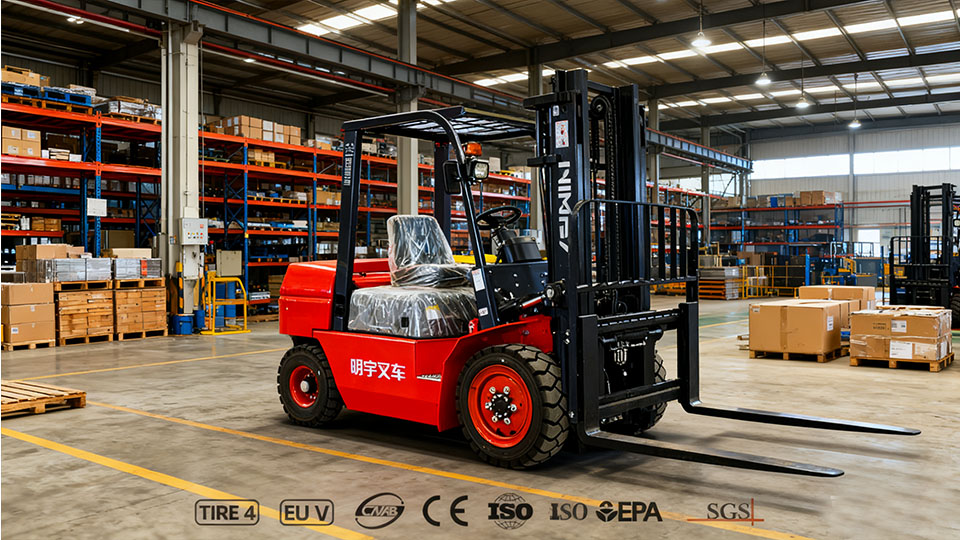
The powertrain must deliver sufficient low-end torque to accelerate laden loads from standstill without excessive clutch or torque converter slip. Hydrostatic transmissions offer precise speed control and reduced maintenance compared to powershift transmissions, though they generate more heat under continuous heavy cycling. In port applications where operators perform hundreds of short shuttle moves per shift, transmission cooling capacity must be oversized relative to standard industrial ratings.
Chassis and Stability: Port duty counterbalance forklifts require reinforced chassis frames with wider wheelbases than standard industrial models. The centre of gravity shifts dramatically when handling containers or heavy project cargo; a 16-tonne forklift carrying a 20-tonne container at 1,200 millimetres load centre operates with stability margins that demand precise engineering. Counterweight mass and distribution must be calculated for the specific load spectrum, with many port forklifts featuring bolt-on additional counterweights for occasional heavy lifts.
Mast and Visibility: Triplex masts with free lift are standard, enabling container handling beneath overhead obstacles such as crane booms, conveyor structures, and vessel deckheads. Lift heights of 4.5 to 6 metres accommodate single-stack container handling and truck bed access. For operations involving double-stack empty containers or high-cube units, masts extending to 7 metres may be necessary.
Visibility is paramount in congested port environments. Wide-view mast designs minimise hydraulic hose and chain routing obstruction. Enclosed operator cabs with curved glass and roof windows enable upward visibility during container placement. Camera systems—rear-view, fork-mounted, and overhead—have become standard equipment, with many terminals mandating 360-degree camera coverage to eliminate blind spots during reversing and stacking operations.
Tyre Selection: Pneumatic tyres are mandatory for port yard surfaces. Super-elastic or solid pneumatic tyres resist punctures from stray nails, container corner castings, and metal debris while providing adequate shock absorption. Dual-front-tyre configurations distribute load across wider ground contact patches, reducing ground pressure and improving stability. Tyre pressure monitoring systems alert operators to underinflation that would accelerate wear and reduce load capacity.
Container-Specific Handling Equipment
While counterbalance forklifts handle diverse cargo, dedicated container handling equipment offers superior efficiency for standardised box movements.
Empty Container Handlers: These specialised machines, with capacities from 8 to 10 tonnes and lift heights reaching 8 to 9 metres, are purpose-built for stacking and transferring empty containers. Top-lift spreader attachments engage corner castings precisely, enabling secure handling without fork penetration. Empty container handlers feature exceptional stability due to wide wheelbases and low centres of gravity, allowing operation on uneven yard surfaces where standard forklifts would risk tip-over. Their short wheelbases and tight turning radii navigate the narrow aisles between container stacks efficiently.
For terminals with high empty container throughput—common in transshipment hubs and export-oriented ports—dedicated empty container handlers reduce cycle times by 30-40% compared to forklift-and-spreader combinations. However, their single-purpose design limits flexibility; terminals handling mixed cargo must evaluate whether the efficiency gain justifies the capital investment alongside general-purpose forklifts.
Reach Stackers: While primarily associated with container stacking, reach stackers excel in short-distance transfer applications where containers must be moved between yard blocks, rail sidings, and truck gates. With capacities from 35 to 45 tonnes and the ability to stack containers up to 5 high, reach stackers combine heavy lift capability with the reach and precision that counterbalance forklifts cannot match.
In short-distance transfer roles, reach stackers reduce the need for yard tractors and trailers in certain workflows. A reach stacker can lift a container directly from a truck chassis, transfer it 200 metres, and place it precisely in a stack—eliminating the double-handling that tractor-trailer systems require. This efficiency comes at the cost of slower travel speeds (typically 20-25 km/h maximum) and higher fuel consumption, making reach stackers optimal for transfers under 500 metres where their lifting versatility outweighs transit time penalties.
Sideloaders: Sideloaders, or sidelifters, carry containers on their own chassis and lift from the side using hydraulic booms. While primarily road-going vehicles, sideloader configurations are deployed in port buffer zones and CFS (container freight station) operations where containers must be transferred between stack areas and ground-level loading/unloading zones. Their unique capability to place containers directly on the ground without external crane support makes them invaluable in short-distance logistics chains where crane availability is constrained.
Breakbulk and Project Cargo Forklifts
Not all port cargo travels in containers. Breakbulk freight—steel coils, lumber, bagged commodities, machinery, and project cargo—requires forklifts with different characteristics than container handlers.
High-Capacity Forklifts (16-32 Tonnes): For steel handling, heavy machinery, and project cargo, forklifts in the 16 to 32-tonne capacity range provide the brute force necessary for single-unit lifts. These machines feature dual front axles, massive counterweights, and reinforced masts capable of withstanding the shock loads generated by steel coil handling. Forks for breakbulk applications are typically thicker and shorter than standard pallet forks, with reinforced heel sections to prevent bending under concentrated loads.
Attachment Versatility: Breakbulk operations demand rapid attachment changes. Coil c-hooks, pipe clamps, bale clamps, and carpet poles transform standard forklifts into specialised handlers. Quick-hitch systems enable attachment swaps without leaving the operator cab, minimising downtime in high-volume operations. Hydraulic systems must provide sufficient flow and pressure for attachment actuation without compromising lift performance.
Electric and Alternative Power Configurations
While diesel dominates port equipment, environmental regulations and operational economics are driving adoption of alternative powertrains.
Battery-Electric Heavy Forklifts: Lithium-ion powered forklifts up to 16-tonne capacity are now commercially available from several manufacturers. These machines eliminate local emissions, reducing air quality impacts in enclosed ferry terminals, ro-ro vessel decks, and ports near residential areas. Opportunity charging during operator breaks enables continuous multi-shift operation without battery changes. However, the charging infrastructure requirements and higher capital costs currently limit widespread adoption in heavy port applications. For short-distance transfer within enclosed warehousing or CFS facilities adjacent to container yards, electric forklifts offer compelling operational and environmental advantages.
Hydrogen Fuel Cell: Experimental deployments of hydrogen fuel cell forklifts and yard tractors are underway at several European and Asian ports. Hydrogen refuelling in 3-5 minutes matches diesel convenience while eliminating emissions. Infrastructure costs remain prohibitive for most terminals, but ports with established hydrogen ecosystems—often linked to industrial clusters or offshore wind electrolysis projects—may find fuel cell equipment economically viable within this decade.
Safety Systems and Port-Specific Requirements
Port environments present collision risks that exceed standard industrial settings. The convergence of heavy forklifts, container cranes, trucks, and pedestrian stevedores creates a complex hazard matrix.
Collision Avoidance: Modern port forklifts should be equipped with proximity detection systems that alert operators to pedestrians, vehicles, and infrastructure. Radar-based systems operate reliably in rain, dust, and darkness where camera-only systems fail. Zone-based speed limiting automatically restricts forklift speed in congested areas, near vessel edges, or in container stack zones. Geofencing capabilities can create virtual boundaries that prevent equipment from entering hazardous zones such as crane operating envelopes or unstable yard surfaces.
Stability Control: Electronic stability control systems monitor chassis inclination, load weight, and mast height to prevent tip-over incidents. In port applications where uneven surfaces and dynamic loads compound stability risks, these systems provide essential protection. Load moment indicators (LMI) calculate real-time stability margins and warn operators when approaching limits.
Operator Protection: Operator cabs must meet ROPS/FOPS (roll-over/falling-object protective structure) standards, with particular attention to protection from container corner castings and lifting gear. In ports with overhead gantry crane operations, falling object protection is not merely advisable but essential. Cab air filtration systems protect operators from diesel particulate matter, coal dust, or grain dust depending on cargo types handled.
Maintenance and Reliability in Marine Environments
The marine atmosphere—salt spray, high humidity, and temperature extremes—demands maintenance protocols that extend equipment lifespan and prevent catastrophic failures.
Corrosion Protection: All structural components should be galvanised or coated with marine-grade epoxy systems. Stainless steel fasteners, while expensive, resist seizing and breakage in salt environments. Electrical connectors must be sealed and treated with dielectric grease. Weekly pressure washing removes salt deposits that accelerate corrosion, though care must be taken to avoid direct spray on sealed electrical enclosures.
Undercarriage Care: Port yard debris—mud, coal dust, grain residue, and spilled cargo—accumulates in undercarriage components. Weekly cleaning prevents this material from trapping moisture against brake drums, axles, and transmission housings. Brake systems require particular attention; contaminated brake shoes lose effectiveness, and salt corrosion causes drum pitting that accelerates lining wear.
Hydraulic System Management: Salt air corrodes hydraulic cylinder rods, destroying chrome plating and compromising seal integrity. Regular application of protective coatings and prompt repair of damaged chrome surfaces prevents this degradation. Hydraulic oil should be sampled quarterly for water contamination, which indicates seal failure or condensation ingress.
Fleet Configuration Recommendations
Optimal port forklift fleets are not homogeneous. Terminal operators should configure mixed fleets based on cargo mix, throughput volume, and yard layout.
Small to Medium Terminals (Under 100,000 TEU annually): A fleet of 3 to 5 heavy-duty diesel counterbalance forklifts (10-16 tonne capacity) with container spreader attachments provides versatility for mixed cargo, empty container handling, and breakbulk. Supplement with 1-2 empty container handlers if empty container storage exceeds 500 units.
Large Container Terminals (Over 500,000 TEU annually): Dedicated equipment maximises efficiency. Deploy reach stackers (35-45 tonne) for container transfers between yard blocks and rail/truck interfaces. Empty container handlers manage empty stacks. Heavy counterbalance forklifts (16-25 tonne) handle out-of-gauge cargo, project loads, and vessel lashing equipment. Terminal tractors with trailers handle long-distance yard transfers where reach stacker travel speed is insufficient.
Multi-Purpose Terminals: Facilities handling containers, breakbulk, and project cargo require maximum flexibility. Articulated heavy forklifts with quick-attach systems enable rapid transition between container handling and breakbulk operations. Sideloaders support CFS and ground-level container operations.
Conclusion
Short-distance transfer operations at ports and container yards demand forklifts engineered for loads, surfaces, and environmental conditions far exceeding standard industrial specifications. The correct equipment configuration—whether heavy-duty counterbalance forklifts for breakbulk versatility, reach stackers for container precision, or empty container handlers for stack efficiency—depends on rigorous analysis of cargo mix, throughput requirements, and yard geometry.
As ports face increasing pressure to reduce emissions while maintaining throughput growth, the evolution toward electric and hydrogen powertrains will reshape fleet configurations. However, the fundamental requirements remain unchanged: robust chassis construction, corrosion-resistant materials, superior visibility, and integrated safety systems. Terminals that align their forklift fleets with these technical requirements achieve superior reliability, reduced downtime, and safer operations in the world's most demanding material handling environments. In the port industry, where every minute of vessel turnaround time carries measurable economic value, equipment selection is not merely an operational decision—it is a competitive imperative.
Name: selena
Mobile:+86-13176910558
Tel:+86-0535-2090977
Whatsapp:8613181602336
Email:vip@mingyuforklift.com
Add:Xiaqiu Town, Laizhou, Yantai City, Shandong Province, China