
vip@mingyuforklift.com
+86-0535-2090977

Introduction
Rough terrain forklifts—commonly classified as Class VII powered industrial trucks under OSHA standards and their international equivalents—occupy a distinct operational niche that standard warehouse forklifts cannot penetrate. Equipped with pneumatic tires, substantial ground clearance, four-wheel-drive capability, and reinforced chassis architecture, these machines navigate unpaved surfaces, gradients, and weather-exposed environments where cushion-tired counterbalance trucks would founder immediately. In the building materials sector, sand and aggregate operations, and open-air storage yards, rough terrain forklifts serve as the primary material handling interface between production, storage, and dispatch.
The global building materials industry moves billions of tonnes annually through outdoor storage and distribution networks. Brick and block manufacturers, lumber yards, steel stockholders, sand quarries, and ready-mix concrete plants all depend on equipment capable of operating reliably on loose substrates, in precipitation, and across uneven topography. This article examines the technical application of rough terrain forklifts within these demanding sectors, addressing machine configuration, attachment selection, operational protocols, and maintenance strategies essential for productivity and safety.
Machine Architecture and Terrain Capability
Rough terrain forklifts diverge fundamentally from standard industrial designs in several critical engineering aspects. Ground clearance typically ranges from 250 to 400 millimetres—three to four times that of warehouse forklifts—enabling traversal of ruts, debris, and uneven hardcore surfaces without undercarriage damage. Four-wheel-drive systems with differential locking distribute torque across axles when wheels encounter low-traction surfaces such as loose sand, wet clay, or gravel.
The mast and carriage assembly on rough terrain forklifts prioritises strength over reach height. While warehouse reach trucks may extend to 12 metres, rough terrain forklifts typically operate within 4 to 7 metre lift heights, reflecting the reality that outdoor yards rarely exceed three or four pallet positions high due to wind loading, stability concerns, and the impracticality of high-density racking in uncontrolled environments. Mast tilt angles of 10 to 15 degrees forward and backward compensate for uneven ground, enabling level fork engagement even when the chassis rests on a slope.
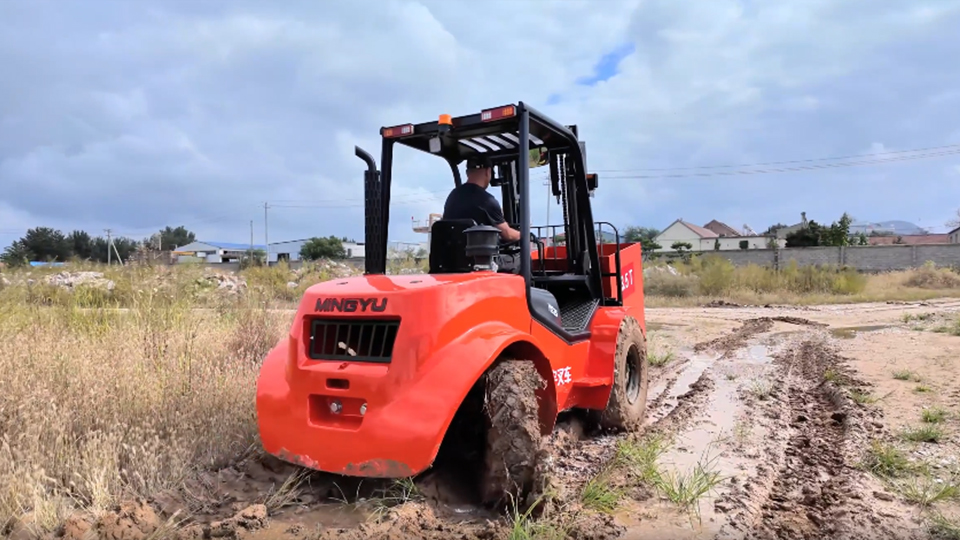
Frame articulation or oscillating axle designs maintain tyre contact across irregular surfaces. In articulated models, the chassis pivots at the centre, allowing front and rear wheels to follow independent contours. In rigid-frame designs with oscillating rear axles, the rear axle pivots longitudinally to maintain four-point ground contact. Both configurations prevent the teetering instability that would render standard forklifts inoperable on construction-site hardstanding.
Tyre selection profoundly influences performance in building materials and aggregate yards. Pneumatic tyres with aggressive tread patterns provide traction on sand and loose gravel, while foam-filled or solid pneumatic options eliminate puncture risks from nails, rebar, and sharp aggregate fragments common in demolition waste and construction material handling. Wide-base tyres distribute ground pressure across softer substrates, reducing the rutting that progressively degrades yard surfaces and creates hazardous conditions.
Building Materials Handling: Bricks, Blocks, and Masonry Products
The clay brick and concrete block industry presents specific material handling challenges that shape rough terrain forklift configuration. Standard palletised brick loads weigh between 1,000 and 1,500 kilograms per pallet, with weight concentrated in a dense, low-profile package. Concrete masonry units (CMUs) often exceed these weights, particularly when handling architectural blocks or retaining wall segments. Forklifts must provide adequate residual capacity at the load centre while navigating yards where surface conditions deteriorate under concentrated wheel loads.
Fork configuration for masonry handling requires attention to fork thickness and tip geometry. Standard ITA Class III or IV forks may prove insufficient for continuous block handling; reinforced forks with greater section modulus resist the bending moments generated by dense masonry loads. Fork tips should be tapered and slightly radiused to facilitate pallet stringer entry without damaging wooden pallets, which in the building materials sector are frequently reused multiple times and develop splintered or crushed entry points.
Pallet stability represents a significant concern. Brick and block pallets, often shrink-wrapped or banded, can shift during transport across uneven yard surfaces. Rough terrain forklifts should be equipped with load backrests of sufficient height to contain palletised loads, and operators must maintain conservative travel speeds—particularly when traversing gradients or turning on loose surfaces where centrifugal forces can overcome friction between pallet layers.
For manufacturers and distributors handling non-palletised products such as loose bricks, bagged cement, or roof tiles, specialised attachments transform standard forks into versatile handling tools. Brick clamps with adjustable arms grip unitised loads without pallets, reducing packaging costs but requiring precise hydraulic pressure regulation to prevent product damage. Rotators and forward bin dumpers enable unloading into mixing hoppers or customer vehicles. When configuring attachments, hydraulic flow and pressure ratings must match the forklift's auxiliary circuit capabilities; underspecification results in sluggish operation, while overpressurisation risks hose rupture and attachment structural failure.
Weather exposure compounds masonry handling difficulties. Wet clay bricks gain significant moisture weight and become slippery, reducing pallet friction. Frost conditions create icy yard surfaces that demand reduced speeds and potentially tyre chain deployment in extreme cold. Rough terrain forklifts operating in exposed northern climates require cold-start packages including engine block heaters, hydraulic oil pre-heaters, and insulated battery enclosures to ensure reliable morning startup after overnight temperature drops.
Sand, Aggregate, and Quarry Applications
Sand and aggregate operations present perhaps the most hostile environment for material handling equipment. Silica sand, crushed stone, gravel, and recycled aggregates generate airborne particulate concentrations that destroy standard filtration systems, abrade exposed surfaces, and infiltrate every mechanical seal and electrical enclosure.
In these applications, rough terrain forklifts frequently serve dual roles: conventional palletised load handling for bagged products, cement, and packaged materials, and bulk material movement when fitted with buckets, grabs, or sweepers. The versatility requirement demands machines with robust auxiliary hydraulics and quick-attach carriage systems that enable rapid tool changes without leaving the operator compartment.
Air filtration systems require aggressive specification for sand and aggregate yards. Standard paper-element air filters may require daily replacement in severe conditions. Cyclonic pre-cleaners—mounted atop the air intake stack—use centrifugal separation to expel coarse dust before it reaches the filter media, extending service intervals by a factor of five or more. In extreme environments, bath-type oil bath air cleaners provide superior dust capture efficiency, though they require more frequent servicing and careful oil level maintenance.
Radiator and cooling system protection is equally critical. Sand dust accumulates in radiator fins, reducing heat rejection capacity and causing engine overheating. Reversible cooling fans, which periodically reverse airflow to blow debris out of the radiator matrix, provide automated protection. Alternatively, radiators mounted in raised, protected positions with coarse screens reduce direct dust impingement. Daily radiator cleaning with low-pressure compressed air—not high-pressure water, which can drive particles deeper into the fins—should be standard procedure.
Tyre wear in aggregate yards is extreme. Sharp crushed stone fragments cut sidewalls, while abrasive surfaces accelerate tread wear. Solid pneumatic or polyurethane-filled tyres eliminate puncture vulnerabilities but transmit more vibration to the chassis and operator. Some operations utilise dual-tire configurations or super-elastic tyres that balance puncture resistance with ride quality. Regardless of tyre type, maintaining proper inflation pressure on pneumatic tyres is essential; underinflation increases sidewall flexing and heat buildup, while overinflation reduces traction and accelerates centre tread wear.
Hydraulic systems in sand operations face contamination from dust infiltration around cylinder rods and breather caps. Rod wipers and bellows boots provide essential mechanical protection, scraping abrasive particles from chrome surfaces before they enter seal zones. Desiccant breathers on hydraulic reservoirs filter incoming air and remove moisture, preventing both particulate and water contamination that degrades oil and corrodes internal components.
Open-Air Storage Yard Logistics and Surface Management
Open-air storage yards for building materials differ fundamentally from warehouse interiors in their dynamic surface conditions, exposure to weather, and lack of environmental control. Yard surface design and maintenance directly influence rough terrain forklift productivity and safety.
Unsurfaced yards of compacted soil or crushed stone deteriorate under repeated forklift traffic, particularly during wet weather. Ruts and potholes develop progressively, creating hazards that can cause load instability, undercarriage damage, and operator injury. Best practice involves maintaining yards with well-draining hardcore surfaces, crowned for water runoff, and regularly graded to restore level profiles. In high-rainfall regions, geotextile reinforcement beneath aggregate layers prevents subgrade pumping and surface degradation.
Yard layout must account for turning radii and travel paths. Rough terrain forklifts require wider aisles than warehouse equipment—typically 4.5 to 6 metres for standard counterbalance models, and more for articulated variants. Stacking patterns should orient rows to prevailing wind directions where possible, reducing wind-driven dust accumulation on loads and improving operator visibility. Lighting for night operations requires robust fixtures rated for vibration and weather exposure, positioned to eliminate shadows in travel paths and loading areas.
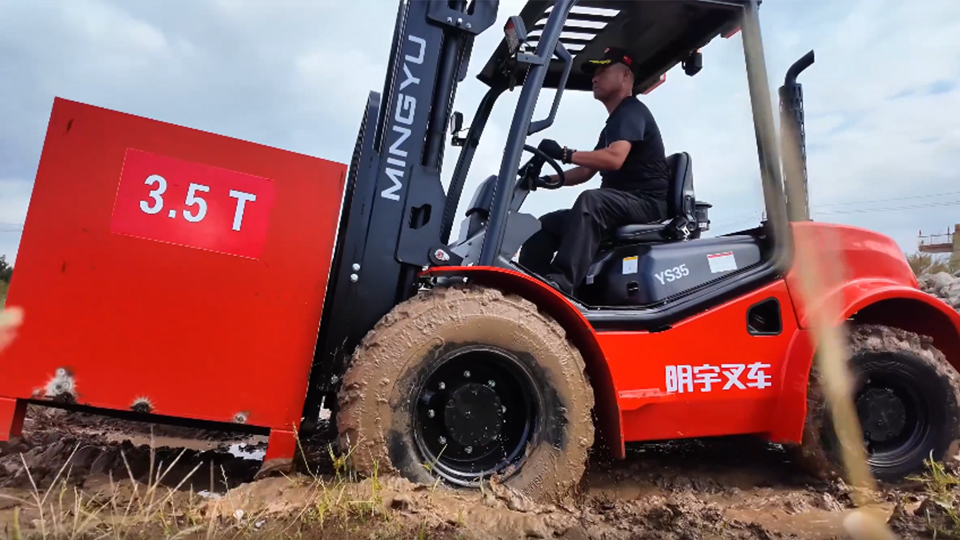
Load stacking height in open yards is constrained by wind exposure and stability rather than rack geometry. Building material pallets stacked four or five high may appear stable in calm conditions but become sail areas in high winds, particularly lightweight products such as insulation boards, timber, or empty pallets. Rough terrain forklifts engaged in high stacking should be equipped with load weight indicators and stability control systems that warn operators when centre-of-gravity limits approach critical thresholds.
Drainage infrastructure prevents yard flooding that renders surfaces impassable and creates standing water that accelerates equipment corrosion. Culverts, French drains, and surface channels must be maintained clear of debris. Forklift operators should be trained to identify soft ground conditions after heavy rain and avoid travel across saturated areas where machines may bog down or tip due to subsurface instability.
Attachment Solutions for Diverse Material Types
The versatility of rough terrain forklifts in building materials and aggregate operations depends heavily on attachment configuration. Beyond standard forks, several attachments address sector-specific requirements.
Bucket attachments with hydraulic dump functions convert forklifts into front-end loaders for handling loose sand, gravel, and aggregate. Bucket capacity must align with forklift rated capacity at the load centre; overloading buckets with dense wet sand easily exceeds safe working loads. Bolt-on cutting edges extend bucket life in abrasive materials.
Fork positioners and side-shifters enable precise pallet engagement without repositioning the entire machine. In tight yard configurations where trailer positioning limits manoeuvring space, side-shifters reduce cycle times significantly. Hydraulic fork positioners allow operators to adjust fork spacing from the cab, accommodating varying pallet dimensions common in international building material supply chains.
Load stabilisers and push-pull systems secure palletised loads during travel across uneven terrain. Hydraulic load guards clamp the top of palletised brick or block loads, preventing layer shift that occurs when traversing ruts or slopes. These attachments require careful pressure calibration; excessive force crushes packaging or product edges, while insufficient force fails to secure the load.
Sweepers and yard brooms maintain yard surfaces by removing loose aggregate and debris that puncture tyres and create slip hazards. Rotary broom attachments mount to the carriage and are driven by auxiliary hydraulics, enabling routine surface maintenance without dedicated sweepers.
Jibs and crane hooks extend lifting capability for non-palletised items such as steel beams, pipes, and precast concrete elements. When configuring jib attachments, engineers must verify that the forklift's load chart accommodates the extended load centre created by jib geometry; a 2-tonne load at 600 millimetres becomes a critical overload at 2,000 millimetres on a jib.
Safety Protocols for Outdoor and Unstable Terrain
Rough terrain forklift operations in building materials and aggregate yards carry elevated risks that demand rigorous safety protocols beyond standard warehouse practices.
Slope operation represents the most hazardous routine activity. Rough terrain forklifts may be rated for operation on gradients up to 30% or more when unladen, but laden travel on slopes dramatically reduces stability margins. Best practice mandates that loaded forklifts ascend slopes forwards and descend in reverse, keeping the load uphill of the centre of gravity. Side-slope travel with raised loads is prohibited; the combined centre of gravity shifts laterally toward the downhill side, creating tip-over risk that increases with load height.
Visibility management in dusty yards requires systematic suppression and personal protection. Water spray systems on yard roads dampen dust during dry periods. Operator cabs should be positive-pressure sealed with recirculating air filtration, preventing respirable silica dust infiltration. Where enclosed cabs are unavailable, operators must wear appropriate respiratory protection during dusty conditions.
Overhead hazards in open yards include power lines, crane booms, and overhead conveyors. Rough terrain forklifts operating near overhead power lines must maintain minimum approach distances—typically 3 metres for lines up to 50 kV, increasing for higher voltages. Load height must be controlled during travel, and spotters should guide operations near overhead obstructions.
Pedestrian segregation in open yards lacks the natural physical boundaries of warehouse aisles. High-visibility clothing, designated pedestrian walkways, and proximity warning systems reduce collision risks. Blue spotlights, backup alarms, and rotating beacons alert personnel to forklift movement in areas with limited sight lines.
Maintenance Strategies for Harsh Environments
Maintenance intervals for rough terrain forklifts in building materials and aggregate operations must be compressed aggressively compared to standard industrial applications. The abrasive, corrosive, and vibratory environment accelerates wear on every system.
Daily maintenance should include air filter inspection or replacement, radiator cleaning, tyre damage assessment, and undercarriage debris removal. Hydraulic oil sampling every 250 hours monitors contamination levels that would be acceptable at 500-hour intervals in cleaner environments. Engine oil and filter changes should occur at half the manufacturer's standard interval when operating in heavy dust.
Weekly maintenance encompasses brake inspection, particularly for drum brake systems where dust and moisture create abrasive paste on shoe linings. Greasing of all pivot points, kingpins, and mast rollers prevents accelerated wear from dust contamination. Battery terminals on electric models require cleaning and protection from corrosion accelerated by humid, salty, or chemically active atmospheres.
Periodic comprehensive inspections must include frame crack detection, particularly at weld joints and stress concentration points where vibration and frame flexing initiate fatigue failures. Mast channels require straightness verification; impacts with loads or yard obstacles distort channels, causing binding and premature roller wear. Hydraulic cylinder rods must be inspected for scoring that indicates seal contamination; even minor scoring accelerates seal failure and oil leakage.
Corrosion protection demands particular attention in coastal building material yards where salt-laden atmospheres combine with cement dust alkalinity to attack metal surfaces. Regular pressure washing removes corrosive deposits, followed by touch-up painting of chipped surfaces. Undercoating and cavity wax injection protect frame interiors where moisture and debris accumulate unseen.
Regulatory Compliance and Operator Competency
Rough terrain forklift operations fall under distinct regulatory frameworks that vary by jurisdiction but share common themes of equipment certification, operator licensing, and workplace safety.
In the European Union, rough terrain forklifts are subject to the Machinery Directive 2006/42/EC and EN 1459 standards, which specify stability, visibility, and safety device requirements. In the United States, OSHA 1910.178(l) mandates operator training specific to the equipment type and operating conditions. Australian operations follow AS 2359, which includes specific provisions for rough terrain equipment.
Operator competency for rough terrain applications must extend beyond standard forklift certification. Operators need training in slope assessment, load stability on uneven ground, attachment operation, and hazard recognition specific to outdoor yards. Competency should be refreshed annually, with additional training provided when operators transition between significantly different machine types or yard configurations.
Equipment inspection records must document daily checks, maintenance activities, and periodic thorough examinations. In many jurisdictions, rough terrain forklifts require annual inspection by a competent person independent from the operator, with documentation retained for regulatory verification.
Conclusion
Rough terrain forklifts serve as indispensable assets in the building materials, sand, and aggregate sectors, bridging the gap between production, storage, and distribution in conditions that would incapacitate standard industrial equipment. Success in these applications demands more than robust machinery; it requires thoughtful configuration of tyres, attachments, and protection systems aligned with specific material characteristics and environmental stressors. Operational excellence emerges from disciplined adherence to slope safety protocols, visibility management, and surface maintenance, supported by maintenance programmes compressed appropriately for abrasive and corrosive environments. As building material supply chains face increasing pressure for efficiency and safety, organisations that master rough terrain forklift application in open-yard settings gain measurable advantages in throughput, equipment longevity, and incident prevention. The technical complexity of these operations rewards systematic engineering analysis and continuous operational refinement.
Name: selena
Mobile:+86-13176910558
Tel:+86-0535-2090977
Whatsapp:8613181602336
Email:vip@mingyuforklift.com
Add:Xiaqiu Town, Laizhou, Yantai City, Shandong Province, China