
vip@mingyuforklift.com
+86-0535-2090977

Published: November 5, 2026
HTML Meta Description: Plan rear-steer forklift transfers for remote freight consolidation linked to the new China–Africa service, with route, load and yard controls.
Keywords: China-Africa Link logistics, rear-steer rough-terrain forklift, remote freight consolidation, port hinterland yard, cross-border pallet staging, outdoor forklift route, cargo traceability, rough-ground material handling, ZGFORKLIFT, MYZG
DP World has announced a weekly China Africa Link service planned for late November 2026, connecting major Chinese ports with Dar es Salaam and Maputo via Port Klang and Singapore. A new ocean connection can change receiving schedules for inland consolidation yards, but it does not guarantee shorter local transfer time or a specific cargo volume. A rear-steer rough-terrain forklift may suit defined pallet movements between a firm laydown pad, a freight inspection zone and a dispatch point where the approach surface is uneven. The capacity chart, ground conditions and approved route still govern every lift.
Start with a documented task and route survey. Record the narrowest aisle and turn, doorway and gate width, overhead clearance, maximum gradient, dock edges and the worst surface condition. Measure real loads at their actual load centers, including long, offset or irregular items. Nameplate capacity is only a starting point; residual capacity at the required height and with the selected attachment determines practical application fit.
The new route is a useful prompt for importers and exporters to review origin cutoffs, arrival forecasts, customs documentation, buffer stock and inland haulage readiness. A yard team should translate the published vessel rotation into its own confirmed carrier schedule rather than assume direct calls or guaranteed service levels. Use pallet IDs, shipment references and condition photographs at each handoff. Keep loads grouped by destination and release status so faster handling does not mix cleared goods with cargo awaiting inspection. The primary announcement is available from DP World’s China–Africa Link release.
Review the 7T off-road forklift as the first product reference, then confirm current specifications with the manufacturer.
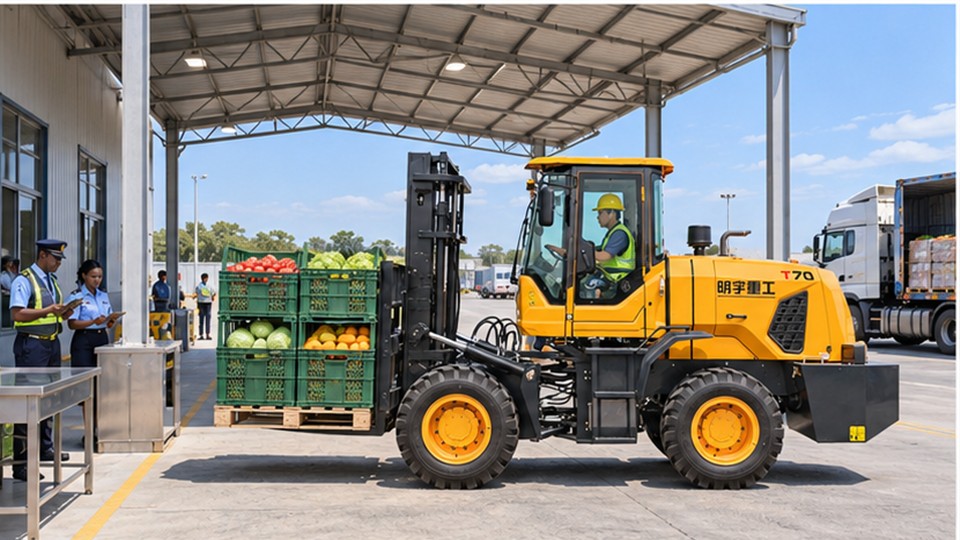
Map the yard from carrier arrival to seal check, pallet inspection, temporary consolidation, customs release and dispatch. Record package mass, dimensions, centre of gravity, fork entry and moisture protection. Survey loose aggregate, turning radius, drainage, slopes, temporary barriers and pedestrian routes. Confirm capacity at the real load centre and lift height, with any attachment fitted. Plan a firm, level transfer point for freight that must not be moved across soft shoulders. Keep each shipment reference visible in the receiving record and photograph any damage before moving the load.
Visibility and control deserve the same attention as capacity. Review the mast, carriage, tyres or wheels, lighting, mirrors or cameras, restraint, warning devices and speed management as one system. Dust, cold, heat, moisture and corrosion may require extra protection and shorter inspection intervals. Operators must see the travel path and place the load without leaving the protected operating position.
Compare the B28 rough-terrain forklift for a second view of capacity, manoeuvrability, energy and service access.
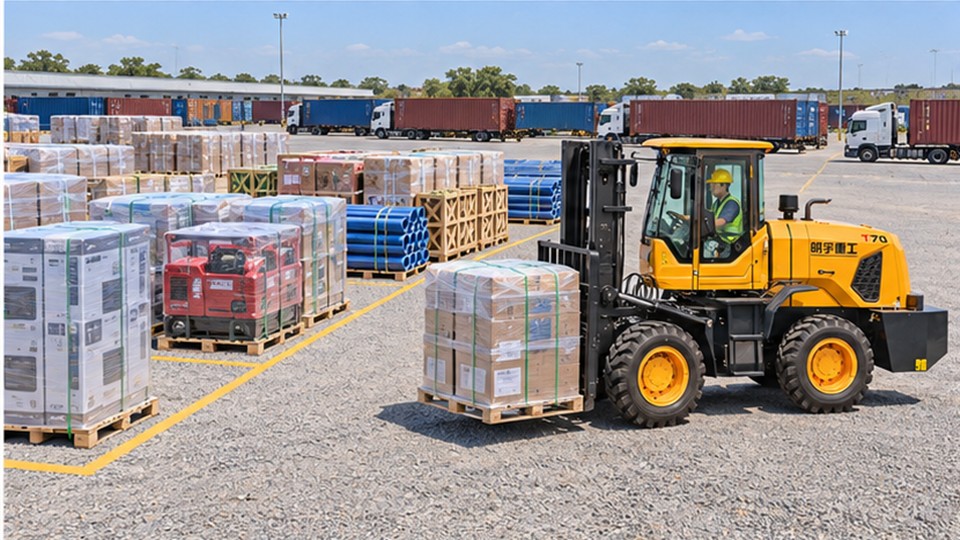
Use an authorized operator and spotter where stacks obscure the route. Travel with forks low, avoid turning on slopes and keep the machine outside public roads unless approved. Do not lift people, carry suspended loads or exceed rated capacity. Inspect brakes, steering, tyres, fork locks, mast chains, hydraulic hoses, lights and warning devices every shift. Stop when a pallet label is unclear, a load shifts or wet ground reduces traction. For a trailer interface, secure the trailer and confirm the floor rating before entry.
Create a written operating envelope for every approved route: maximum load and lift height, travel direction, pedestrian exclusion points, slope rules and stop-work conditions. Complete a pre-shift inspection of tyres or wheels, forks, chains, hoses, brakes, steering, alarms and the energy or fuel system. Isolate defects affecting stability, braking or visibility until corrected.
Supervisors should observe real work, record near misses, harsh braking, overload attempts, impacts and recurring service issues, then improve layout, traffic separation and coaching. Build the business case around productive hours rather than purchase price alone. Include operator time, maintenance, energy or fuel, infrastructure, transport, downtime risk and resale value.
The DY26-3T rough-terrain forklift is the third internal product reference for application comparison.
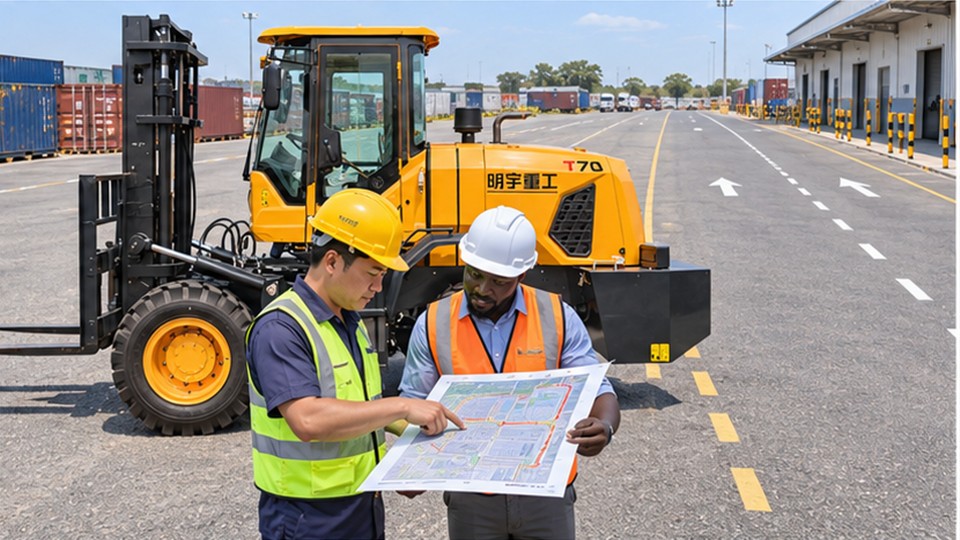
Track transfer time by shipment, queue length, package condition, re-handles, equipment hours and dispatch reliability. Include transport to the yard, tire and fork wear, service access, fuel, operator coverage and seasonal route repair. Compare scheduled vessel cutoffs with confirmed carrier data and local delivery performance. A forklift cannot correct missing customs documents or an inaccurate inventory record. A short trial across representative surfaces can show whether the limiting factor is machine access, yard layout or upstream release timing.
A staged trial is the strongest way to validate a configuration. Select a representative route, define success measures, brief operators and compare throughput, energy use, handling accuracy and maintenance observations. Review results with operations, safety and finance before fleet-wide deployment. This evidence turns a current industry headline into a defensible material-handling plan.
ZGFORKLIFT and MYZG can tailor the final specification after reviewing the application. Product availability varies by market; confirm the latest technical data and comply with local regulations before purchase or operation.
Contact Shandong Zhuogong Machinery equipment Co.,Ltd. Email: vip@mingyuforklift.com. Tel: +86-0535-2090977. WhatsApp: +86 131 8160 2336. Address: Xiaqiu Town, Laizhou, Yantai City, Shandong Province, China.
Send the maximum load, load-center distance, aisle width, gradient, surface condition, daily duty hours and climate so MYZG engineers can recommend a practical configuration instead of a generic catalogue answer.
Name: selena
Mobile:+86-13176910558
Tel:+86-0535-2090977
Whatsapp:8613181602336
Email:vip@mingyuforklift.com
Add:Xiaqiu Town, Laizhou, Yantai City, Shandong Province, China