
vip@mingyuforklift.com
+86-0535-2090977

Warehouse space is expensive, and many operators want to store more pallets without expanding the building. Narrower aisles and higher racking can improve storage density, but only when the layout, truck, pallet and workflow are designed as one system. In 2026, narrow-aisle planning is a major material-handling topic because e-commerce, manufacturing and third-party logistics operations are balancing space utilization with safe, reliable throughput.
Shandong Zhuogong Machinery Equipment Co.,Ltd supplies material-handling equipment through the ZGLOADER and MYZG brands. The company recommends measuring the real operation before selecting a forklift or stacker. A published turning radius alone cannot determine the required aisle width, and reducing clearance without professional review can create rack impacts, product damage and pedestrian risk.
The meaning of “narrow aisle” varies by market, equipment class and pallet system. A conventional counterbalance forklift generally needs room to enter the aisle, turn approximately 90 degrees and place the load. A reach-style truck or stacker can operate differently, allowing the truck body to remain more aligned with the aisle. Very-narrow-aisle systems may require specialized guided equipment and infrastructure.
Instead of beginning with a label, begin with dimensions. Measure the clear distance between rack faces, not only between floor markings. Include column protectors, pallet overhang, mesh, sprinklers, building columns and any other obstruction that reduces usable space.
Manufacturers may provide a right-angle stacking aisle value for a defined pallet size and load orientation. The figure depends on truck geometry, load length, fork length and clearance allowance. A different pallet or an overhanging load can require more room even when the truck is unchanged.
Facilities should verify the calculation using the exact equipment specification and representative loads. A controlled physical trial is valuable before committing to an entire rack layout. The trial should include entering the aisle, approaching the rack, lifting, depositing, retrieving and exiting without contact.
Nominal pallet size is not always the real load size. Cartons, bags or wrapped goods may extend beyond the deck. Damaged pallets can sag or lean, and unstable loads may shift while turning. Measure maximum operating dimensions rather than relying on a purchasing specification.
Fork length should support the load according to the equipment instructions without protruding dangerously into adjacent areas. Load-center distance and total weight must remain within the data plate. Narrow aisles do not change the fundamental rules of forklift capacity and stability.
Storage density often increases vertically as well as horizontally. Capacity at maximum height may be lower than the truck's headline rated capacity. Mast type, lowered height, free lift, overhead clearance and residual capacity should all be reviewed.
The building must also support the proposed racking and loads. Rack design, floor flatness, sprinkler clearances and local fire requirements require qualified specialists. A forklift supplier can help match equipment, but should not replace the structural and regulatory review of the warehouse.
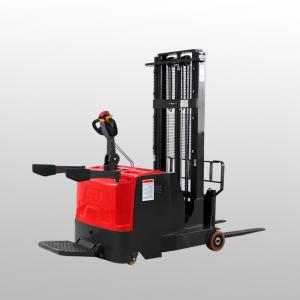
A reach mechanism moves the load toward the rack while allowing the main body of the truck to remain in the aisle. This can support compact warehouse layouts where the application and floor are suitable. Operators need clear visibility and model-specific training because load movement and steering behavior differ from a conventional counterbalance forklift.
Customers can review the MYCQDA electric reach stacker as one reference within the ZGLOADER and MYZG range. Actual capacity, lift height, aisle requirement and available configuration must be confirmed in the current technical proposal.
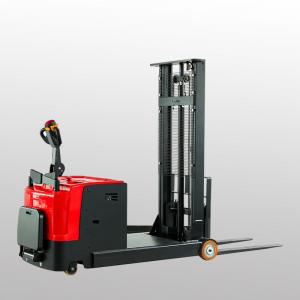
A compact counterbalanced stacker can handle some loads without straddle legs extending around the pallet. A shorter body may support maneuverability, but the safe aisle still depends on the complete truck and load geometry. Buyers should avoid assuming that “short-axis” means the machine can work in any narrow passage.
The MYCPDB08-10 short-axis electric counterbalanced stacker provides a product example. The workplace should verify floor condition, gradients, pallet entry, capacity at height and traffic interaction before selection.
Pedestrian-controlled and standing stackers can suit short-distance pallet movement and rack operations, depending on capacity and lift height. Their traffic pattern differs from a sit-down forklift. The operator's position, emergency controls, travel speed and sight lines must be considered in aisle and intersection design.
Where operators walk with equipment, sufficient separation from racking, walls and other vehicles is essential. Foot-protection structures and controls do not make a cramped route acceptable. The layout should prevent trapping and allow safe stopping and escape space.
Higher lifts and narrower clearances increase the importance of a suitable floor. Uneven slabs, joints, slopes and debris can make the truck lean or cause the load to move relative to the rack opening. Floor requirements should be established for the selected equipment and lift height.
Housekeeping is equally important. Stretch wrap, broken wood and loose packaging can obstruct wheels and create sudden steering changes. Daily aisle inspection and prompt repair are part of safe narrow-aisle operation.
Narrow aisles may leave little room for a person and truck to pass. Facilities should define whether an aisle is vehicle-only during handling, one-way, or controlled by access signals. Pedestrian crossings should be placed where visibility is good, not simply where the walking route is shortest.
Mirrors, warning lights, sensors or barriers may support the plan when correctly selected, but physical separation and clear procedures remain central. Emergency exits, fire equipment and evacuation routes must never be blocked by racking or parked equipment.
Rack uprights are vulnerable to impacts, especially where turning clearance is limited. Approved guards can protect selected locations, but they reduce usable width and must be included in the aisle measurement. Any impact should be reported and the rack assessed under the facility's inspection procedure.
Pallets should be positioned with the required support and clearance. Operators must not push damaged pallets into place or use the mast to straighten racking. Bent beams, missing locks, leaning frames and overloaded locations require immediate attention from qualified personnel.
Electric stackers and narrow-aisle trucks require a charging plan. Charger location, ventilation, electrical supply, cable protection, fire precautions and battery instructions depend on the system and local rules. Charging equipment should not reduce an aisle below its safe clearance or create a trip hazard.
Shift pattern influences battery choice and charging windows. Buyers should provide daily operating hours, travel distance, lift cycles and break schedules. Energy planning should be completed before the warehouse depends on the new layout for peak throughput.
A layout that works with lightly loaded pallets during a demonstration may fail during seasonal peaks. Test the largest approved pallet, heaviest normal load and busiest traffic period. Include staging space for inbound and outbound goods, empty pallets, damaged stock and maintenance access.
Congestion can remove the productivity gained from higher storage density. Fast-moving products may benefit from wider, more accessible zones, while slower inventory can use denser storage. Warehouse slotting and equipment selection should therefore be planned together.
Operators need instruction and supervised practice on the specific model and site. Training should cover steering, braking, load engagement, reach or mast functions, capacity, travel position, pedestrian controls and emergency procedures. A driver experienced on a counterbalance forklift should not be assumed competent on a reach stacker without additional training.
Supervisors should observe real tasks after implementation. Repeated rack contact, rushed reversing or frequent repositioning may show that the aisle calculation, pallet quality, visibility or work target needs correction.
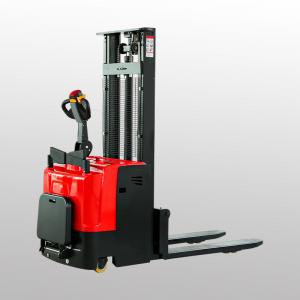
Browse the ZGLOADER and MYZG stacker range for available equipment categories. The MYCDDD standing electric pallet stacker is another product reference for planned warehouse handling.
Shandong Zhuogong Machinery Equipment Co.,Ltd can review aisle drawings, rack height, pallet dimensions, load weight, operating hours and floor conditions. Options and specifications vary by model and market; customers should request current technical documentation and a written application proposal.
For narrow-aisle equipment selection, product information and international cooperation, please contact Shandong Zhuogong Machinery Equipment Co.,Ltd.
Shandong Zhuogong Machinery Equipment Co.,Ltd
Address: Xiaqiu Town, Laizhou, Yantai City, Shandong Province, China
Mobile: +86-13176910558
Email: vip@mingyuforklift.com
Website: https://www.vavforklift.com/
In 2026, successful narrow-aisle planning is not simply about reducing centimeters between racks. When layout, loads, trained people and suitable ZGLOADER or MYZG equipment are evaluated together, a warehouse can improve storage density without sacrificing safe and dependable material flow.
Name: selena
Mobile:+86-13176910558
Tel:+86-0535-2090977
Whatsapp:8613181602336
Email:vip@mingyuforklift.com
Add:Xiaqiu Town, Laizhou, Yantai City, Shandong Province, China
