
vip@mingyuforklift.com
+86-0535-2090977

1. The Fundamental Physics: The Stability Triangle
To understand the center of gravity, one must first understand the Stability Triangle. Most forklifts are designed with a three-point suspension system. Even on a four-wheel forklift, the steer axle is attached to the frame by a single pivot point in the center, creating a triangle between the two front drive wheels and the pivot point of the rear axle.
The Combined Center of Gravity
A forklift has two distinct centers of gravity:
The Truck Center of Gravity: Where the weight of the vehicle itself is concentrated (typically located low and toward the rear to counteract the load).
The Load Center of Gravity: The center of the weight being lifted (typically 24 inches from the fork face).
When the load is picked up, these two points merge into a single Combined Center of Gravity. For a forklift to remain stable, this combined CG must stay within the boundaries of the stability triangle. If the CG moves outside the triangle—either forward, left, or right—the forklift will tip.
2. The Vertical Dimension: The Stability Pyramid
While the Stability Triangle explains lateral (side-to-side) and longitudinal (forward) stability, it is actually a two-dimensional representation of a three-dimensional reality: the Stability Pyramid.
As the forks are raised, the center of gravity moves upward. The "triangle" effectively narrows as it reaches the top of the pyramid. This means that at maximum lift height, the margin for error is significantly reduced. A minor bump or a slight tilt that would be harmless at floor level can cause a catastrophic tip-over when the mast is fully extended.
3. Factors That Shift the Center of Gravity
Several technical variables act upon the center of gravity during operation. Understanding these is critical for calculating safe load capacities.
A. Load Center Distance
The "rated capacity" of a forklift is usually based on a 24-inch load center. This assumes the center of the load's weight is 24 inches from the vertical face of the forks.
If the load is longer (e.g., a 72-inch crate), the load center increases to 36 inches.
As the load center moves further away from the fulcrum (the front wheels), the "leverage" of the load increases, pulling the combined CG forward.
B. Mast Tilt and Dynamic Forces
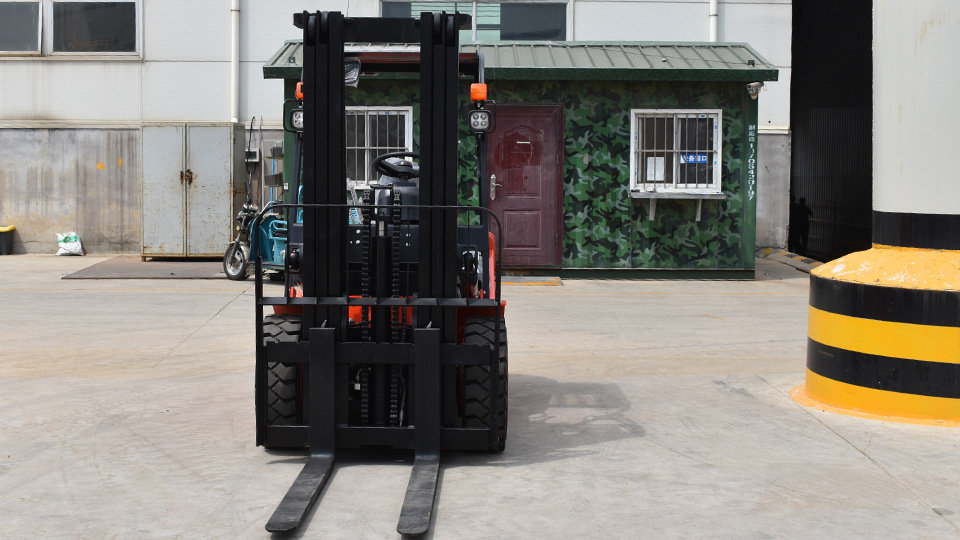
Forward Tilt: Tilting the mast forward moves the CG toward the front edge of the stability triangle. This is the most common cause of forward tip-overs.
Backward Tilt: While safer for transport, excessive backward tilt with a heavy load at high elevations can shift the CG behind the rear pivot point, causing a rearward tip-over.
Momentum and Inertia: Centrifugal force acts on the CG during turns. If a forklift turns too sharply, inertia pushes the CG toward the side of the stability triangle. If the speed is high enough, the CG exits the triangle, and the truck rolls.
4. The Mathematical Formula for Stability
The forklift operates on the principle of a Class 1 Lever. The front drive wheels act as the fulcrum ($F$). To maintain equilibrium, the "Moment" of the truck must be greater than the "Moment" of the load.
The formula for the Load Moment ($M_l$) is:
$$M_l = W \times (D_1 + D_2)$$
Where:
$W$ = Weight of the load.
$D_1$ = Distance from the front axle to the fork face.
$D_2$ = The load center (distance from the fork face to the center of the load).
For the forklift to remain stable, the Truck Moment ($M_t$) must remain higher than the $M_l$. Manufacturers calculate the counterweight specifically to ensure $M_t > M_l$ under rated conditions.
5. Modern Engineering Solutions for CG Management
In 2026, manufacturers have moved beyond passive stability to active, sensor-based management of the center of gravity.
Active Stability Systems
Systems like Toyota’s SAS (System of Active Stability) use a controller to sense the height of the load and the speed of the vehicle. If the sensors detect the CG moving toward the edge of the stability triangle during a turn, the system automatically locks the rear swing axle, transforming the "triangle" into a "rectangle" and momentarily increasing the stability base.
Electronic Mast Control
Advanced trucks now feature automatic speed reduction when the mast is raised above a certain threshold. By limiting the speed and tilt angle at height, the onboard computer ensures the dynamic forces do not push the CG out of the "Stability Pyramid."
6. Practical Implications for Operators
To keep the center of gravity safe, operators must follow three technical rules:
Keep it Low: Travel with the load as close to the ground as possible (typically 4–6 inches). This keeps the CG at its widest point in the stability pyramid.
Smooth Transitions: Avoid "inching" or sudden braking, which causes the load to shift forward due to momentum ($F=ma$).
The Slope Rule: When driving on an incline, always keep the load pointed uphill.
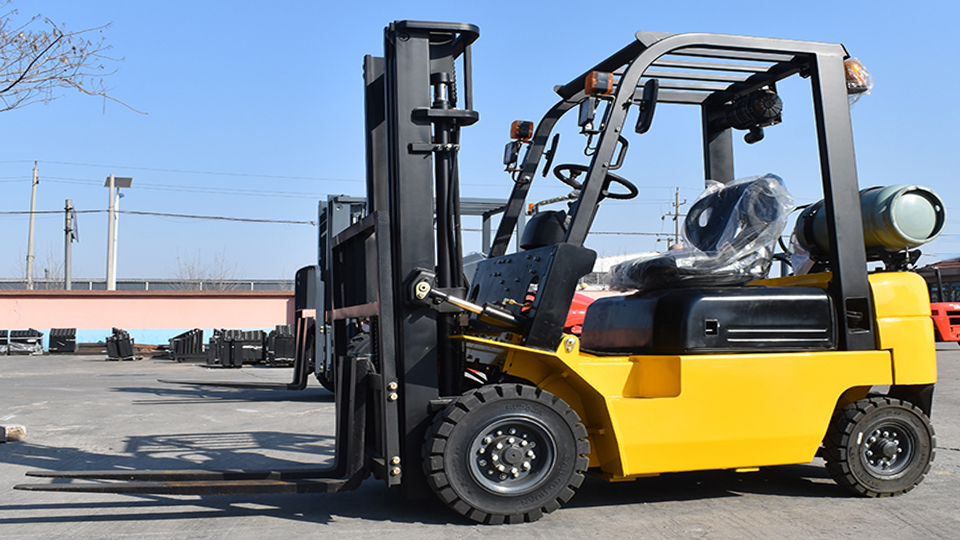
Loaded: Drive forward up the ramp, reverse down.
Unloaded: Drive reverse up the ramp, forward down (to keep the heavy counterweight uphill).
Summary
The "best" forklift is one that is operated within its physical limits. The center of gravity is not a fixed point, but a moving target influenced by height, weight, speed, and tilt. By mastering the physics of the Stability Triangle and understanding the mathematical moments of the load, facilities can virtually eliminate tip-over accidents.
Name: selena
Mobile:+86-13176910558
Tel:+86-0535-2090977
Whatsapp:8613181602336
Email:vip@mingyuforklift.com
Add:Xiaqiu Town, Laizhou, Yantai City, Shandong Province, China
