
vip@mingyuforklift.com
+86-0535-2090977

1. Defining the "Best" by Classification
The Industrial Truck Association (ITA) classifies forklifts into seven categories. Selecting the best machine begins with identifying which class fits your environment.
|
Class |
Description |
Best For |
Top Model (2026) |
|
Class I |
Electric Motor Riders |
Indoor warehouses, food/pharma |
Toyota 8-Series Electric |
|
Class II |
Electric Motor Narrow Aisle |
High-density storage |
Crown RM 6000 Reach Truck |
|
Class III |
Electric Hand Trucks |
Low-volume retail/loading docks |
Raymond 8210 Pallet Jack |
|
Class IV |
IC Engines (Cushion Tires) |
Indoor manufacturing (smooth floors) |
Hyster S50FT |
|
Class V |
IC Engines (Pneumatic Tires) |
Outdoor yards, construction |
Toyota 8-Series IC |
|
Class VI |
Electric/IC Tractors |
Airports, large assembly lines |
Linde P250 |
|
Class VII |
Rough Terrain Forklifts |
Forestry, unimproved job sites |
Manitou M-Series |
2. Power Systems: The Battle of Energy Efficiency
One of the most significant technical decisions is the power source. While internal combustion (IC) dominated the 20th century, 2026 marks the tipping point where electric power has achieved parity in most heavy-duty applications.
Lithium-Ion (Li-ion) vs. Lead-Acid
Traditional lead-acid batteries are essentially chemical ballast. They are inexpensive upfront but require "watering," dedicated charging rooms, and 8-hour cooling periods.
Lithium-ion has become the gold standard for high-utilization fleets.
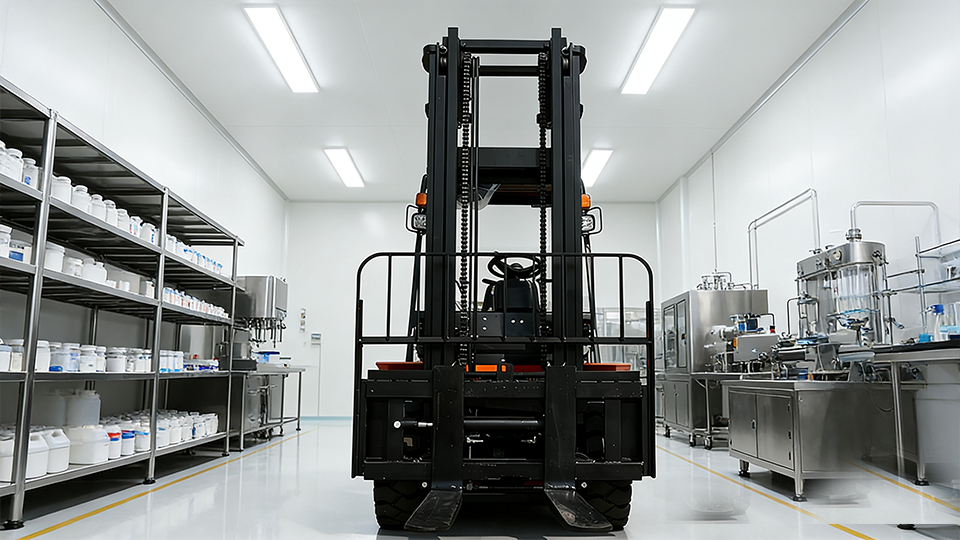
Opportunity Charging: Li-ion can be charged during 15-minute breaks, eliminating the need for battery swapping.
Efficiency: Li-ion batteries are approximately 40% more energy-efficient than lead-acid.
Lifespan: Li-ion typically lasts 3,000+ cycles, compared to 1,000–1,500 for lead-acid.
Hydrogen Fuel Cells (HFC)
For massive 24/7 operations (like Amazon or Walmart distribution centers), Hydrogen is the "best" for uptime.
Refueling Speed: 3 minutes vs. hours for charging.
Consistent Power: Unlike batteries, voltage does not drop as the fuel runs low.
Drawback: Requires significant investment in on-site hydrogen infrastructure.
Internal Combustion (Diesel/LPG)
IC engines remain the best for Class VII rough terrain and remote sites without grid access. However, with rising carbon taxes and the Tier 4 Final emission standards, their TCO is rising relative to electric alternatives.
3. Top Brands and Their Technical Edge
When evaluating manufacturers, three names consistently dominate the "best" conversations due to their engineering and support networks.
Toyota Material Handling: The Reliability King
Toyota has been the world’s #1 manufacturer for decades. Their technical edge is the System of Active Stability (SAS).
SAS uses electronic sensors to monitor load weight and lateral movement. If it detects a potential tip-over, it automatically locks the rear axle cylinder to stabilize the truck or overrides the mast tilt. For fleet managers, Toyota represents the lowest long-term maintenance cost.
Linde (KION Group): The Engineering Specialist
If your priority is precision and ergonomics, Linde is often considered the best. Their proprietary Hydrostatic Drive eliminates the need for a traditional clutch, torque converter, or differential.
Dual Pedal Travel: One pedal for forward, one for reverse. This allows for incredibly fast direction changes without wearing out mechanical components.
Ergonomics: Linde cabins are often designed with "operator-first" principles, featuring vibration-isolated compartments that reduce driver fatigue.
Crown Equipment: The High-Density Specialist
For narrow-aisle (VNA) applications, Crown is the industry leader. Their MonoLift™ Mast on the RM 6000 series provides superior visibility and stability at heights of up to 505 inches ($12.8$ meters). In high-bay warehouses, the "best" forklift is the one that doesn't sway when fully extended.
4. The 2026 Frontier: Autonomous & Connected
The "best" forklift today is increasingly one that doesn't require a driver for repetitive tasks.
Autonomous Mobile Robots (AMRs)
Modern autonomous forklifts use LiDAR and SLAM (Simultaneous Localization and Mapping) rather than magnetic tape or wires in the floor.
Best for: "Point-to-point" hauling or high-reach pallet placement in dark warehouses.
Top Players: Jungheinrich and Yale have integrated advanced AI that allows forklifts to learn the most efficient routes dynamically.
Telematics: Data-Driven Performance
No matter the brand, a forklift is only as good as its uptime. Modern telematics (like Toyota T-Matics or Crown InfoLink) allow managers to:
Monitor Impacts: Get an instant alert if an operator hits a rack.
Predictive Maintenance: The machine sends a code to the technician before a part fails.
Battery Health: Track charging habits to ensure maximum battery life.
5. Technical Specification Comparison
To find the best, you must compare the "Duty Cycle." Below is a technical comparison of three leading 5,000-lb capacity models (Class I/V).
|
Feature |
Toyota 8FGCU25 (LPG) |
Linde E25 (Li-ion) |
Hyster J50XN (Electric) |
|
Max Lift Height |
189 in |
215 in |
190 in |
|
Travel Speed |
11.8 mph |
12.4 mph |
11.0 mph |
|
Turn Radius |
79.5 in |
82.0 in |
81.3 in |
|
Safety System |
SAS |
Linde Curve Assist |
Stability Control |
|
Best For |
High-intensity outdoor |
Precision indoor/outdoor |
Multi-shift warehouse |
6. How to Calculate the "Best" for You
To determine the best forklift for your specific facility, use this technical checklist:
Step 1: Environmental Assessment
Aisle Width: If your aisles are under 10 feet, you need a Reach Truck or VNA (Very Narrow Aisle) unit.
Floor Surface: Cushion tires (smooth concrete) or Pneumatic tires (gravel/asphalt)?
Clearance: Check your lowest doorway and highest rack beam.
Step 2: Load Dynamics
Capacity: Always buy 20% more capacity than your heaviest load. If you lift 4,000 lbs, buy a 5,000-lb capacity truck.
Center of Gravity: Standard ratings are for a 24-inch load center. Long or irregular loads significantly reduce the "safe" lifting capacity.
Step 3: Total Cost of Ownership (TCO) Formula
Don't just look at the sticker price. Use this calculation:
$$TCO = (Purchase Price + Infrastructure) + (Maintenance \times Years) + (Energy/Fuel \times Years) - Resale Value$$
Often, a Toyota or Linde with a higher purchase price has a lower TCO due to high resale value and low maintenance downtime.
Conclusion
In 2026, the best forklift is the Toyota 8-Series Electric with Lithium-Ion power for general warehouse use, and the Linde H-Series Hydrostatic for heavy industrial outdoor use. However, if your facility is moving toward Industry 4.0, an autonomous reach truck may offer the highest return on investment.
The right choice depends on your data. Analyze your shift patterns, your aisle widths, and your energy costs before signing a lease.
Name: selena
Mobile:+86-13176910558
Tel:+86-0535-2090977
Whatsapp:8613181602336
Email:vip@mingyuforklift.com
Add:Xiaqiu Town, Laizhou, Yantai City, Shandong Province, China
