
vip@mingyuforklift.com
+86-0535-2090977

1. The Physics of the Surface: Why Gravel is Dangerous
Gravel is composed of individual stone particles that act like tiny ball bearings. When a 10,000-pound machine moves over them, several physical changes occur:
Shear Failure: Under heavy acceleration or braking, the top layer of gravel slides over the layer beneath it. This "shear" causes an immediate loss of traction.
Variable Compaction: Gravel is rarely uniform. One patch may be hard-packed, while another (especially near drainage areas) may be loose and deep. This causes the forklift to "dip," suddenly shifting the center of gravity.
Tire Displacement: Narrow tires will "sink" into gravel, increasing rolling resistance and potentially grounding the undercarriage.
2. Equipment Specs: The Right Tool for the Job
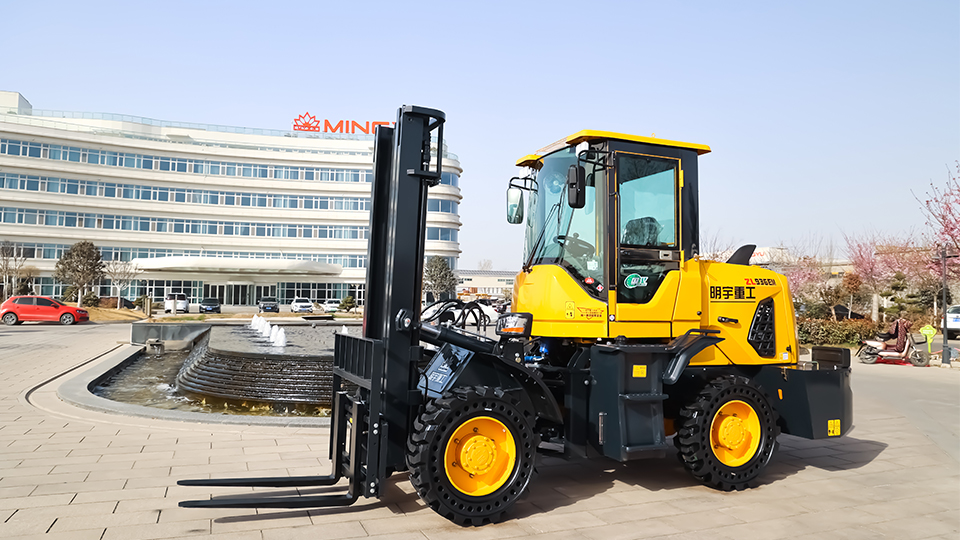
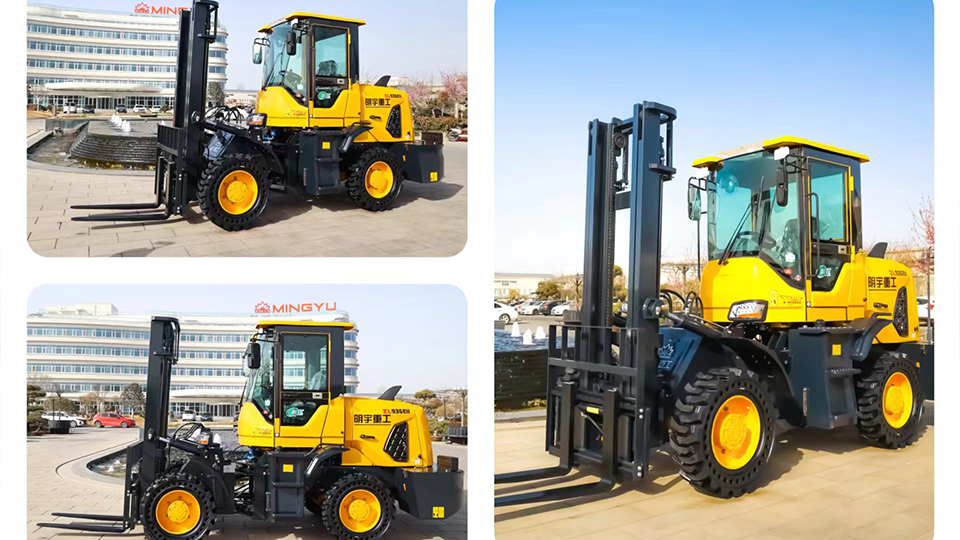
You cannot safely operate a standard "cushion tire" forklift on gravel. Safe operation requires a Class VII Rough Terrain Forklift, which features specific engineering for loose surfaces:
Pneumatic Tires and Flotation
Off-road forklifts use large, air-filled pneumatic tires with aggressive treads.
Flotation: These tires have a wider footprint to distribute the machine's weight over a larger surface area, preventing the "sinking" effect.
Tire Pressure: Technical safety requires daily pressure checks. Under-inflated tires on gravel cause "sidewall lurch," where the tire deforms during a turn, potentially tipping the machine.
High Ground Clearance and 4WD
Gravel yards often have "mounds" or ruts. A high ground clearance prevents the "belly" of the forklift from striking rocks. Furthermore, 4-Wheel Drive (4WD) is essential; if the front drive wheels lose traction on a patch of loose stone, the rear wheels provide the necessary push to maintain momentum.
3. Operational Techniques for Gravel
The "Slow-and-Flow" Principle
Abrupt movements are the primary cause of accidents on gravel.
Gradual Acceleration: Fast starts will cause the drive wheels to "dig in," creating a hole and potentially getting the forklift stuck.
Early Braking: Because gravel offers less friction, your stopping distance can be 30% to 50% longer than on concrete. Operators must use "engine braking" (downshifting or easing off the hydrostatic pedal) rather than slamming the mechanical brakes.
Managing the Stability Triangle
A forklift's stability is defined by a triangle formed by the two front wheels and the center of the rear axle. On gravel, this triangle is constantly tilting.
Low Carriage: Always carry the load as low as possible (roughly 6–8 inches from the ground). A high load on a shifting gravel surface creates a "pendulum effect"—a small bump at the bottom becomes a massive sway at the top, leading to a lateral tip-over.
Wide Turns: Never make sharp, "locked-wheel" turns. On gravel, a sharp turn can cause the rear steering wheels to skid laterally rather than pivot, pushing the center of gravity outside the stability triangle.
4. Navigating Slopes on Gravel
Gravel ramps or natural inclines are the most dangerous zones for an off-road forklift.
The "Heavy-End Up" Rule: * Loaded: Always point the forks uphill (Drive forward going up, reverse going down). This keeps the weight of the load pressed against the mast and carriage.
Unloaded: Always point the forks downhill. This ensures the heavy counterweight is on the uphill side, maintaining traction on the rear steering wheels.
No Turning on Slopes: Never attempt a turn while on a gravel incline. The shifting stones under the downhill tires can give way, causing an immediate roll-over.
5. Technical Safety Checklist for Operators
|
Hazard |
Technical Mitigation |
|
Wheel Spin |
Engage 4WD/Diff-Lock before entering deep gravel. |
|
Dust Obstruction |
Use a "Spotter" and clean air filters daily to prevent engine stalling. |
|
Grounding |
Walk the path first to identify "soft spots" or deep ruts. |
|
Lateral Slide |
Cross ruts or small obstacles at a 45-degree angle to maintain contact. |
Summary: The Professional Mindset
Driving on gravel requires "active" operation. You cannot rely on the machine's brakes or steering to save you from a mistake; you must anticipate the surface. By maintaining low speeds, utilizing pneumatic flotation, and respecting the shifting nature of the stability triangle, you can move heavy loads safely through the most rugged environments.
Name: selena
Mobile:+86-13176910558
Tel:+86-0535-2090977
Whatsapp:8613181602336
Email:vip@mingyuforklift.com
Add:Xiaqiu Town, Laizhou, Yantai City, Shandong Province, China
