
vip@mingyuforklift.com
+86-0535-2090977

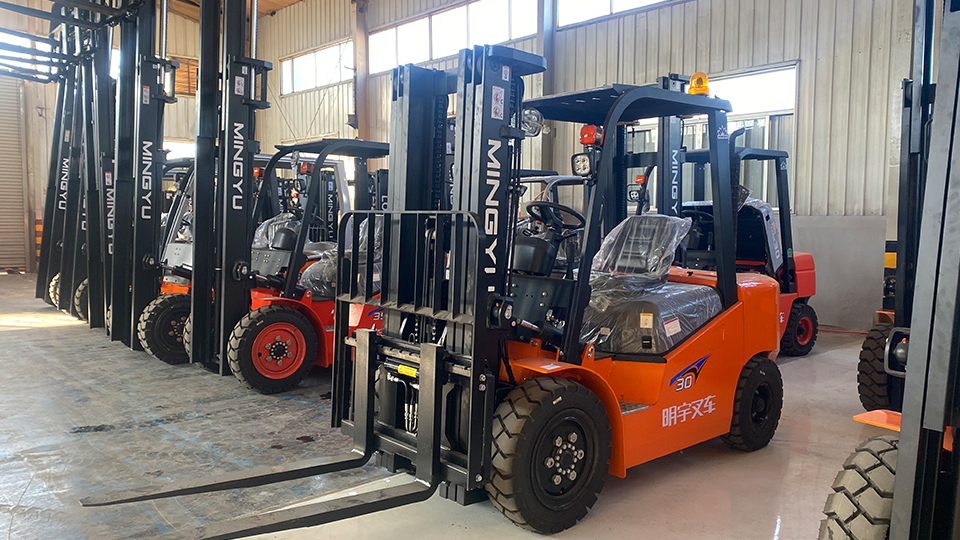
In the material handling industry, the "front" of a forklift is not a single part, but a sophisticated assembly of hydraulic and mechanical components collectively referred to as the Front End or the Mast Assembly.
While a layman might simply call it "the lift," technicians and operators must understand the specific nomenclature to ensure safety and maintenance. The front end is the business end of the machine—it is the system responsible for the primary functions of lifting, lowering, and tilting the load.
1. The Mast: The Vertical Backbone
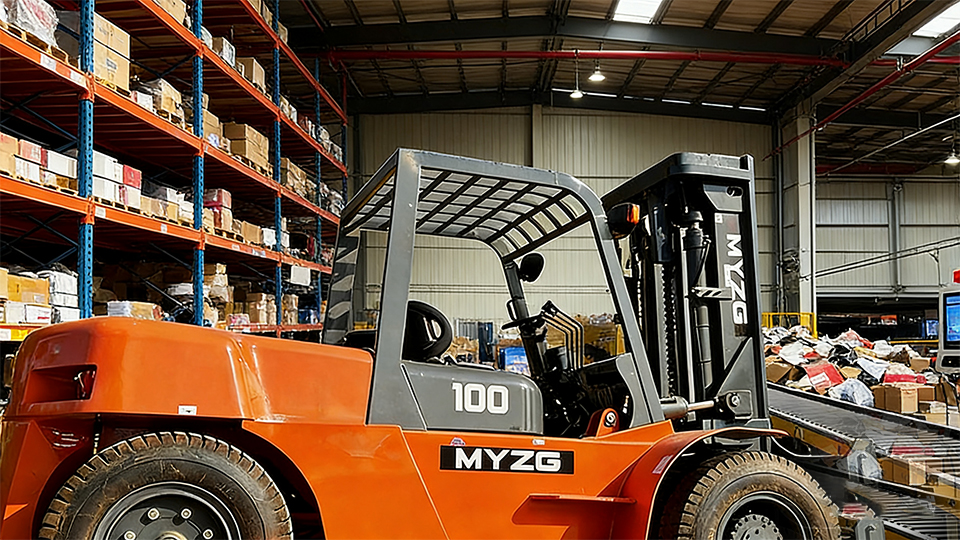
The most prominent structure at the front is the Mast. This is the vertical assembly that supports the load and allows for vertical travel.
Mast Components:
Rails: The mast consists of nested steel channels or "rails." As the forklift lifts, these rails slide within one another like a telescope.
Lift Chains: High-tensile leaf chains that pull the carriage upward as the hydraulic cylinders extend.
Lift Cylinders: Large hydraulic rams that provide the vertical force. Most masts have a central "free lift" cylinder and two side cylinders.
Types of Masts:
|
Type |
Name |
Sections |
Use Case |
|
Simplex |
Single-Stage |
1 |
Basic lifting with no telescoping action. |
|
Duplex |
Two-Stage |
2 |
Common for loading docks and trailers. |
|
Triplex |
Three-Stage |
3 |
The industry standard for high-reach warehouses. |
|
Quad |
Four-Stage |
4 |
Extreme heights (up to 30 feet) with low collapsed height. |
2. The Carriage: The Mounting Platform
Attached to the mast is the Carriage. If the mast is the "arm," the carriage is the "hand." It is a heavy-duty steel plate that slides up and down the mast rails on rollers.
The carriage serves two primary roles:
Mounting: It provides the tracks (ITA Classes) for the forks or attachments to hook onto.
Stability: it holds the load backrest and provides the structural integrity needed to prevent the forks from twisting under weight.
3. The Tools: Forks (Tines)
The most recognizable parts are the Forks, often technically referred to as Tines or Prongs. These are the L-shaped cantilevered metal arms that engage the load.
Heel: The "elbow" of the fork where the horizontal blade meets the vertical shank. This is the highest stress point and the most common site for structural cracks.
Blade: The horizontal portion that slides under the pallet.
Tip: The tapered end of the blade designed for easy entry into pallet stringers.
Technical Note: Forks are wear items. According to ANSI/ITSDF standards, once a fork blade has worn down by 10% of its original thickness, its lifting capacity is reduced by 20%, and it must be decommissioned.
4. Safety and Protection: The Load Backrest
The Load Backrest (or Load Backrest Extension) is the grated metal rack bolted to the carriage. It serves three technical functions:
Operator Shielding: It prevents the load (or parts of it) from falling backward toward the operator’s cabin.
Mast Protection: It shields the hydraulic hoses and lift cylinders from being crushed by the load.
Load Stability: It provides a flat vertical surface for tall loads to lean against during transit.
5. The Powerhouse: Tilt Cylinders
While the lift cylinders handle vertical movement, the Tilt Cylinders connect the mast to the forklift's chassis. These are double-acting hydraulic cylinders, meaning they can both push and pull.
By tilting the mast backward, the operator shifts the center of gravity toward the drive axle, stabilizing the load for travel. By tilting forward, the operator allows the forks to slide out from under a pallet once it has been placed.
6. Front-End Attachments
The front end can be modified with various attachments to handle non-palletized loads:
Sideshifters: Allows the carriage to move left or right without moving the truck.
Fork Positioners: Hydraulically adjusts the distance between forks from inside the cab.
Paper Roll Clamps: Circular clamps for lifting massive rolls of paper or drums.
Rotators: Allows the carriage to spin 360 degrees for dumping bins.
Summary
The front of a forklift is a complex Mast and Carriage Assembly. Understanding these terms is vital for ordering parts, performing daily inspections (as required by OSHA), and communicating with maintenance technicians.
Name: selena
Mobile:+86-13176910558
Tel:+86-0535-2090977
Whatsapp:8613181602336
Email:vip@mingyuforklift.com
Add:Xiaqiu Town, Laizhou, Yantai City, Shandong Province, China