
vip@mingyuforklift.com
+86-0535-2090977

The Spatial Challenge of Modern Construction
Construction and maintenance professionals face an increasingly common dilemma: the need to work at significant heights within environments that seem designed to prevent access. Narrow alleyways between buildings, interior atriums with delicate flooring, congested industrial facilities with tightly spaced equipment, and residential areas with limited yard space all present scenarios where traditional aerial work platforms prove too bulky, too heavy, or simply impossible to maneuver. These spatial constraints have historically forced compromises—using ladders that compromise safety, erecting scaffolding that consumes excessive time and labor, or declining profitable projects that cannot be accessed safely.
The emergence of specialized narrow-space aerial work platforms has fundamentally altered this equation. These remarkable machines combine compact dimensions with substantial working heights, maneuverability with stability, and power with precision to access spaces previously considered unreachable. From spider lifts that crawl through standard doorways to vertical mast lifts that navigate warehouse aisles narrower than 40 inches , and zero-tail-swing booms that rotate within their own footprint , the modern narrow-space platform category represents one of the most innovative segments in access equipment engineering.
This technological evolution addresses more than convenience—it transforms economic viability. Projects in confined spaces can now proceed with the same efficiency and safety standards as open-site construction, while maintenance operations in operational facilities minimize disruption to ongoing activities. The capability to position workers precisely at height, regardless of spatial constraints, expands the addressable market for contractors and facility managers while improving outcomes for clients who require work in challenging environments.
Spider Lifts: The Ultimate Narrow Access Solution
Engineering for Extreme Confinement
Spider lifts—so named for their four-legged outrigger systems that spread for stability and retract for transport—represent the pinnacle of compact access technology. These crawler-mounted platforms combine several engineering innovations that enable operation in spaces where no other elevated access solution can function effectively. With chassis widths as narrow as 0.75 meters (approximately 30 inches) and the ability to pass through standard doorways, spider lifts bring substantial working heights—ranging from 10 meters to over 30 meters—into interior spaces and confined exteriors .
The Jovoo crawler spider boom lift series exemplifies this capability, offering six models with platform heights from 10 to 20 meters while maintaining chassis widths of just 0.75 to 0.85 meters . These dimensions enable access through gates, yard entrances, and public building corridors that would exclude conventional boom lifts. The Platform Basket Spider 18.90 achieves a 17.5-meter working height and 9.2-meter horizontal reach while measuring only 2.5 feet (0.75 meters) wide—narrower than many wheelchairs . Such specifications transform the possibilities for maintenance in historic buildings, atrium work in commercial complexes, and construction in densely developed urban areas.
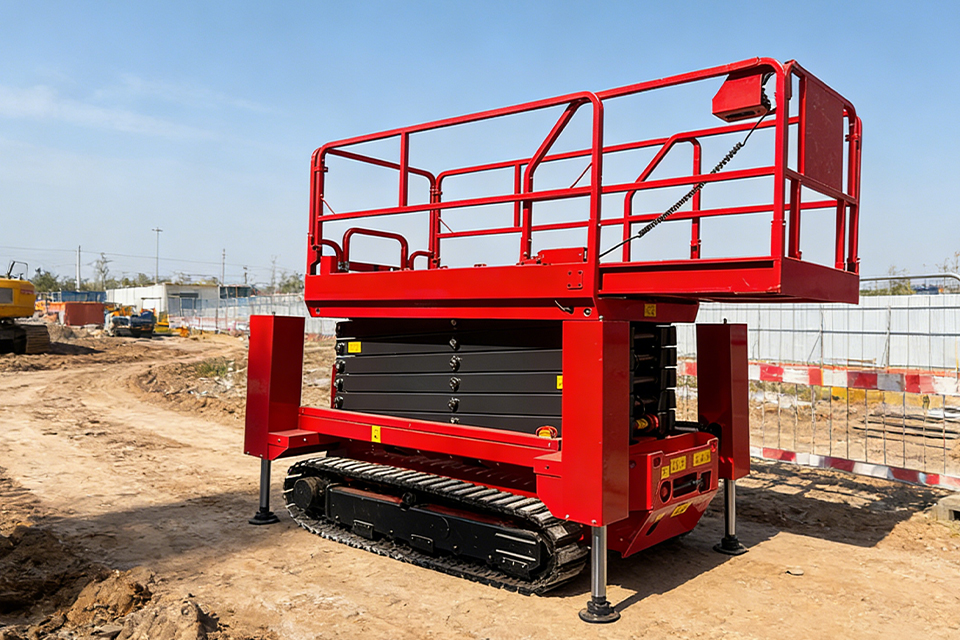
The structural engineering enabling these capabilities relies on high-strength steels such as Weldox, Domex, and Strenx—materials that provide exceptional strength-to-weight ratios . This material selection keeps overall weights manageable—the Jovoo S18C weighs just 2,460 kg despite reaching 19.3 meters working height—while maintaining structural integrity for safe elevated operation . The lightweight construction minimizes ground pressure, enabling operation on sensitive surfaces including landscaping, flooring systems with limited load capacity, and elevated structural slabs not designed for heavy equipment.
Terrain Adaptability Through Crawler Systems
The tracked undercarriage distinguishes spider lifts from wheeled alternatives and enables their unique versatility. Rubber crawler tracks distribute weight across broader surface areas than wheels, reducing ground pressure to levels that protect delicate surfaces while providing traction on uneven terrain . This dual capability—interior floor protection and exterior rough-terrain performance—eliminates the equipment changes that interrupt workflow in projects spanning indoor and outdoor environments.
Advanced crawler systems feature extendable tracks that widen for stability during operation and narrow for transport through constricted openings . The COMET Bharat Spider Lift series utilizes widening crawler tracks combined with hydraulic outriggers to stabilize on gradients up to 30% , enabling work on sloped sites and staircases where level setup would prove impossible. This adaptability proves invaluable for applications such as hillside construction, terraced landscaping maintenance, and industrial facilities with sloped drainage floors.
Track materials have evolved to address surface protection requirements. Non-marking rubber compounds prevent scarring of finished floors in retail environments, hospitals, and residential settings . Some manufacturers offer anti-tracking track options that minimize debris transfer between job sites . These refinements acknowledge that narrow-space applications often occur in sensitive environments where equipment must perform without leaving evidence of its presence.
Outrigger Systems and Automatic Stabilization
The signature spider-like outriggers provide stability that belies the machines' compact dimensions. Four independent hydraulic legs extend and adjust individually, enabling leveling on uneven surfaces and distributing loads across multiple support points . Modern systems feature automatic self-leveling capabilities that calculate and achieve optimal stabilization without manual adjustment, reducing setup time and ensuring consistent safety margins regardless of operator experience.
The outrigger footprint can be adjusted based on spatial constraints and stability requirements. In extremely confined spaces, operators can deploy outriggers in reduced configurations that maintain stability while minimizing spatial intrusion. In open areas, full extension provides maximum stability for demanding applications. This configurability enables spider lifts to adapt to the specific constraints of each work location rather than forcing standardized setups that may not optimize available space.
Zero-Tail-Swing Technology: Revolutionizing Maneuverability
Eliminating the Spatial Safety Buffer
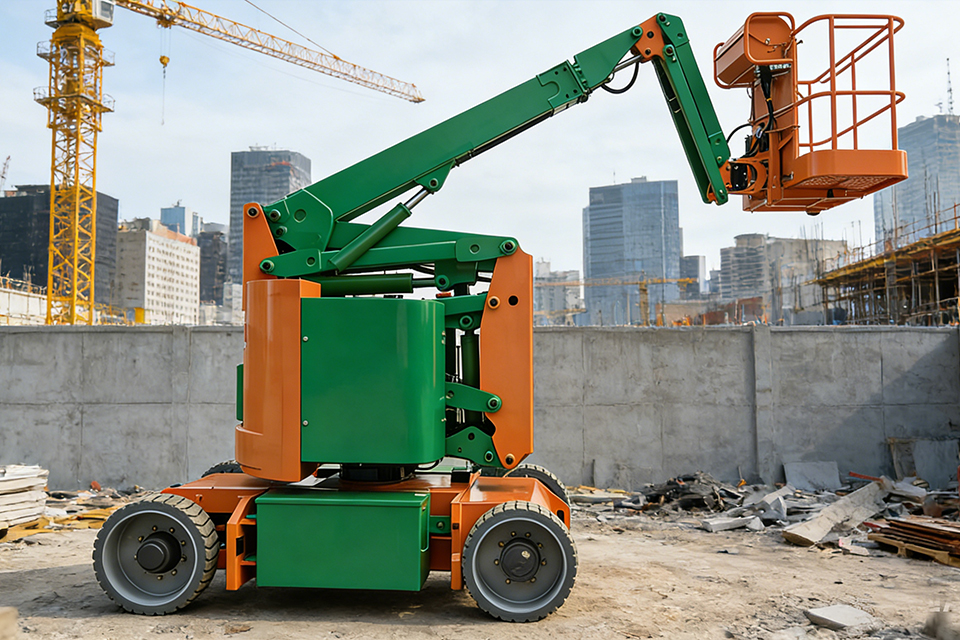
Traditional boom lifts and excavators require substantial clearances behind the machine to accommodate counterweight rotation—a design necessity that has historically excluded such equipment from confined spaces. Zero-tail-swing (ZTS) technology eliminates this constraint by ensuring that the upper structure remains entirely within the width of the undercarriage throughout full rotation . This engineering achievement transforms equipment maneuverability in tight quarters, allowing machines to operate literally against walls and obstacles without risk of collision.
The Genie Z-45/25 articulating boom lift demonstrates this capability with its tight turning radius and zero tail swing, making it "an excellent choice for use in confined spaces" where conventional booms would require impractical clearances . The LiuGong LT20JE electric telescopic boom lift similarly features zero tail swing design, meaning "the rear of the machine doesn't extend beyond the footprint of the tracks," eliminating collision risks in tight spaces . For urban construction, interior renovation, and maintenance alongside operational equipment, this capability enables positioning that would be impossible with traditional designs.
The safety implications extend beyond collision avoidance. By eliminating the rear swing hazard, zero-tail-swing designs reduce the need for spotters and exclusion zones, streamlining operations while improving safety. Operators can focus on the work task rather than continuous monitoring of machine orientation relative to surrounding obstacles. This focus improvement enhances both productivity and safety outcomes, particularly in complex environments with multiple simultaneous operations.
Compact Boom Lifts for Urban Environments
JLG's EC450AJ Compact, launched at bauma 2025, exemplifies the trend toward urban-optimized compact booms. This lithium-ion battery-powered machine features a 2-meter-wide chassis with true zero tail swing, specifically developed "to address the growing demand in Europe for compact equipment that meets both urban space constraints and strict sustainability goals" . The collaboration between JLG and Hinowa combines global manufacturing scale with regional market intelligence to produce equipment tailored for European urban conditions—narrow streets, emissions regulations, and noise restrictions.
The Niftylift HR15N hybrid boom lift offers similar capabilities with a 1.5-meter width, zero tail swing, and non-marking tires suitable for both indoor and outdoor tasks . Its 15.5-meter working height and 9.7-meter outreach provide substantial capability within a footprint that navigates restricted spaces. The integration of Niftylift's SiOPS (Sustained Involuntary Operation Prevention System) adds safety by halting machine movement if the operator is pushed against controls—an important consideration in confined spaces where escape from platform pinch points may be limited .
These compact boom designs typically incorporate multi-directional steering capabilities that further enhance maneuverability. Crab steering, where all wheels turn in the same direction for diagonal movement, and tight turning radii enable positioning in spaces where conventional drive systems would require multiple repositioning cycles . For time-sensitive maintenance operations or construction tasks with repetitive access needs, these maneuverability features accumulate substantial time savings.
Vertical Mast Lifts: Precision in Ultra-Narrow Aisles
Warehouse and Facility Applications
For interior applications with the most extreme space constraints, vertical mast lifts provide access solutions that navigate aisles narrower than 40 inches (approximately 1 meter) . These machines feature single or double mast structures that elevate platforms vertically without the horizontal outreach of boom designs, minimizing footprint while maximizing height capability. The Haulotte Star 10, with a width of just 2.6 feet (0.79 meters) and platform height of 26 feet (7.95 meters), exemplifies the high-reach, narrow-profile combination that makes mast lifts indispensable for warehouse and facility maintenance .
The TIANLU Lift VML-16 Pro demonstrates the technological sophistication modern mast lifts achieve. With zero-turn radius capability, 16-foot platform height, and 500-pound capacity, this electric-powered unit navigates confined spaces while supporting substantial work tasks . Its lithium-ion battery provides up to 8 hours of continuous operation, with fast-charging capabilities that minimize downtime during multi-shift operations. Smart diagnostics alert users to maintenance needs via digital displays, preventing unexpected failures that could strand workers at height or interrupt critical maintenance schedules.
The engineering distinction between mast lifts and scissor lifts involves important trade-offs. While scissor lifts offer larger platforms and higher capacities for multi-person tasks, their collapsed height and width typically exceed mast lift dimensions. For sequential single-point tasks in narrow aisles—such as lighting maintenance, HVAC filter replacement, or inventory management—mast lifts' accessibility advantages outweigh their capacity limitations . The ability to navigate aisle intersections and position precisely at each work point without extensive maneuvering transforms productivity in environments where space constraints dominate operational considerations.
Specialized Configurations for Unique Constraints
Manufacturers have developed specialized mast lift configurations for particularly challenging applications. Explosion-proof models with spark-resistant components enable operation in hazardous environments such as chemical plants and refineries. Insulated platforms allow work near electrical systems with appropriate protection ratings. Low-weight designs with aluminum components minimize floor loading for operation on elevated structural slabs or suspended flooring systems.
The integration of extendable platforms on some mast lift models expands work envelope without expanding transport dimensions. These platforms extend horizontally once elevated, providing outreach capabilities that bridge gaps or access over obstacles while maintaining the narrow chassis profile that enabled initial positioning. This combination of compact transport and extended work reach addresses the complex geometry often encountered in industrial facilities, atriums, and mechanical rooms.
Power Systems for Sensitive Environments
Electric and Hybrid Solutions
Narrow-space applications frequently occur in environments where emissions, noise, or both are strictly regulated. Electric-powered platforms address these constraints while offering operational advantages that extend beyond environmental compliance. Electric motors deliver instant torque for precise positioning, operate at substantially reduced noise levels, and eliminate the exhaust emissions that restrict combustion-powered equipment from indoor use .
Modern battery technology enables electric platforms to match or exceed the performance of combustion equivalents. Lithium-ion batteries offer energy density improvements that extend operational duration, fast-charging capabilities that minimize downtime, and battery management systems that optimize performance and predict maintenance needs . The Jovoo spider lift series utilizes 48V LFP (Lithium Iron Phosphate) batteries with 230Ah or 300Ah capacity, providing extended endurance while maintaining the safety and stability characteristics that make LFP chemistry suitable for industrial applications .
Hybrid systems combine electric drive with compact diesel or gasoline engines for applications requiring extended operation without charging infrastructure. Niftylift's second-generation Hybrid system "combines a smaller, power-optimized engine with an electric motor to reduce fuel consumption and emissions" while maintaining continuous availability . These systems operate on battery power for typical use, engaging combustion engines only during high-demand periods or charging cycles, providing zero-emission capability for indoor phases of mixed-environment projects.
Dual-Power Versatility
Many narrow-space platforms feature dual-power capabilities that enhance operational flexibility. The GLT GCA66 crawler boom lift offers "Dual Power: Diesel Engine+Electric Motor," enabling operators to select power sources based on environmental requirements and operational constraints . This versatility proves particularly valuable for projects spanning indoor and outdoor phases, or for rental fleet applications where equipment must serve diverse customer needs without modification.
The inclusion of 220V AC power outlets in platforms enables operation of electric tools and equipment without separate power management . This integration eliminates the hazards of trailing cables from ground-level power sources, reduces setup time, and ensures that power availability aligns with platform positioning. For maintenance tasks requiring powered tools, lighting systems, or diagnostic equipment, this integrated power supply transforms workflow efficiency.
Safety Engineering for Confined Space Operation
Anti-Entrapment and Collision Avoidance
Operating in narrow spaces increases the risk of entrapment between platforms and surrounding structures. Modern narrow-space platforms incorporate anti-entrapment systems that detect obstructions during movement and automatically halt operation to prevent crushing injuries . These systems utilize pressure-sensitive edges, proximity sensors, or current-monitoring algorithms that detect unexpected resistance and trigger immediate stops.
Proximity sensing systems create virtual safety envelopes around platforms, detecting approaching personnel, equipment, or structural elements before contact occurs. In advanced implementations, these systems integrate with automatic slow-down functions that prevent contact without operator intervention. For confined spaces where escape routes may be limited and neighboring obstacles close, these active safety systems provide protection layers beyond traditional guarding.
Load Management and Stability Control
Narrow-space platforms incorporate sophisticated load-sensing technology that continuously monitors weight distribution and restricts operation when capacity limits approach . This monitoring proves particularly important in compact platforms where operators may be tempted to overload equipment to minimize repositioning cycles. Real-time stability monitoring integrates tilt sensors, outrigger position detectors, and ground pressure measurements to assess platform security continuously, restricting operation when safety margins degrade .
The combination of compact dimensions and substantial working heights creates unique stability challenges that manufacturers address through advanced engineering. Spider lift outrigger systems automatically calculate maximum safe working envelopes based on deployment configuration, ground conditions, and load status, preventing operation outside safe parameters regardless of operator input . These integrated safety systems ensure that the compactness enabling narrow-space access does not compromise the stability essential for safe elevated work.
Applications and Economic Impact
Urban Construction and Renovation
Urbanization trends—projected to concentrate 68% of the global population in cities by 2050 —create sustained demand for equipment capable of operating in densely developed environments. Narrow-space platforms enable construction and renovation in city centers where traditional equipment cannot access job sites, or where space constraints would make conventional approaches economically unviable. Building facade maintenance, window replacement, and exterior renovation in historic districts all require equipment that navigates narrow alleys and operates within confined staging areas.
The economic impact extends to project viability. Without narrow-space access solutions, many urban maintenance and renovation projects would require scaffolding that consumes street space, disrupts pedestrian and vehicular traffic, and extends project timelines. Spider lifts and compact booms enable faster completion with minimal spatial impact, reducing the total project cost while improving community relations in sensitive urban environments.
Industrial Maintenance and Facility Management
Operational industrial facilities present some of the most challenging access scenarios—tightly spaced equipment, active production lines, sensitive instrumentation, and strict safety requirements that limit traditional access methods. Narrow-space platforms enable maintenance without production shutdowns, positioning technicians precisely where needed while maintaining clearances from operational equipment.
The ability to navigate standard doorways enables interior access to mechanical rooms, atriums, and production areas without the structural modifications or equipment disassembly that traditional access methods might require. For facility managers, this capability transforms maintenance from disruptive events requiring extensive preparation to routine operations that proceed with minimal impact on building occupants and operations.
Future Trajectories
The evolution of narrow-space aerial platforms continues toward enhanced autonomy, improved energy efficiency, and expanded capability. Semi-autonomous positioning systems that automatically level and stabilize platforms reduce setup time and operator skill requirements . Advanced materials and manufacturing techniques further reduce weight while maintaining or improving structural capacity, expanding the range of surfaces that can support platform operation.
Integration with Building Information Modeling (BIM) systems enables platforms to navigate to precise coordinates specified in digital models, automating positioning for repetitive maintenance tasks or construction activities . This integration promises to transform narrow-space access from skilled operator tasks to automated processes that proceed with consistent precision regardless of human factors.
Conclusion: Unbounded Access
The narrow-space aerial work platform category has transformed "impossible" into "routine" for thousands of construction and maintenance applications. By combining compact dimensions with substantial working heights, crawler mobility with precise positioning, and power with environmental sensitivity, these remarkable machines have eliminated the spatial constraints that historically limited elevated work.
For contractors, facility managers, and maintenance professionals, the message is clear: space constraints no longer need to compromise safety, efficiency, or capability. The incredible work platforms available today conquer narrow spaces at height with engineering sophistication that makes the difficult look easy, the dangerous become safe, and the inaccessible thoroughly reachable. In an industry where spatial challenges once dictated project limitations, these platforms have truly enabled construction and maintenance professionals to reach new heights—regardless of the constraints that surround them.
Name: selena
Mobile:+86-13176910558
Tel:+86-0535-2090977
Whatsapp:8613181602336
Email:vip@mingyuforklift.com
Add:Xiaqiu Town, Laizhou, Yantai City, Shandong Province, China
