
vip@mingyuforklift.com
+86-0535-2090977

The material handling industry, the engine room of global logistics and manufacturing, has long relied on robust, powerful machinery—most notably, the forklift. For decades, internal combustion (IC) forklifts, powered by diesel, gasoline, or liquefied petroleum gas (LPG/propane), have dominated indoor and outdoor operations. However, a significant shift is underway, driven by growing awareness of environmental sustainability and, critically, the direct impact of machinery on indoor air quality and worker health.1
Electric forklifts, once relegated to light-duty operations, are now formidable contenders, capable of matching their IC counterparts in power and performance, especially with advancements in battery technology like lithium-ion.2 This article provides a technical deep dive into how the transition to electric forklifts fundamentally alters the indoor workplace environment, focusing specifically on their profound positive effects on air quality and the long-term health and safety of industrial workers.
The Hidden Danger: Internal Combustion Forklift Emissions
The most compelling case for electric forklifts is made by examining the pollutants emitted by IC engines. When a diesel, gasoline, or propane-powered forklift operates indoors—as is common in warehouses, distribution centers, and manufacturing plants—its exhaust contaminates the enclosed environment, often leading to air quality that is far below safe and healthy standards.
�� Key Pollutants from IC Forklifts
Internal combustion engines rely on the controlled burning of fuel, a process that inherently produces a complex mixture of gaseous and particulate pollutants.3 The primary concern in an indoor setting is the concentration of these harmful substances, which can rapidly build up in spaces with insufficient ventilation.4
Carbon Monoxide (5$\text{CO}$): The Silent Killer6
Carbon monoxide is a colorless, odorless, and tasteless gas produced by the incomplete combustion of carbon-based fuels.7 $\text{CO}$ is highly toxic because it binds to hemoglobin in the blood with an affinity over 200 times greater than oxygen, forming carboxyhemoglobin ($\text{COHb}$). This process reduces the blood's capacity to transport oxygen to vital organs and tissues.8
Health Impact: Acute exposure can lead to headaches, dizziness, fatigue, nausea, and impaired judgment.9 High concentrations can cause unconsciousness, permanent brain and heart damage, and death.10 Chronic, low-level exposure is linked to neurological conditions, including memory problems and mood swings.11 In a warehouse setting, this can significantly impair operator alertness and increase the risk of accidents.
Nitrogen Oxides (12$\text{NO}_{\text{x}}$): Respiratory Irritants13
Nitrogen oxides, primarily nitric oxide ($\text{NO}$) and nitrogen dioxide ($\text{NO}_2$), are formed at the high temperatures present in the combustion chamber. $\text{NO}_2$ is a reddish-brown gas with a sharp, pungent odor.
Health Impact: $\text{NO}_{\text{x}}$ gases are strong irritants to the eyes, nose, throat, and lungs. Exposure can cause immediate respiratory distress and, over time, contribute to the development or exacerbation of chronic respiratory diseases like asthma, bronchitis, and reduced lung function.14
Particulate Matter (PM): The Deep Lung Threat
Diesel and, to a lesser extent, gasoline and propane engines release fine and ultra-fine particulate matter.15 This includes Diesel Particulate Matter (DPM), which is composed of fine carbon particles onto which various hazardous chemicals, including Polycyclic Aromatic Hydrocarbons (PAHs), adhere.16
Health Impact: Due to their microscopic size (often less than 2.5 micrometers in diameter, $\text{PM}_{2.5}$), these particles can penetrate deep into the lower respiratory tract and the lungs, where they can enter the bloodstream. DPM is classified as a probable human carcinogen and chronic exposure increases the risk of lung cancer and cardiovascular disease.17
Hydrocarbons (HC) and Sulfur Oxides ($\text{SO}_{\text{x}}$):
Unburned fuel residues (HC) and sulfur oxides ($\text{SO}_{\text{x}}$, primarily from diesel) are additional irritants that contribute to general air pollution, unpleasant odors, and, in the case of $\text{SO}_{\text{x}}$, further respiratory irritation.
⚠️ The Failure of Mitigation
For IC forklifts to operate safely indoors, rigorous and costly mitigation strategies are mandatory, often falling under OSHA or other regulatory bodies.18 These strategies include:
Strict Ventilation Requirements: Facilities must employ extensive heating, ventilation, and air conditioning (HVAC) systems or local exhaust ventilation (LEV) to ensure continuous fresh air exchange.19 For example, standards from organizations like the American Conference of Governmental Industrial Hygienists (ACGIH) recommend dilution rates (e.g., up to $10,000$ cubic feet per minute per propane-fueled lift truck) to maintain $\text{CO}$ exposures below permissible limits (e.g., an 8-hour Time-Weighted Average of 35 ppm for CO). However, even with powerful ventilation, the risk of localized, dangerous buildup remains.20
Exhaust After-Treatment: The use of catalytic converters and diesel particulate filters (DPF) can significantly reduce pollutant levels ($\text{CO}$ reduction of 70-90% is possible with a warm catalytic converter). However, these systems require maintenance, are not effective until the engine is sufficiently warm (often 5-10 minutes of operation), and they do not eliminate the danger entirely.21
Engine Maintenance: Poorly tuned IC engines lead to incomplete combustion, massively escalating the output of $\text{CO}$ and other pollutants. Regular, rigorous maintenance, including emissions testing, is essential but adds to operational complexity and cost.22
These necessary controls represent a continuous operational cost and administrative burden, and even when perfectly implemented, they cannot reduce the emissions to zero.
�� The Electric Advantage: Zero Point-of-Use Emissions
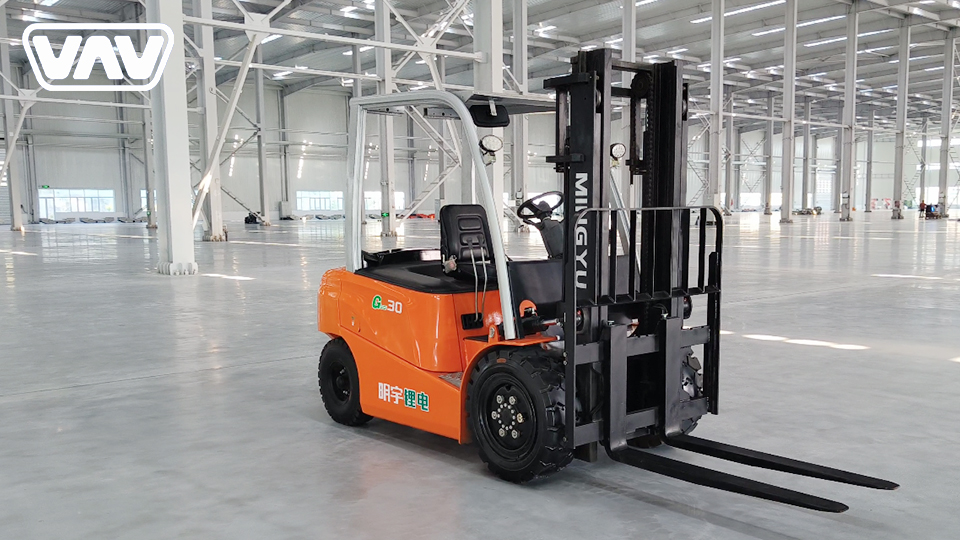
The fundamental difference and primary advantage of electric forklifts is the elimination of the internal combustion process entirely.23 Electric forklifts are powered by high-capacity, rechargeable batteries (typically lead-acid or lithium-ion), and their drive and hydraulic systems use electric motors.24
��️ Improved Indoor Air Quality (IAQ)
Electric forklifts achieve zero tailpipe emissions at the point of use.25 This single factor revolutionizes the indoor work environment.
|
Pollutant |
IC Forklifts (Diesel/Propane) |
Electric Forklifts |
|
Carbon Monoxide ($\text{CO}$) |
High production, odorless hazard |
Zero |
|
Nitrogen Oxides ($\text{NO}_{\text{x}}$) |
Significant production, lung irritant |
Zero |
|
Particulate Matter (DPM/PM) |
High production, carcinogenic risk |
Zero |
|
Hydrocarbons (HC) |
Produced, toxic/odor concerns |
Zero |
|
Noise Pollution |
High (Engine noise) |
Significantly Lower (Motor/system noise) |
The direct consequence of zero exhaust emissions is the immediate and drastic improvement in Indoor Air Quality (IAQ).26 Facilities with electric fleets no longer have to contend with the accumulation of toxic gases, allowing for a safer, healthier, and more compliant workspace without reliance on high-capacity, energy-intensive ventilation systems designed solely to dilute dangerous fumes.
�� Direct Impact on Worker Health
The shift to electric fleets translates directly into tangible benefits for the health and safety of employees:27
Reduced Respiratory Illness: Eliminating exposure to $\text{NO}_{\text{x}}$ and DPM removes two of the most significant contributors to occupational respiratory disease. Workers are less likely to experience acute symptoms like eye/throat irritation and headaches, and the risk of developing chronic conditions like asthma and reduced lung function is substantially lowered.
Elimination of $\text{CO}$ Poisoning Risk: The danger of carbon monoxide poisoning, even in confined or poorly-ventilated areas, is completely removed, safeguarding against acute fatalities and long-term neurological damage.
Decreased Fatigue and Enhanced Alertness: Low-level exposure to $\text{CO}$ and other pollutants causes fatigue and impaired cognitive function. By breathing cleaner air, operators and nearby personnel maintain better focus and energy throughout the shift, reducing operator fatigue and improving judgment—a critical factor in workplace safety.28
Lower Noise Stress: Electric motors operate significantly quieter than IC engines.29 Reduced noise pollution is linked to lower stress levels, less auditory fatigue, and an improved ability for workers to hear alarms, horns, and other critical safety signals, further enhancing overall workplace safety.30
��️ The Full Spectrum of Workplace Health and Safety
While the elimination of exhaust fumes is the most direct air quality benefit, electric forklifts offer secondary, yet equally important, advantages for a healthier work environment.31
1. Minimal Contamination Risk
In sensitive environments like food processing, pharmaceuticals, cold storage, and electronics manufacturing, IC exhaust and the associated oil/fluid leaks pose a significant risk of product contamination. Electric forklifts are inherently cleaner, with no combustion byproducts, fuel storage, or engine fluids to leak, making them the default choice for operations with strict hygiene and air quality standards.32
2. Reduced Maintenance Hazards
Electric forklifts have fewer moving parts than their IC counterparts and do not require oil changes, filter replacements, or the handling and disposal of hazardous engine fluids (e.g., used oil, transmission fluid).33 This simplifies maintenance, reduces the exposure of mechanics and facility personnel to these hazardous materials, and lowers the overall environmental impact of waste disposal.
3. Battery Safety and Management
It is important to acknowledge that electric forklifts introduce new, but manageable, safety considerations, particularly related to the batteries:34
Lead-Acid Batteries: These require dedicated, ventilated charging areas to manage hydrogen off-gassing during charging and contain the risk of electrolyte (acid) spills. Proper safety protocols, including eye washes and neutralizing agents, are essential.
Lithium-Ion Batteries: While offering superior energy density and faster charging, Li-ion batteries require advanced Battery Management Systems (BMS) to prevent thermal runaway (overheating/fire) if damaged or improperly charged.35 However, they eliminate the need for water maintenance and large ventilation rooms required by lead-acid models.36
With proper training, established charging procedures, and modern battery technology, the risks associated with electric batteries are highly controlled and generally considered less severe than the constant, unseen danger of IC exhaust in enclosed spaces.
�� Conclusion: The Technical Mandate for Electrification
The impact of electric forklifts on indoor air quality and worker health is not merely an incremental improvement; it is a paradigm shift. For any operation heavily reliant on material handling within enclosed or partially-enclosed spaces, the transition from internal combustion to electric power is rapidly becoming a technical and ethical imperative.37
By producing zero point-of-use emissions, electric forklifts:
Eliminate exposure to highly toxic gases and particulate matter ($\text{CO}$, $\text{NO}_{\text{x}}$, DPM).
Reduce the risk of acute poisoning and chronic occupational diseases (respiratory failure, cancer, cardiovascular issues).
Lower overall facility noise and operator fatigue, contributing to a more alert and productive workforce.38
Simplify compliance with occupational health and safety regulations (e.g., OSHA exposure limits) by removing the source of the contamination.
While initial investment costs for electric fleets, especially those using advanced lithium-ion batteries, may be higher, the long-term benefits in reduced fuel expenses, lower maintenance requirements, and, most importantly, the quantifiable reduction in health risks and related costs (e.g., sick days, medical claims) make the electric forklift a superior, future-proof, and fundamentally healthier choice for the indoor work environment.39
Name: selena
Mobile:+86-13176910558
Tel:+86-0535-2090977
Whatsapp:8613181602336
Email:vip@mingyuforklift.com
Add:Xiaqiu Town, Laizhou, Yantai City, Shandong Province, China
