
vip@mingyuforklift.com
+86-0535-2090977

The modern warehouse is defined by density. Driven by the relentless pursuit of maximized storage capacity, facilities increasingly rely on narrow aisles, high-bay racking, and complex, multi-level storage systems. This environment necessitates specialized material handling equipment—namely, electric forklifts designed for narrow aisles, such as Reach Trucks, Order Pickers, and Very Narrow Aisle (VNA) Turret Trucks (Class II).1
While electric forklifts offer the inherent safety advantage of zero exhaust emissions, operating these highly specialized, counter-intuitive machines in confined and dynamic spaces introduces a unique set of technical and operational risks. Successful and safe material handling in these tight quarters requires a rigorous adherence to specialized design principles, operational protocols, and advanced training.2
This technical article explores the critical safety considerations when operating electric forklifts within narrow and confined working spaces.
I. Stability and Physics: The Core Hazard
All forklifts operate under the principle of the stability triangle, but this concept is tested to its absolute limit in narrow aisles, particularly at elevated lift heights.
1. The Dynamic Center of Gravity
The most significant risk in tight spaces, especially when stacking or retrieving at height, is the potential for lateral or longitudinal tipover. This risk is exacerbated by the design characteristics of narrow aisle electric forklifts:
Rear-Wheel Steering: Like all conventional forklifts, electric forklifts steer with the rear wheels. In tight spaces, this causes the rear end to swing wide in the direction opposite to the turn.3 If an operator misjudges the swing, they can strike racking or obstacles, generating a force vector that rapidly shifts the center of gravity ($\text{CG}$) outside the stability triangle, leading to a tipover.
High-Mast Operation: Narrow aisle trucks are built for height, often reaching up to 40 feet or more.4 As the mast elevates a load, the $\text{CG}$ shifts dramatically upward and forward, reducing the vehicle’s stability margin ($S_{\text{margin}}$). Any sudden movement, braking, acceleration, or turning at height can initiate a critical instability event.
Reach Mechanism: Reach trucks use a pantograph or sliding mast to extend the load forward into the rack.5 When the load is extended, the $\text{CG}$ shifts forward, further reducing stability. Operators must be trained to never travel with the load extended and to limit lateral movement when the load is elevated.
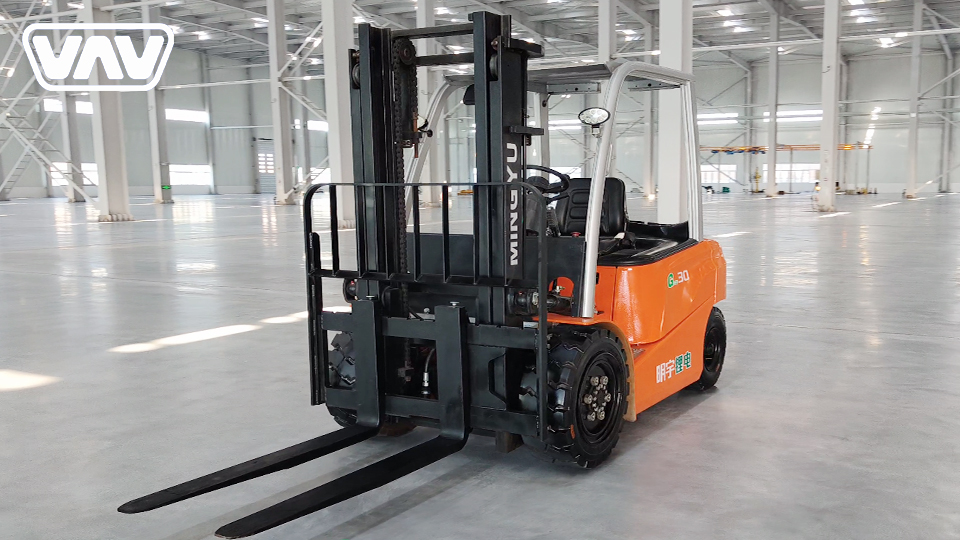
Technical Mitigation:
Load Rating Plates: Operators must strictly adhere to the load capacity charts, which are dynamically adjusted based on the load weight, load center distance, and lift height. Exceeding capacity or operating outside the specified load center distance drastically increases the tipover risk.6
Speed Limiting: In-aisle speeds must be severely restricted (typically 3–5 mph or lower).7 Many modern electric forklifts feature programmable speed limiters that automatically throttle the travel speed when the forks are elevated above a pre-set height.
Stability Systems: Advanced models include electronic stability control systems (like Guardian Stability Systems) that monitor factors such as steer angle, lift height, and load weight, and automatically intervene by reducing travel speed or limiting hydraulic functions to prevent instability.8
II. Visibility and Operator Ergonomics
The geometry of the narrow aisle environment inherently restricts the operator's field of vision, a primary contributor to collisions and striking incidents.
1. Restricted Field of View
In a narrow aisle, the operator's view is obstructed in multiple directions:
Load Obstruction: Large or tall loads inherently block the forward view.9 In these situations, OSHA and best practice mandate traveling in reverse. However, this is more challenging in confined aisles and relies on the operator constantly looking over their shoulder, which can cause strain and slower reaction times.
Overhead Guard and Mast: While essential for protection, the structure of the mast and overhead guard can create blind spots, especially when looking up or diagonally across the aisle.
Racking and Intersections: High racking creates blind corners at every cross-aisle and intersection.10
2. Ergonomic Strains
Operating in confined cabins or compartments, especially with the high degree of twisting and craning required for high-bay work, can lead to severe ergonomic strain and fatigue. Order pickers, where the operator moves with the load, require continuous awareness and positioning.
Technical Mitigation:
Enhanced Visibility Design: Manufacturers address this with design improvements:
Narrow Mast Profiles: Using specialized mast designs (e.g., clear view masts) to minimize the structural obstruction.11
Bar-Type Overhead Guards: Replacing traditional cross-brace designs with bar-type overhead guards to maximize the upward view.12
Lift Cabs: For VNA trucks, the operator's cab can be lifted with the load, providing an unobstructed view of the pallet and the rack area, but requiring specific fall protection (e.g., harnesses).
Technological Aids:
Cameras and Monitors: Fork-tip cameras and mast-mounted cameras provide the operator with a high-definition view of the load interface, crucial for precision stacking at extreme heights.13 Rear-view cameras and convex mirrors are essential for maneuvering out of an aisle or reversing.14
Ergonomic Cabins: Designing the operator compartment with adjustable controls, comfortable seating, and sometimes a 15$45^\circ$ operator stance (as seen in some Reach Trucks) to reduce twisting and improve the line of sight for elevated or reversing travel.16
III. Infrastructure and Traffic Management
The physical layout of the tight space must be engineered around the dimensions and operational needs of the electric fleet to prevent collisions and maximize clearance.
1. Aisle Width and Clearance
While narrow aisle trucks are designed to work in minimal space, inadequate clearance remains a major collision risk.
Minimum Aisle Width Calculation: Facilities must use the correct formula to determine the safe minimum aisle width: 17
$$\text{Min Aisle Width} = \text{Basic Right Angle Stacking Width} + \text{Load Length} + \text{Safety Clearance (e.g., 12 inches)}$$
Any deviation or encroachment on the aisle by stored materials compromises this safety margin.
Overhead Obstructions: Forklifts, especially with elevated loads, are highly susceptible to collision with overhead obstacles, pipework, and lighting. Laser height indicators and clearance warning systems are critical for preventing structural damage and tipover.
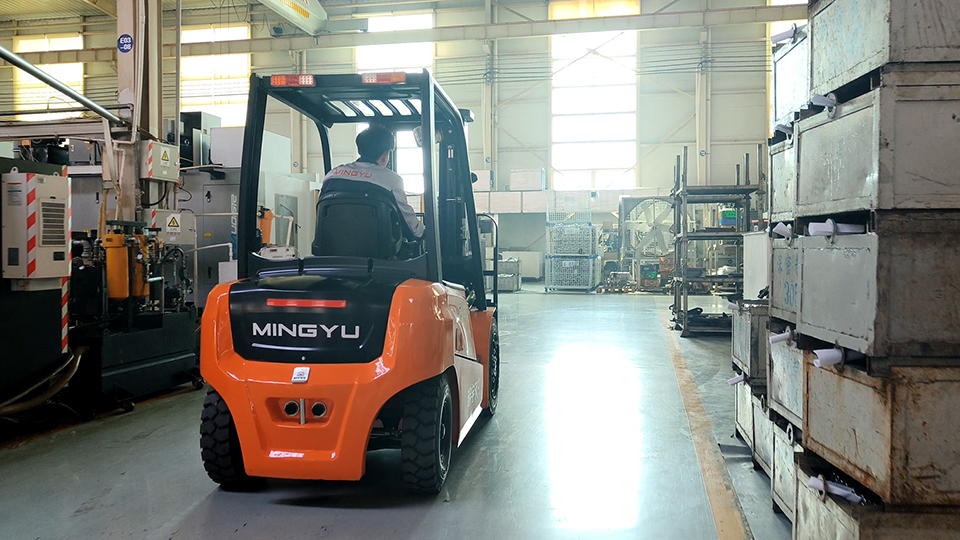
2. Pedestrian and Vehicle Segregation
In tight spaces, the risk of a forklift-pedestrian collision is drastically elevated because there is minimal space for evasion.
Technical Mitigation:
Traffic Zoning: Implement a strict traffic management plan with physically separated pedestrian walkways (using guardrails) wherever possible.18
Warning Systems: Utilize a combination of audio and visual warnings:
Blue Spot Lights: Projects a highly visible blue spot or arrow onto the floor several feet in front of or behind the forklift, alerting pedestrians coming around blind corners.
Directional Lights: Flashing lights that indicate the direction of travel (forward or reverse) are valuable in high-density areas.
Proximity Sensors: Advanced systems use RFID or Ultra-Wideband (UWB) technology to create exclusion zones. If a pedestrian wearing a transponder comes within a dangerous range of a moving forklift, both the machine's speed and the pedestrian's transponder are alerted.
IV. Battery and Maintenance Safety in Confined Areas
Even though electric forklifts eliminate the IC exhaust hazard, they introduce specific safety considerations related to high-energy batteries and maintenance access.
1. Battery Handling and Charging (Lead-Acid)
While Lithium-ion batteries simplify charging, lead-acid batteries remain common and pose risks in confined spaces:
Hydrogen Gas Off-gassing: During the final stages of charging (gassing stage), lead-acid batteries produce highly flammable hydrogen gas.19 In an enclosed, unventilated charging area, hydrogen concentration can quickly reach the lower explosive limit (20$\text{LEL}$), creating an explosion hazard.21
Electrolyte (Acid) Spills: The sulfuric acid electrolyte is corrosive. Spills during watering or maintenance require immediate neutralization and containment.
Technical Mitigation:
Dedicated Charging Bays: Charging must occur in a designated area with:
Forced Ventilation: Ventilation systems must be sufficient to maintain hydrogen concentrations below $1\%$ by volume, per safety standards.
Neutralizing Agents and Eyewash: Ready access to spill kits, neutralizing agents (like soda ash), and emergency eyewash stations.22
Physical Barriers: Protective guardrails to prevent forklifts from accidentally striking the charging equipment or stored batteries.
2. Maintenance Access
In a narrow aisle truck, many critical components are centralized and often tightly packed.23 Accessing them for maintenance (e.g., hydraulic systems, control boards) requires specific procedures and often involves opening access panels in confined spaces.
Technical Mitigation:
Lockout/Tagout Procedures: Rigorous adherence to Lockout/Tagout ($\text{LOTO}$) is paramount to prevent accidental activation during maintenance.
Component Accessibility: Modern designs prioritize easy access (e.g., wide-opening doors and hoods), but technicians must be specifically trained on the unique maintenance requirements of Class II electric trucks.24
V. Operator Training and Competency
The complexity of narrow aisle operations demands a level of proficiency far beyond that required for basic counterbalanced trucks.
1. Specialized Training
OSHA and global safety standards mandate specific training for the type of powered industrial truck being operated. For electric forklifts in tight spaces, this training must cover:
Stability Dynamics: In-depth instruction on the rear-wheel steering arc, the impact of high-lift operation on the $\text{CG}$, and the use of the load capacity chart.
Load Handling at Height: Techniques for smooth acceleration, braking, and steering, specifically focusing on minimizing sway and avoiding "whipping" the mast when placing/retrieving loads at high elevation.
Blind Spot Protocols: Procedures for approaching intersections (sounding the horn), utilizing mirrors and cameras, and the appropriate use of a spotter/ground guide when visibility is completely obstructed.25
2. Behavioral and Operational Protocols
The culture of safety in tight spaces is as important as the technology:
Speed Control: Enforcing speed limits that are often at walking pace (5-7 km/h or 26$\approx 3-5$ mph) in narrow aisles, potentially using mandatory speed limiting devices.27
Clear Lanes: Strict administrative controls must be in place to ensure aisles are never encroached upon by inventory, wrapping, or debris, which can severely compromise the safe passage of the forklift.
Travel Distance and Path Planning: Operators should be trained to anticipate turns and stop smoothly, recognizing that the rear steering requires more planning and a wider initial entry into a turn to clear the rear-end swing.28
Conclusion: Safety by Design and Discipline
Operating electric forklifts in tight spaces leverages the inherent environmental safety of electric power while confronting the magnified physical hazards of confined, high-density storage. The safety solution is two-fold:
Engineering and Technology: Utilizing specialized Class II electric trucks (Reach, VNA) equipped with modern stability controls, advanced visibility aids (cameras, sensors), and robust infrastructural support (traffic management, segregated zones).29
Training and Discipline: Implementing hyper-focused training on stability dynamics, load handling at height, and strict adherence to speed and clearance protocols that respect the minimal safety margins available in narrow aisles.
By addressing the specific challenges of stability, sightlines, and traffic in these confined areas through a blend of smart technology and uncompromising operational discipline, facilities can successfully maximize storage capacity without compromising the health and safety of their workforce.
Name: selena
Mobile:+86-13176910558
Tel:+86-0535-2090977
Whatsapp:8613181602336
Email:vip@mingyuforklift.com
Add:Xiaqiu Town, Laizhou, Yantai City, Shandong Province, China
