
vip@mingyuforklift.com
+86-0535-2090977

Abstract
Accurate diesel budgeting for warehouse forklifts is a foundational discipline in industrial fleet cost management, yet it remains poorly understood outside specialized operations circles. This technical article establishes rigorous consumption benchmarks for standard 2.5–3.5 ton diesel counterbalance forklifts operating in typical warehousing environments. By analyzing engine load factors, duty cycles, idle penalties, and shift duration variables, we derive actionable per-shift fuel budgets and examine the operational, maintenance, and alternative-power considerations that influence total fuel expenditure. The analysis provides fleet managers with calculation frameworks applicable to single-shift, multi-shift, and seasonal operations.
1. Introduction: The Budgeting Imperative
The diesel-powered counterbalance forklift remains the dominant material handling platform in warehousing and distribution despite decades of electric vehicle advocacy. Its persistence is not technological inertia but operational rationality: diesel forklifts deliver consistent power output across full shift durations, tolerate outdoor and cold-storage environments, and refuel in minutes rather than hours. For fleet managers, however, this operational advantage introduces a persistent cost management challenge—how much diesel must be budgeted per machine per shift to maintain predictable operating expenses?
Fuel budgeting errors cascade quickly. Underestimate consumption, and operations face mid-shift refueling disruptions, emergency fuel deliveries at premium pricing, or worse, equipment downtime during peak throughput windows. Overestimate, and working capital sits idle in oversized bulk tanks, while per-unit cost allocations distort profitability analyses across contracts and product lines. In an industry where logistics costs constitute 5–10% of total supply chain expenditure and fuel represents 30% of fleet operating costs in intensive applications, precision matters.
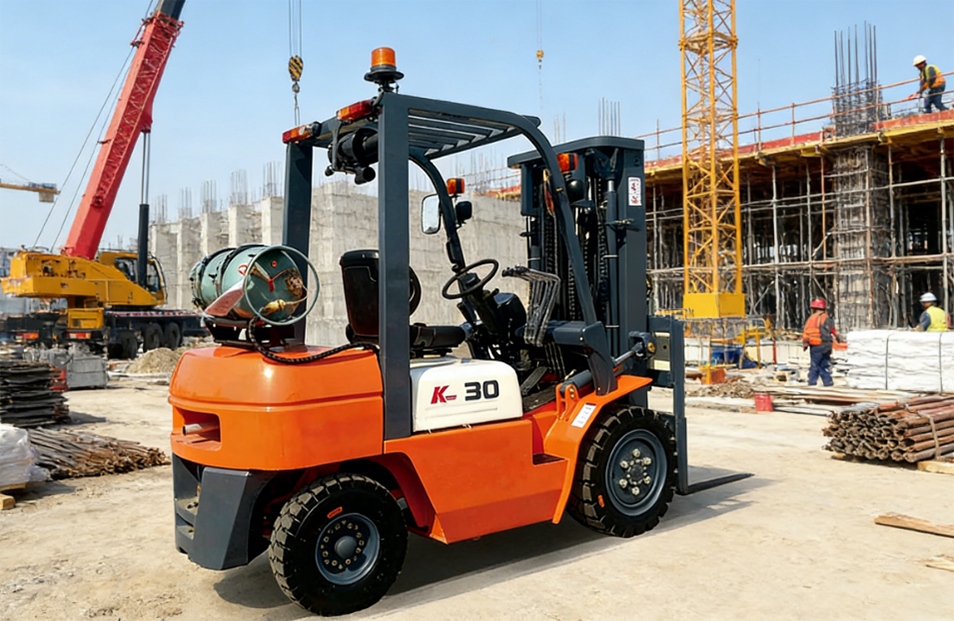
This article addresses the standard warehouse forklift—defined here as a 2.5–3.5 ton diesel counterbalance unit with a mast height of 3–6 meters, operating in ambient-temperature warehousing with paved surfaces and typical palletized goods. We exclude specialized applications such as cold storage (-20°C operations), outdoor rough-terrain handling, or continuous high-rack retrieval systems, each of which modifies consumption profiles substantially.
2. Equipment Specifications and Baseline Parameters
2.1 The Standard Warehouse Forklift Profile
Standard diesel forklifts in the 3.0–3.5 ton capacity class—the most commonly deployed in warehousing—share common mechanical characteristics. Engine displacement typically ranges from 2.0 to 3.3 liters, with naturally aspirated or turbocharged diesels producing 35–55 kW. Fuel tank capacities generally fall between 60 and 80 liters, providing theoretical autonomy of 12–20 operating hours depending on consumption intensity.
These machines balance lifting capacity with maneuverability. A 3.5-ton unit can handle standard Euro pallets (1,200 × 800 mm) loaded to 1,000–1,500 kg, while remaining compact enough for 3.5-meter aisle widths. The diesel engine drives both the traction system and the hydraulic pump for mast operations (lifting, tilting, side-shifting), meaning fuel consumption reflects not merely travel distance but the frequency and intensity of vertical material movement.
2.2 Clock Hours vs. Productive Engine Hours
A critical distinction in fuel budgeting separates clock hours—the elapsed time of a shift—from productive engine hours, during which the engine operates under load. In managed warehouse operations, productive hours typically constitute 75–85% of clock hours. The remaining 15–25% encompasses operator breaks, coordination delays, waiting for instructions, and inter-shift handovers.
For an 8-hour shift, this translates to 6.0–6.8 productive hours. A 12-hour shift yields 9.0–10.2 productive hours. Budgeting based on clock hours without this correction introduces systematic overestimation of 15–25%, which may seem conservative but actually distorts cost allocation and masks operational inefficiency.
3. Fuel Consumption Rate Analysis
3.1 Manufacturer Specifications vs. Reality
Forklift manufacturers publish fuel consumption figures under standardized test conditions—typically steady-state operation at partial load. These specifications, often expressed in grams per kilowatt-hour (g/kWh), translate to theoretical consumption rates of 2.5–3.5 liters per hour for standard 3.5-ton units under light, continuous travel.
Real-world consumption diverges substantially. Warehouse operations involve stop-start travel, frequent acceleration, variable hydraulic loading, and significant idle time. Empirical data from fleet monitoring systems indicates that standard diesel forklifts in typical warehousing consume 3.5–6.0 liters per hour when averaged across full shift durations including idle periods.
3.2 Load Factor Stratification
Consumption varies primarily with the load factor—the percentage of rated capacity actually lifted and transported. We stratify typical warehouse operations into three load factor categories:
Light Duty (20–30% load factor): Predominantly empty travel, occasional light loads under 1,000 kg. Long horizontal transport distances with minimal vertical movement. Consumption: 2.5–3.5 liters per productive hour.
Medium Duty (40–60% load factor): Standard pallet handling at 800–1,500 kg, routine put-away and retrieval to 3–4 meter rack heights. Mixed travel and vertical operations. Consumption: 4.0–5.5 liters per productive hour.
Heavy Duty (70–90% load factor): Near-capacity loads, frequent high-rack retrieval (5–6 meters), intensive loading dock operations with repeated climbing on ramps. Consumption: 5.5–7.5 liters per productive hour.
Most general warehousing falls into the medium-duty category, making 4.0–5.5 L/h the relevant budgeting baseline. Specialized operations such as beverage distribution (heavy liquid loads) or paper goods (high volume, frequent high-bay storage) trend toward heavy-duty consumption.
3.3 The Idle Consumption Penalty
Diesel engines at idle continue consuming fuel without producing productive work. A 2.5–3.5 liter diesel engine at idle burns approximately 0.8–1.2 liters per hour depending on displacement and ambient temperature. In poorly managed operations where operators leave engines running during extended breaks, documentation periods, or waiting for next assignments, idle time can accumulate to 1.5–2.5 hours per 8-hour shift.
This idle consumption adds 1.2–3.0 liters per shift—representing a 10–20% fuel penalty over productive-only consumption. For a fleet of 20 forklifts operating 250 days annually, this idle penalty alone adds 6,000–15,000 liters of unnecessary consumption, directly impacting both budget accuracy and emissions compliance.
4. Per-Shift Diesel Budget Calculations
4.1 The Core Formula
The fundamental budgeting equation:
Diesel Budget per Shift = (Productive Hours × Consumption Rate at Load Factor) + (Idle Hours × Idle Consumption Rate) + Contingency Margin
Where contingency margin accounts for measurement error, fuel temperature expansion, and operational variance—typically 10–15%.
4.2 Worked Example: Standard 8-Hour Shift
Consider a medium-duty warehouse operation with a 3.5-ton diesel forklift:
Clock hours: 8
Productive engine hours: 6.5 (81% utilization)
Idle hours: 1.5
Load factor: 50% (medium duty)
Consumption rate: 4.5 L/h productive
Idle consumption: 1.0 L/h
Calculation:
Productive consumption: 6.5 h × 4.5 L/h = 29.25 liters
Idle consumption: 1.5 h × 1.0 L/h = 1.50 liters
Subtotal: 30.75 liters
Contingency (12%): 3.69 liters
Total budget: ~34.5 liters per shift
At a diesel price of $1.50 per liter (representative of industrial bulk pricing in many markets), this equates to $51.75 per shift in fuel costs.
4.3 Worked Example: Extended 12-Hour Shift
Operations running extended shifts to reduce handover inefficiencies:
Clock hours: 12
Productive engine hours: 10.0 (83% utilization)
Idle hours: 2.0
Load factor: 50%
Calculation:
Productive consumption: 10.0 h × 4.5 L/h = 45.0 liters
Idle consumption: 2.0 h × 1.0 L/h = 2.0 liters
Subtotal: 47.0 liters
Contingency (12%): 5.64 liters
Total budget: ~52.5 liters per shift
The non-linear scaling reflects improved utilization rates in longer shifts—fewer handover delays per productive hour.
4.4 Worked Example: Light-Duty Cross-Docking
A cross-docking operation with minimal vertical movement and short travel distances:
Clock hours: 8
Productive hours: 7.0 (88% utilization—higher due to continuous flow)
Idle hours: 1.0
Load factor: 25% (light duty)
Consumption rate: 3.0 L/h productive
Calculation:
Productive consumption: 7.0 h × 3.0 L/h = 21.0 liters
Idle consumption: 1.0 h × 1.0 L/h = 1.0 liter
Subtotal: 22.0 liters
Contingency (10%): 2.2 liters
Total budget: ~24 liters per shift
This represents the lower bound for standard diesel forklift operations.
4.5 Worked Example: Heavy-Duty High-Bay Retrieval
A beverage distribution center with frequent full-capacity loads to 6-meter rack heights:
Clock hours: 8
Productive hours: 6.0 (75% utilization—higher due to complex maneuvering)
Idle hours: 2.0
Load factor: 80%
Consumption rate: 6.5 L/h productive
Calculation:
Productive consumption: 6.0 h × 6.5 L/h = 39.0 liters
Idle consumption: 2.0 h × 1.0 L/h = 2.0 liters
Subtotal: 41.0 liters
Contingency (15%): 6.15 liters
Total budget: ~47 liters per shift
5. Operational Variables Modifying Consumption
5.1 Mast Height and Lifting Frequency
Vertical movement consumes disproportionate fuel. Lifting a 2,000 kg pallet to 6 meters requires substantial hydraulic energy, with the hydraulic pump drawing engine power at 50–70% of rated output during the lift cycle. Operations with frequent high-bay retrieval (5–6 meter heights) experience 20–30% higher consumption than ground-level or low-rack operations. Conversely, cross-docking with minimal vertical movement achieves the lowest consumption rates.
5.2 Travel Distance and Surface Conditions
Floor surface resistance measurably impacts fuel consumption. Polished concrete with sealed surfaces offers minimal rolling resistance, while rough or dusty untreated concrete increases consumption by 5–8%. Ramp operations—common in loading docks with 10–15% grades—impose severe fuel penalties: a fully loaded forklift ascending a ramp may consume 8–10 liters per hour during the climb segment.
5.3 Operator Behavior and Training
Operator technique significantly influences consumption. Aggressive acceleration, excessive speed (above 15 km/h in warehouse environments), and "pre-staging" hydraulics (raising forks while traveling unnecessarily) increase fuel burn. Conversely, trained operators who minimize idle time, optimize travel paths, and match lifting speeds to load requirements can reduce consumption by 10–15% below fleet averages. Some operations implement operator scorecards based on fuel consumption per pallet move, creating accountability for efficiency.
5.4 Maintenance Condition
Mechanical degradation directly increases fuel consumption. A clogged air filter can elevate consumption by 10–15%. Worn fuel injectors disrupt atomization, reducing combustion efficiency. Underinflated pneumatic tires increase rolling resistance. Hydraulic oil degradation forces pumps to work harder. Preventive maintenance intervals for diesel forklifts in warehouse environments typically occur every 250–500 operating hours, with air filter inspection recommended every 50 hours in dusty conditions.
5.5 Ambient Temperature and Fuel Properties
Cold weather increases consumption through multiple mechanisms: higher idle speeds for warm-up, increased oil viscosity raising mechanical resistance, and winter diesel formulations with lower energy density. Operations in unheated warehouses during winter months may experience 15–25% consumption increases. Conversely, extreme heat increases cooling system loads and can elevate consumption by 5–10%.
6. Fleet Scaling and Annual Budgeting
6.1 From Single Unit to Fleet
The per-shift calculations scale linearly for fleet budgeting, but with important caveats. A 20-forklift fleet operating single 8-hour shifts requires:
Medium-duty baseline: 34.5 liters/unit × 20 units = 690 liters/shift
Annual (250 operating days): 690 liters × 250 = 172,500 liters
At $1.50/liter: $258,750 annual diesel expenditure
For 2-shift operations (16 hours coverage with shift change), budget 65 liters per unit per day (accounting for slightly reduced per-shift consumption in second shifts due to warmed engines). A 20-unit, 2-shift fleet consumes approximately 325,000 liters annually.
6.2 Multi-Shift Considerations
Engines operating back-to-back shifts (12+ hours continuous) experience thermal efficiency advantages—warm engines achieve optimal combustion temperatures faster, reducing warm-up consumption. However, continuous operation accelerates maintenance intervals. Budgeting for multi-shift operations should apply a 5–8% consumption reduction per productive hour for second and third shifts, while increasing maintenance cost allocations by 20–30%.
6.3 Storage and Delivery Logistics
Bulk diesel storage tanks must accommodate delivery intervals. A 20-unit fleet consuming 690 liters daily requires either:
Weekly deliveries: 4,830 liter tank capacity (plus 20% safety margin = ~5,800 liters)
Bi-weekly deliveries: 9,660 liter tank capacity (plus margin = ~11,600 liters)
Larger tanks reduce delivery frequency and associated labor costs but increase capital tied up in inventory and heighten contamination or leakage risks. Mobile refueling services offer alternative logistics, delivering fuel directly to equipment during operation, though at premium pricing of 10–20% above bulk rates.
7. Comparative Context: Diesel vs. Alternative Power
7.1 Propane (LPG) Forklifts
Propane forklifts offer comparable power output to diesel units with cleaner emissions. Consumption in energy-equivalent terms runs 4.5–6.0 liters (propane equivalent) per productive hour for medium duty—slightly higher than diesel due to lower energy density per liter. However, propane eliminates particulate filter maintenance and cold-start issues. Refueling via cylinder swap takes 5 minutes, versus 10–15 minutes for diesel tank filling. For operations prioritizing indoor air quality or operating in jurisdictions with diesel restrictions, propane presents a viable alternative with roughly equivalent per-shift energy costs but different infrastructure requirements.
7.2 Electric Forklifts
Electric forklifts using lead-acid or lithium-ion batteries offer zero direct emissions and substantially lower per-shift energy costs. A 3.5-ton electric forklift consumes approximately 5–7 kWh per productive hour. At industrial electricity rates of $0.12/kWh, an 8-hour shift (6.5 productive hours) costs $3.90–$5.46 in energy—versus $51.75 for the diesel equivalent.
However, this comparison requires qualification. Battery charging demands 6–8 hours for lead-acid, 2–3 hours for lithium-ion fast-charging. Multi-shift operations require battery swapping infrastructure or multiple battery sets per truck. Cold storage operations reduce battery efficiency by 30–40%. And the capital cost differential—electric forklifts command 20–30% purchase premiums—must be amortized across operational savings.
7.3 When Diesel Remains Rational
Despite electric alternatives, diesel forklifts retain advantages in specific scenarios: outdoor yard operations where weather exposure degrades electrical systems, multi-shift continuous operations where charging infrastructure is impractical, cold climates where battery performance degrades, and operations requiring rapid refueling without capital investment in charging infrastructure. For these applications, accurate diesel budgeting remains operationally critical.
8. Monitoring, Control, and Variance Management
8.1 Fuel Management Systems
Modern fuel monitoring systems track consumption at the individual machine level through flow meters integrated with fleet management software. These systems detect variance between budgeted and actual consumption, flagging potential issues: mechanical degradation, fuel theft, leakage, or operator behavior changes. In unmanaged operations, fuel theft and leakage commonly account for 3–5% of total consumption—on a 172,500 liter annual budget, this represents 5,000–8,500 liters of unexplained loss.
8.2 Idle Time Reduction Programs
Given that idle consumption represents 10–20% of total shift consumption, idle reduction yields immediate budget impact. Automatic engine shut-off systems—killing engines after 3–5 minutes of idleness—reduce idle consumption by 60–80%. Operator training programs targeting idle awareness typically achieve 15–25% idle time reductions. Combined, these interventions can reduce per-shift consumption by 2–4 liters without impacting productivity.
8.3 Predictive Maintenance Integration
Fuel consumption trending serves as an early indicator of mechanical degradation. A forklift consuming 5.0 L/h that trends to 5.8 L/h over three months likely requires air filter replacement, injector service, or hydraulic system attention. Integrating fuel monitoring with preventive maintenance scheduling enables intervention before consumption degrades further, preserving both budget accuracy and equipment longevity.
9. Practical Budgeting Guidelines
9.1 The Conservative Budget Formula
For fleet managers requiring a quick-reference calculation without detailed operational analysis:
Per-Shift Budget (liters) = (Clock Hours × 0.80 × 5.0) + (Clock Hours × 0.20 × 1.0) × 1.12
Where:
0.80 represents productive time ratio (conservative)
5.0 L/h represents medium-duty consumption (conservative)
0.20 represents idle time
1.0 L/h idle consumption
1.12 applies 12% contingency
For an 8-hour shift: (8 × 0.80 × 5.0) + (8 × 0.20 × 1.0) = 33.6 liters × 1.12 = 37.6 liters
This conservative formula provides budget headroom for operational variance and minor mechanical degradation.
9.2 Monthly Reconciliation Protocol
Accurate budgeting requires monthly reconciliation:
Record bulk tank deliveries and inventory levels
Log equipment hour meter readings
Calculate actual liters per productive hour
Compare against budgeted rate (4.0–5.5 L/h for medium duty)
Investigate variances exceeding ±10%
Adjust subsequent month budgets based on trending
10. Conclusion
For the standard 3.0–3.5 ton diesel warehouse forklift operating typical medium-duty cycles, the per-shift diesel budget falls within a predictable range: 25–35 liters for an 8-hour shift under light-to-medium duty, and 40–55 liters for 12-hour extended shifts or heavy-duty applications. At representative industrial diesel pricing, this translates to $37.50–$52.50 per 8-hour shift and $60.00–$82.50 per 12-hour shift.
These figures are not arbitrary estimates but derive from the mechanical characteristics of diesel engines, the physics of material handling, and the operational realities of warehouse environments. The variance within these ranges reflects load factors, idle time management, operator behavior, and maintenance discipline—variables that fleet managers can influence through training, monitoring, and preventive maintenance programs.
As warehousing operations face increasing pressure to reduce emissions and operating costs, the diesel forklift's role may gradually diminish in favor of electric alternatives. Until infrastructure and technology enable universal electrification, however, precise diesel budgeting remains an essential competency. The fleet manager who calculates consumption at 4.5 liters per hour rather than estimating "about a tank per week" gains not merely cost control but operational predictability—the foundation upon which efficient logistics is built.
Name: selena
Mobile:+86-13176910558
Tel:+86-0535-2090977
Whatsapp:8613181602336
Email:vip@mingyuforklift.com
Add:Xiaqiu Town, Laizhou, Yantai City, Shandong Province, China
