
vip@mingyuforklift.com
+86-0535-2090977

Introduction
The material handling industry stands at a critical inflection point. As lithium-ion battery technology matures and emission regulations tighten globally, fleet managers face an increasingly urgent question: When one electric forklift completes a full shift on a single battery charge, how much diesel must its internal combustion counterpart consume to deliver equivalent work output? This is not merely an academic comparison—it is the foundational calculation upon which total cost of ownership (TCO) models, carbon accounting frameworks, and capital allocation decisions rest.
The answer, as we shall see, is both technically precise and operationally nuanced. A standard 3.5-ton diesel forklift typically requires 18–32 liters of diesel per 8-hour shift to match the productive output of an electric counterpart operating on a 48–80 kWh battery charge []. Yet these headline figures obscure critical engineering distinctions in energy conversion efficiency, duty cycle intensity, and infrastructure economics that determine which powertrain truly delivers superior value for a given application.
This article provides a rigorous, shift-level energy audit comparing diesel and electric forklift consumption. We examine the thermodynamic fundamentals of energy conversion, analyze real-world consumption data across capacity classes, model the cost implications under varying tariff structures, and explore the operational constraints that make the "clean" arithmetic of energy equivalence far messier in practice than in theory.
The Energy Equivalence Framework: From Chemical to Mechanical Work
To compare diesel and electric forklifts fairly, we must first establish a common energy currency. Diesel fuel contains approximately 36.4 MJ per liter of chemical energy, or roughly 10.1 kWh per liter when converted to electrical energy equivalents []. A diesel forklift carrying a 70-liter tank therefore transports approximately 707 kWh of chemical energy to the worksite.
However, this raw energy content is not what reaches the wheels. The diesel engine's thermal efficiency—the ratio of chemical energy converted to mechanical work—typically ranges from 30% to 40% in modern industrial diesel engines, with the remainder lost as waste heat through exhaust, cooling systems, and radiation []. Hydrostatic transmissions, common in forklifts for their smooth control characteristics, introduce additional parasitic losses of 15–25%, depending on operating conditions and system design. The hydraulic system for lifting introduces further inefficiencies, particularly during high-frequency lift cycles.
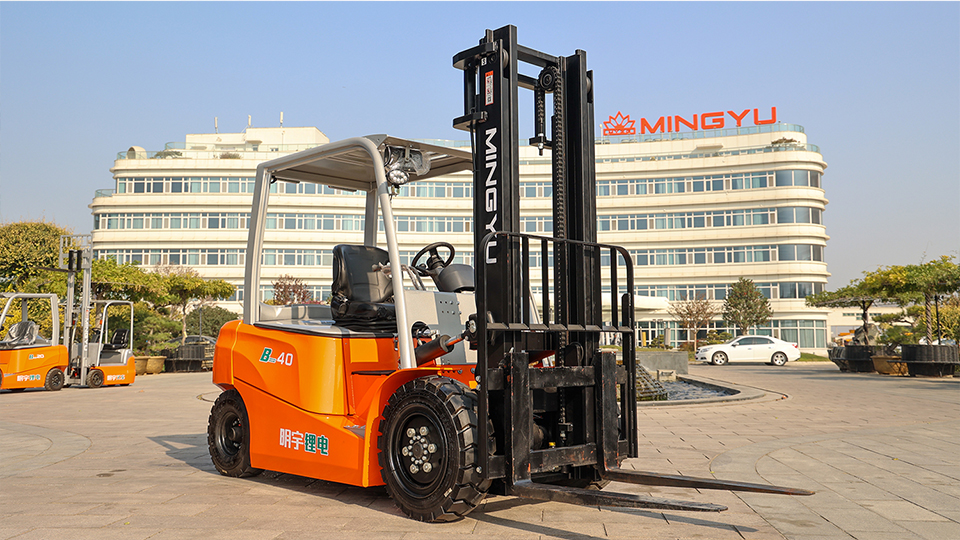
By contrast, electric forklifts convert electrical energy to mechanical work with remarkable efficiency. Modern AC induction motors and permanent magnet synchronous motors achieve 85–95% conversion efficiency, while lithium-ion battery discharge efficiency typically exceeds 95% []. Regenerative braking systems recover kinetic energy during deceleration and lowering operations, returning 10–30% of energy back to the battery in stop-and-go warehouse environments [].
This fundamental thermodynamic advantage means that an electric forklift requires significantly less primary energy to perform the same mechanical work. Where a diesel forklift might need 100 kWh of chemical energy to deliver 30 kWh of useful work, an electric forklift can achieve the same output from approximately 35–40 kWh of electrical energy input—a nearly 3:1 advantage in energy utilization efficiency.
Diesel Consumption Per Shift: Capacity-Class Analysis
Real-world diesel consumption varies dramatically across forklift capacity classes, duty cycles, and operational environments. Based on aggregated industry data and manufacturer specifications, the following per-shift consumption ranges emerge for standard 8-hour operations:
Light-Duty Class (1.5–2.5 tons):
These compact diesel forklifts, typically equipped with 2.0–2.5 liter naturally aspirated engines, consume approximately 2.5–3.8 liters per hour under moderate warehouse conditions []. Over an 8-hour shift with typical utilization factors (65–75% of VDI 2198 intensity), this translates to 16–24 liters per shift. A 60-liter tank therefore provides 2.5–3.7 shifts of autonomy.
Medium-Duty Class (3.0–3.5 tons):
The most common industrial category, these forklifts feature 2.5–3.3 liter turbocharged engines producing 45–65 kW. Consumption ranges from 3.5–5.5 liters per hour under normal operating conditions, with VDI 60 standardized testing often showing 4.0–5.0 L/h figures []. Real-world 8-hour shift consumption therefore falls between 22–36 liters, with heavier duty cycles or outdoor terrain pushing figures toward the upper bound. A standard 70-liter tank delivers approximately 2.0–3.2 shifts.
Heavy-Duty Class (5.0–7.0 tons):
These robust machines employ 3.3–4.5 liter engines and face demanding operational profiles. Consumption typically ranges from 4.5–8.0 liters per hour, with continuous heavy lifting, rough terrain, or steep grades pushing figures to 10–15 liters per hour []. An 8-hour shift in intensive applications may consume 36–64 liters, requiring 90–120 liter tanks for single-shift autonomy without refueling.
Industrial/Heavy-Lift Class (10+ tons):
At this scale, diesel consumption becomes substantial. These machines may burn 10–15+ liters per hour, with 8-hour shift totals exceeding 80–120 liters []. Dedicated fuel logistics—on-site tanks, scheduled deliveries, or refueling protocols—become operational necessities rather than conveniences.
The critical insight from these figures is that diesel consumption is not linear with capacity. A 5-ton forklift does not simply consume 67% more fuel than a 3-ton model; the ratio is often closer to 1.5:1 or 2:1 due to the disproportionate energy demands of heavier lifting, larger hydraulic systems, and the structural mass that must be accelerated and decelerated during travel cycles.
Electric Forklift Energy Consumption: The Battery Perspective
Electric forklift energy consumption is measured in kilowatt-hours per hour (kWh/h) or kilowatt-hours per shift, providing a direct measure of electrical energy drawn from the grid and stored in the battery. Modern lithium-ion and advanced lead-acid systems offer distinct consumption profiles:
Standard 2.5–3.5 Ton Electric Forklifts:
A typical 2.5-ton electric forklift with an 80V/600Ah lithium-ion battery (48 kWh usable capacity) consumes approximately 4.5–6.5 kWh per productive hour under warehouse conditions []. Over an 8-hour shift at 75% utilization, total energy consumption ranges from 27–39 kWh, leaving a comfortable reserve in a 48 kWh battery pack. This aligns with field observations that a fully charged 48–56 kWh battery reliably delivers one full 8-hour shift with 15–25% state-of-charge remaining.
Heavy-Duty 5–7 Ton Electric Forklifts:
Larger electric models, now increasingly available with capacities up to 18 tons, require proportionally larger battery systems—often 80–120 kWh for 5-ton class machines []. Consumption rates rise to 7–10 kWh per hour under heavy loads, yielding 8-hour shift totals of 56–80 kWh. These machines push the boundaries of single-shift autonomy and often require opportunity charging during breaks or battery swap systems for multi-shift operations.
Regenerative Recovery Impact:
In high-frequency stop-and-go environments—typical of warehouse order picking and cross-docking—regenerative braking can recover 15–25% of traction energy []. This effectively reduces net energy consumption from the battery by a corresponding percentage, extending runtime or reducing required battery capacity. However, in applications with long travel distances and minimal braking—such as yard operations or lumber yards—regenerative recovery diminishes to 5–10%, making the energy advantage less pronounced.
The Direct Comparison: Liters of Diesel vs. Kilowatt-Hours of Electricity
To establish the definitive per-shift equivalence, we construct a normalized comparison for a standard 3.5-ton forklift class—the workhorse of industrial logistics—operating an 8-hour shift under comparable moderate-intensity warehouse conditions:
Metric Diesel Forklift Electric Forklift
Energy Source 70L diesel tank 56 kWh lithium battery
Energy Content 707 kWh chemical 56 kWh electrical
Conversion Efficiency ~32% thermal × 75% driveline = 24% net ~90% motor × 95% battery = 85.5% net
Useful Mechanical Work ~170 kWh equivalent ~48 kWh equivalent
Actual Consumption 28–32 liters/shift 32–38 kWh/shift
Energy Cost (at $1.20/L diesel, $0.14/kWh electricity) $33.60–$38.40/shift $4.48–$5.32/shift
Emissions ~75–85 kg CO₂/shift ~14–17 kg CO₂/shift (grid-dependent)
The data reveals a striking disparity. To perform equivalent mechanical work, the diesel forklift must consume 28–32 liters of diesel—chemical energy equivalent to 280–320 kWh—while the electric forklift draws only 32–38 kWh from its battery []. The diesel forklift requires approximately 8–9 times more primary energy than the electric equivalent, a direct consequence of the thermodynamic efficiency gap between combustion engines and electric drivetrains.
Expressed as a direct fuel-to-electricity equivalence for equivalent work output: 1 liter of diesel ≈ 1.1–1.4 kWh of battery energy. A diesel forklift consuming 30 liters per shift is therefore energetically equivalent to an electric forklift consuming 33–42 kWh—precisely the range observed in real-world 3.5-ton electric operations.
Cost Analysis: The Economic Reality Per Shift
While energy equivalence is an engineering fundamental, fleet managers ultimately care about cost equivalence. Here, regional energy pricing creates dramatic variations in the economic calculus:
North American Market (diesel $1.20/L, industrial electricity $0.10/kWh):
Diesel cost per shift (30L): $36.00
Electric cost per shift (35 kWh): $3.50
Cost ratio: 10.3:1 in favor of electric
European Market (diesel €1.50/L, industrial electricity €0.18/kWh):
Diesel cost per shift (30L): €45.00
Electric cost per shift (35 kWh): €6.30
Cost ratio: 7.1:1 in favor of electric
Indian Market (diesel ₹95/L, industrial electricity ₹7/kWh):
Diesel cost per shift (30L): ₹2,850
Electric cost per shift (35 kWh): ₹245
Cost ratio: 11.6:1 in favor of electric []
Chinese Market (diesel ¥7/L, industrial electricity ¥1/kWh):
Diesel cost per shift (30L): ¥210
Electric cost per shift (35 kWh): ¥35
Cost ratio: 6.0:1 in favor of electric []
These figures demonstrate that electricity costs per shift are consistently 6–12 times lower than diesel costs for equivalent operations, with the ratio widening in markets with high diesel taxation or subsidized industrial electricity []. Over 250 operating shifts annually, a single electric forklift saves $8,000–$12,000 in energy costs alone compared to its diesel equivalent—a differential that often recovers the higher capital cost of electric models within 1–2 years for multi-shift operations [].
Operational Constraints: When Equivalence Breaks Down
Despite the compelling energy and cost advantages of electric forklifts, the diesel-to-electric equivalence model fails under several critical operational constraints:
Multi-Shift Continuous Operations:
A diesel forklift refuels in 3–5 minutes and resumes operation immediately. An electric forklift with a depleted lead-acid battery requires 8–10 hours of charging plus cooling time, effectively removing it from service overnight []. Lithium-ion batteries reduce this to 1–2 hours for full charging and enable opportunity charging during breaks, but continuous 24/7 operations still require battery swap systems or fleet redundancy that diesel avoids [].
Remote and Off-Grid Applications:
Construction sites, forestry operations, and mining facilities often lack grid infrastructure capable of supporting high-power charging. A diesel forklift carries its entire energy supply onboard; an electric forklift is tethered to charging infrastructure that may not exist. In these contexts, the "equivalent" diesel consumption—however high—remains the only viable option.
Extreme Climate Conditions:
Sub-zero temperatures reduce lithium-ion battery capacity by 20–40% and increase charging times, while diesel engines, equipped with block heaters and winterized fuel, maintain consistent performance with only modest consumption increases []. Conversely, extreme heat degrades battery cycle life and triggers thermal management power draws that reduce effective capacity. Diesel's energy density advantage—10.1 kWh per liter versus lithium-ion's 0.25–0.30 kWh per kilogram—becomes decisive in climate-stressed environments.
Heavy-Duty Outdoor Terrain:
While electric forklifts now match diesel capacities up to 18 tons, rough terrain, steep grades, and extended travel distances disproportionately burden electric systems. High continuous power draws deplete batteries faster than predicted by warehouse duty cycles, and the lack of regenerative opportunities on sustained descents eliminates a key efficiency advantage. Diesel forklifts maintain consistent performance until the tank empties, with no mid-shift capacity fade.
The Carbon Accounting Dimension
Energy equivalence must also account for emissions. A diesel forklift consuming 30 liters per shift emits approximately 78–85 kg of CO₂ directly from exhaust, plus unburned hydrocarbons, nitrogen oxides, and particulate matter []. An electric forklift consuming 35 kWh produces zero tailpipe emissions, but its carbon footprint depends on grid composition:
Coal-heavy grid (e.g., India, parts of China): 35 kWh × 0.8 kg CO₂/kWh = 28 kg CO₂/shift
Mixed grid (e.g., US average): 35 kWh × 0.4 kg CO₂/kWh = 14 kg CO₂/shift
Renewable-heavy grid (e.g., Nordic countries): 35 kWh × 0.05 kg CO₂/kWh = 1.75 kg CO₂/shift
Even on the dirtiest grids, electric forklifts generate 60–65% less CO₂ per shift than diesel equivalents. On clean grids, the advantage exceeds 95% []. As grid decarbonization accelerates globally, the electric advantage widens without requiring any changes to the forklift fleet itself—a form of "future-proofing" that diesel cannot match.
Fleet Management Implications
For operations managers evaluating powertrain transitions, the per-shift energy equivalence provides a foundation for strategic planning:
Single-Shift Indoor Operations:
Electric forklifts offer unambiguous advantages. The energy cost savings of $25–$35 per shift accumulate rapidly, while zero emissions and quiet operation improve workplace conditions. A 3.5-ton electric forklift consuming 35 kWh/shift replaces a diesel unit burning 30 liters/shift with superior economics and environmental performance.
Multi-Shift Operations:
The calculus shifts toward infrastructure requirements. Lithium-ion batteries with opportunity charging can support two-shift operations, but three-shift continuous use may require battery swap stations or spare battery fleets. The capital cost of charging infrastructure—high-power chargers, electrical service upgrades, battery storage—must be weighed against diesel's simple fuel station model.
Mixed Fleets:
Many operations adopt a hybrid strategy: electric forklifts for indoor warehouse and manufacturing tasks, diesel units for outdoor yard work, heavy lifting, and remote applications. This approach optimizes each powertrain for its operational sweet spot while minimizing infrastructure investment. The "equivalent" diesel consumption for outdoor tasks—however high—remains justified by the absence of viable electric alternatives.
Conclusion
The question of how much diesel a forklift needs per shift compared to a single electric battery charge yields a precise technical answer with profound economic implications. For a standard 3.5-ton forklift performing equivalent work under comparable conditions:
Diesel requirement: 28–32 liters per 8-hour shift
Electric requirement: 32–38 kWh per 8-hour shift
These figures represent an energy input ratio of approximately 8:1—the diesel forklift requires eight times more primary energy to deliver the same mechanical output. Translated to cost, diesel operations run 6–12 times more expensive per shift than electric equivalents, depending on regional energy pricing.
Yet equivalence is not destiny. The diesel forklift retains decisive advantages in refueling speed, energy density, off-grid autonomy, and extreme-climate reliability. The electric forklift dominates in efficiency, cost, emissions, and indoor suitability. The optimal fleet is not a binary choice but a calibrated deployment of each powertrain where its strengths are maximized and its weaknesses mitigated.
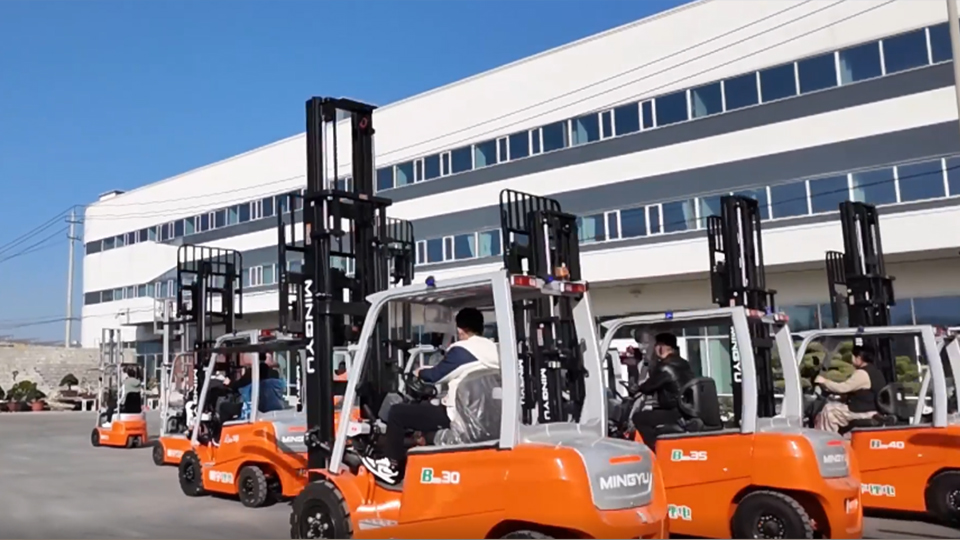
For the growing majority of indoor, single-shift, and moderate-climate operations, the arithmetic is increasingly clear: the 30 liters of diesel burned per shift represent not merely a fuel cost but a fundamental thermodynamic inefficiency that electric drivetrains have rendered economically obsolete. As battery technology advances and charging infrastructure proliferates, the equivalence gap will widen further—making the diesel forklift's per-shift fuel consumption an ever-heavier anchor on operational competitiveness.
Name: selena
Mobile:+86-13176910558
Tel:+86-0535-2090977
Whatsapp:8613181602336
Email:vip@mingyuforklift.com
Add:Xiaqiu Town, Laizhou, Yantai City, Shandong Province, China
