
vip@mingyuforklift.com
+86-0535-2090977

Abstract
Determining refueling frequency per shift is a critical operational parameter in industrial fleet management, directly impacting equipment utilization rates, labor productivity, and total cost of ownership. This technical article examines the variables governing refuel frequency across diverse industrial sectors—including mining, construction, warehousing, and material handling—by analyzing fuel consumption rates, tank capacities, shift durations, and operational duty cycles. Through empirical data from heavy machinery operations, we establish a framework for calculating optimal refueling intervals and evaluate emerging technologies that are reshaping traditional fuel logistics paradigms.
1. Introduction: The Refueling Calculation Problem
In continuous industrial operations, the question "How many refuels are needed per shift?" is deceptively simple yet operationally profound. The answer depends on a matrix of interdependent variables: equipment class, engine displacement, fuel tank capacity, shift duration, duty cycle intensity, terrain characteristics, and operational strategy. Unlike passenger vehicles that refuel based on remaining range, industrial equipment operates within tightly constrained production schedules where refueling represents planned downtime that must be minimized or eliminated.
Modern industrial operations typically run shifts of 8, 10, or 12 hours, with many mining and port facilities operating 24/7 across three or four rotation periods. Within these windows, equipment availability—the percentage of time a machine is productive versus idle or in maintenance—is a key performance indicator directly influenced by refueling logistics. According to industry analyses, fuel costs constitute 3% to 10% of total mine operating expenses, and in some heavy-haul operations, fuel represents 30% to 40% of operating costs, making refueling efficiency a strategic priority rather than merely an operational detail.
2. Defining the Baseline: Fuel Consumption by Equipment Class
2.1 Material Handling Equipment
For diesel forklifts—the workhorses of warehousing and logistics—fuel consumption varies significantly by capacity class. Standard 3.0–3.5 ton diesel forklifts consume 2.5 to 5 liters per hour under medium-load conditions, with modern turbocharged Tier 4 Final engines achieving the lower end of this spectrum. A typical 8-hour shift yields 5.5 to 6.5 productive hours after accounting for operator breaks, loading delays, and coordination pauses. This translates to per-shift consumption of 18–30 liters for standard models.
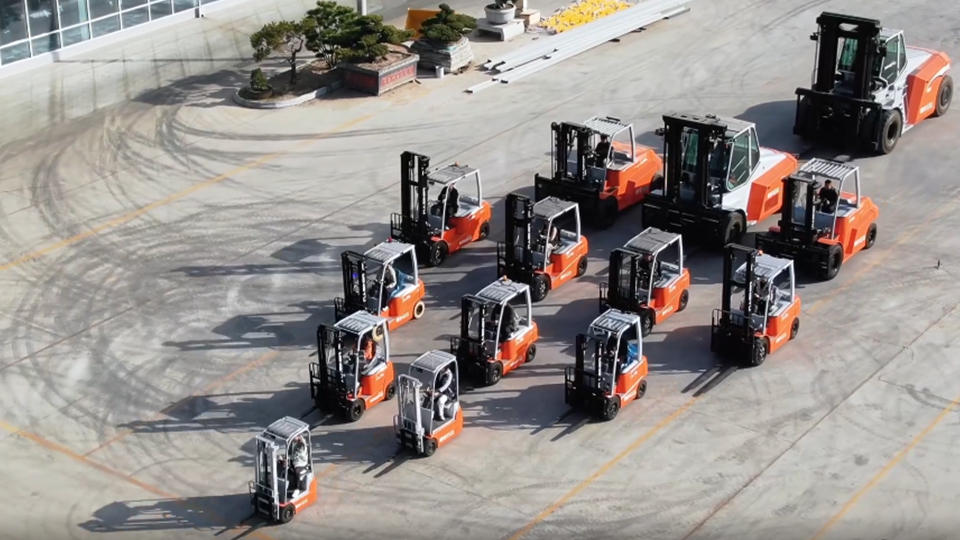
Heavy-duty forklifts (5.0–7.0 ton capacity) exhibit proportionally higher consumption, ranging from 4.5 to 8.0 liters per hour, yielding 33–60 liters per shift under standard operations and up to 90 liters under extreme conditions. Industrial forklifts exceeding 10 tons capacity can consume 10–20 liters per hour, potentially exceeding 100 liters per shift.
Standard diesel forklifts in the 3.5-ton class typically feature fuel tanks of 60–80 liters, providing 2 to 3 shifts of autonomy under moderate consumption. This suggests that for standard 8-hour operations, zero to one refuel per shift is typical, with refueling occurring at shift end or during scheduled breaks. However, extended 12-hour shifts or high-intensity applications may require one mid-shift refuel for standard models, and one to two refuels per shift for heavy-duty units.
Propane-powered forklifts offer a different profile. A propane forklift can operate for up to eight hours between cylinder replacements, with refueling accomplished in approximately five minutes by swapping cylinders. For standard 8-hour shifts, this implies one refuel per shift at shift change. For 12-hour continuous operations, two refuels per shift are necessary. Electric forklifts, by contrast, typically require 6–8 hours of charging time, making them unsuitable for continuous multi-shift operations without battery swapping infrastructure.
2.2 Excavators and Construction Equipment
Excavators present a broader consumption spectrum based on size class and application. A 12-ton class excavator such as the SANY SY120 features a 96-liter fuel tank and an 85 kW engine, providing extended runtime for small-to-medium construction projects. A 22-ton class excavator like the Case CX220C carries a 458-liter fuel tank with consumption rates around 12 liters per hour, enabling approximately 38 hours of theoretical operation—suggesting zero refuels per standard 8-hour shift and potentially zero refuels across multiple shifts.
Mini excavators (1.8–3.5 tons) used in residential construction consume approximately 2.5 gallons per hour (9.5 liters/hour). With typical tank capacities of 30–50 liters, these machines require one refuel every 1.5 to 2 shifts under continuous operation, or one refuel per day in intermittent use.
2.3 Mining Haul Trucks
Large-scale mining operations present the most extreme refueling scenarios. A 500-ton haul truck consumes 30–50 gallons (114–190 liters) per hour depending on load, terrain gradient, and operational conditions. Over a 10-hour shift, daily consumption reaches 300–500 gallons (1,136–1,893 liters).
These massive machines carry fuel tanks sized accordingly—often 3,000–5,000 liters—yet even with such capacities, they typically require one to two refuels per 12-hour shift under heavy-load conditions. In open-pit mining where trucks traverse steep grades fully loaded, consumption peaks at the upper range, necessitating more frequent refueling. A fleet of five such trucks can burn 2,500 gallons (9,464 liters) daily, requiring sophisticated fuel logistics coordination.
3. The Mathematics of Refuel Frequency
3.1 Core Formula
The fundamental calculation for refuel frequency per shift follows:
Refuel Events per Shift = (Consumption Rate × Operating Hours) / Tank Capacity
Where:
Consumption Rate = liters or gallons per hour (variable by load factor)
Operating Hours = productive hours per shift (typically 75–85% of clock hours)
Tank Capacity = usable fuel volume (accounting for reserve/sediment space)
3.2 Worked Examples
Example A: Standard Warehouse Forklift (8-hour shift)
Consumption: 4 L/h × 6 productive hours = 24 L/shift
Tank capacity: 70 L usable
Refuel frequency: 24/70 = 0.34 → 0 refuels per shift (refuel every 2–3 shifts)
Example B: Heavy-Duty Construction Excavator (12-hour shift)
Consumption: 12 L/h × 10 productive hours = 120 L/shift
Tank capacity: 458 L
Refuel frequency: 120/458 = 0.26 → 0 refuels per shift (refuel every 3–4 shifts)
Example C: Mining Haul Truck (12-hour shift, high load)
Consumption: 190 L/h × 11 productive hours = 2,090 L/shift
Tank capacity: 4,000 L
Refuel frequency: 2,090/4,000 = 0.52 → 1 refuel per shift (typically mid-shift)
Example D: Propane Forklift Multi-Shift Operation
Runtime per cylinder: 8 hours
Shift duration: 12 hours
Refuel frequency: 12/8 = 1.5 → 2 refuels per extended shift
3.3 The Idle Time Penalty
A frequently underestimated factor is idle consumption. Diesel engines at idle burn 0.5–1.5 liters per hour depending on displacement. In poorly managed operations where equipment idles for 2 hours within an 8-hour shift, idle consumption adds 1–3 liters—representing a 10–15% increase over productive-only consumption. This seemingly marginal increase can push machines across the threshold requiring an additional refuel over multiple shifts.
4. Operational Strategies and Their Impact on Refuel Frequency
4.1 Traditional Fixed-Station Refueling
The conventional approach requires equipment to travel to centralized fuel farms or service stations. This model introduces significant non-productive time (NPT). In mining operations, fleet travel to fuel stations can consume substantial productive hours. One Australian open-cut coal mine documented that transitioning from fixed-station to mobile refueling recovered 43 productive machine hours per day across the fleet by eliminating transit time to fuel farms.
Under fixed-station models, refueling is typically scheduled at shift changes to minimize production impact. This creates a paradox: equipment either refuels before it is necessary (topping off with significant remaining fuel) or risks running dry during the shift. The result is often one scheduled refuel per shift regardless of actual need, representing a conservative but inefficient approach.
4.2 Mobile and Wet-Hosing Refueling
Wet-hosing—delivering fuel directly to equipment via specialized service trucks—fundamentally alters the refuel frequency equation. Rather than equipment traveling to fuel, fuel travels to equipment. In a Texas refinery turnaround project, wet-hosing services supported over 40 pieces of construction equipment across a 500-acre facility, with fuel trucks making scheduled rounds every four hours. Equipment utilization rates remained high, and the project completed two days ahead of schedule because fuel logistics never became a bottleneck.
This approach enables micro-refueling—topping off tanks during operator breaks or shift changes in the pit or work zone. Rather than calculating "how many refuels per shift," operations can transition to continuous fuel maintenance where tanks are perpetually maintained above 75% capacity. In the Bowen Basin case study, operator shift changes and equipment refueling were synchronized in the pit, meaning production equipment only parked up once rather than twice (once for fuel, once for shift change).
4.3 Alternative Fuel Paradigms
Hydrogen fuel cells are emerging as a disruptive force in refueling logistics. Hydrogen-powered material handling equipment refuels in 3–5 minutes compared to 1–2 hours for battery charging. Walmart's deployment of over 9,500 hydrogen pallet jacks across 40+ distribution centers leverages rapid refueling to maintain continuous multi-shift operations. BMW's Leipzig plant converted automated guided vehicles (AGVs) to hydrogen fuel cells, achieving refueling in seconds rather than the hours required for battery swaps, and expects to reduce fleet size by 20% while maintaining throughput.
For hydrogen-powered industrial fleets, the refuel frequency calculation shifts from "how many refuels" to "how many minutes of downtime." With 3-minute refueling events, even two to three refuels per shift impose less total downtime than a single battery swap or charging session.
5. Industry-Specific Refuel Benchmarks
5.1 Mining Operations
Mining represents the most fuel-intensive industrial sector. Large open-pit operations running 24/7 typically schedule one refuel per 12-hour shift for haul trucks, with fuel farms positioned strategically around the pit to minimize transit time. Mobile fueling technologies have enabled some operations to achieve zero dedicated refuel stops by integrating refueling with other scheduled downtime events.
5.2 Construction and Earthmoving
Construction equipment operates under more variable duty cycles. A typical 8-hour construction shift with a mid-size excavator (20–30 tons) generally requires zero refuels per shift, with refueling occurring at the end of the workday. However, high-intensity applications such as quarry work or continuous pipeline trenching may necessitate one mid-shift refuel for machines in the 20-ton class. Mini excavators in residential work, with smaller tanks and proportionally significant idle time, may require one refuel every 1.5 shifts.
5.3 Warehousing and Logistics
Three-shift warehousing operations present unique challenges. Diesel and propane forklifts typically require one refuel per shift when operating continuously, with refueling synchronized to shift changes. Electric forklifts in multi-shift operations require battery swapping infrastructure, effectively creating one "refuel" (swap) per shift but with significantly longer downtime (15–30 minutes for lithium batteries, hours for lead-acid). Hydrogen fuel cell forklifts achieve one 3-minute refuel per shift, offering the closest approximation to continuous operation.
5.4 Port and Terminal Operations
Container handling equipment and port tractors operate under severe time pressure. Equipment in this sector typically follows one refuel per 8–10 hour shift for diesel-powered units, with many ports transitioning to LNG or electric power to reduce emissions. The high utilization rates (often 85–90% of clock hours) in port operations mean fuel tanks are sized precisely to avoid mid-shift refueling, as any downtime directly impacts vessel turnaround times.
6. Optimizing Refuel Frequency: Technical Considerations
6.1 Tank Sizing Strategy
OEMs size fuel tanks based on intended duty cycles. A tank providing exactly one shift of autonomy forces a refuel every shift—acceptable if refueling occurs during shift change, but problematic if it interrupts production. Tanks providing 1.5–2 shifts of autonomy offer operational flexibility, allowing refueling to be scheduled during lowest-value time windows. Mining haul trucks with 4,000+ liter tanks sized for 1.5–2 shifts exemplify this strategy.
6.2 Fuel Monitoring and Predictive Analytics
Modern fuel management systems track consumption in real time, enabling dynamic refueling schedules rather than fixed intervals. In the Bowen Basin implementation, real-time visibility into diesel stored across the site—including service truck levels updated every time they drove within communication range—enabled delivery scheduling that reduced stored diesel levels by 31% and freed $100,000 in working capital.
AI-powered fuel monitoring systems in Indian mining operations have demonstrated ±1% accuracy in detecting fuel level changes, catching theft events as small as 0.5 liters and enabling precise consumption tracking to optimize refuel timing.
6.3 Maintenance Impact on Consumption
Mechanical condition directly influences refuel frequency. Clogged air filters can increase consumption by 10–15%, potentially pushing a machine that normally requires zero refuels per shift into needing one. Worn injectors, underinflated tires, and degraded hydraulic systems all impose fuel penalties that compound over shift durations. Preventive maintenance intervals in mining environments are typically 20–40% shorter than standard schedules due to severe dust and operational stress, preserving fuel efficiency.
7. Conclusion: The Variable Answer
The question "How many refuels are needed per shift?" yields no universal constant but rather a distribution dependent on equipment class, operational intensity, and logistical strategy:
Standard material handling (8-hour shift): 0–1 refuels per shift
Heavy-duty construction (12-hour shift): 0–1 refuels per shift
Mining haul trucks (12-hour shift): 1–2 refuels per shift
Continuous multi-shift warehousing: 1 refuel per shift (diesel/propane), 1 swap per shift (electric), 1 quick refuel per shift (hydrogen)
The evolution from fixed-station refueling to mobile wet-hosing and alternative fuels is progressively decoupling refuel frequency from production constraints. The emerging paradigm shifts the question from "How many refuels?" to "How many minutes of fuel-related downtime?"—a metric that better captures the true operational impact of fuel logistics.
For fleet managers, the technical imperative is clear: calculate baseline consumption using empirical load factors rather than manufacturer specifications, size tanks or plan mobile refueling to provide 1.2–1.5 shifts of autonomy, and integrate refueling with other scheduled downtime events. In an industry where equipment availability directly correlates with profitability, optimizing refuel frequency is not merely a fuel management task—it is a production optimization strategy.
Name: selena
Mobile:+86-13176910558
Tel:+86-0535-2090977
Whatsapp:8613181602336
Email:vip@mingyuforklift.com
Add:Xiaqiu Town, Laizhou, Yantai City, Shandong Province, China
