
vip@mingyuforklift.com
+86-0535-2090977

Introduction
Warehouse design and material handling efficiency hinge on one critical relationship: the precise matching of forklift specifications to pallet dimensions and aisle clearances. Get this equation wrong, and the consequences cascade through every aspect of operations—reduced storage density, increased product damage, compromised safety, and diminished throughput. Get it right, and a facility unlocks maximum storage capacity while maintaining safe, efficient material flow.
The challenge lies in the interdependence of three variables: the physical dimensions of the unit load (pallet plus goods), the maneuvering envelope of the forklift, and the available aisle width between storage structures. Each variable constrains the others, and optimizing the system requires understanding the technical specifications, calculation methodologies, and operational trade-offs that govern forklift selection.
This article provides a comprehensive technical framework for matching forklift models to pallet size and aisle width, covering the fundamental formulas, equipment classifications, real-world calculation examples, and the practical considerations that transform theoretical models into operational reality.
Understanding the Core Variables
Pallet Dimensions: The Foundation of Forklift Selection
Pallet dimensions serve as the primary input for forklift specification. Globally, the most common pallet sizes include the EUR/EPAL pallet (1,200 × 800 mm), the ISO standard pallet (1,200 × 1,000 mm), the North American GMA pallet (1,219 × 1,016 mm or 48 × 40 inches), and the Asian standard (1,100 × 1,100 mm). Each dimension—particularly the depth (the direction the pallet enters the rack)—directly influences the required aisle width and forklift turning characteristics.
Beyond the pallet itself, the critical measurement is the load length: the pallet depth plus any product overhang. A standard 48-inch (1,219 mm) pallet with 4 inches (100 mm) of product overhang on each end effectively becomes a 56-inch (1,422 mm) load. This distinction between pallet size and load length is frequently overlooked in preliminary planning, leading to aisles that are adequate for the pallet but insufficient for the actual goods being handled.
The pallet width (the dimension perpendicular to travel when entering a rack position) also matters for fork carriage selection. Forklift fork spacing must accommodate the pallet stringer or block spacing, and the overall carriage width must clear the pallet edges without interference. For the EUR pallet (1,200 mm wide), fork spacing of approximately 570 mm is standard; for the 1,000 mm wide pallet, spacing adjusts proportionally.
Forklift Turning Radius and Right-Angle Stacking
Two related but distinct specifications govern forklift maneuverability: the minimum turning radius and the right-angle stacking aisle width (RASA).
The minimum turning radius is defined as the distance from the center of the steering axle to the outermost point of the forklift (or load) when the steering is at full lock. This specification determines the theoretical minimum space required for the forklift to execute a 180-degree turn. However, this value alone does not determine practical aisle width for pallet handling operations.
The right-angle stacking aisle width (also called the basic right-angle stack dimension) is the minimum space a forklift requires to turn 90 degrees and enter a pallet position. This is the critical specification for warehouse aisle design, as it accounts for the combined envelope of the forklift chassis and the load during the stacking maneuver. This value is manufacturer-specific and model-specific, typically found in technical datasheets or obtainable from dealership technical support.
The relationship between these two values is not linear. A forklift with a relatively compact turning radius may still require substantial aisle width if it has a long load center distance or extended front overhang. Conversely, specialized designs such as articulated forklifts or turret trucks achieve remarkably narrow aisle requirements despite moderate turning radii through alternative load handling mechanisms.
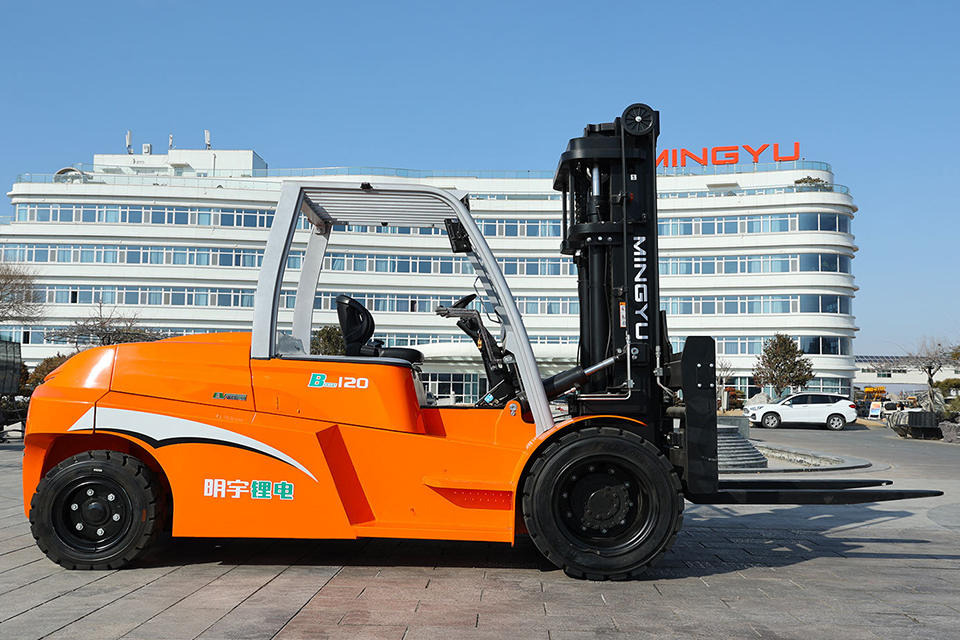
Aisle Width Classifications
Industry practice categorizes warehouse aisles into four primary classifications, each dictating a different class of material handling equipment:
Wide Aisles (3.5–4.5 meters / 12–14 feet): The traditional standard for counterbalance forklifts. These aisles accommodate the full turning envelope of standard sit-down electric or internal combustion forklifts. Wide aisles offer maximum operational flexibility, highest travel speeds, and the lowest skill requirements for operators, but they sacrifice storage density.
Narrow Aisles (2.7–3.5 meters / 9–11.5 feet): Designed for reach trucks and stand-up counterbalance forklifts. These aisles reduce the required turning envelope by eliminating the need for the forklift body to turn within the aisle—instead, the mast reaches forward to deposit or retrieve loads while the chassis remains aligned with the aisle.
Very Narrow Aisles (1.6–2.0 meters / 5.3–6.6 feet): Require specialized turret trucks or swing-reach forklifts, typically wire-guided or rail-guided to prevent rack impact. These machines rotate the load rather than the chassis, achieving dramatic space savings at the cost of specialized equipment and reduced flexibility.
Ultra-Narrow Aisles (less than 1.6 meters / 5.3 feet): Served by automated storage and retrieval systems (AS/RS) or highly specialized man-up order pickers. These systems operate in aisles barely wider than the load itself, maximizing vertical storage density.
The aisle classification selected for a facility fundamentally determines the forklift model class that can operate within it. This decision should precede rack layout design, not follow it—a common error that forces suboptimal equipment choices onto predetermined aisle widths.
The Aisle Width Calculation Framework
The Fundamental Formula
The industry-standard formula for calculating minimum aisle width for counterbalance forklift operations is:
Aisle Width = Right-Angle Stack + Load Length + Clearance
Where:
Right-Angle Stack (RAS) = The manufacturer-specified minimum space the forklift requires to execute a 90-degree turn and align with a pallet position (typically 2,200–2,800 mm for 1.5–3 ton electric counterbalance forklifts).
Load Length = The depth of the pallet plus any product overhang (typically 1,000–1,200 mm for standard pallets).
Clearance = Operational safety margin, typically 300–400 mm (150–200 mm per side), accounting for operator skill variation, load swing, and rack protection.
An alternative formulation used in some technical references breaks down the components more granularly:
RASA = Turning Radius (R) + Front Overhang (X) + Load Length (b) + Safety Gap (a)
Where the front overhang (X) represents the distance from the front axle centerline to the vertical plane of the fork face, and the safety gap (a) is typically 200 mm total (100 mm per side).
Practical Calculation Example
Consider a typical warehouse scenario using a 2.5-ton electric counterbalance forklift handling standard EUR pallets (1,200 × 800 mm) with no load overhang:
Right-Angle Stack (manufacturer specification): 2,400 mm
Load Length (pallet depth): 800 mm
Clearance (200 mm per side): 400 mm
Minimum Aisle Width = 2,400 + 800 + 400 = 3,600 mm (3.6 meters)
This represents the theoretical minimum. In practice, most designers add an additional 100–200 mm buffer to account for the documented tendency of manufacturer turning radius specifications to be approximately 100 mm optimistic compared to real-world performance, particularly when loads are elevated. Thus, the recommended design aisle width would be 3,700–3,800 mm.
For a North American scenario using a Toyota 8FGCU25 (5,000 lb capacity) handling 48-inch deep pallets:
Right-Angle Stack: 94.3 inches (2,395 mm)
Load Length: 48 inches (1,219 mm)
Clearance: 12 inches (305 mm)
Minimum Aisle Width = 94.3 + 48 + 12 = 154.3 inches (3,919 mm or approximately 12.9 feet)
This calculation explains why the industry rule of thumb for standard counterbalance forklifts is approximately 12–14 feet (3.6–4.3 meters) of aisle width.
Adjustments for Special Conditions
Several factors necessitate aisle width adjustments beyond the base calculation:
Load Overhang: When products extend beyond the pallet edges, the effective load length increases proportionally. A 48-inch pallet with 3-inch overhang on each end becomes a 54-inch effective load, adding 152 mm to the required aisle width.
Elevated Loads: When operating at maximum lift heights (6 meters and above), forklift stability characteristics change, and the effective maneuvering envelope may increase due to mast sway and operator caution. Some practitioners recommend adding 150–200 mm to aisle width for operations above 5 meters.
Operator Skill Level: Experienced operators can work effectively in aisles at the calculated minimum, while novice operators may require 200–400 mm of additional clearance to maintain productivity and safety. Facilities with high operator turnover should design toward the generous end of the clearance range.
Bidirectional Traffic: Aisles designed for two-way forklift traffic require substantially more width than the minimum calculated for stacking operations. The formula for bidirectional travel is approximately: 2 × (Forklift Width + Load Width) + 900 mm safety separation. This typically results in 4.8–6.0 meter aisles, effectively placing such aisles in the wide-aisle category regardless of the forklift type.
Matching Forklift Models to Pallet and Aisle Configurations
Standard Pallets (1,200 × 1,000 mm) in Wide Aisles (3.5–4.5 m)
For facilities handling the ISO standard 1,200 × 1,000 mm pallet in wide aisles of 3.5 meters or greater, the full spectrum of counterbalance forklifts is available. A 1.5-ton to 2.5-ton four-wheel electric counterbalance forklift represents the optimal choice, offering:
Sufficient capacity margin for loads up to 1,500 kg on the pallet
Stability for loads at maximum lift heights of 4.5–6.0 meters
Maneuverability within the generous aisle width
Compatibility with standard fork spacing (typically 570 mm for this pallet class)
The four-wheel configuration provides superior stability for loads approaching the rated capacity, while the wide aisle allows the forklift to execute turns without the precision demands of narrow-aisle operations. Mast selection should prioritize triplex designs for lift heights above 4.5 meters, ensuring adequate free lift for container unloading and reduced overall height in travel position.
Euro Pallets (1,200 × 800 mm) in Medium Aisles (3.0–3.5 m)
The EUR pallet's reduced depth (800 mm versus 1,000 mm) creates opportunities for aisle width reduction. In aisles of 3.0–3.5 meters, a three-wheel electric counterbalance forklift becomes the preferred option. Three-wheel designs achieve turning radius reductions of 15–20% compared to equivalent four-wheel models, directly translating to narrower aisle requirements.
For a 1.5-ton three-wheel electric forklift handling EUR pallets:
Right-Angle Stack: approximately 2,200–2,400 mm
Load Length: 800 mm
Clearance: 300 mm
Calculated Minimum: 3,300–3,500 mm
This places the operation comfortably within the medium aisle range. The three-wheel configuration's enhanced maneuverability comes with a trade-off: reduced stability on uneven surfaces and lower capacity at maximum lift heights compared to four-wheel equivalents. These forklifts are best suited to smooth warehouse floors and loads well within the rated capacity.
Oversized Pallets in Standard Aisles
When handling non-standard or oversized pallets—such as the 1,200 × 1,500 mm pallets common in some manufacturing applications or the 1,500 × 1,500 mm pallets used for bulk materials—the load length component of the aisle calculation increases significantly.
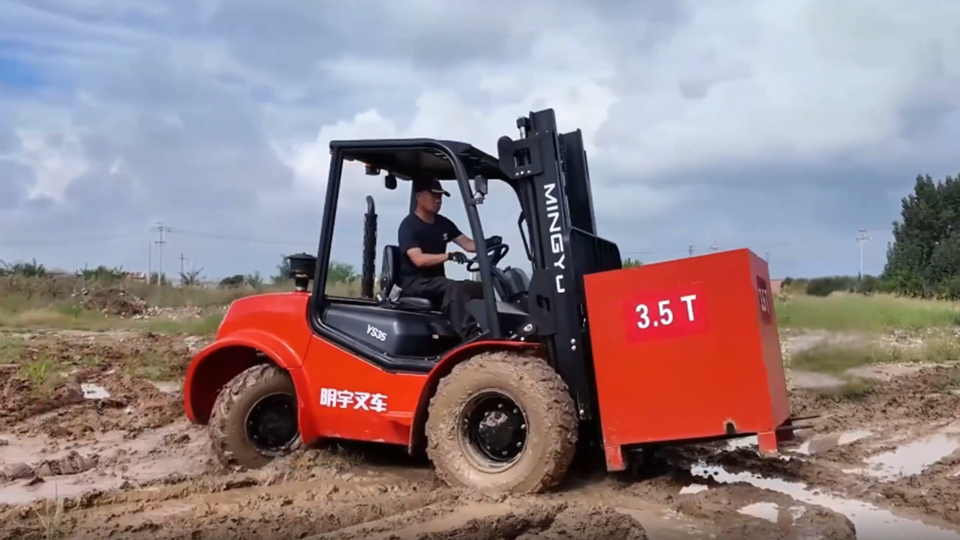
For a 1,500 mm deep pallet handled by a standard counterbalance forklift:
Right-Angle Stack: 2,400 mm
Load Length: 1,500 mm
Clearance: 400 mm
Calculated Minimum: 4,300 mm
This pushes the requirement into the wide-aisle category and may necessitate a larger capacity forklift (2.5–3.5 tons) to maintain stability with the extended load center. Alternatively, facilities can consider specialized equipment such as multi-directional forklifts or side-loaders, which handle long loads without requiring the aisle width dictated by the right-angle stack calculation.
Narrow Aisle Operations (2.7–3.0 m) with Reach Trucks
When warehouse design demands aisle widths below 3.5 meters to maximize storage density, counterbalance forklifts become impractical regardless of pallet size. Reach trucks—available in stand-up and sit-down configurations—become the required equipment class.
Reach trucks operate by extending the mast carriage forward to deposit or retrieve loads while the chassis remains stationary in the aisle. This design eliminates the turning radius constraint from the aisle width calculation. Instead, the determining factors become:
Chassis width plus clearance (typically 1,200–1,400 mm)
Reach mechanism extension requirements
Load width plus overhang
For standard 1,200 mm wide pallets in a reach truck configuration:
Chassis Width: approximately 1,270 mm
Load Width: 1,200 mm
Clearance: 300 mm
Calculated Aisle: 2,770–2,900 mm
This explains the industry standard of 2.8–3.0 meter aisles for reach truck operations. The trade-off is reduced travel speed in aisles, higher equipment cost, and the requirement for smooth, level floors due to the reach mechanism's sensitivity to floor irregularities.
Very Narrow Aisle (VNA) Operations (1.6–2.0 m)
For maximum storage density, very narrow aisle systems utilizing turret trucks or swing-reach forklifts achieve aisle widths of 1.6–2.0 meters. These machines rotate the load 90 degrees using a rotating fork carriage or turret head, eliminating the need for chassis rotation entirely.
VNA systems require:
Wire guidance or rail guidance systems embedded in the floor
Precision floor flatness tolerances (typically ±2 mm over 3 meters)
Dedicated aisle design with no obstructions
Pallet dimensions that match the turret head specifications
The pallet size constraint in VNA systems is not aisle width but rather the compatibility of pallet dimensions with the turret head and load handling attachments. Standard pallets are accommodated, but non-standard sizes may require custom fork configurations or may be incompatible entirely.
Rack Depth and Pallet Orientation Considerations
Rack Depth Selection
The depth of the pallet rack beams relative to the pallet depth significantly impacts aisle width requirements. Industry practice recommends rack depths that allow 75–100 mm of pallet overhang on each side (150–200 mm total). For a 1,000 mm deep pallet, a 1,200 mm deep rack frame is standard; for an 800 mm deep EUR pallet, a 1,000 mm or 1,100 mm frame is typical.
This overhang serves multiple purposes: it centers the load weight over the beams, facilitates easier pallet placement by operators, and accommodates minor pallet dimension variations. However, the overhang also reduces the effective aisle clearance. A common design error is measuring aisle width "steel to steel" (between rack faces) without accounting for the pallet overhang that protrudes into the aisle. For a standard configuration with 75 mm overhang on each side, the effective aisle width is 150 mm narrower than the steel-to-steel measurement.
Pallet Orientation: Stringer vs. Block Entry
The orientation of the pallet relative to the aisle—whether the pallet enters the rack with the stringers parallel to the aisle (lengthwise entry) or perpendicular (widthwise entry)—affects both aisle width and forklift specification.
Lengthwise entry (pallet depth aligned with aisle direction) is standard for selective racking and is the configuration assumed in most aisle width calculations. Widthwise entry may be employed in drive-in or drive-through racking systems where the forklift enters the rack lane. In these configurations, the critical dimension becomes the pallet width rather than depth, and the aisle width must accommodate the forklift's maneuvering within the rack structure itself.
Double-Deep Racking Considerations
Double-deep racking systems, where pallets are stored two-deep on each side of the aisle, require specialized equipment—either double-deep reach trucks or counterbalance forklifts with extended reach attachments. The aisle width for double-deep configurations is similar to standard reach truck aisles (3.0–3.5 meters), but the equipment must accommodate the extended reach to access the second pallet position.
The pallet size constraint in double-deep systems is particularly critical: the combined depth of two pallets plus clearance must not exceed the reach capability of the forklift. For two 1,000 mm deep pallets, the reach mechanism must extend at least 2,000 mm plus clearance, a specification that must be verified against the forklift datasheet.
Operational and Safety Considerations
OSHA and Regulatory Requirements
OSHA 29 CFR 1910.178(n)(1) establishes that aisles used by powered industrial trucks must be at least 3 feet (914 mm) wider than the widest vehicle or load traveling through the aisle. For a standard counterbalance forklift handling a 48-inch wide pallet, this establishes a theoretical minimum of 84 inches (2,134 mm) before the forklift's own width is factored in. In practice, the forklift's turning radius and stacking requirements establish minimums well above this regulatory floor.
Additionally, OSHA 29 CFR 1910.22 requires that aisles be kept clear and unobstructed, with visible floor markings. These requirements, while not directly dictating aisle width, influence practical design by requiring buffer zones for marking visibility and pedestrian separation.
Floor Conditions and Aisle Design
The quality of the warehouse floor directly impacts the practical aisle width required for safe operations. Uneven floors, expansion joints, and level deviations force operators to reduce speed and increase caution, effectively increasing the operational aisle envelope. For narrow-aisle and very-narrow-aisle systems, floor flatness specifications become critical design parameters, with tolerances of ±2 mm over 3 meters required for wire-guided VNA systems.
Load Center and Capacity Derating
The load center—the horizontal distance from the heel of the forks to the center of gravity of the load—is a critical but frequently overlooked factor in forklift selection. Standard ratings assume a 500 mm load center. When handling pallets deeper than 1,000 mm or loads with rearward center of gravity, the effective load center increases, reducing the safe lifting capacity.
For example, a 2.5-ton forklift rated at 500 mm load center may only safely lift 2.0 tons at a 600 mm load center. Facilities handling oversized pallets or irregularly distributed loads must verify capacity derating curves and may need to upsize forklift capacity to maintain safe operations within their aisle constraints.
Conclusion
Matching forklift models to pallet size and aisle width is a multidimensional optimization problem that demands systematic analysis rather than rule-of-thumb approximations. The fundamental relationship—Aisle Width = Right-Angle Stack + Load Length + Clearance—provides the mathematical foundation, but successful implementation requires attention to the nuances of pallet orientation, rack depth, load overhang, operator skill, floor conditions, and regulatory requirements.
For wide aisles (3.5–4.5 meters), standard four-wheel electric counterbalance forklifts offer maximum flexibility and operational simplicity across all standard pallet sizes. As aisle widths narrow to 3.0–3.5 meters, three-wheel counterbalance designs and reach trucks become necessary, with the choice depending on pallet depth and throughput requirements. Below 3.0 meters, reach trucks are mandatory, and below 2.0 meters, specialized VNA equipment with guidance systems is required.
The critical insight is that forklift selection and aisle design must be coordinated from the outset of warehouse planning. Attempting to force standard counterbalance forklifts into aisles designed for narrower equipment—or conversely, accepting unnecessarily wide aisles that sacrifice storage density—represents a fundamental design failure that compromises both efficiency and safety. By applying the calculation frameworks and matching principles outlined in this article, facility planners can achieve the optimal balance of storage density, operational efficiency, and safe material handling.
Name: selena
Mobile:+86-13176910558
Tel:+86-0535-2090977
Whatsapp:8613181602336
Email:vip@mingyuforklift.com
Add:Xiaqiu Town, Laizhou, Yantai City, Shandong Province, China