
vip@mingyuforklift.com
+86-0535-2090977

Introduction: The Criticality of Load Validation in Export Markets
The global material handling industry is witnessing an unprecedented transition from internal combustion and lead-acid electric forklifts to lithium-ion powered counterbalance trucks, driven by operational efficiency mandates and increasingly stringent emissions regulations in target export markets. For manufacturers exporting 3-ton capacity lithium counterbalance forklifts—arguably the most versatile and widely deployed class in warehousing, manufacturing, and logistics applications—comprehensive load testing represents the definitive gate between production completion and market authorization. Unlike domestic sales where iterative field validation is feasible, exported units must demonstrate full compliance with destination market standards upon arrival, leaving no margin for performance discrepancies discovered post-shipment. This article presents a rigorous technical examination of the load test protocols, performance benchmarks, lithium-specific validation parameters, and export compliance documentation required to certify a 3-ton lithium counterbalance forklift for international deployment.
Regulatory Framework and Applicable Standards
Export-oriented load testing of 3-ton lithium counterbalance forklifts must reconcile multiple overlapping regulatory frameworks, depending on destination markets. The foundational standard remains ISO 3691-1:2011, "Industrial trucks — Safety requirements and verification — Part 1: Self-propelled industrial trucks, other than driverless trucks, variable-reach trucks and burden-carrier trucks," which establishes baseline stability, braking, and structural integrity requirements under rated load conditions. For European Union destinations, EN 1175:1998+A1:2010 addresses electrical safety requirements for battery-powered trucks, with specific provisions for lithium-ion systems that supersede legacy lead-acid assumptions. North American exports require compliance with ANSI/ITSDF B56.1, which imposes distinct stability triangle criteria and load center specifications—typically 600 mm for Class 1 electric counterbalance trucks—that may differ from ISO configurations. Emerging markets increasingly adopt GB/T 10827 (China) or JIS D 6201 (Japan) with market-specific amendments. The load test protocol must therefore be designed as a superset of the most stringent requirements across target destinations, ensuring universal compliance while maintaining test efficiency. For lithium-specific validation, UN 38.3 transportation testing and IEC 62660 cell-level certification provide prerequisite foundation, but the integrated forklift load test validates system-level performance under realistic mechanical and electrical stress.
Pre-Test Preparation and Baseline Configuration
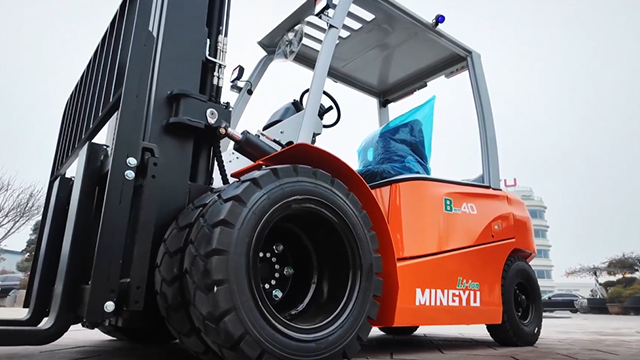
Rigorous load testing begins with meticulous pre-test preparation that establishes controlled baseline conditions. The test unit must complete a minimum 50-hour run-in period per manufacturer specifications to seat bearings, validate initial torque retention on critical fasteners, and stabilize battery formation. Upon arrival at the test facility, the forklift undergoes comprehensive dimensional verification: fork spacing is set to standard 760 mm centers, mast tilt angles are calibrated to manufacturer specifications (typically 6° rearward and 3° forward), and tire pressures are adjusted to rated values accounting for ambient temperature. The lithium battery pack must be conditioned to a defined state of charge—typically 80% to 100% SOC—to ensure consistent power delivery throughout dynamic testing while representing normal operational readiness. Critical to export validation, the unit is configured with destination-market specific parameters: metric or imperial display units, localized operator presence systems, and any market-mandated speed limiters. Test instrumentation installation includes strain gauges on mast channels, pressure transducers on hydraulic lines, accelerometers on the chassis and overhead guard, thermocouples distributed across battery modules, and high-sample-rate data loggers capturing CAN bus communications between the battery management system (BMS), motor controller, and vehicle control unit (VCU). Test loads are certified calibration masses with traceable accuracy within ±0.1%, configured to achieve the rated 3,000 kg at the standard 600 mm load center, with provisions for testing at extended load centers up to 900 mm where market standards require.
Static Load Validation: Structural Integrity and Stability
The static load test sequence establishes the fundamental structural and stability credentials of the 3-ton lithium forklift. Initial testing positions the rated 3,000 kg load at maximum lift height—typically 3,000 mm to 6,000 mm depending on mast configuration—with the mast in vertical orientation. The load is held for a minimum 10-minute interval while technicians monitor mast deflection, hydraulic pressure maintenance, and chassis stability. Acceptance criteria mandate zero hydraulic pressure loss beyond normal thermal contraction, mast deflection within 1/500 of extended height, and no perceptible chassis settlement. Stability testing progresses through the tilted load scenarios required by ISO and ANSI standards. With the rated load elevated to 400 mm above ground level—the prescribed height for stability validation—the mast is tilted to maximum forward and rearward angles while the truck is positioned on a prescribed tilt platform simulating gradient conditions. For 3-ton counterbalance trucks, the longitudinal stability test requires the truck to maintain equilibrium on a 14% gradient (approximately 8°) with the load facing downgrade, while lateral stability is validated on an 18% cross-gradient. The lithium battery configuration introduces unique stability considerations; because lithium packs are typically 20% to 30% lighter than equivalent lead-acid batteries, the counterweight mass and distribution must be recalibrated to maintain the required load moment ratio. Static testing validates that this recalibration achieves stability margins equivalent to or exceeding lead-acid counterparts, with particular attention to lateral stability where reduced battery mass could theoretically shift the center of gravity.
Dynamic Load Testing: Propulsion and Braking Under Rated Conditions
Dynamic load testing subjects the 3-ton lithium forklift to the operational stresses of acceleration, travel, and deceleration while carrying rated capacity. The acceleration test measures the time required to achieve maximum travel speed from a standing start over a defined 15-meter course with the 3,000 kg load elevated to standard travel height (typically 300 mm to 400 mm). Lithium-powered trucks generally demonstrate superior acceleration characteristics due to the high instantaneous torque availability of electric motors combined with the low internal resistance of lithium battery packs, but the load test validates that this performance remains consistent across the SOC range and does not induce excessive wheel slip or structural stress. Braking performance represents the most critical safety validation. Service brake testing measures stopping distance from maximum travel speed (typically 18 km/h to 20 km/h for 3-ton trucks) with rated load carried both facing forward and rearward. Acceptance criteria per ISO 3691-1 mandate stopping distances not exceeding prescribed values based on truck mass and speed—typically 4.5 meters from 20 km/h for unloaded trucks and proportionally adjusted for loaded conditions. The lithium architecture's regenerative braking capability complicates validation; while regenerative deceleration contributes to energy efficiency and reduces service brake wear, the load test must verify that mechanical braking systems independently achieve required stopping distances in the event of electrical system failure. Parking brake validation requires the loaded forklift to maintain position on a 15% gradient indefinitely, with additional testing of automatic parking brake engagement when the operator leaves the seated position.
Hydraulic System Performance Under Maximum Load
The hydraulic system load test validates lifting, lowering, and attachment functions under the mechanical stress of rated capacity. Lifting speed is measured from ground level to maximum height with the 3,000 kg load, with acceptance criteria typically requiring full lift in 15 to 25 seconds depending on pump capacity and market specifications. Critical to the test is measurement of hydraulic pressure at the lift cylinder during initial breakout—the moment of lifting from rest—which indicates system integrity and relief valve calibration. Pressure readings must remain below 90% of system maximum working pressure, providing margin for cold-weather viscosity effects and component wear. Lowering speed control receives equal scrutiny; the load test verifies that controlled lowering rates remain within specified limits (typically 300 mm/s to 600 mm/s) and that the descent does not accelerate beyond safe parameters if the operator releases the control. For forklifts equipped with side-shift or fork positioner attachments, load testing extends to these functions under rated capacity, validating that auxiliary hydraulic circuits maintain pressure without compromising main lift performance. The lithium powertrain's electrical architecture supports these tests through high-efficiency electric hydraulic pumps that maintain consistent flow rates independent of engine speed variations—a distinct advantage over internal combustion counterparts that the load test quantifies through repeatable cycle timing.
Lithium Battery Performance Characterization Under Load
Perhaps the most technically distinctive aspect of load testing a lithium counterbalance forklift is the comprehensive characterization of battery performance under sustained mechanical demand. Unlike lead-acid batteries, which exhibit predictable but significant voltage sag under high current draw, lithium-ion systems maintain relatively stable voltage profiles until near-complete discharge, but generate substantial thermal energy during high-rate discharge and regenerative charging events. The load test protocol incorporates continuous monitoring of individual cell voltages, module temperatures, and state-of-charge estimation accuracy throughout the test sequence. A full-duty-cycle test simulates realistic two-shift operation: sequential cycles of loaded acceleration, travel, lifting to maximum height, lowering, and braking, repeated until the battery reaches manufacturer-defined minimum SOC (typically 20%). Critical acceptance criteria include: maximum cell temperature not exceeding 45°C during continuous operation, cell voltage differential (delta) remaining below 50 mV indicating balanced pack performance, and available power not degrading more than 10% from initial SOC levels until below 20% SOC. The BMS communication validation ensures that derating commands—automatic reduction of travel speed or hydraulic performance when thermal or voltage limits approach—function correctly and provide adequate operator notification. For export markets with extreme climate conditions, additional high-ambient (40°C) and low-ambient (-20°C) load tests validate thermal management system effectiveness and cold-weather power availability, with particular attention to lithium iron phosphate (LiFePO₄) chemistry's reduced performance at sub-zero temperatures.
Endurance and Cyclic Load Testing
Beyond single-cycle validation, exported 3-ton lithium forklifts must demonstrate durability through extended cyclic load testing. The standard endurance protocol requires 200 to 500 continuous duty cycles—each comprising loaded travel, lifting, maneuvering, lowering, and unloading—without mechanical failure, excessive wear, or battery degradation. This testing reveals issues invisible in single-cycle validation: thermal accumulation in motors and controllers, hydraulic fluid temperature rise affecting viscosity and seal performance, and structural fatigue in mast assemblies and chassis welds. For lithium battery validation, the endurance test includes periodic capacity verification; the battery must deliver within 95% of rated ampere-hour capacity after the test sequence, with internal resistance increases not exceeding 5% from baseline. Vibration analysis during loaded travel identifies resonant frequencies in mast structures or battery mounting systems that could lead to long-term mechanical failure or electrical connection degradation. The endurance test also validates the accuracy of manufacturer claims regarding operational autonomy; a 3-ton lithium forklift marketed for eight hours of continuous operation must substantiate this claim under the standardized duty cycle, with test data providing the empirical basis for customer-facing runtime specifications.
Safety System Validation Under Loaded Conditions
Load testing serves as the ultimate validation environment for integrated safety systems, which must function flawlessly when the forklift is under maximum mechanical stress. The operator presence system is tested under load to verify immediate hydraulic and travel disablement when the operator leaves the seat. Load height indicators and travel speed derating systems—mandatory in many export markets—are validated to ensure automatic speed reduction engages when the mast exceeds specified elevation thresholds, typically 2,000 mm or 3,000 mm depending on configuration. The stability control system, if equipped, is tested through deliberate loaded maneuvers that approach stability limits, verifying that electronic intervention reduces travel speed or restricts hydraulic functions before tip conditions develop. For lithium-specific safety, the load test includes validation of emergency disconnect functionality, confirming that high-voltage system isolation occurs within specified timeframes when triggered, and that the truck can be safely immobilized under load without uncontrolled hydraulic release. Overload protection systems are tested by incrementally exceeding rated capacity to verify that alarm thresholds engage at 100% to 110% of rated load and that hydraulic functions are restricted before structural limits are approached.
Data Acquisition, Analysis, and Export Documentation
Modern load testing generates substantial datasets that serve dual purposes: immediate pass/fail determination and comprehensive documentation for export certification. Data acquisition systems sample at 100 Hz to 1,000 Hz depending on parameter criticality, capturing transient events during acceleration, braking, and hydraulic breakout. Post-test analysis generates statistical summaries of performance consistency, identifying any parameters that approach specification limits even if remaining within acceptance criteria. For export markets, this data compilation becomes part of the technical construction file required for CE marking or the technical documentation package for EPA/CARB compliance in North American markets. The load test report must include: test facility accreditation, instrument calibration certificates, environmental conditions during testing, detailed procedure adherence documentation, raw data archives, and executive summary with explicit conformity declarations. For lithium battery systems, additional documentation includes cell and pack UN 38.3 test summaries, BMS functional safety assessments per ISO 13849 or IEC 61508, and electromagnetic compatibility (EMC) test results demonstrating that high-voltage power electronics do not interfere with control systems or external equipment.
Market-Specific Adaptations and Considerations
Export load testing must accommodate market-specific requirements that extend beyond universal standards. Middle Eastern and Southeast Asian destinations often require validation at ambient temperatures exceeding 45°C, testing the limits of thermal management systems and hydraulic fluid specifications. European markets increasingly demand documentation of noise emissions during loaded operation, with 3-ton electric forklifts required to meet stringent workplace noise directives. North American exports must validate compliance with OSHA visibility requirements, ensuring that rated load configurations do not obstruct operator sightlines beyond permitted thresholds. Emerging markets may require additional validation of dust and moisture ingress protection (IP ratings) for electrical enclosures, particularly critical for lithium battery packs and high-voltage junction boxes. The load test protocol is therefore customized with supplementary test modules for each destination market, ensuring that a single comprehensive test campaign produces all documentation required for multiple export authorizations.
Conclusion: Load Testing as Competitive Differentiation
The load test of an exported 3-ton lithium counterbalance forklift represents far more than a regulatory checkbox; it is the empirical foundation upon which manufacturer credibility, market access, and long-term customer relationships are built. As lithium forklift technology continues to mature, load testing protocols are evolving from static pass/fail exercises to comprehensive performance characterizations that provide customers with predictive insights into operational capabilities, maintenance intervals, and total cost of ownership. For export markets where direct manufacturer support may be geographically distant, the rigor of the pre-shipment load test provides the confidence that the equipment will perform as specified from the first hour of operation. The technical sophistication of modern lithium powertrains—precise torque control, integrated thermal management, and intelligent battery monitoring—demands equally sophisticated validation methodologies. Manufacturers who invest in advanced load testing capabilities, generating granular performance data and transparent documentation, position themselves not merely as compliant suppliers but as trusted technical partners in the global transition to electrified material handling. In an increasingly competitive export landscape, the quality and comprehensiveness of load test validation has become a definitive competitive differentiator, separating premium lithium forklift offerings from commoditized alternatives.
Name: selena
Mobile:+86-13176910558
Tel:+86-0535-2090977
Whatsapp:8613181602336
Email:vip@mingyuforklift.com
Add:Xiaqiu Town, Laizhou, Yantai City, Shandong Province, China
