
vip@mingyuforklift.com
+86-0535-2090977

In modern logistics and industrial warehousing, space utilization and operational efficiency have become core competitive indicators for storage management. With rising land rents, expanding inventory volume, and the rapid development of e-commerce and finished goods distribution, more factories, distribution centers, and third-party logistics enterprises are transforming traditional wide-aisle warehouses into high-density narrow-aisle storage systems. For narrow-aisle working scenarios, reach trucks and trilateral stackers (three-way stackers) are the two most mainstream handling devices. Both are designed for high-level stacking and narrow-space operation, yet they differ greatly in aisle occupancy, lifting height, working flexibility, investment cost, and applicable working conditions. Many warehouse managers and equipment purchasers face confusion in model selection: blindly choosing reach trucks may fail to maximize storage density, while fully deploying trilateral stackers may cause excessive investment and wasted operational efficiency. This article comprehensively analyzes the structural principles, performance advantages, applicable scenarios, cost differences, and selection standards of reach trucks and trilateral stackers, providing systematic technical references for narrow-aisle warehouse equipment configuration.
1. Basic Definition and Working Principle
A narrow-aisle warehouse is defined as a storage space that optimizes rack layout to reduce redundant aisle width and increase effective storage positions. Traditional counterbalance forklifts require an operating aisle of 3.5 to 4.5 meters, which leads to low space utilization. In contrast, narrow-aisle equipment represented by reach trucks and trilateral stackers greatly reduces aisle dependence through structural optimization, realizing high-density three-dimensional storage.
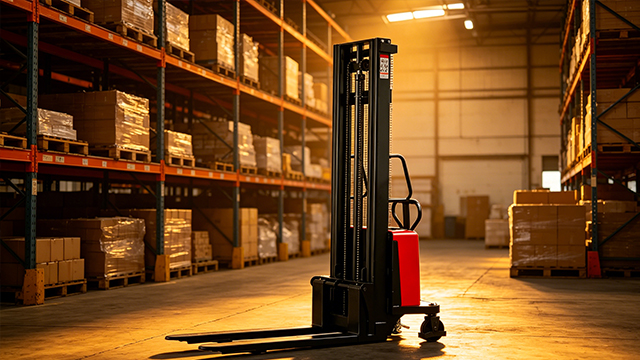
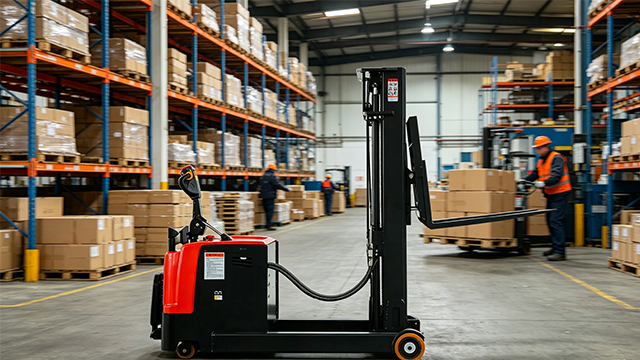
A reach truck is a classic narrow-aisle handling device equipped with a scalable pantograph mast and telescopic fork structure. Its core working principle is that the truck body remains fixed in the aisle during operation, and the mast and fork arms stretch forward to complete pallet picking, stacking, and loading and unloading operations. The whole machine does not need large-angle turning, so it can adapt to narrow channel environments. Conventional electric reach trucks are widely used in medium and high-level warehousing due to their mature technology, flexible operation, and strong universal adaptability.
A trilateral stacker, also known as a three-way narrow-aisle stacker, belongs to the VNA (Very Narrow Aisle) equipment category. Different from reach trucks, its core design advantage lies in the rotatable fork head. The fork carriage can rotate 90 degrees left and right and perform lateral stacking without turning the vehicle body or stretching the mast forward. It can complete cargo access operations on the left, right, and front sides of the aisle in an ultra-narrow channel. This special structural design enables trilateral stackers to adapt to narrower working aisles and higher racking layouts, becoming the preferred equipment for ultra-high-density warehousing scenarios.
2. Core Parameter and Performance Difference Analysis
2.1 Operating Aisle Width
Aisle width is the most intuitive difference between the two devices and the primary basis for warehouse selection. Standard electric reach trucks require a working aisle width of 2.5m to 2.8m. Although it is far narrower than that of counterbalance forklifts, it still has certain space requirements. The telescopic mast needs reserved stretching and safety buffer space, which limits further compression of channel width.
Trilateral stackers break through the aisle limitation of reach trucks. Thanks to the three-way rotating fork design, the vehicle body runs in a straight line without turning, and the required aisle width is only 1.6m to 2
Trilateral stackers are more inclined to ultra-high-level intensive storage. The mainstream lifting height can reach 9m to 12m, and high-customized models can even support higher high-bay warehouse operations. Although the conventional load capacity is slightly lower than that of reach trucks, generally 1.0 ton to 2.5 tons, its advantages in high-altitude precise stacking are more prominent. The straight body operation and lateral stacking structure make the high-level cargo alignment accuracy higher, which is not easy to cause cargo deviation and rack collision, and is more suitable for high-precision intensive storage management.
2.3 Operational Flexibility and Efficiency
Reach trucks have extremely high operational flexibility. They integrate the functions of horizontal transportation, short-distance transfer, and high-level stacking. They can not only complete fixed-point cargo access in the rack area but also freely transfer goods between different warehouse areas, loading and unloading goods at warehouse doors. The operation threshold is low, and ordinary skilled operators can quickly get started. It is suitable for warehouses with frequent cargo entry and exit, scattered inventory, and flexible operation requirements.
Trilateral stackers focus on intensive fixed-point stacking efficiency. Their advantages are concentrated in single-channel high-density storage and retrieval operations. In a single narrow aisle, the stacking efficiency is higher than that of reach trucks, and the operation stability is stronger. However, due to the limitation of ultra-narrow aisles, their cross-region transfer ability is weak, and they are not suitable for frequent long-distance cargo transfer and truck loading and unloading operations. Their functional attributes are more single, and they are more dependent on standardized warehouse layout.
3.1 Scenarios Suitable for Reach Trucks
3. Applicable Warehouse Scenarios
Reach trucks are versatile narrow-aisle equipment with strong scenario adaptability, covering most medium-density warehousing needs. First, they are very suitable for e-commerce fulfillment warehouses and finished product distribution warehouses with frequent incoming and outgoing goods. Such warehouses have uncertain cargo flow directions, frequent cargo transfers, and mixed stacking of multiple SKUs, requiring equipment with flexible movement and multi-scenario adaptation capabilities. Second, they are ideal for factory raw material warehouses and semi-finished product storage workshops. The medium lifting height and stable load capacity can meet the daily material handling and workshop turnover needs. In addition, for newly transformed narrow-aisle warehouses with insufficient standardized layout and certain limitations in aisle uniformity, reach trucks can well adapt to the non-standard working environment and avoid the problem of equipment inadaptability caused by warehouse reconstruction.
3.2 Scenarios Suitable for Trilateral Stackers
Trilateral stackers are targeted at ultra-high-density standardized warehousing scenarios, which are the best choice for maximizing storage capacity. First, they are suitable for high-bay intensive warehouses with limited floor area and sufficient vertical space, such as large-scale finished product storage centers and spare parts centralized storage warehouses. By compressing aisle width and increasing stacking height, they can increase warehouse storage capacity by 20% to 35% without expanding the plant area. Second, they perform excellently in cold chain warehouses and precision electronic component warehouses. The ultra-narrow aisle design reduces cold air loss and temperature fluctuation, and the high-precision stacking structure avoids cargo collision and damage, meeting the high-standard storage requirements of precision goods and low-temperature environments. In addition, for large-scale standardized logistics parks and automated supporting warehouses with fixed cargo storage positions and single operation flow, trilateral stackers can give full play to their intensive and efficient stacking advantages.
4. Cost, Maintenance and Operation Management Comparison
4.1 Procurement and Supporting Costs
Reach trucks have a mature industrial chain and moderate procurement costs, with high cost performance. The warehouse supporting requirements are low, and there is no need for high-precision ground leveling and fully standardized rack layout. Ordinary cement ground and conventional narrow-aisle racks can meet the operation requirements, and the early warehouse transformation investment is small. It is very friendly for small and medium-sized enterprises and warehouses with limited budget.
The procurement cost of trilateral stackers is significantly higher than that of reach trucks. At the same time, the equipment has high requirements on warehouse infrastructure: the ground flatness error needs to be controlled within a small range, and the rack installation must be vertical and horizontal standardized, otherwise it will affect the straight-line driving and stacking accuracy of the equipment. The early warehouse transformation and supporting investment are large, which is suitable for large enterprises with sufficient budget and long-term warehousing layout planning.
4.2 Daily Maintenance and Service Life
Reach trucks have simple mechanical structure, few precision parts, low daily maintenance difficulty and low after-sales maintenance cost. The telescopic mast and hydraulic system are mature and stable, with low failure rate and long service life. Operators can complete daily inspection and simple maintenance independently, with low operation and maintenance threshold.
Trilateral stackers involve precision rotating mechanisms and lateral hydraulic control systems, with complex internal structures and high requirements for daily maintenance. Regular professional calibration of rotating accuracy and driving stability is required. The maintenance cost and technical threshold are higher than those of reach trucks, and long-term stable after-sales service support is needed.
5. Scientific Selection Standards for Narrow-aisle Warehouse Equipment
To sum up, the core of selecting reach trucks or trilateral stackers is to match the warehouse’s storage density demand, cargo flow frequency, budget scale and standardized layout level.
Choose reach trucks if your warehouse has the following characteristics: medium storage density, frequent cargo entry and exit, diverse operation scenarios, need to take into account stacking and cargo transfer loading and unloading, limited renovation budget, and non-fully standardized warehouse layout. It can balance efficiency, flexibility and cost, and meet the diversified operation needs of most conventional narrow-aisle warehouses.
Choose trilateral stackers if your warehouse pursues ultra-high storage density, has sufficient vertical height resources, single and fixed cargo operation flow, high requirements for stacking accuracy and cargo safety, and has sufficient budget for infrastructure transformation and equipment investment. It can maximize the utilization rate of warehouse space and create higher storage benefits for long-term standardized warehousing operations.
For large multi-functional warehouses with both flexible turnover and intensive storage needs, a mixed configuration scheme can be adopted: deploying reach trucks in the frequent cargo turnover area and trilateral stackers in the fixed high-density storage area, so as to give full play to the respective advantages of the two devices and realize optimal overall warehouse operation efficiency.
6. Conclusion
Both reach trucks and trilateral stackers are core equipment for modern narrow-aisle warehousing, and there is no absolute distinction between good and bad. Reach trucks are known for high flexibility, low comprehensive cost and strong universality, and are the preferred equipment for conventional narrow-aisle warehouse transformation and daily flexible operation. Trilateral stackers rely on ultra-narrow aisle adaptability and high-precision high-altitude stacking performance to become the core solution for ultra-high-density intensive warehousing. Warehouse equipment selection must be based on actual operational demands, combined with warehouse space conditions, cargo characteristics, flow frequency and long-term development planning. Scientific matching of handling equipment can not only reduce unnecessary investment costs, but also maximize warehouse space utilization and operational efficiency, helping enterprises build more efficient and standardized modern logistics storage systems.
Name: selena
Mobile:+86-13176910558
Tel:+86-0535-2090977
Whatsapp:8613181602336
Email:vip@mingyuforklift.com
Add:Xiaqiu Town, Laizhou, Yantai City, Shandong Province, China
