
vip@mingyuforklift.com
+86-0535-2090977

Industrial logistics often relies on smooth concrete slabs, precise warehouse racking, and small-diameter solid rubber tires. However, a significant portion of global material handling occurs outdoors—on unpaved mud, loose gravel, agricultural earth, and uneven staging areas. In these non-standard environments, conventional industrial forklifts experience traction failure, structural stress, and ground clearance limitations.Rough terrain forklifts (RTFs) exist to solve this problem. Engineered with heavy-duty drivetrains, high-clearance chassis frames, and specialized hydraulic systems, RTFs bridge the gap between heavy earthmoving equipment and conventional material handling machinery.
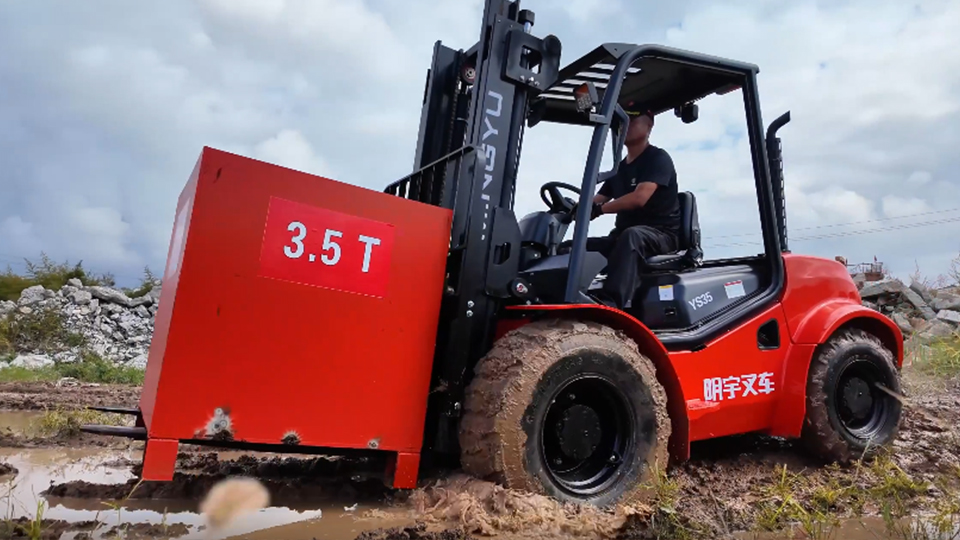
This technical article examines the core engineering principles of rough terrain forklifts and provides a detailed operational breakdown across three primary application scenarios: construction sites, agricultural operations, and open industrial yards.Technical Foundations: Engineering for Extreme ConditionsTo understand why rough terrain forklifts excel in unstructured environments, we must analyze the structural and mechanical modifications that distinguish them from standard industrial counterbalanced forklifts.1. Drivetrain Architecture & Traction ControlStandard warehouse forklifts typically utilize a two-wheel drive (2WD) configuration with small-diameter, solid cushion tires designed for high load density on level surfaces. In contrast, rough terrain forklifts utilize:Four-Wheel Drive (4WD) / All-Wheel Drive (AWD): Selectable or full-time 4WD systems equipped with limited-slip or fully locking differentials. When one wheel loses traction on mud or loose aggregate, torque is automatically redirected to the wheels with grip.High-Torque Internal Combustion Engines: Powered by Tier 4 Final / Stage V diesel engines (and increasingly high-voltage lithium-ion systems), providing high low-end torque necessary to push through soft soil while carrying heavy payloads.Pneumatic Deep-Tread Tires: Large-diameter, wide-section pneumatic or foam-filled tractor tires featuring aggressive tread patterns (such as lug or button designs). These tires increase the ground contact footprint to reduce ground bearing pressure and prevent sinking, while self-cleaning tread grooves shed mud during rotation.2. Chassis Geometry & Ground ClearanceGround clearance is the primary defense against vehicle belly-slapping—where the underside of the chassis contacts the ground, hanging up the machine and causing loss of wheel traction.Feature ParameterStandard Industrial ForkliftRough Terrain Forklift (RTF)Technical ImpactGround Clearance3.5 to 5.0 inches (90–125 mm)10.0 to 16.0 inches (250–400 mm)Prevents bottoming out over rocks, ruts, and debris.Approach / Departure Angle~10° to 15°30° to 45°Allows the unit to navigate steep ramps, embankments, and ditches without striking the frame or mast.Wheelbase & Track WidthCompact, narrow trackExtended wheelbase, wide trackLowers the overall center of gravity and increases lateral stability on uneven gradients.3. Reinforced Structural Rigidity & Mast DesignLifting heavy loads on an incline introduces severe torsional stress to the mast assembly and chassis frame. RTFs mitigate this risk through:Heavy-Section Structural Steel: Masts are manufactured with thick channel steel and reinforced cross-members to resist twisting under asymmetrical dynamic loads.Oscillating Axles & Frame Leveling: Many RTF models feature rear-axle oscillation to keep all four wheels planted on uneven ground. Advanced models incorporate frame-leveling (tilt) cylinders, allowing the operator to adjust the chassis up to $\pm 10^\circ$ horizontally before raising the mast, ensuring the load remains vertical even on a slope.Scenario 1: Construction Sites – Navigating Unstructured InfrastructureConstruction sites are dynamic, dirty, and chaotic. Before concrete foundations are poured and asphalt access roads are laid, material transport must happen across raw earth, exposed rebar, and debris-strewn fields. [Unloading Stage]
Key Operational ChallengesMud and Unpaved Terrain: Rain transforms active job sites into deep mud, bringing standard transport vehicles to a halt.Staging Distance: Delivery trucks frequently cannot enter the immediate perimeter of a building due to excavation pits and safety zones. Materials must be offloaded hundreds of feet away.Vertical Heights: Modular building components (trusses, brick pallets, drywall boards) must be elevated to second- or third-story staging platforms without installing fixed cranes.Technical Advantages of RTFs on Construction SitesSuperior Off-Loading and Site MobilityEquipped with dynamic load-sensing hydraulics and multi-mode steering (two-wheel, four-wheel, and crab steering), RTFs can approach flatbed trailers parked on unpaved perimeter roads, pick up 5,000–10,000 lb pallets, and transport them directly to the point of installation. Crab steering allows the operator to maneuver sideways around scaffolding, concrete footings, and open trenches in restricted-clearance sites.Vertical Material PlacementStraight-mast rough terrain forklifts offer lift heights exceeding 20 to 30 feet, while telescopic variants (telehandlers) extend reaching capabilities both vertically and forward. This forward reach allows the operator to extend a pallet of cinder blocks across a trench directly onto a elevated slab, eliminating manual double-handling by ground crews.Durability Against Puncture and ImpactConstruction debris (exposed nails, rebar cut-offs, crushed concrete) destroys standard solid or thin-ply pneumatic tires. Rough terrain forklifts utilize heavy-duty 14- or 16-ply industrial tires, often filled with polyurethane foam. Foam-filling guarantees zero flat-tire downtime while adding low-slung ballast weight that further improves machine stability during elevated picks.Scenario 2: Farms & Agricultural Operations – Heavy Handling on Variable SoilAgricultural operations demand versatile machinery capable of moving heavy, bulky organic products across fields, unpaved farmyards, and enclosed barns.Key Operational ChallengesSoil Preservation & Traction: Machinery must traverse soft, cultivated soil or wet pasture without sinking or causing excessive soil compaction, which damages crops.Handling Delicate yet Bulky Payloads: From 1,500 lb round hay bales to fragile fruit crates, agricultural loads require high hydraulic flow control to avoid dropping or crushing products.Seasonal High-Intensity Duty Cycles: During harvest windows, equipment runs continuously for 14–18 hours daily in severe dust, heat, and high ambient vibration.Technical Advantages of RTFs in AgricultureLow Ground Pressure & High FlotationBy utilizing wide-base agricultural flotation tires, RTFs distribute vehicle mass over a larger surface area. This reduces the ground bearing pressure ($\text{PSI}$ or $\text{kPa}$), allowing the machine to drive across soggy pastures, orchard rows, or tilled soil without digging deep ruts.Hydraulic Attachment VersatilityUnlike standard warehouse trucks limited to simple side-shifters, agricultural RTFs are equipped with high-flow auxiliary hydraulic circuits operating at high pressure (often $200\text{--}250\text{ bar}$).
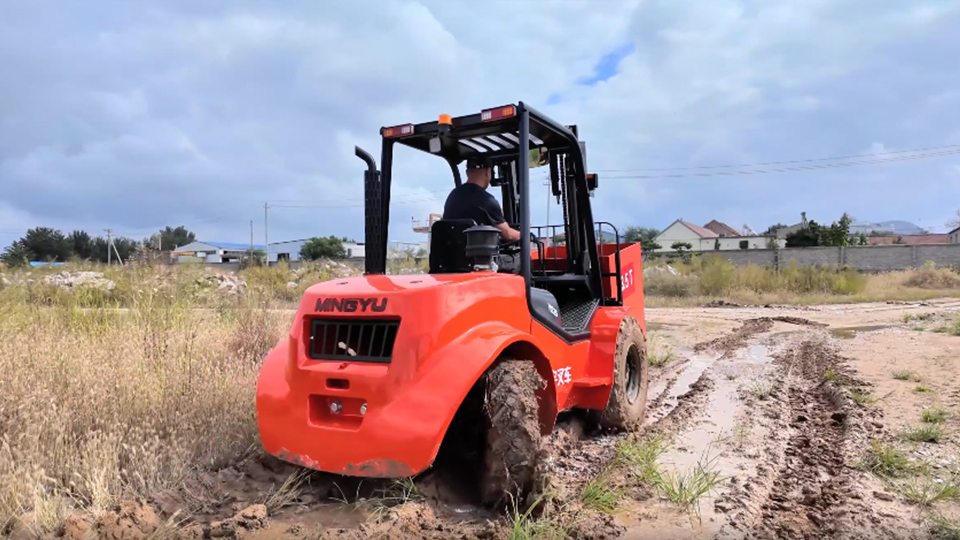
Quick-attach couplings allow operators to swap forks for specialized hydraulic implements in under two minutes:Bale Huggers & Spears: To stack and transport round or square hay bales.Hydraulic Rotators: For tipping fruit and vegetable collection bins into processing hoppers.Silage Clamshell Buckets: Turning the forklift into a bulk material loader for feed, manure, or grain.
Dust Filtration and Thermal ManagementAgricultural environments generate airborne chaff, seed dust, and debris that rapidly clog standard cooling radiators. Rough terrain forklifts built for agriculture incorporate reversible cooling fans—which periodically blast air outward through the radiator core to clear debris—along with multi-stage engine air pre-cleaners (such as cyclonic separators) to extend engine life.Scenario 3: Open Yards & Heavy Industrial Depots – High-Density Outdoor StagingOpen storage yards—including lumber mills, pipe yards, stone quarries, shipyards, and steel distribution centers—combine heavy payloads with uneven, unpaved ground.Key Operational ChallengesMassive Unit Payload Weights: Loads in open yards routinely range from 6,000 lbs to over 20,000 lbs (structural steel beams, concrete culverts, bundled timber).Potholes, Rutting, and Weather Extremes: Gravel yards develop deep potholes, ice patches, and standing water, which cause severe lateral instability when lifting wide loads high in the air.Spatial Constraints & Wide Turn Radii: Outdoor yards prioritize high-density stacking, requiring equipment that can navigate narrow gravel aisles while carrying long, unstable materials.Technical Advantages of RTFs in Open YardsHigh Dynamic Stability & Load Capacity MaintenanceWhen a forklift lifts a 10,000 lb steel load 15 feet in the air, a small depression under one tire causes a dangerous lateral tip angle at the top of the mast. RTFs address this risk using heavy-duty wide-track axles, low center-of-gravity counterweight design, and integrated load-moment indicators (LMI).An LMI system monitors hydraulic pressure and boom/mast angle in real time, warning the operator or automatically limiting movement if the vehicle approaches a tipping threshold.Superior Incline Performance & GradeabilityOpen yards frequently feature steep access ramps, drainage swales, and unpaved slopes. Rough terrain forklifts offer gradeability ratings between 30% and 50% (compared to 15–20% for standard industrial forklifts).The relationship between engine torque output, gear reduction ratio, and tire traction determines maximum gradeability:$$\text{Gradeability (\%)} = \left( \frac{\text{Tractive Effort}}{\text{Gross Vehicle Weight}} \right) \times 100$$With high torque transfer across 4WD differential systems, RTFs can ascend fully loaded gravel ramps without wheel spin or engine stall.All-Weather Reliability and Cab ErgonomicsOutdoor operations run through rain, snow, and extreme heat. Heavy-duty RTFs feature fully enclosed, pressure-sealed cabs with HVAC systems, heated mirrors, and ROPS/FOPS (Roll-Over / Falling Object Protective Structure) certifications. Tinted safety glass and overhead visibility windows allow operators to maintain a clear line of sight on elevated loads regardless of environmental conditions.Strategic Selection Matrix: Selecting the Right EquipmentChoosing between a standard warehouse forklift, a rough terrain forklift, and a telescopic handler requires evaluating load types, terrain severity, and lift height requirements:Application CriteriaStandard Warehouse ForkliftRough Terrain Mast ForkliftRough Terrain TelehandlerPrimary Ground SurfaceSmooth concrete, asphaltUnpaved mud, gravel, soilExtreme mud, unpaved gradesMax Lift Height10–20 ft (3–6 m)15–30 ft (4.5–9 m)30–55 ft (9–17 m)Forward ReachNoneMinimal (via mast tilt)Extensive (telescopic boom)Maintenance ComplexityLowMediumHighInitial Capital CostBaseline$1.5\times\text{ to }2.0\times$ Baseline$2.2\times\text{ to }3.0\times$ BaselineSummary: Maximizing Fleet Efficiency in Harsh EnvironmentsRough terrain forklifts are specialized workhorses built to eliminate logistics bottlenecks where paved surfaces end. By integrating high-torque all-wheel drivetrains, deep-tread pneumatic tires, high ground clearance, and reinforced structural frames, RTFs deliver safety, stability, and speed across harsh operating environments:On Construction Sites: They bypass terrain obstacles to deliver critical building materials directly to elevated working zones, reducing manual labor and vehicle staging delays.On Farms: Their low ground pressure, hydraulic attachment versatility, and dust-resistant cooling systems allow them to handle delicate produce, livestock feed, and heavy bales without damaging soil.In Open Yards: They combine heavy payload capacities with high gradeability and dynamic frame stability, enabling high-density storage on gravel and unpaved grounds.Investing in rough terrain forklifts transforms challenging outdoor topography from an operational obstacle into a manageable, efficient material handling workflow.
Name: selena
Mobile:+86-13176910558
Tel:+86-0535-2090977
Whatsapp:8613181602336
Email:vip@mingyuforklift.com
Add:Xiaqiu Town, Laizhou, Yantai City, Shandong Province, China
