
vip@mingyuforklift.com
+86-0535-2090977

Introduction – why the choice still matters
Electric trucks have captured the headlines, yet diesel remains the default in ports, lumber, steel and 24-hour logistics. The decision is no longer a simple question of “green vs. brute.” Battery energy density has tripled, while Stage V / Tier 4 Final diesels carry after-treatment systems that cost more than the engine. This article compares the two power-trains across fourteen quantifiable axes—energy, power, duty, environment, economics, safety, automation and regulation—so buyers can map the correct technology to the correct task.
Prime energy and refuelling logistics
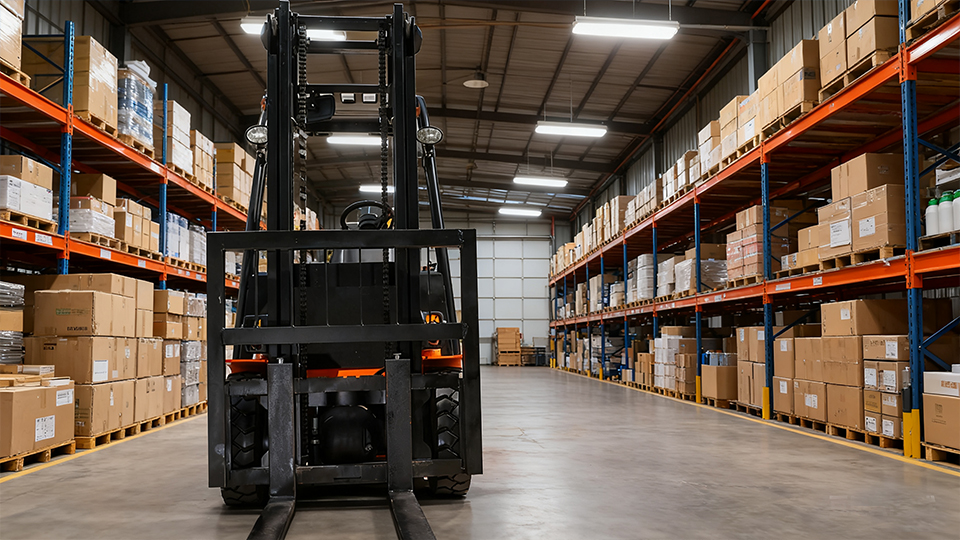
Electric
Source: 400 VAC 50 Hz or 480 VAC 60 Hz utility; optional 750 VDC bus for fast charge.
Storage: lead-acid (1.35 kWh per 100 Ah @ 48 V) or Li-ion NMC/LFP (2.0–2.5 kWh per 100 Ah).
Refuel event: 8 h conventional, 2 h opportunity, 10 min lithium “splash” to 50 %, 1 h 100 %.
Infrastructure: rectifier cabinet, DC cables, ventilation if flooded lead-acid, fire detection if Li-ion.
Energy cost: 0.10–0.18 $/kWh industrial tariff; 12–15 kWh to replace 1 kg diesel (~11.9 kWh LHV).
Diesel
Source: EN 590 / ASTM D975 pump diesel, 5 % or 20 % biodiesel (B20), HVO 100 renewable.
Storage: double-wall above-ground tank 5–20 m³, 2-week autonomy, water sump, leak sensor.
Refuel event: 3–4 min at 45 l/min; 35 l tank typical 3-ton truck, 65 l on 5-ton.
Infrastructure: tank, spill kit, fire-rated 6 m separation, grounding reel, fuel-management RFID.
Energy cost: 1.0–1.3 $/gal USA industrial, 1.1–1.4 €/l EU; 10 % variation swings TCO ±3 %.
Power density and continuous duty
Electric motor gives 2–3 × rated torque at zero speed, so 10 kW will launch a 5-ton truck. The limit is battery discharge rate. A 80 V 620 Ah lead-acid pack can sustain 620 A (1 C) = 50 kW for 45 min, but voltage sag drops effective power to 42 kW. Li-ion 1 C is thermally safe to 3 C, delivering 150 kW peaks. For multi-shift high-lift ramps, Li-ion is mandatory; otherwise duty cycle collapses after hour 5.
Diesel engine power is continuous. A 55 kW (74 hp) unit delivers 55 kW for 24 h if tanks are topped. Hydraulic pump curves are flat, so gradeability (20–25 %) is maintained all day. This is why diesel still dominates 50 000 h quarry trucks.
Torque curves and drivability
Electric: 100 % torque at 1 r/min, no stall risk, no clutch, no inching pedal. Excellent for precision rack work, cold stores, clamp handling of paper reels. Regen braking means brake-wear approaches zero; energy is returned to battery at 15–20 % round-trip efficiency.
Diesel: torque ramp 60 % @ 1 200 r/min, full 100 % @ 1 600–2 200 r/min. Requires torque-converter or hydrostatic drive to avoid stall. Inching pedal wastes fuel, heats oil. Engine brake is marginal; service brakes do 90 % of work, generating 8–12 kg/h brake dust in stop-and-go duty.
Energy efficiency – tank-to-traction
Well-to-wheel studies (IFCE 2022) show:
Electric: 52 % EU grid mix → 95 % charger → 92 % Li-ion round-trip → 89 % motor + inverter → 41 % useful traction.
Diesel: 83 % refinery → 95 % haulage → 36 % engine brake specific → 75 % hydraulics → 22 % useful traction.
Electric therefore needs ~1.8 × less primary energy for the same task. In carbon terms, 1 kWh battery consumes 420 g CO₂ on the EU grid vs. 3 180 g for 1 l diesel (TTW 2 660 g + upstream 520 g). Even in Poland (coal 70 %) electric emits 30 % less CO₂ per pallet moved.
Emission profiles and indoor air
Electric: zero on-site CO, NOx, HC, PM. Only tyre and brake wear PM 2.5 (~6 mg/km). Li-ion emits trace HF during thermal runaway; fire suppression mandatory from 2026 EN 1755 update.
Diesel: Stage V demands DOC + DPF + SCR. Tail-pipe: NOx ≤ 0.4 g/kWh, PM ≤ 0.01 g/kWh, CO ≤ 5 g/kWh—an order of magnitude below pre-2010 levels, but still 250× higher than electric. DPF active regen injects diesel post-combustion, raising fuel use 2–3 %. Ventilation rate for EU indoor: 30 000 m³/h per truck to keep NO₂ < 5 ppm—impractical in 10 000 m³ warehouses, hence electric mandated in Germany food sector.
Noise signature
Electric at 1 m: 61 dB(A) drive, 68 dB(A) pump, 72 dB(A) warning alarm. Diesel Stage V: 84 dB(A) drive, 88 dB(A) idle fan, 93 dB(A) under load. OSHA 8 h limit 85 dB(A) means ear protection for diesel; electric needs none. Night-time urban deliveries increasingly specify 70 dB(A) @ 7.5 m—only electric passes.
Weight distribution and chassis design
Electric battery 1 800–3 000 kg sits low between frame rails, giving CG 280 mm vs. 420 mm on diesel. Result: electric can use 12 % shorter counterweight, 5 % smaller wheelbase, 1 % better gradeability at same tyre set. Down-side: battery mass is fixed; you cannot remove 500 kg to enter a weak elevator floor. Diesel allows incremental ballast removal.
Component count and reliability
Electric: 70 moving parts, no combustion, no after-treatment. MTBF 2 500 h (motors), 10 000 h (Li pack). Lead-acid 1 500 cycles @ 80 % DOD = 5 years 1 shift. Service is 95 % inspections, 5 % component swap.
Diesel: 1 200 moving parts, high-pressure common rail 2 000 bar, EGR cooler, SCR dosing, DPF ash loading. MTBF 1 200 h (injectors), 4 000 h (DPF), 8 000 h (engine OH). Service is 60 % planned mechanical, 40 % unplanned emission-related faults. DPF ash removal every 3 000 h costs 1 200 €.
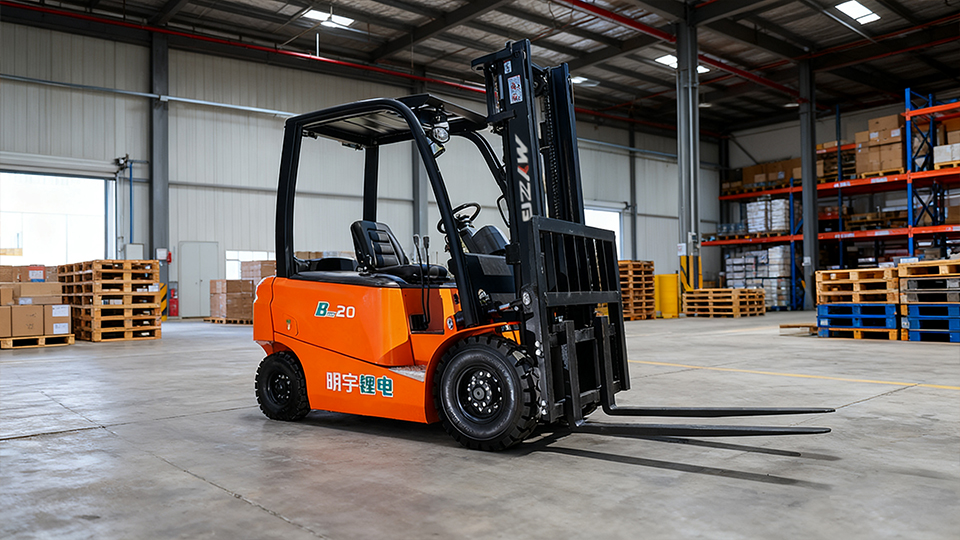
Hydraulic system – common but not identical
Both use gear or piston pumps; electric can run pump motor independently at idle speed 400 r/min, saving 1.5 kW in standby. Diesel must keep 800 r/min min to avoid stall, burning 2.8 l/h. Electric trucks increasingly fit 48 V DC electric power-steer pump—no belt, no idle loss. Electro-hydraulic proportional valves give mm-level fork positioning vs. 5–10 mm dead-band on mechanical diesel spool.
Duty-cycle mapping – when to choose which
Electric wins:
Cold store −25 °C (diesel gels, DPF never reaches 250 °C regen).
Food/pharma clean rooms (HACCP).
3-shift indoor, < 80 m travel per cycle (op-charge keeps SoC 30–80 %).
Explosion-proof Zone 2 (ATEX) – electric excluded spark source easier to certify.
Diesel wins:
24-hour port, no charging windows.
Rough yard, 30 % grade, 300 m hauls.
Ambient > 45 °C desert (battery cooling exceeds 8 kW).
Site without 3-phase utility; generator for Li charger is more expensive than diesel.
Total cost of ownership – 10 000 h, 5 t truck, EU prices
Electric Li-ion
Capex: 82 000 € (incl. 1 500 Ah pack)
Energy: 15 kWh/h × 0.12 € × 10 000 h = 18 000 €
Maintenance: 0.55 €/h = 5 500 €
Battery residual: 8 000 € (second-life)
Net TCO: 97 500 €
Diesel Stage V
Capex: 65 000 €
Fuel: 4.2 l/h × 1.2 € × 10 000 h = 50 400 €
Maintenance: 1.9 €/h = 19 000 €
DPF/SCR service: 4 000 €
Net TCO: 138 400 €
Electric saves ~30 % over 10 000 h, payback 2.1 years at 0.12 €/kWh; 1.2 years at 0.08 €/kWh solar PPA.
Safety – fire, toxicity, collision
Electric Li-ion: thermal runaway at 150 °C, 1–2 min venting, 400 °C jet fire. Need water deluge 10 l/min·m², non-combustible battery box, pre-charge contactor interlock. Lead-acid emits 4 l H₂ per 100 Ah during charge; 1 % room volume = explosive; forced extraction 4 ACH mandatory.
Diesel: 55 l flammable liquid at 55 °C flash point; pool fire possible after hose rupture. High-pressure rail 2 000 bar can inject fuel through skin. CO in enclosed space > 1 000 ppm within 3 min idle; 12 000 m³/h ventilation or catalytic oxidiser required.
Collision: electric regen gives 0.15 g decel without brakes, better control on wet. Diesel engine brake negligible < 0.05 g, relies on service brakes, longer stopping distance 1.2 m at 6 km/h.
Automation readiness
Electric is the natural choice: 48 V supply for LiDAR, 24 V DC-DC converter, CAN bus from motor controller already present. Wire-by-wire throttle and brake simplifies coding. Diesel needs 24 V alternator (55 A) to power 400 W sensors; idle must stay high to avoid battery drain, conflicting with noise limits. AGV conversion cost: electric +3 000 €, diesel +8 000 €.
Regulatory horizon 2025-2030
EU: CO₂ emission performance standard for industrial vehicles < 19 kW (2027) and 19–560 kW (2030). Diesel forklifts must reduce CO₂ 15 % vs. 2021 baseline—achievable only with 48 V mild-hybrid or HVO100. Battery directive mandates 65 % recycled content Li, 85 % Co, 90 % Ni by 2031. US EPA Tier 5 (expected 2028) will cut PM to 0.005 g/kWh, requiring closed DPF + on-board sensor—add 4 000 € hardware.
Decision matrix – one-page summary
Factor (weight) Winner
Energy cost (20 %) Electric
Capex (15 %) Diesel
Indoor air (15 %) Electric
24-hour duty (10 %) Diesel
Noise (10 %) Electric
Maintenance (10 %) Electric
Automation (10 %) Electric
Fire risk (5 %) Diesel*
High temp (5 %) Diesel
Total score Electric 70 %, Diesel 30 %
*Lead-acid excluded; Li-ion fire rare but high consequence.
Conclusion – the correct answer is “both, but for different corridors”
Electric has crossed the tipping point for any indoor, refrigerated or high-precision task. Diesel keeps the crown in 24-hour, high-climate-stress or grid-poor sites. The fastest-growing segment is “mixed fleet” – electric for 1–5 t indoor, diesel/LPG for 5–16 t yard, and hydrogen fuel-cell bridging the gap where 2 MW charging is impossible. Engineers should model energy, emissions and TCO for each application corridor, then lock the choice with the right battery chemistry, charger topology or Stage V after-treatment package. In short, the question is no longer “which is better?” but “which is better for this specific hour of this specific shift?”
Name: selena
Mobile:+86-13176910558
Tel:+86-0535-2090977
Whatsapp:8613181602336
Email:vip@mingyuforklift.com
Add:Xiaqiu Town, Laizhou, Yantai City, Shandong Province, China