
vip@mingyuforklift.com
+86-0535-2090977

The Industrial Divide: Matching Forklift Technology to the Working Environment
The selection of material handling equipment is a critical decision that dictates operational efficiency, compliance with safety and environmental regulations, and overall total cost of ownership (TCO).1 In the realm of industrial logistics, the choice between electric forklifts and diesel forklifts is a central technical and financial assessment.2 While both technologies perform the fundamental task of lifting and transporting loads, their underlying power systems—an internal combustion engine versus a high-capacity electric motor—render them suitable for vastly different working environments.
This technical article will delve into the specific operational contexts where each forklift type excels, offering a comprehensive analysis of the technical and environmental factors that govern this industrial divide.
⚡ Electric Forklifts: The Domain of Controlled Environments
Electric forklifts, powered by rechargeable industrial batteries (typically lead-acid or lithium-ion), are the undisputed champions of indoor, controlled, and sensitive working environments.3 Their inherent design advantages address key logistical challenges related to air quality, noise pollution, maneuverability, and long-term operating economics.4
Indoor Warehousing and Distribution Centers
The modern warehouse is the primary habitat for the electric forklift. These environments are characterized by smooth, level flooring, narrow aisles, and a constant flow of inventory, often operating across multiple shifts.
Air Quality and Emissions: The most significant advantage is zero point-of-use emissions.5 Internal combustion (IC) engines, even when equipped with catalytic converters, produce exhaust gases (carbon monoxide, nitrogen oxides, and particulate matter) that are unacceptable in enclosed spaces.6 Electric lifts eliminate this risk, making them mandatory in environments with poor ventilation or those handling sensitive goods.7
Applicable Industries: General Warehousing, E-commerce Fulfillment, Retail Distribution.8
Noise Pollution: Electric motors operate with significantly less noise and vibration than diesel engines.9 This creates a safer, less fatiguing work environment, improving operator comfort and enabling clearer communication, which is crucial for reducing workplace accidents.10 Typical noise levels for electric lifts are often below 70 dB, compared to diesel models that can exceed 90 dB.
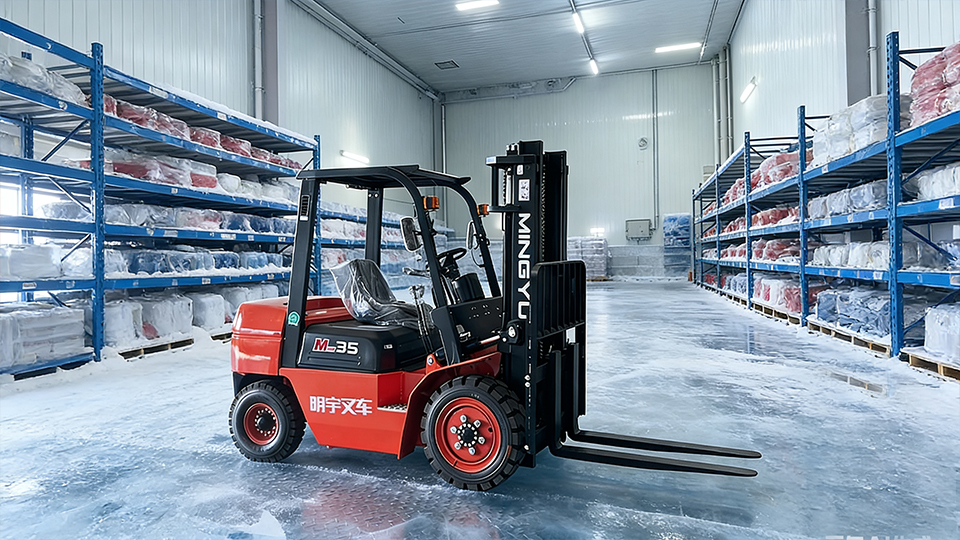
Maneuverability and Compactness: Electric counterbalance, reach, and turret trucks are typically designed with a smaller footprint and a tighter turning radius.11 The battery pack, often housed beneath the operator's seat, acts as the counterweight, contributing to a more compact chassis.12 This makes them ideal for maneuvering in the narrow aisles (13$\approx 10-12$ feet for standard electric, 14$\approx 5-7$ feet for very narrow aisle - VNA) common in high-density storage facilities.15
Maintenance and TCO: With fewer moving parts (no engine block, transmission, or complex exhaust system), electric forklifts require less frequent and less complex maintenance.16 They eliminate the need for oil changes, spark plug replacements, and fuel system checks.17 Although the initial capital cost, including the battery and charging infrastructure, is often higher, the lower operational cost (electricity versus diesel fuel) and reduced maintenance typically result in a lower TCO over the machine's lifespan.18
Sensitive and Specialized Applications
Beyond general warehousing, electric forklifts are essential in industries with strict hygiene or environmental control standards:19
Food and Beverage/Cold Storage: In refrigerated and frozen food environments, zero emissions are non-negotiable to prevent product contamination.20 Modern electric forklifts, especially those with specialized oil and greases, are designed to perform reliably in low-temperature conditions where IC engine performance and cold-weather starting can be compromised.
Pharmaceutical and Clean Rooms: These spaces demand the highest level of air purity to prevent contamination of sensitive products.21 The absence of exhaust fumes and particulates makes electric lifts the only viable option.22
Textile and Paper Industries: Reduced emissions and the elimination of fire risk from hot exhaust components are advantages when handling flammable or easily contaminated materials.23
⛽ Diesel Forklifts: Power and Endurance for Harsh Terrain
Diesel-powered forklifts, driven by robust internal combustion engines, are characterized by their superior power, high torque output, and durability.24 These attributes make them the only practical choice for environments defined by heavy-duty lifting, rugged terrain, and continuous, high-intensity operation.
Outdoor and Rough-Terrain Operations
The diesel forklift excels in outdoor environments where surface conditions and weather present constant challenges to material handling.25
Heavy Lifting and High Capacity: The diesel engine's high torque is crucial for accelerating and lifting massive loads.26 For applications demanding lift capacities above $\approx 15,000$ lbs, diesel models typically offer the most cost-effective solution. They are the workhorses for moving heavy raw materials, shipping containers, and large construction elements.
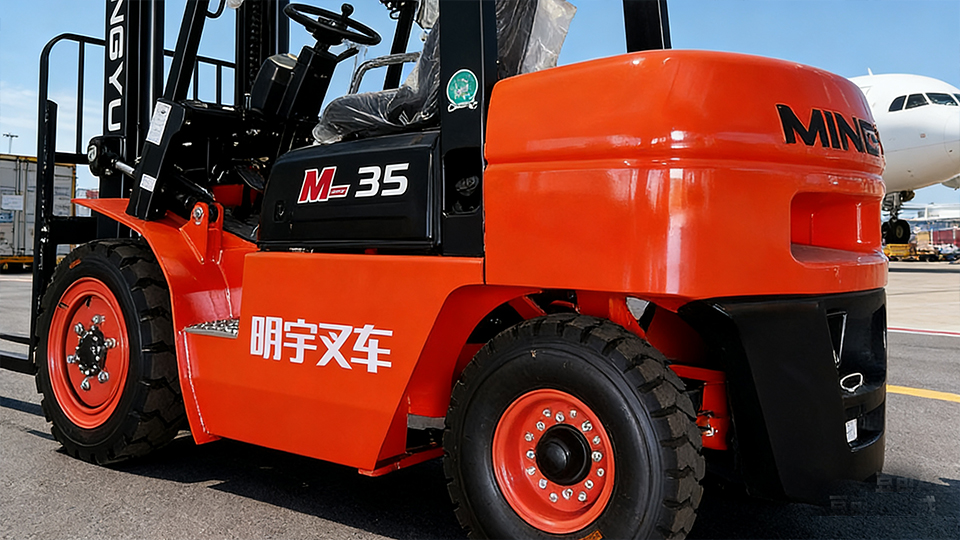
Uneven and Rough Terrain: Diesel forklifts are frequently fitted with pneumatic tires—large, air-filled tires with deep treads—and robust, durable chassis designed to withstand the stress of uneven surfaces, potholes, dirt, gravel, and inclines.27 Their high ground clearance and mechanical power allow them to navigate challenging job sites where an electric forklift would quickly damage its electrical systems or deplete its battery trying to overcome rolling resistance.
Applicable Industries: Construction Sites, Lumber Yards, Ports and Dockyards, Mining, and Agriculture.
Weather Resistance and Durability: The sealed nature and inherent ruggedness of an IC engine and its mechanical components provide superior resilience against the elements. Diesel forklifts can operate effectively in rain, snow, and extreme temperatures (both hot and cold) without the risk of electrical system damage or the severe battery performance degradation experienced by electric models in deep cold.
Continuous Operation and Rapid Refueling: The defining characteristic of a diesel forklift is its high uptime.28 A diesel tank can be refilled in minutes, ensuring near-continuous operation over long shifts or 24/7 cycles.29 This is a critical factor for high-throughput operations like ports and manufacturing plants where the downtime required for the 6-8 hours of charging or battery swapping (for electric lifts) is operationally unacceptable.
Technical Performance Metrics
The fundamental difference in power delivery is a key technical differentiator:
|
Feature |
Electric Forklift (Battery) |
Diesel Forklift (IC Engine) |
|
Power Source |
Electric motor (DC or AC) |
Internal Combustion Engine |
|
Torque Profile |
Instantaneous, high torque at low speed, consistent. |
High torque at higher RPM, superior maximum torque. |
|
Max Capacity |
Up to $\approx 36,000$ lbs (modern high-voltage models). |
Up to $\approx 100,000$ lbs (heavy-duty applications). |
|
Fueling/Charging |
6-8 hours for full charge (Lead-Acid); 1-2 hours (Li-Ion). |
5-10 minutes for full tank. |
|
Maintenance |
Lower frequency (e.g., 500 hours), simpler tasks. |
Higher frequency (e.g., 200-250 hours), more complex. |
|
Emissions |
Zero at point-of-use. |
High (CO, $\text{NO}_\text{x}$, PM), requires excellent ventilation. |
⚖️ Environmental and Economic Trade-offs
The suitability of a forklift is not just a matter of physical environment but also a function of a company's financial and environmental strategy.
Total Cost of Ownership (TCO)
The TCO analysis is crucial for the long-term decision.
Initial Purchase Cost: Diesel forklifts generally have a lower initial purchase price than an equivalent-capacity electric forklift, especially when factoring in the cost of a lead-acid or lithium-ion battery and the necessary charging infrastructure.30
Energy Cost: The cost of electricity per hour of operation is consistently lower than the cost of diesel fuel.31 This difference widens with fluctuating global oil prices.
Maintenance Cost: Electric forklifts boast significantly lower maintenance costs due to fewer mechanical components subject to wear and tear.32 Over a ten-year lifespan, the savings in maintenance and fluids for an electric fleet often offset the higher upfront cost.33
Regulatory and Sustainability Compliance
Modern regulatory environments increasingly favor electric equipment. The growing pressure for sustainability means that companies are seeking ways to reduce their Scope 1 emissions.34
Indoor Air Quality Regulations: OSHA and equivalent global bodies impose strict limits on worker exposure to IC engine exhaust, effectively prohibiting the routine use of diesel forklifts in poorly ventilated indoor spaces.35 Even with advanced exhaust treatment systems (like Diesel Particulate Filters, or DPFs), residual emissions pose an issue for sensitive areas.36
Green Initiatives: Companies with corporate social responsibility (CSR) goals and commitments to reducing their carbon footprint will opt for electric fleets.37 While the electricity generation source can impact the total carbon footprint, the zero point-of-use emissions offer immediate, tangible environmental and health benefits within the facility.38
�� The Hybridization of Material Handling
Technological advancements are subtly blurring the traditional lines of suitability, particularly with the advent of lithium-ion (Li-ion) batteries and increasingly powerful, weather-sealed electric models.
Li-ion Technology: Li-ion batteries offer faster charging times (often allowing for opportunity charging during short breaks), consistent power delivery throughout the discharge cycle, and a longer overall lifespan compared to traditional lead-acid batteries.39 This dramatically reduces the downtime penalty traditionally associated with electric forklifts, making them viable for multi-shift operations that previously necessitated diesel use.
High-Capacity Electric Lifts: Manufacturers are now producing pneumatic-tired electric counterbalance forklifts with capacities rivaling those of smaller diesel models, allowing for emission-free operation on challenging outdoor surfaces. While they still do not match the absolute raw power of the largest diesel trucks for port and container handling, they are increasingly viable for combined indoor/outdoor yards, lumber, and basic construction work.
Conclusion
The selection between electric and diesel forklifts is fundamentally a process of matching the power source to the demands of the operational environment.40
Electric Forklifts are the superior, and often the only compliant, solution for indoor, sensitive, high-density, and continuous-operation environments where air quality, noise reduction, and TCO optimization are paramount.41 They dominate general warehousing, food processing, pharmaceuticals, and manufacturing assembly lines.42
Diesel Forklifts remain essential for heavy-duty, high-capacity, and rough-terrain outdoor applications.43 Their unparalleled torque, power, and rapid refueling are indispensable in ports, lumber yards, construction sites, and wherever the highest levels of lift capacity and operational durability in harsh weather are required.
As electric technology, particularly Li-ion, continues to advance, the crossover point—where electric power can sufficiently replace diesel's performance—is rising.44 However, for the foreseeable future, both technologies will maintain their vital, distinct roles in the global material handling ecosystem, each optimally suited to its unique working environment.
Name: selena
Mobile:+86-13176910558
Tel:+86-0535-2090977
Whatsapp:8613181602336
Email:vip@mingyuforklift.com
Add:Xiaqiu Town, Laizhou, Yantai City, Shandong Province, China
