
vip@mingyuforklift.com
+86-0535-2090977

Loading and unloading operations are the core links of forklift work, involving the safety of personnel, equipment, goods, and the entire operation site. According to statistics from the Occupational Safety and Health Administration (OSHA), nearly 40% of forklift-related accidents occur during loading and unloading processes, mainly due to irregular operations, inadequate risk prevention, and improper handling of special goods. To standardize forklift loading and unloading operations and reduce accident risks, it is essential to grasp the key precautions throughout the entire process. This article systematically elaborates on the precautions for forklifts during loading and unloading goods, providing comprehensive technical guidance for industry practitioners.
1. Pre-Operation Preparation: Lay the Foundation for Safe Loading and Unloading
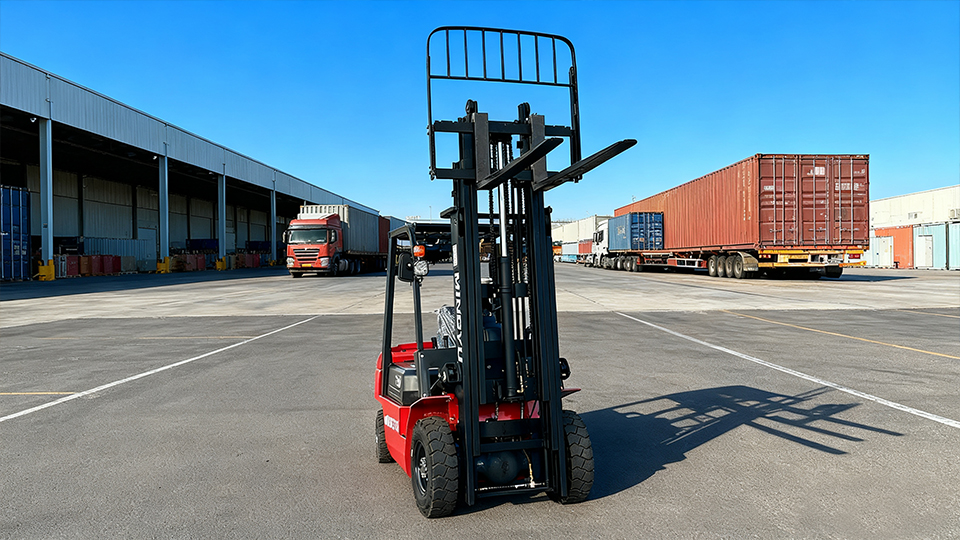
Adequate pre-operation preparation is the premise to ensure the smooth progress of loading and unloading operations. It is necessary to conduct comprehensive inspections on operators, forklifts, goods, and operation sites to eliminate potential safety hazards in advance.
1.1 Operator Preparation
First, operators must hold a valid forklift operation certificate and receive professional pre-job training, mastering the structural principles of forklifts, loading and unloading operation norms, and emergency handling skills. It is strictly prohibited for unlicensed personnel to operate forklifts. Second, operators must maintain a good physical and mental state, avoiding fatigue, illness, or operation under the influence of alcohol and drugs. During the operation, they should wear standard labor protection equipment, including safety helmets, anti-slip work shoes, and reflective vests, to ensure their own safety. In addition, before the operation, operators should clarify the types, weights, packaging forms, and stacking requirements of the goods, and formulate reasonable loading and unloading plans according to the site conditions.
1.2 Forklift Inspection
Forklift performance directly affects the safety of loading and unloading operations, so a comprehensive inspection must be carried out before use. First, check the fork assembly: confirm that the forks have no deformation, cracks, or excessive wear, the fork positioning pins are intact and firm, and the fork surface is clean without oil stains (to avoid reducing friction with the pallet). Second, inspect the hydraulic system: check whether the hydraulic oil level is sufficient, whether there is leakage at the oil pipe joints and cylinders, and test the lifting and lowering functions to ensure smooth and stable operation without jitter or sudden stop. Third, check the braking and driving system: test the foot brake and handbrake to ensure they are sensitive and effective; check the tire pressure and wear status, ensuring no bulges, cracks, or insufficient pressure. Finally, inspect safety devices: confirm that the reverse alarm, warning lights, overhead guard, and seat belt are intact and functional. If any fault is found during the inspection, the forklift must be shut down immediately for maintenance, and it can only be put into use after passing the inspection.
1.3 Goods and Pallet Inspection
Before loading and unloading, it is necessary to inspect the goods and pallets to ensure their stability and safety. For goods, check whether the packaging is intact, whether there is damage, leakage, or looseness; confirm the weight and center of gravity of the goods, and ensure that they do not exceed the rated load capacity of the forklift. For irregularly shaped or easily scattered goods, they should be sorted and fixed in advance (such as using strapping belts or wrapping film). For pallets, check whether there are cracks, deformation, or broken boards, and ensure that the bearing capacity matches the goods. It is strictly prohibited to use damaged pallets to carry goods. In addition, for goods with special properties (such as flammable, explosive, toxic, or corrosive), it is necessary to confirm the corresponding safety operation procedures and prepare special protective equipment and emergency materials.
1.4 Operation Site Inspection
The safety of the operation site is an important guarantee for loading and unloading operations. First, check whether the ground of the operation area is flat, firm, and free of potholes, oil stains, or water accumulation (to avoid forklift slipping or goods shaking). Clear obstacles such as debris and wires in the operation area to ensure unobstructed passage. Second, check the loading and unloading platform: confirm that the platform is stable, the guardrail is intact, and the connection between the platform and the forklift is smooth. For outdoor operation sites, pay attention to weather conditions, and suspend operation in severe weather such as heavy rain, strong wind, or heavy snow. In addition, set up obvious safety warning signs in the operation area, such as "No Entry for Unauthorized Personnel", "Forklift Operation Area", and "Slow Down", and arrange special personnel to command and guide if necessary to avoid personnel and vehicle congestion.
2. Key Precautions for Loading Operations
Loading operations are the first link of goods transportation, and standardized operation is crucial to ensure the stability of goods. Operators must strictly follow the operating procedures and pay attention to the following key points.
2.1 Standard Fork Insertion Operation
When inserting the fork into the pallet, first adjust the distance between the two forks according to the width of the pallet, ensuring that the distance is consistent with the pallet's fork pocket spacing and the forks are symmetrically distributed on both sides of the goods' center of gravity. Then, drive the forklift slowly to the front of the pallet, and insert the forks into the fork pockets horizontally. The insertion depth must not be less than 2/3 of the length of the pallet, and it is strictly prohibited to insert the forks obliquely or partially (to avoid uneven stress on the pallet and goods slipping). During the insertion process, pay attention to observing the surrounding environment to avoid colliding with other goods or personnel. After the forks are fully inserted, adjust the forklift position to ensure that the goods are aligned with the forks and there is no deviation.
2.2 Stable Lifting of Goods
After the forks are inserted in place, start lifting the goods. The lifting speed should be slow and steady, avoiding sudden lifting (to prevent the goods from shaking due to inertial force). During the lifting process, observe the state of the goods at any time. If the goods are found to be tilted or loose, stop lifting immediately and take fixing measures. When the goods are lifted to a suitable height (generally 10-20 cm above the ground for short-distance movement), tilt the mast backward slightly to make the goods lean against the mast, which can effectively prevent the goods from sliding forward. It should be noted that the lifting height of the goods should not exceed the necessary limit. Excessively high lifting will increase the center of gravity of the forklift and reduce stability.
2.3 Strictly Abide by Load Capacity Requirements
Overloading is one of the main causes of forklift rollover and goods sliding accidents. Operators must strictly abide by the rated load capacity of the forklift and must not overload for the sake of efficiency. When carrying goods with unknown weight, they should first weigh them to confirm that they are within the load range. In addition, pay attention to the distribution of the goods' center of gravity. The center of gravity of the goods should be located at the midpoint of the forks. If the goods are eccentric, adjust the position of the forks or use auxiliary tools to balance the center of gravity. For goods with a high center of gravity (such as stacked cartons), reduce the stacking height appropriately and take additional fixing measures.
3. Key Precautions for Unloading Operations
Unloading operations require precise control to ensure that the goods are placed stably and safely. Operators should focus on the following aspects to avoid accidents such as goods collision and falling.
3.1 Accurate Positioning and Slow Approach
Before unloading, drive the forklift to the unloading point slowly and accurately. During the approach process, observe the unloading platform or stacking area to ensure that there are no obstacles or personnel. If there is a dedicated commander, follow the commander's gestures or voice instructions to adjust the position. When the forklift is close to the unloading point, stop the vehicle, pull the handbrake, and confirm that the forklift is stable before starting the unloading operation. It is strictly prohibited to unload goods when the forklift is not parked stably.
3.2 Stable Lowering and Correct Placement
When lowering the goods, the lowering speed should be slow and steady, avoiding sudden lowering (to prevent the goods from being damaged or shaking). During the lowering process, adjust the tilt angle of the mast appropriately to ensure that the goods are in contact with the ground or the stacking surface smoothly. When the goods are placed stably, tilt the mast forward slightly to separate the forks from the pallet. After confirming that the forks are not stuck with the pallet, slowly drive the forklift backward to pull out the forks. It should be noted that when unloading goods on the platform, ensure that the goods are placed within the safe range of the platform and do not exceed the edge of the platform (to avoid the goods falling due to uneven stress).
3.3 Handling of Special Unloading Scenarios
For special unloading scenarios, corresponding preventive measures should be taken. When unloading goods in narrow spaces, control the driving speed strictly, and use the forklift's steering system flexibly to avoid colliding with the surrounding environment. When unloading goods on ramps, the forklift should be parked on a flat area adjacent to the ramp as much as possible. If it is necessary to unload on the ramp, use wheel chocks to fix the forklift to prevent slipping. When unloading flammable, explosive, or other dangerous goods, strictly follow the special operation procedures, avoid generating sparks (such as avoiding violent collision), and ensure that the unloading area is well-ventilated and equipped with fire-fighting equipment.
4. Precautions for Handling Special Goods
Special goods (such as dangerous goods, oversized goods, fragile goods, and refrigerated goods) have special properties, and their loading and unloading operations require more strict precautions to ensure safety.
4.1 Dangerous Goods
When loading and unloading flammable, explosive, toxic, corrosive, or radioactive dangerous goods, operators must hold relevant special operation certificates and be familiar with the properties and safety precautions of the goods. Use special forklifts and pallets that meet the requirements (such as anti-static forklifts for flammable goods). During the operation, avoid violent collision, friction, or impact to prevent the goods from leaking or exploding. The operation area should be isolated from other areas, set up obvious warning signs, and equipped with corresponding emergency equipment (such as fire extinguishers, protective masks, and neutralizers). After the operation, clean the forklift and the operation site to avoid residual dangerous substances.
4.2 Oversized and Overweight Goods
For oversized and overweight goods that exceed the standard size and weight of ordinary goods, it is necessary to use special forklifts (such as large-tonnage forklifts, side-loading forklifts) that match the goods. Before loading and unloading, check the bearing capacity of the operation site and the unloading platform to ensure that they can withstand the weight of the goods. During the operation, arrange multiple commanders to coordinate and guide to ensure that the forklift moves smoothly and the goods are lifted and lowered stably. Use auxiliary fixing tools (such as steel wire ropes, strapping belts) to fix the goods to prevent them from shifting during the operation. It should be noted that the transportation route of oversized and overweight goods should be planned in advance, avoiding narrow passages and weak ground.
4.3 Fragile and Easy-to-Damage Goods
When loading and unloading fragile goods (such as glass products, precision instruments, and ceramic products), the operation should be gentle, avoiding sudden acceleration, emergency braking, and sharp turns. Use shock-absorbing pallets or buffer materials (such as foam, cardboard) to wrap the goods to reduce vibration during transportation. When stacking fragile goods, control the stacking height, avoid excessive pressure on the bottom goods, and separate each layer with buffer materials. During unloading, place the goods gently, and do not throw or drop them.
4.4 Refrigerated and Frozen Goods
When loading and unloading refrigerated and frozen goods, minimize the time the goods are exposed to the outside environment to avoid affecting the quality of the goods. The operation should be fast and efficient, and the door of the refrigerated warehouse or container should be closed in time after loading and unloading. The forklift used in the refrigerated environment should be a special refrigerated forklift with good low-temperature resistance, and check the performance of the forklift (such as battery life, hydraulic system) regularly. The ground of the operation area may be icy and slippery, so pay attention to driving safety and avoid slipping.
5. Emergency Handling Measures for Loading and Unloading Accidents
Even with comprehensive preventive measures, accidents may still occur during loading and unloading operations. Operators must master the corresponding emergency handling measures to minimize the loss caused by accidents.
5.1 Goods Sliding and Tilting
If the goods are found to be sliding or tilting during loading and unloading, stop the operation immediately and pull the handbrake to fix the forklift. Do not try to manually adjust the goods (to avoid being crushed by the goods). If the goods are slightly tilted and can be fixed, use strapping belts or other tools to fix the goods after ensuring safety; if the goods are seriously tilted and there is a risk of falling, evacuate the personnel around the operation area immediately, set up warning signs, and notify the relevant department to formulate a handling plan. It is strictly prohibited to continue the operation without handling.
5.2 Forklift Malfunction During Operation
If the forklift malfunctions (such as hydraulic system failure, braking failure) during loading and unloading, stop the vehicle immediately, pull the handbrake, and turn off the power. If the goods are in a suspended state, do not leave the forklift. Notify the maintenance personnel to repair the forklift in time, and take measures to fix the goods (such as using jacks to support the goods) during the maintenance process to avoid the goods falling. After the forklift is repaired and passes the inspection, continue the operation.
5.3 Personnel Injury Accidents
If a personnel injury accident occurs (such as being crushed by goods, hit by a forklift), stop the operation immediately, call the emergency number, and organize on-site first aid. Protect the accident scene, do not move the injured person randomly (to avoid secondary injury), and wait for the arrival of professional medical personnel. After the accident, report to the relevant department in time, conduct an accident investigation and analysis, and formulate preventive measures to avoid similar accidents from happening again.
6. Post-Operation Finishing Work
After the loading and unloading operation is completed, do a good job in finishing work to ensure the safety and order of the operation site and the normal maintenance of the forklift.
6.1 Forklift Finishing
Park the forklift in the designated area, pull the handbrake, shift to neutral, and turn off the power. Lower the forks to the ground, tilt the mast forward to the original position, and clean the forklift (such as removing goods residues and oil stains on the fork surface). Check the forklift again, record the operation status and existing problems, and hand over to the next shift. If any fault is found, notify the maintenance personnel in time for repair.
6.2 Site Finishing
Sort out the goods in the operation area, stack them neatly according to the requirements, and ensure that the passage is unobstructed. Clean the operation site, remove debris, oil stains, and water accumulation. Check whether the safety warning signs are intact, and repair or replace them if they are damaged. Count the goods and complete the operation records to ensure the accuracy and traceability of the goods.
7. Conclusion
The precautions for forklifts during loading and unloading goods cover the entire process of pre-operation preparation, loading operation, unloading operation, special goods handling, emergency handling, and post-operation finishing. It requires the joint efforts of enterprises, operators, and managers to implement these precautions in practice. Enterprises should establish a sound safety management system, strengthen the training and assessment of operators, and provide safe and reliable operation equipment and sites. Operators should enhance their safety awareness, strictly abide by operating procedures, and master the skills of handling various complex scenarios. Only by forming a full-process and multi-dimensional safety prevention system can we effectively reduce the risk of accidents during forklift loading and unloading operations, ensure the safety of personnel and property, and improve the efficiency and quality of logistics operations.
With the continuous development of the logistics industry, the types of goods and operation scenarios of forklifts are becoming more and more complex, and the requirements for loading and unloading safety are also getting higher and higher. In the future, with the application of intelligent technologies such as unmanned forklifts and visual recognition, the safety and efficiency of forklift loading and unloading operations will be further improved. However, no matter how advanced the technology is, standardized operation and strict adherence to precautions are still the fundamental guarantee for safe production. Therefore, it is necessary to continuously strengthen the popularization and implementation of safety precautions to promote the healthy and sustainable development of the forklift operation industry.
Name: selena
Mobile:+86-13176910558
Tel:+86-0535-2090977
Whatsapp:8613181602336
Email:vip@mingyuforklift.com
Add:Xiaqiu Town, Laizhou, Yantai City, Shandong Province, China