
vip@mingyuforklift.com
+86-0535-2090977

1. Construction and Infrastructure
Construction is the primary driver for rough terrain equipment.3 Unlike a finished warehouse, a construction site is a dynamic environment where the ground shifts with every rainstorm or excavation.
Site Preparation and Material Distribution
Rough terrain forklifts are often the first machines on-site.4 They are used to unload "first-drop" materials—such as rebar, perimeter fencing, and drainage pipes—onto raw, uneven soil.
Vertical Mast Applications: Moving pallets of bricks, cinder blocks, and bags of mortar across muddy sites.5
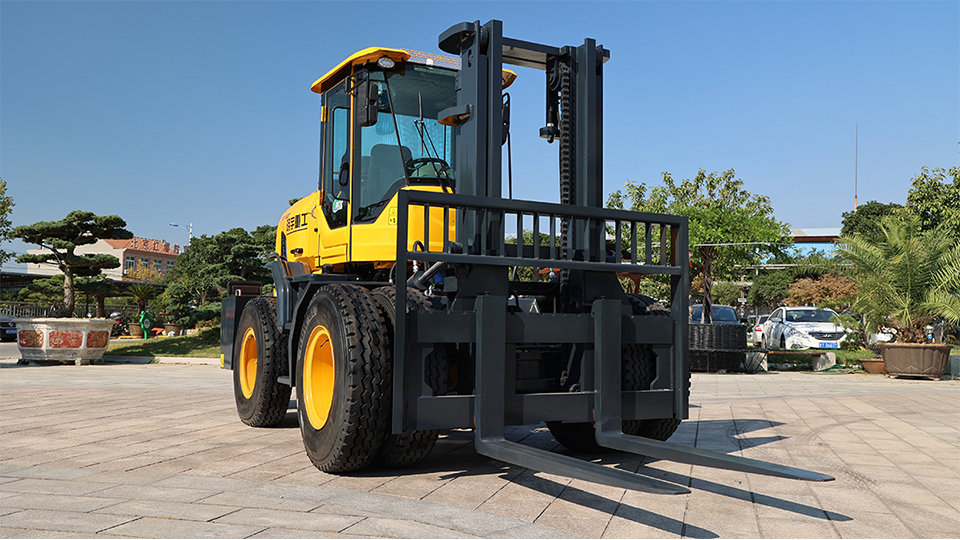
Telehandler (Variable Reach) Applications: Essential for multi-story residential and commercial builds. They are used to place roofing trusses, palletized shingles, and HVAC units onto second- or third-story platforms where a standard vertical lift cannot reach.6
Road and Bridge Work
In civil engineering, these trucks operate on highway medians or under-bridge embankments. They carry concrete barriers, heavy-duty signage, and reinforcement steel over rocky slopes that would cause a standard forklift to tip or bottom out.
2. Agriculture and Farming
Farming requires equipment that can transition seamlessly from a paved barn floor to a soft, tilled field.
Bulk Crop Handling
During harvest, rough terrain forklifts move large bins of produce (apples, potatoes, or citrus) from the center of an orchard or field to the loading area.7 Their high-flotation tires are critical here; they distribute the machine's weight to avoid compacting the soil, which can damage future crop yields.
Livestock and Feed Management
Farmers utilize these machines to transport:
Large Hay Bales: Often weighing up to 2,000 lbs each, moved across snowy or muddy paddocks.8
Feed and Fertilizer: Unloading IBC (Intermediate Bulk Container) tanks of liquid fertilizer or 1-ton bags of seed from delivery trailers parked on soft shoulders.
3. Forestry and Timber Operations
The forestry industry presents some of the most punishing conditions for machinery.9 Debris-strewn forest floors and steep logging trails require the extreme durability found in rough terrain models.10
Sawmill Operations
At the mill, rough terrain forklifts are used to sort raw logs and move heavy stacks of "green" (wet) lumber.11 The machines must handle lateral instability as they navigate the uneven terrain of a lumber yard.
Logging Sites
Small-scale logging operations use these trucks to move logs from the felling area to the "landing" where they are loaded onto highway trucks.12 The 4-Wheel Drive (4WD) and differential locks are non-negotiable features in this sector, ensuring traction on steep, muddy inclines.13
4. Energy and Mining
Whether it is a remote oil rig or an underground mine, the energy sector relies on rough terrain capability to keep operations moving 24/7.
Oil and Gas Rigs
In the "oil patch," equipment often sits on gravel pads or in desert sand. Rough terrain forklifts move heavy drill pipes, valves, and specialized machinery components. Because these sites are often remote, the serviceability and ruggedness of the forklift are more important than its aesthetic design.
Mining Support
In surface mining (quarrying), forklifts transport spare parts for massive excavators and haul trucks. Specialized "low-profile" rough terrain models are even used in underground mining to navigate low-ceiling tunnels with steep gradients, often requiring custom exhaust scrubbing systems for safety.14
5. Specialized and Emergency Applications
The versatility of the Class VII chassis allows it to be used in niche sectors that many would not immediately associate with "forklifts."15
Military Logistics: Used to move supplies from transport planes or ships onto unimproved beaches or desert outposts.
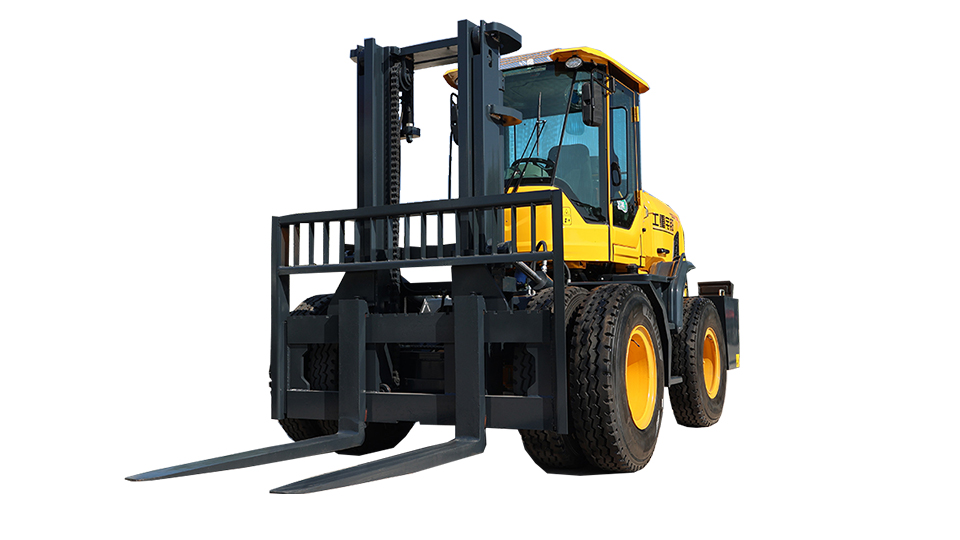
Disaster Relief: After floods or earthquakes, rough terrain trucks are used to clear debris and deliver pallets of water and food to areas where roads have been destroyed.
Docks and Shipyards: Specifically in smaller ports without paved container terminals, these machines move boat cradles and shipping crates over sand and gravel.
Technical Summary: Why These Applications Matter
The choice to use a rough terrain forklift over a standard model is driven by three technical factors:
Traction: The ability to move $10,000\text{ lbs}$ of material without the wheels spinning in the mud.
Stability: Using a wider wheelbase and an oscillating axle to keep the load level on a $15\%$ grade.
Durability: A reinforced chassis that can handle the "pounding" of driving over rocks 10 hours a day.16
|
Industry |
Primary Load Type |
Key Feature Required |
|
Construction |
Bricks, Trusses, Steel |
Reach and Height (Telehandler) |
|
Agriculture |
Produce Bins, Hay |
Soil Flotation (Wide Tires) |
|
Forestry |
Logs, Raw Timber |
Traction and Torque (4WD) |
|
Mining |
Machine Parts, Ore Samples |
Durability and Gradeability |
Name: selena
Mobile:+86-13176910558
Tel:+86-0535-2090977
Whatsapp:8613181602336
Email:vip@mingyuforklift.com
Add:Xiaqiu Town, Laizhou, Yantai City, Shandong Province, China
