
vip@mingyuforklift.com
+86-0535-2090977

1. The Foundation: Chassis and Ground Clearance
The most immediate difference is the "stance" of the machine.
Standard Forklifts: These feature a low-profile chassis. The goal is a low center of gravity to maximize stability on flat surfaces. Ground clearance is often as little as 2 to 4 inches.
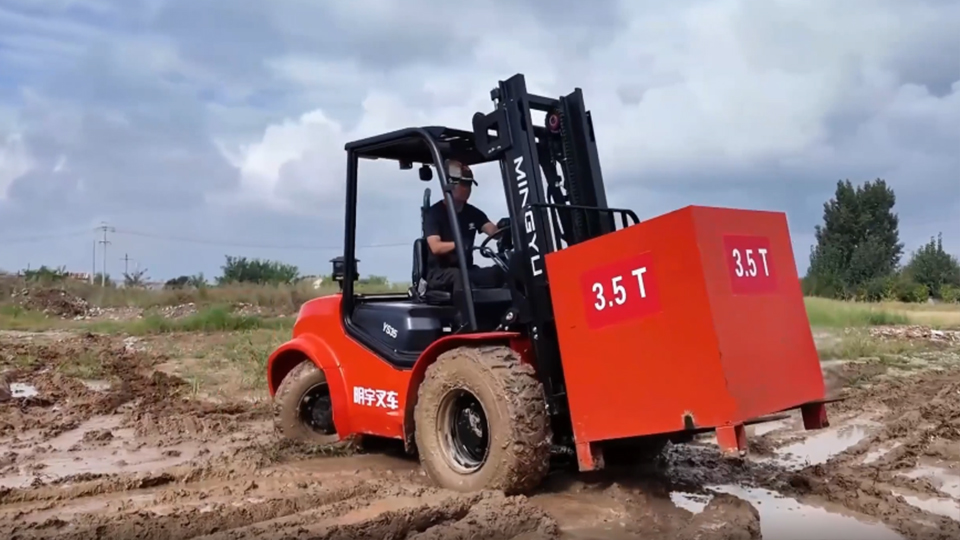
Off-Road Forklifts: These are built with high ground clearance, often exceeding 10 to 12 inches, to navigate over rocks, ruts, and debris without "high-centering" (getting stuck with the wheels spinning in the air).
The chassis of an off-road model is reinforced to handle torsional stress. When one wheel is on a mound of dirt and the other is in a ditch, the frame must resist twisting forces that would snap a standard warehouse lift in half.
2. Drivetrain and Power Plants
What’s under the hood differs significantly based on the torque requirements and the availability of fuel.
Fuel Types
Standard: Dominated by Electric (Lead-acid or Lithium-ion) and LPG (Propane). These are preferred for indoor use because they produce zero or low emissions.
Off-Road: Almost exclusively Diesel. Diesel engines provide the high torque necessary to push through mud or climb steep grades (incline ratings) while carrying several tons.
Drive Systems
Most warehouse forklifts are two-wheel drive, with the drive wheels located under the load for traction. Off-road forklifts frequently employ 4WD (Four-Wheel Drive) or AWD. They often include differential locks, allowing the operator to force all wheels to spin at the same speed—crucial when one tire loses grip in the mud.
3. The "Shoes": Tires and Traction
If you tried to drive a standard forklift onto a construction site, it would sink instantly.
|
Feature |
Standard (Cushion/Solid) |
Off-Road (Pneumatic/Lugs) |
|
Material |
Solid rubber or specialized poly |
Deep-tread rubber, air-filled or foam-filled |
|
Surface |
Smooth or lightly sipped |
Massive "tractor" lugs |
|
Pressure |
High PSI, low footprint |
Lower PSI, wide footprint for "flotation" |
Standard tires are designed for longevity and precision on concrete. Off-road tires are designed for flotation—the ability to stay on top of soft surfaces rather than digging in.
4. Mast Design and Stability
In a warehouse, the mast only needs to move vertically (and tilt a few degrees). On a job site, the ground is rarely level, which creates a massive safety risk: the "Center of Gravity" shift.
Vertical vs. Telescopic
While many rough terrain forklifts use a traditional vertical mast, a huge sub-section uses a Telescopic Boom (often called a Telehandler). This allows the operator to reach out and over obstacles, not just up.
Side-Shifting and Leveling
Off-road units often feature a frame-leveling system. This allows the operator to tilt the entire upper chassis relative to the axles. If the wheels are on a 10° slope, the operator can "level" the mast so the load remains perfectly vertical, preventing a tip-over.
5. Braking and Steering Dynamics
Stopping a 10,000lb machine on a wet, grassy hill is harder than stopping it on a level warehouse floor.
Brakes: Standard lifts usually have drum or disc brakes on the drive axle. Off-road lifts use wet disc brakes (enclosed in oil to prevent contamination from mud and grit) often on all four wheels.
Steering: Off-road models often feature multi-mode steering:
Two-wheel: For road travel.
Four-wheel: For tight turns in muddy enclosures.
Crab steer: Moving the machine diagonally to line up a load in a tight spot.
6. Operator Comfort and Safety (ROPS/FOPS)
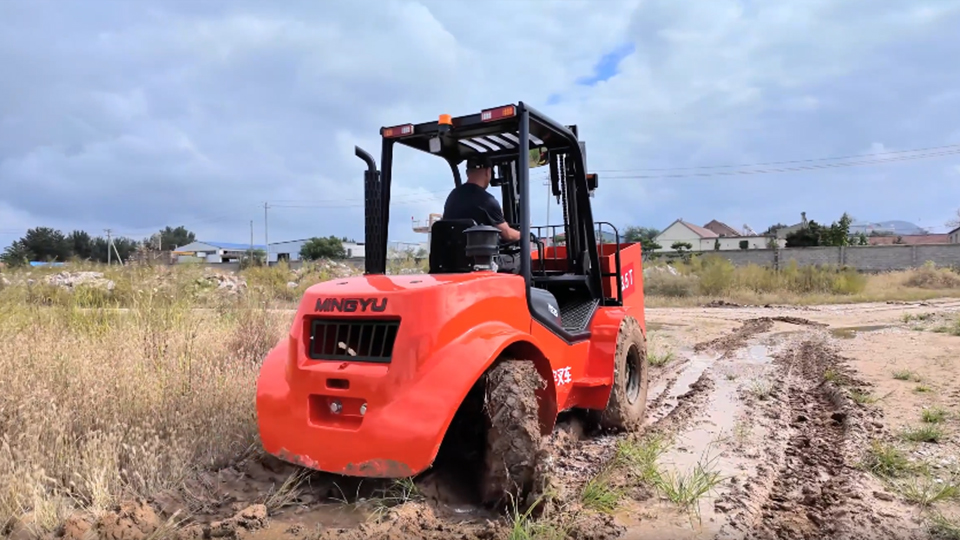
Inside a warehouse, the biggest danger is hitting a rack. Outside, the dangers include weather, falling debris, and rollovers.
Off-road forklifts are required to meet ROPS (Roll-Over Protective Structure) and FOPS (Falling Object Protective Structure) standards. Their cabs are often fully enclosed with heating and AC, and the seats feature advanced suspension to absorb the jolts of driving over uneven terrain—something a standard "dead-axle" warehouse lift lacks entirely.
Summary of Use Cases
Standard Forklift: Best for high-density storage, narrow aisles, and indoor environments where emission control and floor preservation are key.
Off-Road Forklift: Essential for infrastructure projects, lumber yards, brickyards, and any application where the "road" is just a suggestion.
Choosing the wrong one isn't just inefficient; it’s a mechanical death sentence for the machine. A warehouse lift’s transmission will overheat trying to plow through dirt, and an off-road lift’s massive tires will wear down (and potentially mark up) a warehouse floor in weeks.
Name: selena
Mobile:+86-13176910558
Tel:+86-0535-2090977
Whatsapp:8613181602336
Email:vip@mingyuforklift.com
Add:Xiaqiu Town, Laizhou, Yantai City, Shandong Province, China